2007 CADILLAC ESCALADE EXT belt
[x] Cancel search: beltPage 269 of 580

Notice:The chime signals related to safety
belts, parking brake, and other functions of
your vehicle operate through the radio/
entertainment system. If that equipment is
replaced or additional equipment is added to
your vehicle, the chimes may not work. Make
sure that replacement or additional equipment
is compatible with your vehicle before installing
it. SeeAccessories and Modifications on
page 397.
Your vehicle has a feature called Retained
Accessory Power (RAP). With RAP, the audio
system can be played even after the ignition
is turned off. SeeRetained Accessory Power
(RAP) on page 125for more information.Setting the Time
1. Press the tune/select knob (the right knob)
to enter the main menu.
2. Turn the tune/select knob until SET CLOCK
appears on the display.
3. Press the tune/select knob to select
SET CLOCK.
4. Turn the tune/select knob to adjust the time.
5. Press the tune/select knob to update the time.
VEHICLE TIME UPDATED will appear on
the display.
If the CLOCK/RADIO DISP (display) is
programmed into one of the congurable keys,
pressing the key will switch the display back to the
clock set function. The time and date will always
appear on the radio display. See “Congurable
Radio Display Keys” underRadio with CD and DVD
on page 270for more information on conguring
the keys.
269
Page 322 of 580

Your Driving, the Road, and
Your Vehicle
Defensive Driving
The best advice anyone can give about driving is:
Drive defensively.
Please start with a very important safety device in
your vehicle: Buckle up. SeeSafety Belts: They
Are for Everyone on page 18.
{CAUTION:
Defensive driving really means “Be ready
for anything.” On city streets, rural roads,
or expressways, it means “Always expect
the unexpected.” Assume that pedestrians
or other drivers are going to be careless
and make mistakes. Anticipate what they
might do and be ready. Rear-end collisions
are about the most preventable of
accidents. Yet they are common. Allow
enough following distance. Defensive
driving requires that a driver concentrate
on the driving task. Anything that distracts
from the driving task makes proper
defensive driving more difficult and can
even cause a collision, with resulting
injury. Ask a passenger to help do these
things, or pull off the road in a safe place to
do them. These simple defensive driving
techniques could save your life.
322
Page 335 of 580
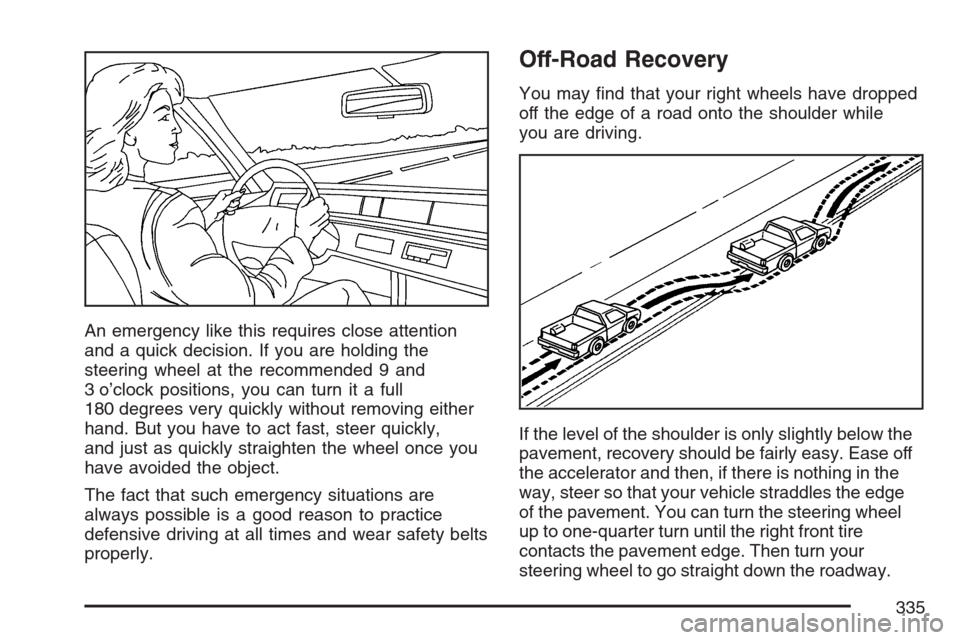
An emergency like this requires close attention
and a quick decision. If you are holding the
steering wheel at the recommended 9 and
3 o’clock positions, you can turn it a full
180 degrees very quickly without removing either
hand. But you have to act fast, steer quickly,
and just as quickly straighten the wheel once you
have avoided the object.
The fact that such emergency situations are
always possible is a good reason to practice
defensive driving at all times and wear safety belts
properly.
Off-Road Recovery
You may nd that your right wheels have dropped
off the edge of a road onto the shoulder while
you are driving.
If the level of the shoulder is only slightly below the
pavement, recovery should be fairly easy. Ease off
the accelerator and then, if there is nothing in the
way, steer so that your vehicle straddles the edge
of the pavement. You can turn the steering wheel
up to one-quarter turn until the right front tire
contacts the pavement edge. Then turn your
steering wheel to go straight down the roadway.
335
Page 343 of 580

Controlling your vehicle is the key to successful
off-road driving. One of the best ways to
control your vehicle is to control your speed. Here
are some things to keep in mind. At higher
speeds:
You approach things faster and you have less
time to scan the terrain for obstacles.
You have less time to react.
You have more vehicle bounce when you
drive over obstacles.
You will need more distance for braking,
especially since you are on an unpaved
surface.
{CAUTION:
When you are driving off-road, bouncing
and quick changes in direction can easily
throw you out of position. This could
cause you to lose control and crash. So,
whether you are driving on or off the road,
you and your passengers should wear
safety belts.
Scanning the Terrain
Off-road driving can take you over many different
kinds of terrain. You need to be familiar with
the terrain and its many different features. Here
are some things to consider.
Surface Conditions:Off-roading can take you
over hard-packed dirt, gravel, rocks, grass, sand,
mud, snow, or ice. Each of these surfaces
affects the steering, acceleration, and braking of
your vehicle in different ways. Depending upon the
kind of surface you are on, you may experience
slipping, sliding, wheel spinning, delayed
acceleration, poor traction, and longer braking
distances.
Surface Obstacles:Unseen or hidden obstacles
can be hazardous. A rock, log, hole, rut, or
bump can startle you if you are not prepared for
them. Often these obstacles are hidden by
grass, bushes, snow, or even the rise and fall of
the terrain itself. Here are some things to consider:
Is the path ahead clear?
Will the surface texture change abruptly up
ahead?
343
Page 390 of 580

Parking on Hills
{CAUTION:
You really should not park your vehicle,
with a trailer attached, on a hill. If
something goes wrong, your rig could
start to move. People can be injured, and
both your vehicle and the trailer can be
damaged.
But if you ever have to park your rig on a hill,
here’s how to do it:
1. Apply your regular brakes, but don’t shift into
PARK (P) yet.
2. Have someone place chocks under the trailer
wheels.
3. When the wheel chocks are in place, release
the regular brakes until the chocks absorb
the load.
4. Reapply the regular brakes. Then apply your
parking brake and shift into PARK (P).
5. Release the regular brakes.
When You Are Ready to Leave After
Parking on a Hill
1. Apply your regular brakes and hold the pedal
down while you:
start your engine,
shift into a gear, and
release the parking brake.
2. Let up on the brake pedal.
3. Drive slowly until the trailer is clear of the
chocks.
4. Stop and have someone pick up and store the
chocks.
Maintenance When Trailer Towing
Your vehicle will need service more often when
you’re pulling a trailer. See the Maintenance
Schedule for more on this. Things that are
especially important in trailer operation are
automatic transmission uid (don’t overll), engine
oil, axle lubricant, belts, cooling system and
brake system. Each of these is covered in this
manual, and the Index will help you nd them
quickly. If you’re trailering, it’s a good idea
to review these sections before you start your trip.
Check periodically to see that all hitch nuts and
bolts are tight.
390
Page 394 of 580

Windshield Wiper Blade Replacement....... 453
Tires............................................................ 454
Tire Sidewall Labeling............................... 455
Tire Terminology and Denitions............... 457
Ination - Tire Pressure............................. 460
High-Speed Operation............................... 462
Tire Pressure Monitor System................... 462
Tire Inspection and Rotation...................... 467
When It Is Time for New Tires.................. 469
Buying New Tires...................................... 470
Different Size Tires and Wheels................ 472
Uniform Tire Quality Grading..................... 473
Wheel Alignment and Tire Balance............ 474
Wheel Replacement.................................. 474
Tire Chains............................................... 476
If a Tire Goes Flat.................................... 476
Changing a Flat Tire................................. 477
Removing the Spare Tire and Tools.......... 478
Removing the Flat Tire and Installing
the Spare Tire....................................... 482
Secondary Latch System........................... 489
Storing a Flat or Spare Tire and Tools...... 492
Spare Tire................................................. 495Appearance Care........................................ 496
Cleaning the Inside of Your Vehicle.......... 496
Fabric/Carpet............................................. 498
Leather...................................................... 499
Instrument Panel, Vinyl, and Other
Plastic Surfaces..................................... 499
Wood Panels............................................. 500
Speaker Covers........................................ 500
Care of Safety Belts.................................. 500
Weatherstrips............................................ 501
Washing Your Vehicle............................... 501
Cleaning Exterior Lamps/Lenses................ 502
Finish Care............................................... 502
Windshield and Wiper Blades.................... 503
Aluminum or Chrome-Plated Wheels......... 504
Tires......................................................... 505
Sheet Metal Damage................................. 505
Finish Damage.......................................... 505
Underbody Maintenance............................ 506
Chemical Paint Spotting............................ 506
Vehicle Care/Appearance Materials............ 507
Section 5 Service and Appearance Care
394
Page 457 of 580

(B) Tire Width:The three-digit number indicates
the tire section width in millimeters from sidewall
to sidewall.
(C) Aspect Ratio:A two-digit number that
indicates the tire height-to-width measurements.
For example, if the tire size aspect ratio is
75, as shown in item C of the light truck
(LT-Metric) tire illustration, it would mean that the
tire’s sidewall is 75% as high as it is wide.
(D) Construction Code:A letter code is used to
indicate the type of ply construction in the tire.
The letter R means radial ply construction;
the letter D means diagonal or bias ply
construction; and the letter B means belted-bias
ply construction.
(E) Rim Diameter:Diameter of the wheel in
inches.
(F) Service Description:The service description
indicates the load range and speed rating of a
tire. The load index can range from 1 to 279.
Speed ratings range from A to Z.Tire Terminology and Denitions
Air Pressure:The amount of air inside the tire
pressing outward on each square inch of the
tire. Air pressure is expressed in pounds
per square inch (psi) or kilopascal (kPa).
Accessory Weight:This means the combined
weight of optional accessories. Some examples of
optional accessories are, automatic
transmission/transaxle, power steering, power
brakes, power windows, power seats, and
air conditioning.
Aspect Ratio:The relationship of a tire’s height
to its width.
Belt:A rubber coated layer of cords that is
located between the plies and the tread. Cords
may be made from steel or other reinforcing
materials.
Bead:The tire bead contains steel wires wrapped
by steel cords that hold the tire onto the rim.
Bias Ply Tire:A pneumatic tire in which the plies
are laid at alternate angles less than 90 degrees
to the centerline of the tread.
457
Page 470 of 580

Buying New Tires
GM has developed and matched specic tires for
your vehicle. The original equipment tires
installed on your vehicle, when it was new, were
designed to meet General Motors Tire
Performance Criteria Specication (TPC spec)
system rating. If you need replacement tires, GM
strongly recommends that you get tires with
the same TPC Spec rating. This way, your vehicle
will continue to have tires that are designed to
give the same performance and vehicle safety,
during normal use, as the original tires.
GM’s exclusive TPC Spec system considers over
a dozen critical specications that impact the
overall performance of your vehicle, including
brake system performance, ride and handling,
traction control, and tire pressure monitoring
performance. GM’s TPC Spec number is molded
onto the tire’s sidewall by the tire manufacturer.
If the tires have an all-season tread design,
the TPC spec number will be followed by an MS
for mud and snow. SeeTire Sidewall Labeling
on page 455for additional information.{CAUTION:
Mixing tires could cause you to lose
control while driving. If you mix tires of
different sizes, brands, or types (radial
and bias-belted tires), the vehicle may not
handle properly, and you could have a
crash. Using tires of different sizes,
brands or types may also cause damage
to your vehicle. Be sure to use the same
size, brand, and type tires on all wheels.
Your vehicle may have a different size
spare than the road tires (those originally
installed on your vehicle). When new, your
vehicle included a spare tire and wheel
assembly with a similar overall diameter
as your vehicle’s road tires and wheels,
so it is all right to drive on it. Because
this spare was developed for use on your
vehicle, it will not affect vehicle handling.
470