2007 CADILLAC CTS oil pressure
[x] Cancel search: oil pressurePage 440 of 518

Approved cleaning products can be obtained from
your dealer. SeeVehicle Care/Appearance
Materials on page 444. Do not use cleaning agents
that are petroleum based, or that contain acid or
abrasives. All cleaning agents should be
ushed promptly and not allowed to dry on the
surface, or they could stain. Dry the nish with a
soft, clean chamois or an all-cotton towel to
avoid surface scratches and water spotting.
High pressure car washes may cause water to
enter the vehicle.
Cleaning Exterior Lamps/Lenses
Use only lukewarm or cold water, a soft cloth and
a car washing soap to clean exterior lamps
and lenses. Follow instructions underWashing
Your Vehicle on page 439.
Finish Care
Occasional waxing or mild polishing of the vehicle
by hand may be necessary to remove residue
from the paint nish. Approved cleaning products
can be obtained from your dealer. SeeVehicle
Care/Appearance Materials on page 444.Notice:Machine compounding or aggressive
polishing on a basecoat/clearcoat paint
nish may damage it. Use only non-abrasive
waxes and polishes that are made for a
basecoat/clearcoat paint nish on your vehicle.
The vehicle has a basecoat/clearcoat paint
nish. The clearcoat gives more depth and gloss
to the colored basecoat. Always use waxes
and polishes that are non-abrasive and made for a
basecoat/clearcoat paint nish.
Foreign materials such as calcium chloride and
other salts, ice melting agents, road oil and
tar, tree sap, bird droppings, chemicals from
industrial chimneys, etc., can damage the vehicle’s
nish if they remain on painted surfaces. Wash
the vehicle as soon as possible. If necessary, use
non-abrasive cleaners that are marked safe for
painted surfaces to remove foreign matter.
Exterior painted surfaces are subject to aging,
weather, and chemical fallout that can take their
toll over a period of years. To help keep the
paint nish looking new, keep the vehicle in a
garage or covered whenever possible.
440
Page 463 of 518

When the Change Engine Oil message appears,
certain services, checks, and inspections are
required. Required services are described in the
following for “MaintenanceI” and “MaintenanceII.”
Generally, it is recommended that your rst
service be MaintenanceI, your second service
be MaintenanceII, and that you alternate
MaintenanceIand MaintenanceIIthereafter.
However, in some cases, MaintenanceIImay be
required more often.MaintenanceI— Use MaintenanceIif the
change engine oil message comes on within
10 months since the vehicle was purchased or
MaintenanceIIwas performed.
MaintenanceII— Use MaintenanceIIif the
previous service performed was MaintenanceI.
Always use MaintenanceIIwhenever the message
comes on 10 months or more since the last
service or if the message has not come on at all
for one year.
Scheduled Maintenance
Service MaintenanceIMaintenanceII
Change engine oil and lter. SeeEngine Oil on page 346. Reset oil life system.
SeeEngine Oil Life System on page 349.An Emission Control Service.••
Visually check for any leaks or damage.See footnote (k).••
Inspect engine air cleaner lter. If necessary, replace lter. SeeEngine Air
Cleaner/Filter on page 351.See footnote (n).•
Rotate tires and check ination pressures and wear. SeeTire Inspection and
Rotation on page 409and “Tire Wear Inspection” inAt Least Once a Month on
page 470.••
463
Page 468 of 518

(h)Change automatic transmission uid and lter
if the vehicle is mainly driven under one or
more of these conditions:
In heavy city traffic where the outside
temperature regularly reaches 90°F (32°C)
or higher.
In hilly or mountainous terrain.
When doing frequent trailer towing.
Uses such as high performance operation.
If you do not use your vehicle under any of these
conditions, the uid and lter do not require
changing.
(i)Drain, ush, and rell cooling system.
This service can be complex; you should have
your dealer perform this service. See Engine
Coolant on page 356 for what to use. Inspect
hoses. Clean radiator, condenser, pressure cap,
and ller neck. Pressure test the cooling
system and pressure cap.
(j)If using DOT-4 brake uid only: Drain, ush,
and rell brake hydraulic system at a regular
maintenance service (IorII) every two years.
This service can be complex; you should have
your dealer perform this service. See Brakes
on page 371.(k)A uid loss in any vehicle system could
indicate a problem. Have the system inspected
and repaired and the uid level checked. Add uid
if needed.
(l)Change uid if the vehicle is used for high
performance operation.
(m)Change uid whenever the vehicle has been
driven for 3,000 miles (5 000 km) with the
transmission temperature at 290°F (143°C) or
higher without using an auxiliary uid cooler.
See Message Center (CTS-V) on page 215 and
Transmission Fluid Hot Message on page 219.
(n)If you drive regularly under dusty conditions,
inspect the lter at each engine oil change.
(p)Visually inspect belt for fraying, excessive
cracks, or obvious damage. Replace belt if
necessary.
468
Page 470 of 518

At Least Once a Month
Tire Ination Check
Visually inspect your vehicle’s tires and make sure
they are inated to the correct pressures. Do not
forget to check the spare tire. SeeInation - Tire
Pressure on page 402. Check to make sure the
spare tire is stored securely. SeeChanging a Flat
Tire (CTS Only) on page 424.
Tire Wear Inspection
Tire rotation may be required for high mileage
highway drivers prior to the Engine Oil Life System
service notication. Check the tires for wear
and, if necessary, rotate the tires. SeeTire
Inspection and Rotation on page 409.
At Least Once a Year
Starter Switch Check
{CAUTION:
When you are doing this inspection,
the vehicle could move suddenly. If the
vehicle moves, you or others could be
injured.
1. Before you start, be sure you have enough
room around the vehicle.
2. Firmly apply both the parking brake and the
regular brake. SeeParking Brake on page 128.
Do not use the accelerator pedal, and be
ready to turn off the engine immediately
if it starts.
3. On automatic transmission vehicles, try to
start the engine in each gear. The vehicle
should start only in PARK (P) or
NEUTRAL (N). If the vehicle starts in any
other position, contact your GM Goodwrench
®
dealer for service.
470
Page 505 of 518

Care of
Safety Belts............................................. 439
Your CD Player........................................ 283
Your CDs ................................................. 283
Center Console Storage Area...................... 160
Chains, Tire................................................. 418
Charging System Light................................ 204
Check
Engine Light............................................ 209
Engine Oil Pressure Message.................. 220
Checking Things Under the Hood................ 340
Chemical Paint Spotting.............................. 443
Child Restraints
Child Restraint Systems............................. 49
Infants and Young Children........................ 45
Lower Anchors and Tethers for Children..... 55
Older Children........................................... 42
Securing a Child Restraint in a Rear
Seat Position.......................................... 63
Securing a Child Restraint in the
Right Front Seat Position........................ 66
Where to Put the Restraint........................ 54
Cigarette Lighter.......................................... 188
Cleaning
Aluminum or Chrome-Plated Wheels........ 441
Exterior Lamps/Lenses............................. 440
Fabric/Carpet........................................... 437Cleaning (cont.)
Finish Care.............................................. 440
Inside of Your Vehicle.............................. 435
Instrument Panel, Vinyl, and Other
Plastic Surfaces.................................... 438
Leather.................................................... 438
Speaker Covers....................................... 439
Tires........................................................ 442
Underbody Maintenance........................... 443
Washing Your Vehicle.............................. 439
Weatherstrips........................................... 439
Windshield and Wiper Blades................... 441
Wood Panels........................................... 439
Climate Control System
Air Filter, Passenger Compartment ........... 195
Dual......................................................... 189
Outlet Adjustment..................................... 194
Steering Wheel Controls.......................... 196
Clock.......................................................... 259
Clutch, Hydraulic......................................... 356
Collision Damage Repair............................. 496
Comfort Guides, Rear Safety Belt................. 38
Compact Spare Tire.................................... 434
Compass..................................................... 137
Competitive Driving..................................... 304
Competitive Driving Mode............................ 296
Control of a Vehicle..................................... 290
505
Page 507 of 518
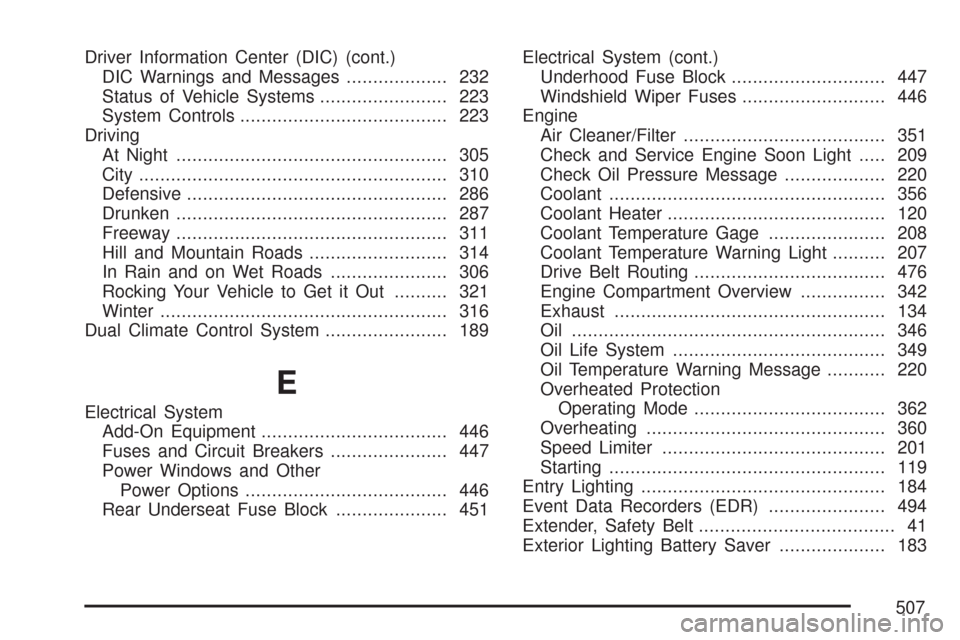
Driver Information Center (DIC) (cont.)
DIC Warnings and Messages................... 232
Status of Vehicle Systems........................ 223
System Controls....................................... 223
Driving
At Night................................................... 305
City.......................................................... 310
Defensive................................................. 286
Drunken................................................... 287
Freeway................................................... 311
Hill and Mountain Roads.......................... 314
In Rain and on Wet Roads...................... 306
Rocking Your Vehicle to Get it Out.......... 321
Winter...................................................... 316
Dual Climate Control System....................... 189
E
Electrical System
Add-On Equipment................................... 446
Fuses and Circuit Breakers...................... 447
Power Windows and Other
Power Options...................................... 446
Rear Underseat Fuse Block..................... 451Electrical System (cont.)
Underhood Fuse Block............................. 447
Windshield Wiper Fuses........................... 446
Engine
Air Cleaner/Filter...................................... 351
Check and Service Engine Soon Light..... 209
Check Oil Pressure Message................... 220
Coolant.................................................... 356
Coolant Heater......................................... 120
Coolant Temperature Gage...................... 208
Coolant Temperature Warning Light.......... 207
Drive Belt Routing.................................... 476
Engine Compartment Overview................ 342
Exhaust................................................... 134
Oil ........................................................... 346
Oil Life System........................................ 349
Oil Temperature Warning Message ........... 220
Overheated Protection
Operating Mode.................................... 362
Overheating............................................. 360
Speed Limiter.......................................... 201
Starting.................................................... 119
Entry Lighting.............................................. 184
Event Data Recorders (EDR)...................... 494
Extender, Safety Belt..................................... 41
Exterior Lighting Battery Saver.................... 183
507
Page 510 of 518

J
Jump Starting.............................................. 376
K
Keyless Entry System................................... 96
Keys............................................................. 95
L
Labeling, Tire Sidewall................................. 394
Lamps
Exterior Lighting Battery Saver................. 183
Reading................................................... 185
LATCH System
Child Restraints......................................... 55
Lifting Your Vehicle, Tires............................ 418
Light
Airbag Readiness..................................... 201
Anti-Lock Brake System Warning............. 206
Brake System Warning............................. 205
Charging System..................................... 204
Cruise Control.......................................... 214
Engine Coolant Temperature Warning....... 207
Fog Lamp................................................ 213
Highbeam On.......................................... 214Light (cont.)
Lights On Reminder................................. 213
Malfunction Indicator................................ 209
Oil Pressure............................................. 212
Passenger Airbag Status Indicator............ 202
Safety Belt Reminder............................... 201
Security................................................... 213
Sport Mode.............................................. 213
TCS Warning Light.................................. 206
Tire Pressure........................................... 208
Traction Control System (TCS)
Warning................................................ 206
Lighting
Entry........................................................ 184
Parade Dimming...................................... 185
Limited-Slip Rear Axle................................. 297
Loading Your Vehicle................................... 321
Lockout Protection....................................... 104
Locks
Central Door Unlocking System................ 101
Delayed Locking...................................... 102
Door........................................................ 100
Lockout Protection................................... 104
Power Door............................................. 101
Programmable Automatic Door Locks....... 102
Rear Door Security Locks........................ 103
510
Page 511 of 518

Loss of Control........................................... 303
Lumbar
Power Controls.......................................... 10
M
Maintenance Schedule
Additional Required Services.................... 465
At Each Fuel Fill...................................... 469
At Least Once a Month............................ 470
At Least Once a Year.............................. 470
Introduction.............................................. 460
Maintenance Footnotes............................ 467
Maintenance Record................................ 477
Maintenance Requirements...................... 460
Normal Maintenance Replacement
Parts.................................................... 475
Owner Checks and Services.................... 469
Recommended Fluids and Lubricants....... 473
Scheduled Maintenance........................... 462
Using....................................................... 461
Your Vehicle and the Environment............ 460
Malfunction Indicator Light........................... 209
Manual Seats.................................................. 8Manual Transmission
Fluid........................................................ 354
Operation................................................. 126
Map Pocket................................................. 160
Memory Seat and Mirrors.............................. 11
Message
Center..................................................... 215
Check Engine Oil Pressure...................... 220
DIC Warnings and Messages................... 232
Hot Coolant Temperature Warning............ 219
Oil Temperature Warning.......................... 220
One-to-Four Shift..................................... 222
Tire Pressure Warning............................. 221
Transmission Fluid Hot............................. 219
Mirrors
Automatic Dimming Rearview with
OnStar
®................................................ 136
Automatic Dimming Rearview with
OnStar
®and Compass......................... 137
Outside Convex Mirror............................. 141
Outside Curb View Assist Mirror............... 141
Outside Heated Mirrors............................ 141
Outside Power Mirrors............................. 140
MyGMLink.com............................................ 485
511