2007 CADILLAC CTS air condition
[x] Cancel search: air conditionPage 407 of 518

Your vehicle’s TPMS can alert you about a low
tire pressure condition but it does not replace
normal tire maintenance. SeeTire Inspection and
Rotation on page 409andTires on page 392.
Notice:Do not use a tire sealant if your vehicle
has Tire Pressure Monitors. The liquid sealant
can damage the tire pressure monitor sensors.
Resetting the TPMS Identication
Codes
Each TPMS sensor has a unique identication
code. Any time you replace one or more of
the TPMS sensors or rotate the tires, the
identication codes will need to be matched to the
new tire and wheel position. The sensors are
matched to the tire and wheel positions in
the following order: driver’s side front tire,
passenger’s side front tire, passenger’s side rear
tire, and driver’s side rear tire using a TPMS
diagnostic tool. See your GM dealer for service.
The TPMS sensors may also be matched to each
tire and wheel position by increasing or
decreasing the tire’s air pressure. When increasing
tire pressure do not exceed the maximum
ination pressure indicated on the tire’s sidewall.You will have two minutes to match the rst tire
and wheel position, and ve minutes overall
to match all four tire and wheel positions. If it takes
longer than two minutes, to match the rst tire
and wheel, or more than ve minutes to match all
four tire and wheel positions the matching
process stops and you will need to start over.
The TPM matching process is outlined below:
1. Set the parking brake.
2. Turn the ignition switch to ON with the
engine off.
3. Using the Remote Keyless Entry (RKE)
transmitter, lock and unlock the vehicle’s
doors.
4. Press the lock and unlock buttons, at the
same time, on the RKE transmitter. A single
horn chirp will sound, indicating that the
TPMS system is ready, and the sensor
matching process can begin.
5. Start with the driver’s side front tire.
407
Page 416 of 518

Temperature – A, B, C
The temperature grades are A (the highest), B,
and C, representing the tire’s resistance to
the generation of heat and its ability to dissipate
heat when tested under controlled conditions on a
specied indoor laboratory test wheel. Sustained
high temperature can cause the material of the tire
to degenerate and reduce tire life, and excessive
temperature can lead to sudden tire failure.
The grade C corresponds to a level of performance
which all passenger car tires must meet under
the Federal Motor Vehicle Safety Standard
No. 109. Grades B and A represent higher levels
of performance on the laboratory test wheel
than the minimum required by law.
Warning:The temperature grade for this tire is
established for a tire that is properly inated
and not overloaded. Excessive speed,
underination, or excessive loading, either
separately or in combination, can cause heat
buildup and possible tire failure.
Wheel Alignment and Tire Balance
The tires and wheels on your vehicle were aligned
and balanced carefully at the factory to give you
the longest tire life and best overall performance.
Adjustments to wheel alignment and tire
balancing will not be necessary on a regular basis.
However, if you notice unusual tire wear or your
vehicle pulling to one side or the other, the
alignment may need to be checked. If you notice
your vehicle vibrating when driving on a smooth
road, your tires and wheels may need to be
rebalanced. See your dealer/retailer for proper
diagnosis.
Wheel Replacement
Replace any wheel that is bent, cracked, or badly
rusted or corroded. If wheel nuts keep coming
loose, the wheel, wheel bolts, and wheel
nuts should be replaced. If the wheel leaks air,
replace it (except some aluminum wheels,
which can sometimes be repaired). See your
dealer/retailer if any of these conditions exist.
Your dealer/retailer will know the kind of wheel
you need.
416
Page 423 of 518

Run-Flat Tires (CTS-V)
If your vehicle has run-at tires, there is no spare
tire and no tire changing equipment. Run-at
tires can operate effectively with no air pressure
for a limited distance and speed. Your vehicle also
has a Tire Pressure Monitor (TPM) which will
alert you if there is a loss of tire pressure in any of
the tires. These tires perform so well without
any air pressure that a Tire Pressure Monitor
(TPM) is used to alert you when there is a low tire
condition.
{CAUTION:
When the low tire warning light is
displayed on the instrument panel cluster,
your vehicle’s handling capabilities will
be reduced during severe maneuvers.
If you drive too fast, you could lose control
of your vehicle. You or others could be
injured. Do not drive over 55 mph (90 km/h)
CAUTION: (Continued)
CAUTION: (Continued)
when the low tire warning light is
displayed. Drive cautiously and check
your tire pressures as soon as you can.
SeeRun-Flat Tires (CTS-V) on page 400and
Tire Pressure Monitor System on page 405,
for additional information.
{CAUTION:
Special tools and procedures are required
to service a run-at tire. If these special
tools and procedures are not used you or
others could be injured and your vehicle
could be damaged. Always be sure the
proper tools and procedures, as described
in the service manual, are used.
To order a service manual seeService
Publications Ordering Information on page 501.
423
Page 441 of 518

Windshield and Wiper Blades
If the windshield is not clear after using the
windshield washer, or if the wiper blade chatters
when running, wax, sap, or other material may be
on the blade or windshield.
Clean the outside of the windshield with a glass
cleaning liquid or powder and water solution. The
windshield is clean if beads do not form when it is
rinsed with water.
Grime from the windshield will stick to the wiper
blades and affect their performance. Clean the
blade by wiping vigorously with a cloth soaked in
full-strength windshield washer solvent. Then rinse
the blade with water.
Check the wiper blades and clean them as
necessary; replace blades that look worn.
Aluminum or Chrome-Plated Wheels
and Trim
Your vehicle may have either aluminum or
chrome-plated wheels.
Keep the wheels clean using a soft clean cloth
with mild soap and water. Rinse with clean water.
After rinsing thoroughly, dry with a soft clean towel.
A wax may then be applied.Notice:Chrome wheels and other chrome trim
may be damaged if you do not wash your
vehicle after driving on roads that have been
sprayed with magnesium, calcium or sodium
chloride. These chlorides are used on roads for
conditions such as ice and dust. This damage
would not be covered by your vehicle’s
warranty. Always wash your vehicle’s chrome
with soap and water after exposure.
Notice:If you use strong soaps, chemicals,
abrasive polishes, cleaners, brushes, or
cleaners that contain acid on aluminum or
chrome-plated wheels, you could damage the
surface of the wheel(s). The repairs would
not be covered by your warranty. Use
only GM-approved cleaners on aluminum or
chrome-plated wheels.
The surface of these wheels is similar to the
painted surface of your vehicle. Do not use strong
soaps, chemicals, abrasive polishes, abrasive
cleaners, cleaners with acid, or abrasive cleaning
brushes on them because you could damage
the surface. Do not use chrome polish on
aluminum wheels.
441
Page 443 of 518
Underbody Maintenance
Chemicals used for ice and snow removal and
dust control can collect on the underbody. If these
are not removed, corrosion and rust can develop
on the underbody parts such as fuel lines,
frame, oor pan, and exhaust system even though
they have corrosion protection.
At least every spring, ush these materials from the
underbody with plain water. Clean any areas where
mud and debris can collect. Dirt packed in close
areas of the frame should be loosened before being
ushed. Your dealer or an underbody car washing
system can do this for you.
Chemical Paint Spotting
Some weather and atmospheric conditions can
create a chemical fallout. Airborne pollutants can
fall upon and attack painted surfaces on the
vehicle. This damage can take two forms: blotchy,
ring-shaped discolorations, and small, irregular
dark spots etched into the paint surface.
Although no defect in the paint job causes this, GM
will repair, at no charge to the owner, the surfaces
of new vehicles damaged by this fallout condition
within 12 months or 12,000 miles (20 000 km) of
purchase, whichever occurs rst.
443
Page 457 of 518
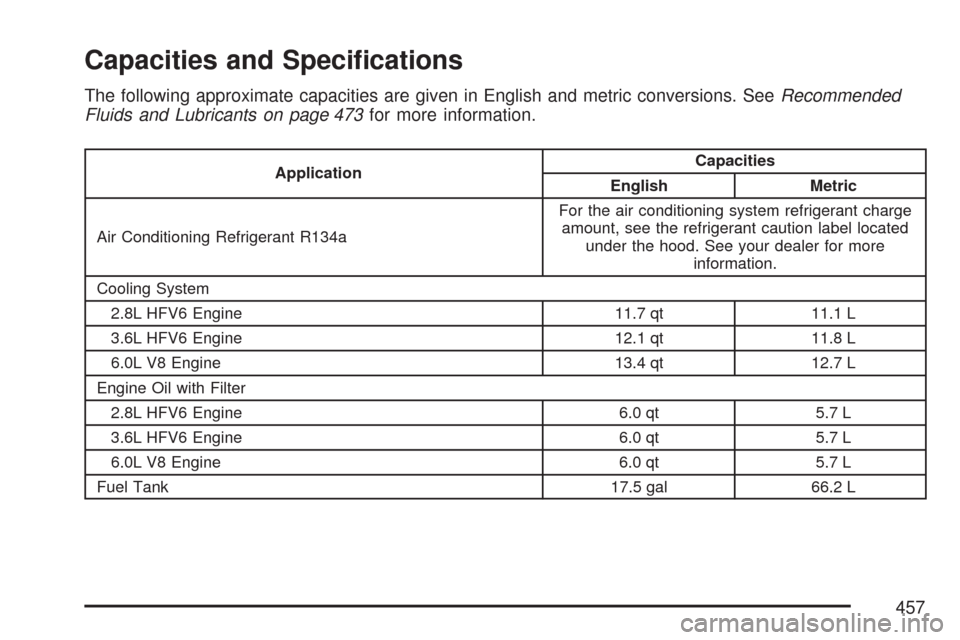
Capacities and Specications
The following approximate capacities are given in English and metric conversions. SeeRecommended
Fluids and Lubricants on page 473for more information.
ApplicationCapacities
English Metric
Air Conditioning Refrigerant R134aFor the air conditioning system refrigerant charge
amount, see the refrigerant caution label located
under the hood. See your dealer for more
information.
Cooling System
2.8L HFV6 Engine 11.7 qt 11.1 L
3.6L HFV6 Engine 12.1 qt 11.8 L
6.0L V8 Engine 13.4 qt 12.7 L
Engine Oil with Filter
2.8L HFV6 Engine 6.0 qt 5.7 L
3.6L HFV6 Engine 6.0 qt 5.7 L
6.0L V8 Engine 6.0 qt 5.7 L
Fuel Tank 17.5 gal 66.2 L
457
Page 460 of 518
Maintenance Schedule
Introduction
Important: Keep engine oil at the proper level
and change as recommended.
Have you purchased the GM Protection Plan?
The Plan supplements your new vehicle
warranties. See your Warranty and Owner
Assistance booklet or your dealer for details.
Maintenance Requirements
Notice:Maintenance intervals, checks,
inspections, replacement parts, and
recommended uids and lubricants as
prescribed in this manual are necessary to
keep your vehicle in good working condition.
Any damage caused by failure to follow
scheduled maintenance might not be covered
by warranty.
Your Vehicle and the Environment
Proper vehicle maintenance not only helps to keep
your vehicle in good working condition, but also
helps the environment. All recommended
maintenance is important. Improper vehicle
maintenance can even affect the quality of the air
we breathe. Improper uid levels or the wrong
tire ination can increase the level of emissions
from your vehicle. To help protect our environment,
and to keep your vehicle in good condition, be
sure to maintain your vehicle properly.
460
Page 462 of 518
When you go to your GM Goodwrench®dealer for
your service needs, you will know that GM-trained
and supported service technicians will perform
the work using genuine GM parts.
If you want to purchase service information,
seeService Publications Ordering Information
on page 501.
Owner Checks and Services on page 469tells you
what should be checked, when to check it, and
what you can easily do to help keep your vehicle in
good condition.
The proper replacement parts, uids, and
lubricants to use are listed inRecommended
Fluids and Lubricants on page 473andNormal
Maintenance Replacement Parts on page 475.
When your vehicle is serviced, make sure these
are used. All parts should be replaced and all
necessary repairs done before you or anyone else
drives the vehicle. We recommend the use of
genuine GM parts.Scheduled Maintenance
When the Change Engine Oil message in the
Driver Information Center (DIC) comes on,
it means that service is required for your vehicle.
Have your vehicle serviced as soon as possible
within the next 600 miles (1 000 km). It is possible
that, if you are driving under the best conditions,
the engine oil life system may not indicate
that vehicle service is necessary for over a year.
However, your engine oil and lter must be
changed at least once a year and at this time the
system must be reset. Your GM Goodwrench
®
dealer has GM-trained service technicians who will
perform this work using genuine GM parts and
reset the system.
If the engine oil life system is ever reset
accidentally, you must service your vehicle within
3,000 miles (5 000 km) since your last service.
Remember to reset the oil life system whenever
the oil is changed. SeeEngine Oil Life System on
page 349for information on the Engine Oil Life
System and resetting the system.
462