Page 126 of 562

PASS-Key®III
Your PASS-Key®III system operates on a radio
frequency subject to Federal Communications
Commission (FCC) Rules and with Industry
Canada.
This device complies with Part 15 of the FCC
Rules. Operation is subject to the following
two conditions:
1. This device may not cause harmful
interference.
2. This device must accept any interference
received, including interference that may
cause undesired operation.
This device complies with RSS-210 of Industry
Canada. Operation is subject to the following two
conditions:
1. This device may not cause interference.
2. This device must accept any interference
received, including interference that may
cause undesired operation of the device.
Changes or modications to this system by other
than an authorized service facility could void
authorization to use this equipment.PASS-Key
®III uses a radio frequency transponder
in the key that matches a decoder in your
vehicle.
PASS-Key®III Operation
Your vehicle is equipped
with the PASS-Key®III
(Personalized
Automotive Security
System) theft-deterrent
system. PASS-Key
®III
is a passive theft
deterrent system.
This means you do not have to do anything
different to arm or disarm the system. It works
when you insert or remove the key from the
ignition.
When the PASS-Key
®III system senses that
someone is using the wrong key, it shuts down the
vehicle’s starter and fuel systems.
126
Page 127 of 562

The starter will not work and fuel will stop being
delivered to the engine. Anyone using a
trial-and-error method to start the vehicle will be
discouraged because of the high number of
electrical key codes.
If the engine does not start and the security
message comes on, the key may have a damaged
transponder. Turn the ignition off and try again.
If the engine still does not start, and the key
appears to be undamaged, try another ignition key.
At this time, you may also want to check the
instrument panel PASS KEY fuse. If the engine still
does not start with the other key, your vehicle
needs service. If your vehicle does start, the rst
key may be faulty. See your dealer or a locksmith
who can service the PASS-Key
®III to have a new
key made. SeeFuses and Circuit Breakers on
page 497.
It is possible for the PASS-Key
®III decoder to learn
the transponder value of a new or replacement key.
Up to 10 keys may be programmed for the vehicle.
This procedure is for learning additional keys only.
If all the currently programmed keys are lost or do
not operate, you must see your dealer or a
locksmith who can service PASS-Key
®III to have
keys made and programmed to the system.See your dealer or a locksmith who can service
PASS-Key
®III to get a new key blank that is
cut exactly as the ignition key that operates the
system.
To program the new key, do the following:
1. Verify the new key has PK3 stamped on it.
2. Insert the original, already programmed
key into the ignition lock cylinder and start the
engine. If the engine will not start, see your
dealer for service.
3. After the engine has started, turn the key to
LOCK and remove the key.
4. Insert the key to be programmed and turn it to
RUN within 10 seconds of removing the
previous key.
5. The security message will turn off once the
key has been programmed. It may not be
apparent that the security message went on
due to how quickly the key is programmed.
6. Repeat Steps 1 through 4 if additional keys
are to be programmed.
127
Page 128 of 562

If you are ever driving and the security message
comes on and stays on, you will be able to restart
your engine if you turn it off. Your PASS-Key
®III
system, however, is not working properly and must
be serviced by your dealer. Your vehicle is not
protected by the PASS-Key
®III system at
this time.
If you lose or damage a PASS-Key
®III key, see
your dealer or a locksmith who can service
PASS-Key
®III to have a new key made.
Starting and Operating Your
Vehicle
New Vehicle Break-In
Notice:Your vehicle does not need an
elaborate break-in. But it will perform better in
the long run if you follow these guidelines:
Do not drive at any one constant speed,
fast or slow, for the rst 500 miles
(805 km). Do not make full-throttle starts.
Avoid downshifting to brake, or slow,
the vehicle.
Avoid making hard stops for the rst
200 miles (322 km) or so. During this time
your new brake linings are not yet broken
in. Hard stops with new linings can mean
premature wear and earlier replacement.
Follow this breaking-in guideline every time
you get new brake linings.
Do not tow a trailer during break-in. See
Towing a Trailer on page 386for the trailer
towing capabilities of your vehicle and more
information.
Following break-in, engine speed and load can
be gradually increased.
128
Page 145 of 562

OnStar®System
OnStar®uses several innovative technologies and
live advisors to provide you with a wide range
of safety, security, information, and convenience
services. If your airbags deploy, the system is
designed to make an automatic call to OnStar
®
Emergency where we can request emergency
services be sent to your location. If you lock
your keys in the vehicle, call OnStar
®at
1-888-4-ONSTAR and they can send a signal
to unlock your doors. If you need roadside
assistance, press the OnStar
®button and they
can contact Roadside Service for you.A complete OnStar
®Owner’s Guide and the
Terms and Conditions of the OnStar®Subscription
Service Agreement are included in the vehicle’s
OnStar
®Subscriber Information packet located
in your vehicle. For more information, visit
www.onstar.com or www.onstar.ca, contact
OnStar
®at 1-888-4-ONSTAR (1-888-466-7827),
or press the OnStar®button to speak with an
OnStar®advisor 24 hours a day, 7 days a week.
OnStar®Services
For new vehicles equipped with OnStar®, the Safe
& Sound Plan, or the Directions & Connections®
Plan is included for one year from the date of
purchase. You can extend this plan beyond
the rst year, or upgrade to the Directions &
Connections
®Plan to meet your needs. For more
information, press the OnStar®button to speak
with an advisor.
145
Page 147 of 562

OnStar®Steering Wheel Controls
$
:Your vehicle may be equipped with a
Talk/Mute button that can be used to interact with
OnStar
®.
SeeAudio Steering Wheel Controls on page 341
for more information.
When calling into voice mail systems or to dial
directory numbers, press this button once, wait for
the response, say the number(s) to be dialed,
wait for the number(s) to be repeated and then say
“dial.” See the OnStar
®Owner’s Guide for more
information.
Universal Home Remote
System
Universal Home Remote System
(With Three Round LED)
The Universal Home Remote System provides a
way to replace up to three hand-held
Radio-Frequency (RF) transmitters used to
activate devices such as garage door openers,
security systems, and home lighting.This device complies with Part 15 of the FCC
Rules. Operation is subject to the following
two conditions:
1. This device may not cause harmful
interference.
2. This device must accept any interference
received, including interference that may
cause undesired operation.
The FCC Grant of Equipment Authorization
Certicate number is KOBGTE05A.
This device complies with RSS-210 of Industry
Canada. Operation is subject to the following two
conditions:
1. This device may not cause interference.
2. This device must accept any interference
received, including interference that may
cause undesired operation of the device.
The Canadian Registration ID number is
3521A-GTE05A.
Changes or modications to this system by other
than an authorized service facility could void
authorization to use this equipment.
147
Page 148 of 562

Universal Home Remote System
(With One Triangular LED)
The Universal Home Remote System provides a
way to replace up to three hand-held
radio-frequency (RF) transmitters used to activate
devices such as garage door openers, security
systems, and home lighting.
This device complies with Part 15 of the FCC
Rules. Operation is subject to the following
two conditions:
1. This device may not cause harmful
interference.
2. This device must accept any interference
received, including interference that may
cause undesired operation.The FCC Grant of Equipment Authorization
Certicate number is CB2SAHL3.
This device complies with RSS-210 of Industry
Canada. Operation is subject to the following
two conditions:
1. This device may not cause interference.
2. This device must accept any interference
received, including interference that may
cause undesired operation of the device.
The Canadian Registration ID number is
2791021849A.
Changes or modications to this system by other
than an authorized service facility could void
authorization to use this equipment.
148
Page 149 of 562

Universal Home Remote System
Operation (With Three Round LED)
Your vehicle may have the Universal Home Remote
System. If there are three round Light Emitting
Diode (LED) above the Universal Home Remote
System buttons, follow the instructions below. If
there is one triangular LED above the Universal
Home Remote System buttons, follow the
instructions under Universal Home Remote System
Operation (with one triangular LED).
This system provides a way to replace up to
three remote control transmitters used to activate
devices such as garage door openers, security
systems, and home lighting.Do not use the this system with any garage door
opener that does not have the stop and reverse
feature. This includes any garage door opener
model manufactured before April 1, 1982.
Read the instructions completely before attempting
to program the transmitter. Because of the steps
involved, it may be helpful to have another
person available to assist you in programming the
transmitter.
Be sure to keep the original remote control
transmitter for use in other vehicles, as well as, for
future programming. You only need the original
remote control transmitter for xed code
programming. It is also recommended that upon
the sale or lease termination of the vehicle,
the programmed buttons should be erased for
security purposes. See “Erasing your Universal
Home Remote Buttons” later in this section.
149
Page 150 of 562
Be sure that people and objects are clear of the
garage door or security device you are
programming. When programming a garage door,
it is advised to park outside of the garage.
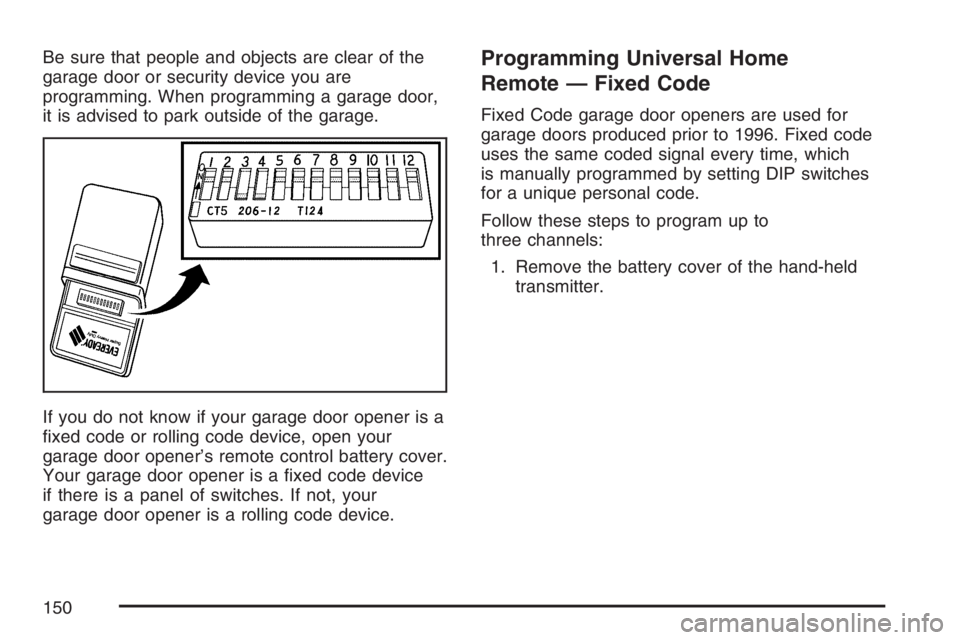
If you do not know if your garage door opener is a
xed code or rolling code device, open your
garage door opener’s remote control battery cover.
Your garage door opener is a xed code device
if there is a panel of switches. If not, your
garage door opener is a rolling code device.Programming Universal Home
Remote — Fixed Code
Fixed Code garage door openers are used for
garage doors produced prior to 1996. Fixed code
uses the same coded signal every time, which
is manually programmed by setting DIP switches
for a unique personal code.
Follow these steps to program up to
three channels:
1. Remove the battery cover of the hand-held
transmitter.
150