2007 BUICK TERRAZA service
[x] Cancel search: servicePage 449 of 562

Tires
Your new vehicle comes with high-quality tires
made by a leading tire manufacturer. If you ever
have questions about your tire warranty and where
to obtain service, see your GM Warranty booklet for
details. For additional information refer to the tire
manufacturer’s booklet included with your vehicle.
{CAUTION:
Poorly maintained and improperly used
tires are dangerous.
Overloading your vehicle’s tires can
cause overheating as a result of too
much friction. You could have an
air-out and a serious accident. See
Loading Your Vehicle on page 378.
Underinated tires pose the same
danger as overloaded tires. The
resulting accident could cause serious
injury. Check all tires frequently to
maintain the recommended pressure.
CAUTION: (Continued)
CAUTION: (Continued)
Tire pressure should be checked when
your vehicle’s tires are cold. See
Inflation - Tire Pressure on page 456.
Overinated tires are more likely to be
cut, punctured, or broken by a sudden
impact — such as when you hit a
pothole. Keep tires at the
recommended pressure.
Worn, old tires can cause accidents. If
the tire’s tread is badly worn, or if
your vehicle’s tires have been
damaged, replace them.
449
Page 450 of 562

Tire Sidewall Labeling
Useful information about a tire is molded into its
sidewall. The examples below show a typical
passenger vehicle tire and a compact spare tire
sidewall.(A) Tire Size:The tire size is a combination of
letters and numbers used to dene a particular
tire’s width, height, aspect ratio, construction type,
and service description. See the “Tire Size”
illustration later in this section for more detail.
(B) TPC Spec (Tire Performance Criteria
Specication):Original equipment tires designed
to GM’s specic tire performance criteria have
a TPC specication code molded onto the sidewall.
GM’s TPC specications meet or exceed all
federal safety guidelines.
(C) DOT (Department of Transportation):The
Department of Transportation (DOT) code
indicates that the tire is in compliance with the
U.S. Department of Transportation Motor Vehicle
Safety Standards.
(D) Tire Identication Number (TIN):The letters
and numbers following DOT (Department of
Transportation) code is the Tire Identication
Number (TIN). The TIN shows the manufacturer
and plant code, tire size, and date the tire
was manufactured. The TIN is molded onto both
sides of the tire, although only one side may have
the date of manufacture.
Passenger (P-Metric) Tire Example
450
Page 452 of 562

(B) Tire Ply Material:The type of cord and
number of plies in the sidewall and under the
tread.
(C) Tire Identication Number (TIN):The letters
and numbers following the DOT (Department of
Transportation) code is the Tire Identication
Number (TIN). The TIN shows the manufacturer
and plant code, tire size, and date the tire
was manufactured. The TIN is molded onto both
sides of the tire, although only one side may have
the date of manufacture.
(D) Maximum Cold Ination Load Limit:
Maximum load that can be carried and the
maximum pressure needed to support that load.
(E) Tire Ination:The temporary use tire or
compact spare tire should be inated to 60 psi
(420 kPa). For more information on tire pressure
and ination seeInation - Tire Pressure on
page 456.
(F) Tire Size:A combination of letters and
numbers dene a tire’s width, height, aspect ratio,
construction type, and service description. The
letter T as the rst character in the tire size means
the tire is for temporary use only.(G) TPC Spec (Tire Performance Criteria
Specication):Original equipment tires designed
to GM’s specic tire performance criteria have
a TPC specication code molded onto the sidewall.
GM’s TPC specications meet or exceed all
federal safety guidelines.
Tire Size
The following illustration shows an example of a
typical passenger vehicle tire size.
(A) Passenger (P-Metric) Tire:The United States
version of a metric tire sizing system. The letter P
as the rst character in the tire size means a
passenger vehicle tire engineered to standards set
by the U.S. Tire and Rim Association.
(B) Tire Width:The three-digit number indicates
the tire section width in millimeters from sidewall
to sidewall.
452
Page 453 of 562

(C) Aspect Ratio:A two-digit number that
indicates the tire height-to-width measurements.
For example, if the tire size aspect ratio is
60, as shown in item C of the illustration, it would
mean that the tire’s sidewall is 60 percent as
high as it is wide.
(D) Construction Code:A letter code is used to
indicate the type of ply construction in the tire.
The letter R means radial ply construction;
the letter D means diagonal or bias ply
construction; and the letter B means belted-bias
ply construction.
(E) Rim Diameter:Diameter of the wheel in
inches.
(F) Service Description:These characters
represent the load range and speed rating of the
tire. The load index represents the load carry
capacity a tire is certied to carry. The load index
can range from 1 to 279. The speed rating is
the maximum speed a tire is certied to carry a
load. Speed ratings range from A to Z.Tire Terminology and Denitions
Air Pressure:The amount of air inside the tire
pressing outward on each square inch of the
tire. Air pressure is expressed in pounds
per square inch (psi) or kilopascal (kPa).
Accessory Weight:This means the combined
weight of optional accessories. Some examples of
optional accessories are, automatic
transmission/transaxle, power steering, power
brakes, power windows, power seats, and
air conditioning.
Aspect Ratio:The relationship of a tire’s height
to its width.
Belt:A rubber coated layer of cords that is
located between the plies and the tread. Cords
may be made from steel or other reinforcing
materials.
453
Page 464 of 562

Uniform Tire Quality Grading
Quality grades can be found where applicable on
the tire sidewall between tread shoulder and
maximum section width. For example:
Treadwear 200 Traction AA Temperature A
The following information relates to the system
developed by the United States National Highway
Traffic Safety Administration (NHTSA), which
grades tires by treadwear, traction, and
temperature performance. This applies only to
vehicles sold in the United States. The grades are
molded on the sidewalls of most passenger car
tires. The Uniform Tire Quality Grading (UTQG)
system does not apply to deep tread, winter-type
snow tires, space-saver, or temporary use
spare tires, tires with nominal rim diameters of
10 to 12 inches (25 to 30 cm), or to some
limited-production tires.
While the tires available on General Motors
passenger cars and light trucks may vary with
respect to these grades, they must also conform
to federal safety requirements and additional
General Motors Tire Performance Criteria (TPC)
standards.
Treadwear
The treadwear grade is a comparative rating
based on the wear rate of the tire when tested
under controlled conditions on a specied
government test course. For example, a tire
graded 150 would wear one and a half (1.5) times
as well on the government course as a tire
graded 100. The relative performance of tires
depends upon the actual conditions of their use,
however, and may depart signicantly from
the norm due to variations in driving habits, service
practices, and differences in road characteristics
and climate.
Traction – AA, A, B, C
The traction grades, from highest to lowest, are
AA, A, B, and C. Those grades represent the tire’s
ability to stop on wet pavement as measured
under controlled conditions on specied
government test surfaces of asphalt and concrete.
A tire marked C may have poor traction
performance.
Warning:The traction grade assigned to this tire
is based on straight-ahead braking traction
tests, and does not include acceleration, cornering,
hydroplaning, or peak traction characteristics.
464
Page 469 of 562

To use your accessory inator system, do the
following:
1. Turn the ignition to ACCESSORY or RUN.
2. Attach the appropriate nozzle adapter, if
required, to the end of the hose that has
the pressure gage.
3. Attach that end of the hose to the object you
wish to inate.
4. Remove the protective cap covering the
outlet.
5. Attach the other end of the hose to the outlet.
6. Press the accessory inator switch. The
light in the switch will come on to show
the system is working.
If the accessory inator system does not turn on
or the light does not come on, the fuse may
be blown or installed incorrectly. SeeFuses and
Circuit Breakers on page 497or see your
dealer for service.
Your accessory inator will automatically shut off
after about 10 minutes. The light in the switch
will blink. After about one minute you can use the
system again. Press the switch and the indicator
light will come on.Notice:If you run the accessory inator
longer than 30 minutes at a time, you could
damage the inator. The repairs would not be
covered by your warranty. Run the inator
for short periods of time only.
After running the accessory inator for 30 minutes,
wait at least 10 minutes before restarting the
accessory inator.
To turn off the inator, do the following:
1. Press the switch and detach the hose, rst
from the inated object, then from the outlet.
2. Put the protective cap back on.
3. Place the inator kit tools in the pouch, and
store in the rear compartment on the
passenger’s side.
To put the cover back on, line up the tabs at the
bottom of the cover and put it in place. Push down
the tab to secure the cover.
469
Page 496 of 562

Vehicle Identication
Vehicle Identication Number (VIN)
This is the legal identier for your vehicle. It
appears on a plate in the front corner of the
instrument panel, on the driver’s side. You can see
it if you look through the windshield from outside
your vehicle. The VIN also appears on the
Certication/Tire and Service Parts labels and the
certicates of title and registration.
Engine Identication
The eighth character in the VIN is the engine
code. This code will help you identify your vehicle’s
engine, specications, and replacement parts.
Service Parts Identication Label
You will nd this label on the inside of the glove
box. It is very helpful if you ever need to order
parts. On this label, you will nd the following:
VIN
Model designation
Paint information
Production options and special equipment
Do not remove this label from the vehicle.
Electrical System
Add-On Electrical Equipment
Notice:Do not add anything electrical to your
vehicle unless you check with your dealer
rst. Some electrical equipment can damage
your vehicle and the damage would not
be covered by your warranty. Some add-on
electrical equipment can keep other
components from working as they should.
Add-on equipment can drain your vehicle’s battery,
even if your vehicle is not operating.
496
Page 505 of 562
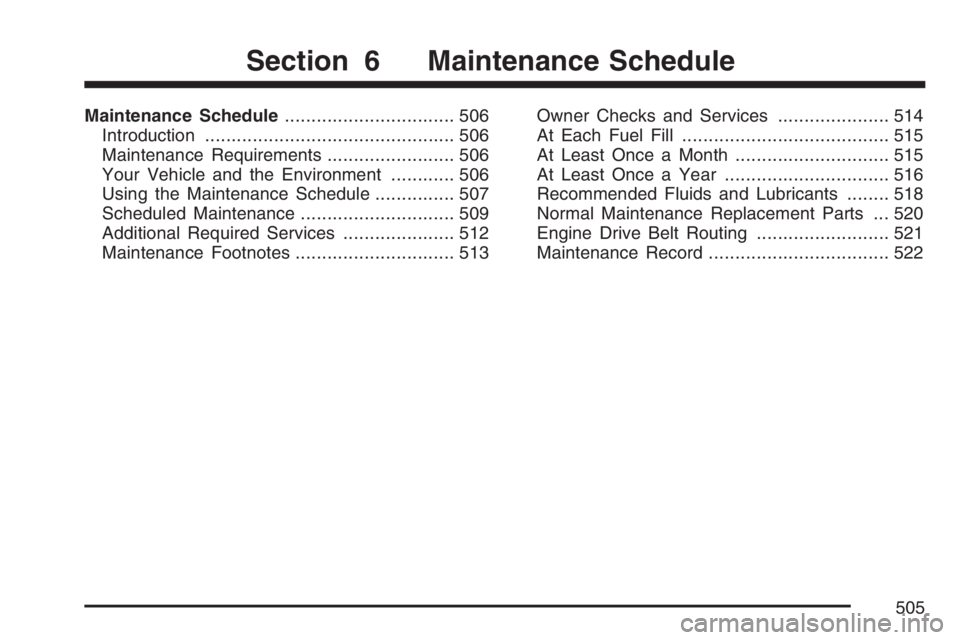
Maintenance Schedule................................ 506
Introduction............................................... 506
Maintenance Requirements........................ 506
Your Vehicle and the Environment............ 506
Using the Maintenance Schedule............... 507
Scheduled Maintenance............................. 509
Additional Required Services..................... 512
Maintenance Footnotes.............................. 513Owner Checks and Services..................... 514
At Each Fuel Fill....................................... 515
At Least Once a Month............................. 515
At Least Once a Year............................... 516
Recommended Fluids and Lubricants........ 518
Normal Maintenance Replacement Parts ... 520
Engine Drive Belt Routing......................... 521
Maintenance Record.................................. 522
Section 6 Maintenance Schedule
505