Page 417 of 512

{CAUTION:
Rust or dirt on a wheel, or on the parts to
which it is fastened, can make wheel nuts
become loose after time. The wheel could
come off and cause an accident. When
you change a wheel, remove any rust or
dirt from places where the wheel attaches
to the vehicle. In an emergency, you can
use a cloth or a paper towel to do this;
but be sure to use a scraper or wire brush
later, if needed, to get all the rust or dirt
off. SeeChanging a Flat Tire on page 426.
When It Is Time for New Tires
One way to tell when it
is time for new tires is
to check the treadwear
indicators, which will
appear when your tires
have only 1/16 inch
(1.6 mm) or less of
tread remaining.
You need a new tire if any of the following
statements are true:
You can see the indicators at three or more
places around the tire.
You can see cord or fabric showing through
the tire’s rubber.
The tread or sidewall is cracked, cut, or
snagged deep enough to show cord or fabric.
The tire has a bump, bulge, or split.
The tire has a puncture, cut, or other damage
that cannot be repaired well because of the
size or location of the damage.
417
Page 419 of 512

{CAUTION:
Mixing tires could cause you to lose
control while driving. If you mix tires of
different sizes, brands, or types (radial
and bias-belted tires), the vehicle may not
handle properly, and you could have a
crash. Using tires of different sizes,
brands, or types may also cause damage
to your vehicle. Be sure to use the correct
size, brand, and type of tires on all
wheels. It is all right to drive with your
compact spare temporarily, as it was
developed for use on your vehicle. See
Compact Spare Tire on page 437.
{CAUTION:
If you use bias-ply tires on your vehicle,
the wheel rim anges could develop
cracks after many miles of driving. A tire
and/or wheel could fail suddenly, causing
a crash. Use only radial-ply tires with the
wheels on your vehicle.
If you must replace your vehicle’s tires with those
that do not have a TPC Spec number, make
sure they are the same size, load range, speed
rating, and construction type (radial and
bias-belted tires) as your vehicle’s original tires.
Your vehicle’s original equipment tires are listed on
the Tire and Loading Information label. This
label is attached to the vehicle’s center pillar
(B-pillar). SeeLoading Your Vehicle on page 319,
for more information about the Tire and Loading
Information label and its location on your vehicle.
419
Page 420 of 512
Different Size Tires and Wheels
If you add wheels or tires that are a different
size than your original equipment wheels and
tires, this may affect the way your vehicle
performs, including its braking, ride and handling
characteristics, stability, and resistance to
rollover. Additionally, if your vehicle has electronic
systems such as, anti-lock brakes, traction
control, and electronic stability control, the
performance of these systems can be affected.{CAUTION:
If you add different sized wheels, your
vehicle may not provide an acceptable
level of performance and safety if tires
not recommended for those wheels are
selected. You may increase the chance
that you will crash and suffer serious
injury. Only use GM specic wheel and
tire systems developed for your vehicle,
and have them properly installed by a
GM certied technician.
SeeBuying New Tires on page 418and
Accessories and Modications on page 341for
additional information.
420
Page 424 of 512

Tire Chains
{CAUTION:
If your vehicle has P225/55R17 size tires,
do not use tire chains, there is not
enough clearance.
Tire chains used on a vehicle without the
proper amount of clearance can cause
damage to the brakes, suspension or
other vehicle parts. The area damaged by
the tire chains could cause you to lose
control of your vehicle and you or others
may be injured in a crash.
Use another type of traction device
only if its manufacturer recommends
it for use on your vehicle and tire size
combination and road conditions.
Follow that manufacturer’s instructions.
CAUTION: (Continued)
CAUTION: (Continued)
To help avoid damage to your vehicle,
drive slowly, readjust or remove the
device if it is contacting your vehicle,
and do not spin your wheels.
If you do nd traction devices that will t,
install them on the front tires.
Notice:If your vehicle has a tire size other
than P225/55R17 size tires, use tire chains only
where legal and only when you must. Use only
SAE Class “S” type chains that are the proper
size for your tires. Install them on the front tires
and tighten them as tightly as possible with the
ends securely fastened. Drive slowly and follow
the chain manufacturer’s instructions. If you
can hear the chains contacting your vehicle,
stop and retighten them. If the contact
continues, slow down until it stops. Driving too
fast or spinning the wheels with chains on will
damage your vehicle.
424
Page 435 of 512
11. Tighten the wheel
nuts rmly in a
crisscross sequence
as shown.
Notice:Wheel covers will not t on your
compact spare. If you try to put a wheel cover
on the compact spare, you could damage
the cover or the spare.
Do not try to put the wheel cover on the compact
spare tire. It will not t. Store the wheel cover
in the trunk until you have the at tire repaired
or replaced.Storing a Flat or Spare Tire
and Tools
{CAUTION:
Storing a jack, a tire, or other equipment
in the passenger compartment of the
vehicle could cause injury. In a sudden
stop or collision, loose equipment could
strike someone. Store all these in the
proper place.
After the compact spare tire has been installed on
the vehicle, store the at tire in the trunk.
When storing a full-size tire, use the extension
with the protector, located in the foam holder, to
help avoid wheel surface damage.
435
Page 436 of 512
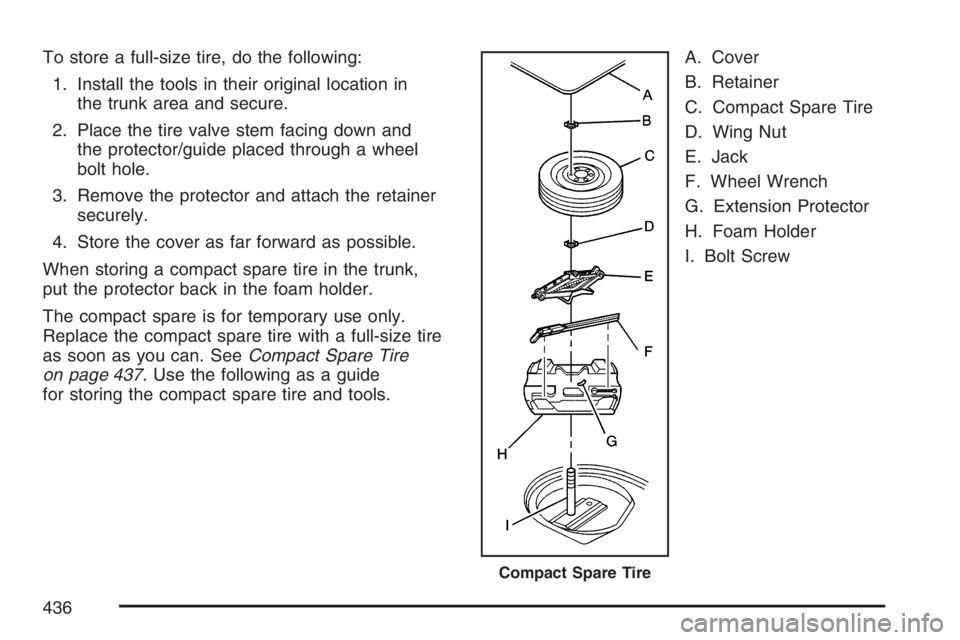
To store a full-size tire, do the following:
1. Install the tools in their original location in
the trunk area and secure.
2. Place the tire valve stem facing down and
the protector/guide placed through a wheel
bolt hole.
3. Remove the protector and attach the retainer
securely.
4. Store the cover as far forward as possible.
When storing a compact spare tire in the trunk,
put the protector back in the foam holder.
The compact spare is for temporary use only.
Replace the compact spare tire with a full-size tire
as soon as you can. SeeCompact Spare Tire
on page 437. Use the following as a guide
for storing the compact spare tire and tools.A. Cover
B. Retainer
C. Compact Spare Tire
D. Wing Nut
E. Jack
F. Wheel Wrench
G. Extension Protector
H. Foam Holder
I. Bolt Screw
Compact Spare Tire
436
Page 437 of 512
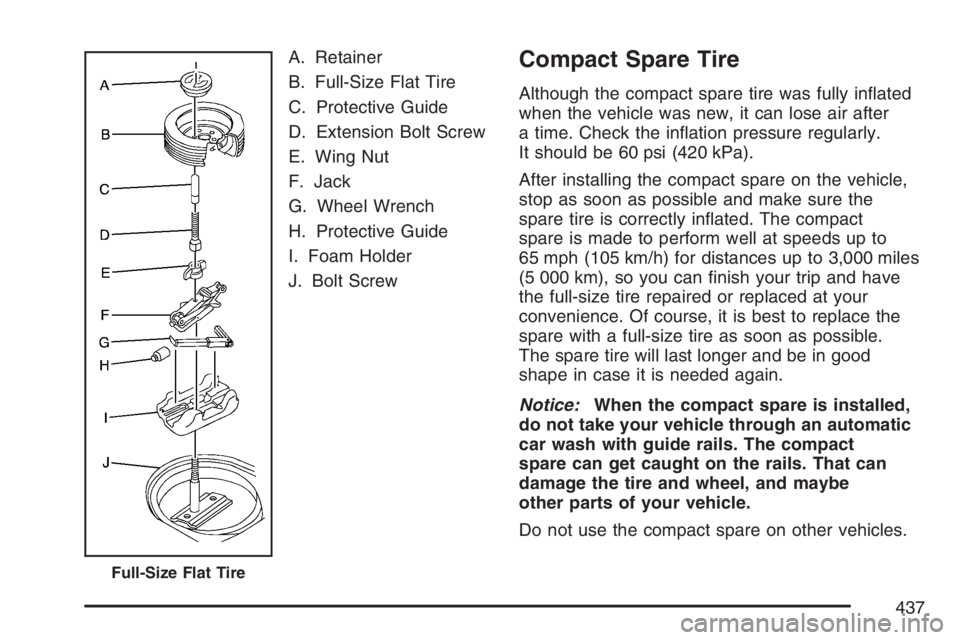
A. Retainer
B. Full-Size Flat Tire
C. Protective Guide
D. Extension Bolt Screw
E. Wing Nut
F. Jack
G. Wheel Wrench
H. Protective Guide
I. Foam Holder
J. Bolt ScrewCompact Spare Tire
Although the compact spare tire was fully inated
when the vehicle was new, it can lose air after
a time. Check the ination pressure regularly.
It should be 60 psi (420 kPa).
After installing the compact spare on the vehicle,
stop as soon as possible and make sure the
spare tire is correctly inated. The compact
spare is made to perform well at speeds up to
65 mph (105 km/h) for distances up to 3,000 miles
(5 000 km), so you can nish your trip and have
the full-size tire repaired or replaced at your
convenience. Of course, it is best to replace the
spare with a full-size tire as soon as possible.
The spare tire will last longer and be in good
shape in case it is needed again.
Notice:When the compact spare is installed,
do not take your vehicle through an automatic
car wash with guide rails. The compact
spare can get caught on the rails. That can
damage the tire and wheel, and maybe
other parts of your vehicle.
Do not use the compact spare on other vehicles.
Full-Size Flat Tire
437
Page 510 of 512

Starting Your Engine................................... 111
Steering...................................................... 297
Steering Wheel Controls, Audio................... 280
Steering Wheel, Tilt Wheel.......................... 151
Storage Areas
Center Console Storage Area................... 142
Convenience Net..................................... 142
Cupholder(s)............................................ 141
Glove Box................................................ 141
Stuck in Sand, Mud, Ice, or Snow............... 318
Sun Visors.................................................. 104
Sunroof....................................................... 143
T
Tachometer................................................. 181
Taillamps
Turn Signal, Sidemarker, Stoplamps, and
Back-Up Lamps.................................... 398
TCS Warning Light...................................... 187
Theater Dimming......................................... 162
Theft-Deterrent, Radio................................. 280
Theft-Deterrent Systems.............................. 104
Content Theft-Deterrent............................ 104
PASS-Key
®III .......................................... 106
PASS-Key®III Operation.......................... 107Tilt Wheel.................................................... 151
Tire
Pressure Light.......................................... 190
Tires........................................................... 402
Aluminum or Chrome-Plated Wheels,
Cleaning............................................... 444
Buying New Tires..................................... 418
Chains..................................................... 424
Changing a Flat Tire................................ 426
Cleaning.................................................. 445
Compact Spare Tire................................. 437
Different Size........................................... 420
If a Tire Goes Flat................................... 425
Ination - Tire Pressure............................ 409
Inspection and Rotation............................ 416
Installing the Spare Tire........................... 429
Pressure Monitor System ......................... 411
Removing the Flat Tire............................. 429
Removing the Spare Tire and Tools......... 427
Storing a Flat or Spare Tire and Tools..... 435
Tire Sidewall Labeling.............................. 403
Tire Terminology and Denitions............... 406
Uniform Tire Quality Grading.................... 421
Wheel Alignment and Tire Balance........... 422
Wheel Replacement................................. 422
When It Is Time for New Tires................. 417
510