2007 BMW X3 3.0SI Wiper
[x] Cancel search: WiperPage 12 of 139
Cockpit
10
Cockpit
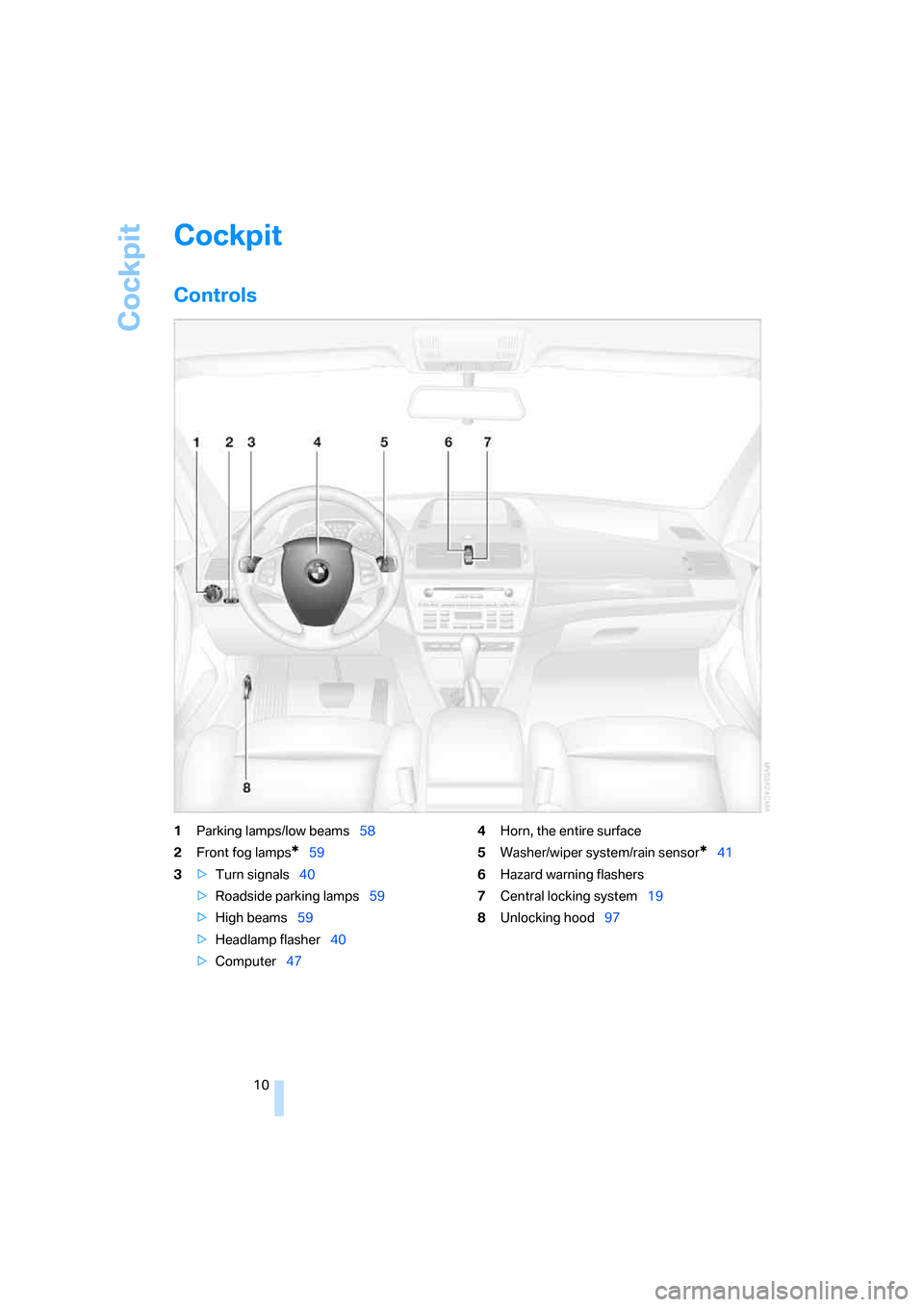
Controls
1Parking lamps/low beams58
2Front fog lamps
*59
3>Turn signals40
>Roadside parking lamps59
>High beams59
>Headlamp flasher40
>Computer474Horn, the entire surface
5Washer/wiper system/rain sensor*41
6Hazard warning flashers
7Central locking system19
8Unlocking hood97
Page 43 of 139
Reference
At a glance
Controls
Driving tips
Mobility
41
Atypically rapid flashing of the indicator
lamp indicates that a turn signal bulb has
gone out.<
Signaling briefly
Press lever to resistance point and hold for as
long as you wish to signal.
Touch signaling
Press lever to resistance point.
The signal flashes three times.
If you wish, you can have this function
activated.<
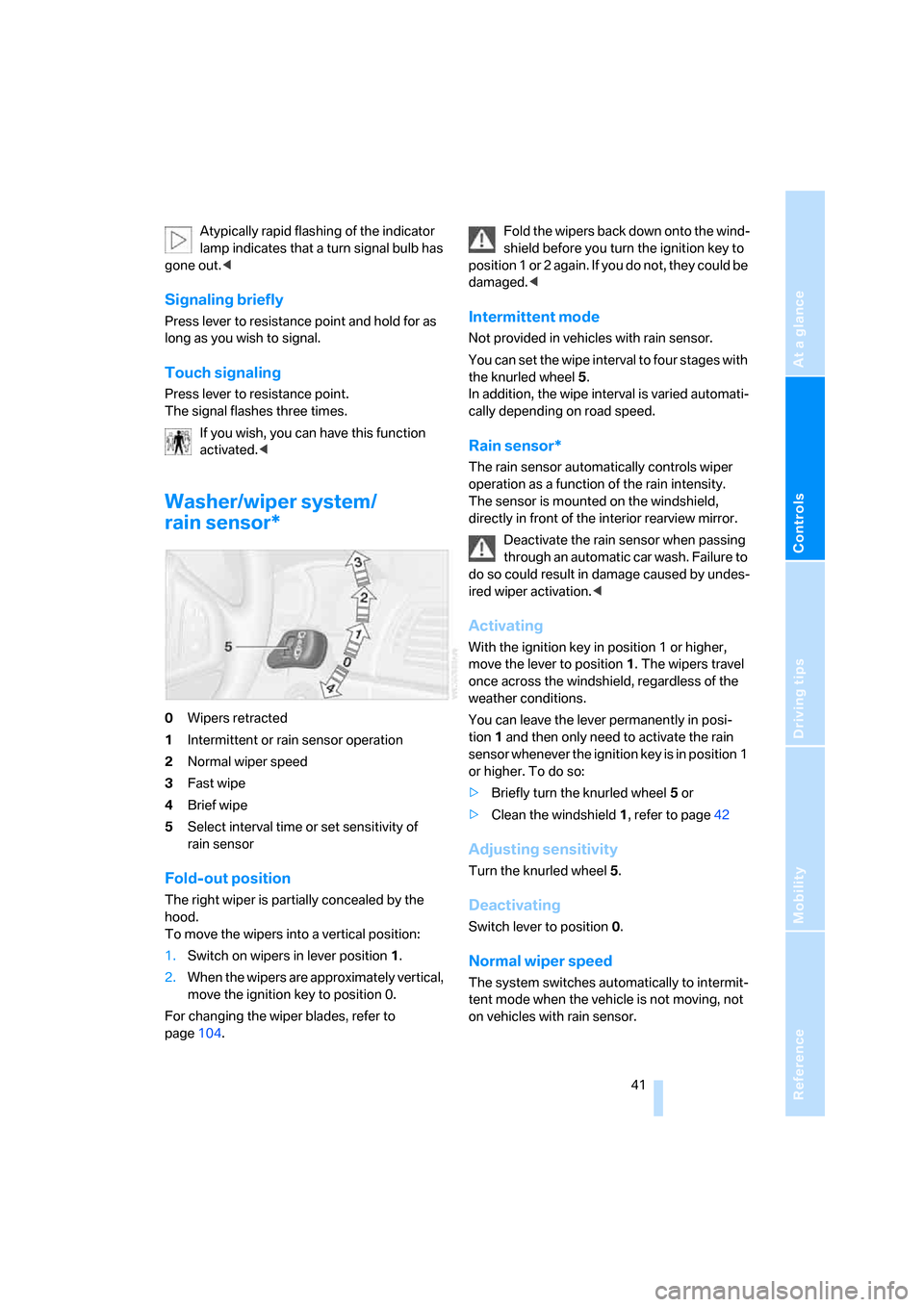
Washer/wiper system/
rain sensor*
0Wipers retracted
1Intermittent or rain sensor operation
2Normal wiper speed
3Fast wipe
4Brief wipe
5Select interval time or set sensitivity of
rain sensor
Fold-out position
The right wiper is partially concealed by the
hood.
To move the wipers into a vertical position:
1.Switch on wipers in lever position 1.
2.When the wipers are approximately vertical,
move the ignition key to position 0.
For changing the wiper blades, refer to
page104.Fold the wipers back down onto the wind-
shield before you turn the ignition key to
p o s i t i o n 1 o r 2 a g a i n . I f y o u d o n o t , t h e y c o u l d b e
damaged.<
Intermittent mode
Not provided in vehicles with rain sensor.
You can set the wipe interval to four stages with
the knurled wheel 5.
In addition, the wipe interval is varied automati-
cally depending on road speed.
Rain sensor*
The rain sensor automatically controls wiper
operation as a function of the rain intensity.
The sensor is mounted on the windshield,
directly in front of the interior rearview mirror.
Deactivate the rain sensor when passing
through an automatic car wash. Failure to
do so could result in damage caused by undes-
ired wiper activation.<
Activating
With the ignition key in position 1 or higher,
move the lever to position1. The wipers travel
once across the windshield, regardless of the
weather conditions.
You can leave the lever permanently in posi-
tion1 and then only need to activate the rain
sensor whenever the ignition key is in position 1
or higher. To do so:
>Briefly turn the knurled wheel 5 or
>Clean the windshield 1, refer to page42
Adjusting sensitivity
Turn the knurled wheel 5.
Deactivating
Switch lever to position 0.
Normal wiper speed
The system switches automatically to intermit-
tent mode when the vehicle is not moving, not
on vehicles with rain sensor.
Page 44 of 139

Driving
42
Fast wipe
The wipers operate at normal speed when the
vehicle is not moving, not on vehicles with rain
sensor.
Cleaning windshield, rear window and
headlamps*
0Wipers retracted
1Cleaning windshield and headlamps
2Rear window wiper intermittent mode
3Cleaning rear window
Do not activate the washer if there is
any danger of the fluid freezing on the
windshield. If you do so, your vision could be
obscured. To avoid freezing, use a washer fluid
antifreeze, refer to Washer fluid. Do not activate
the washer when the washer fluid is empty as
this will damage the washer pump.<
Cleaning windshield
The system sprays washer fluid against the
windshield and activates the wipers for a brief
period.
The washer jets are automatically heated
whenever the engine is running or the ignition is
switched on.
Cleaning headlamps*
When the vehicle lighting system is switched
on, the headlamps are cleaned at regular and
appropriate intervals.
Rear window wiper
Rear window wiper in intermittent mode. When
reverse gear is engaged, the wiper operates
continuously.You can also program the interval:
1.Briefly move the wiper lever from position 0
to position 2.
2.Wait for desired interval; maximum of
30 seconds.
3.Move the wiper lever from position 0 to
position 2 again.
Washer fluid
Washer fluid antifreeze is flammable. For
this reason, keep it away from sources of
flame and store it only in its original containers.
Store it so that it is inaccessible to children.
Always follow the instructions for use provided
on the containers.<
Filler neck for Washer fluid
O nly refill was her fluid when the engine is
cool in order to prevent contact with hot
engine components. Otherwise, there is a risk
of fire and personal injury if the fluid spills.<
All of the washer jets are supplied from one res-
ervoir.
Fill with water and, if required, with an antifreeze
additive according to manufacturer's recom-
mendations.
To maintain the mixing ratio, mix the
washer fluid before adding it to the reser-
voir.<
Capacity
Approx. 3.2 US quarts/3 liters.
With headlamp washer system
* approx.
6.9 US quarts/6.5 liters.
Page 83 of 139

Reference
At a glance
Controls
Driving tips
Mobility
81
2.Greatly increase the air supply of the air
conditioning system or automatic climate
control, refer to page62 or65.
Hot exhaust system
High temperatures occur in the exhaust
system of every vehicle. Do not remove
the heat shields installed adjacent to various
sections of the exhaust system, and never apply
undercoating to them. When driving, standing
at idle, and parking, take care to avoid possible
contact between the hot exhaust system and
any highly flammable materials such as hay,
leaves, grass, etc. Such contact could lead to
a fire, resulting in serious personal injury and
property damage. Do not touch hot exhaust
pipe, it can cause burns.<
Mobile communications devices in
vehicle
BMW does not recommend using mobile
communications devices, e.g. mobile
phones, on the interior of the vehicle without a
direct connection to an outside antenna. Other-
wise, the vehicle electronics and mobile com-
munications device can affect each other. In
addition, there is no assurance that the radia-
tion which results during transmission will be
dissipated from the vehicle interior.<
When the vehicle is parked
Condensation forms in the air conditioner/auto-
matic climate control system during operation,
and then exits under the vehicle. Traces of con-
densed water under the vehicle are therefore
normal.
Before driving into a car wash
Fold in the exterior mirrors, refer to page32;
otherwise, they could be damaged due to the
width of the vehicle.
Deactivate the rain sensor; otherwise, damage
could result from undesired wiper activation,
refer to page41.
Hydroplaning
When driving on wet or slushy roads,
reduce road speed. If you do not, a wedge
of water can form between tires and road sur-
face. This phenomenon is referred to as hydro-
planing, and is characterized by a partial or
complete loss of contact between tires and
road surface, ultimately undermining your abil-
ity to steer and brake the vehicle.<
The danger of hydroplaning increases as tire
tread depth decreases, also refer to Minimum
tread depth on page94.
Driving through water
Do not drive through water on the road if it
is deeper than 20 in/50 cm, and then only
at walking speed. Otherwise, the vehicle's
engine, the electrical systems, and the trans-
mission may be damaged.<
Using handbrake on inclines
Do not hold the vehicle in place on slopes
by slipping or riding the clutch, use the
handbrake instead. Otherwise, greater clutch
wear will result.<
Safe braking
Your BMW is equipped with ABS as standard
equipment. In situations in which it is required, it
is best to apply the brakes fully. Since the vehi-
cle maintains steering responsiveness, you can
nevertheless avoid possible obstacles with a
minimum of steering effort.
Pulsation at the brake pedal combined with
sounds from the hydraulic circuits indicates to
the driver that ABS is in its active mode.
Wet roads
On wet roads or in heavy rain, briefly apply light
pressure to the brake pedal every few miles.
Watch traffic conditions to ensure that this
maneuver does not endanger other road users.
The heat that is generated by the brake applica-
tions helps to dry the brake pads and rotors.
The full braking force will then be available
when you need it.
Page 99 of 139

Reference
At a glance
Controls
Driving tips
Mobility
97
Under the hood
Never attempt to perform any service or
repair operations on your vehicle without
the required professional technical training. If
you are not familiar with the regulations to be
observed, have work on your vehicle carried out
only by your BMW Sports Activity Vehicle Cen-
ter or at a workshop that works according to
BMW repair procedures with appropriately
trained personnel. If this work is not carried out
properly, there is a danger of subsequent dam-
age and related safety hazards.<
Hood
Unlocking
Pull the lever located under the left side of the
instrument cluster.
Opening
To avoid causing damage, make sure that
wiper arms are resting against the wind-
shield before opening the hood.<
Press the release handle and open the hood.
Closing
Close the hood with force by allowing it to fall
from a height of approx. 1 ft/30 cm. It must
engage audibly.
Avoid injuries by making sure that the
hood's closing region is clear and unob-
structed.
If you see any signs that the hood is not com-
pletely closed while driving your vehicle, you
should stop at once and close it securely.<
Page 106 of 139

Replacing components
104
Replacing components
Onboard tool kit
The onboard tool kit is located in a compart-
ment on the left in the cargo area.
Wiper blades
Replacing front wiper blades
1.Move the wiper into the fold-out position,
refer to page41.
2.Lift the wiper arm and press the securing
spring, refer to arrow.
3.Pull the wiper blade off toward the wiper
arm.
4.Insert the new blade and snap it into place.
To prevent damage to the wipers, always
fold them back down onto the windshield
before you turn the ignition key to position 1
or 2 or open the hood.<
Replacing rear wiper blade
1.Lift the wiper arm.
2.Pull off the wiper blade, refer to arrow.
3.Insert a new wiper blade.
Lamps and bulbs
Lamps and bulbs make a significant contribu-
tion to road safety. Therefore, comply fully with
the following instructions during bulb replace-
ment. If you are not familiar with the specified
procedures or they are not described here,
BMW recommends having this work carried out
at your BMW Sports Activity Vehicle Center.
Never touch the glass of new bulbs with
your bare fingers, as even minute
amounts of contamination will burn into the
bulb's surface and reduce its service life. Use a
clean cloth, paper towel, or the like or grasp
bulb by its base.<
A replacement bulb set is available from your
BMW Sports Activity Vehicle Center.
In all work on the electrical system, switch
off the relevant component to prevent
short circuits. To avoid possible injury or equip-
ment damage when replacing bulbs, follow any
instructions provided by the bulb manufac-
turer.<
When maintaining the headlamps, please follow
the instructions in the separate Caring for your
vehicle brochure.
Page 131 of 139

Reference
At a glance
Controls
Driving tips
Mobility
129
Indicator and warning lamps,
overview12
Individual settings, refer to
Vehicle Memory,
Key Memory18
Inflation pressure, refer to Tire
inflation pressure90
Inflation pressure monitoring,
refer to
– Flat Tire Monitor53
– Tire Pressure Monitor54
Initializing, refer to Power
failure23,24
INSPECTION46
Instrument cluster11
Instrument lighting60
Instrument panel, refer to
Cockpit10
Integrated universal remote
control67
Interior lamps60
– remote control20
Interior motion sensor26
– switching off20,26
Interior rearview mirror33
– automatic dimming
feature33
– compass68
Interlock37
Intermittent mode of the
wipers41
Interval indicator, Service46
J
Jacking points110
– vehicle jack110
Jump starting114
K
Key Memory18
Keys18
– key-specific settings, refer
to Vehicle Memory, Key
Memory18
Kick-down40
L
Labeling, tires93
Lamps and bulbs104
Lashing eyes, refer to
Securing load83
LATCH child restraint fixing
system35
LEDs light-emitting
diodes105
Length, refer to
Dimensions121
License plate lamp, replacing
bulbs108
Liftgate22
– closing22
– emergency operation22
– manually opening22
– opening from outside22
– remote control20
Liftgate lamp, replacing
bulbs108
Lifting handle, compact
wheel109
Light-alloy wheels, care, refer
to Caring for your vehicle
brochure
Light-emitting diodes
LEDs105
Lighter72
Lighter socket72
Lighting of instruments60
Lights, refer to Parking lamps/
low beams58
Light switch58
Load
– determining load limit82
– refer to Cargo loading82
Lock buttons, doors, refer to
Locking21
Locking
– from inside21
– with the remote control19
Low beams58
– automatic58
– indicator lamp, defective
bulb58
– replacing bulbs105Lower back support, refer to
Lumbar support29
Lug bolts110
– torque110
Luggage compartment22
– capacity122
– cover, refer to Cargo area
cover75
– floor cover76
– increasing volume74
– opening/closing, refer to
Liftgate22
– opening from outside22
– opening with remote
control20
– refer to Cargo area
74
Luggage compartment lid
– emergency operation, refer
to Opening manually22
– opening with remote control,
refer to Unlocking liftgate20
– refer to Liftgate22
Luggage compartment net,
refer to Partition net75
Luggage rack, refer to Roof-
mounted luggage rack84
Lug wrench109
Lumbar support29
M
Maintenance102
– refer to Service Interval
Display46
Maintenance system102
Malfunctions
– automatic transmission40
– door lock21
– fuel filler door88
– liftgate22
– panorama glass sunroof25
Manual air distribution62,65
Manual operation
– door lock21
– driver's door21
– fuel filler door88
– liftgate22
– panorama glass sunroof25
Page 132 of 139

Everything from A to Z
130 Manual transmission39
Master key18
– with remote control18
Maximum speed, with winter
tires95
Mechanical seats28
Memory, refer to
– Seat and mirror memory30
– Vehicle Memory, Key
Memory18
Microfilter
– air conditioner63
– automatic climate control66
Microphone, refer to Car
phone preparation73
Microphone for telephone73
Mirrors32
– automatic curb monitor32
– mirror heating32
– mirror memory, refer to Seat
and mirror memory30
Mobile communications
devices in vehicle81
Mobile phone, refer to
separate operating
instructions
Monitoring tire pressure
– refer to Flat Tire Monitor53
– refer to Tire Pressure
Monitor54
Multi-function steering wheel,
refer to Buttons on steering
wheel13
Multifunction switch
– turn signals/headlamp
flasher40
– washer/wiper system41
N
Navigation system, refer to
separate Owner's Manual
Neck support, refer to Head
restraints29
Nets71
New keys18
Non-smoker's equipment
package72Nozzles, refer to
Ventilation63,66
Nylon rope, refer to Tow
starting and towing115
O
OBD socket102
Octane rating, refer to Fuel
quality89
Odometer45
Oil
– additives, refer to Approved
engine oils100
– approved engine oils100
– level99
– refilling, refer to Adding
engine oil100
Oil change interval, refer to
Service Interval Display46
Oil grades100
Oil level99
– warning lamp99
Oil pressure99
– warning lamp99
OILSERVICE46
Old batteries, refer to
Disposal111
Onboard computer, refer to
separate Owner's Manual
Onboard Diagnostics OBD
interface socket102
Onboard tool kit104
Opening and closing
– from inside21
– using the door lock21
– with the remote control19
Output, refer to Engine
data120
Outside air
– air conditioner62
– automatic climate control66
Outside temperature display
– changing unit of measure47
– on computer47
Overheating of engine, refer to
Coolant thermometer46
P
Panic mode20
Panorama glass sunroof23
– closing with electrical
malfunction25
– convenience operation21
– initializing24
– power failure24
– remote control20
Park Distance Control PDC49
Parking aid, refer to PDC Park
Distance Control49
Parking assistant, refer to
PDC Park Distance
Control49
Parking brake, refer to
Handbrake38
Parking lamps58
Parking lamps/low beams58
Partition net75
Parts and accessories, refer to
For your own safety5
Passenger-side mirror tilt
function32
Pathway lighting58
PDC Park Distance Control49
Pinch protection system23
– power windows23
Plastic, refer to Caring for your
vehicle brochure
Pollen, refer to
– Microfilter63
– Microfilter/activated
charcoal filter66
Power failure
– battery111
– panorama glass sunroof24
– windows23
Power seat adjustment28
Power socket
– in cargo area72
– refer to Cigarette lighter
socket72
Power windows22
– initializing23
– safety switch23