2007 BMW 328I CONVERTIBLE PRESSURE
[x] Cancel search: PRESSUREPage 104 of 272

Lamps
102 angle and other parameters, the light from the
headlamp follows the course of the road.
In tight curves at speeds up to 40 mph/70 km/h,
e.g. on mountainous roads or when turning, an
additional, corner-illuminating lamp is switched
on that lights up the inside area of the curve.
Activating Adaptive Head Light
With the ignition switched on, turn the light
switch to position 3, refer to page100.
The corner-illuminating lamp is switched on
automatically, depending on the steering wheel
angle or turn signal indicator.
To avoid blinding oncoming traffic, the Adaptive
Head Light directs light towards the front pas-
senger side when the vehicle is at a standstill.
When you are reversing, only the corner-illumi-
nating lamps are active and switched on on
both sides.
Malfunction
The LED next to the symbol for automatic head-
lamp control flashes. Adaptive Head Light is
malfunctioning or has failed. Have the system
checked as soon as possible.
High beams/roadside parking
lamps
1High beams
2Headlamp flasher
3Roadside parking lamps
*
Roadside parking lamps, left or right*
There is an additional option of switching on the
lamps on the side of the car facing the road
when parked.
Switching on
After parking the vehicle, press the lever up or
down beyond the pressure point for a longer
period, arrow 3.
The roadside parking lamps drain the bat-
tery. Therefore, do not leave them on for
unduly long periods of time, otherwise the bat-
tery might not have enough power to start the
engine.<
Switching off
Press the lever in the opposite direction to the
pressure point, arrow 3.
Fog lamps
The parking lamps or low beams must
be switched on for the fog lamps to
operate. The green indicator lamp in
the instrument cluster lights up whenever the
fog lamps are on.
The fog lamps are switched off while you acti-
vate the headlamp flasher or switch on the high
beams*.
If the automatic headlamp control is acti-
vated, the low beams will come on auto-
matically when you switch on the fog lamps.<
Page 127 of 272

Driving tips
125Reference
At a glance
Controls
Communications
Navigation
Entertainment
Mobility
device can influence one another. In addition,
there is no assurance that the radiation which
results from transmission will be dissipated
from the vehicle interior.<
Hydroplaning
When driving on wet or slushy roads,
reduce road speed. If you do not, a wedge
of water can form between tires and road sur-
face. This situation, known as hydroplaning,
means that the tire can completely lose contact
with the road surface, so that neither the car can
be steered nor the brake be properly applied.<
The risk of hydroplaning increases with declin-
ing tread depth on the tires, refer also to Mini-
mum tread depth on page220.
Driving through water
Drive through water on the road only if it is
not deeper than 1 ft/30 cm, and then only
at walking speed at the most. Otherwise, the
vehicle's engine, the electrical systems and the
transmission may be damaged.<
Use the parking brake on inclines
On inclines, do not hold the vehicle with
the clutch; use the parking brake. Other-
wise greater clutch wear will result.<
For more information about the drive-off assis-
tant, refer to page91.
Braking safely
Your BMW is equipped with ABS as a standard
feature. Applying the brakes fully is the most
effective way of braking in situations in which
this is necessary. Since the vehicle maintains
steering responsiveness, you can still avoid
possible obstacles with a minimum of steering
effort.
Pulsation of the brake pedal, combined with
sounds from the hydraulic circuits, indicate that
ABS is in its active mode.
Driving in wet conditions
When roads are wet or there is heavy rain,
briefly exert gentle pressure on the brake pedal
every few miles. Monitor traffic conditions to ensure that this maneuver does not endanger
other road users. The heat generated in this
process helps dry the pads and rotors to ensure
that full braking efficiency will then be available
when you need it.
Hills
To prevent overheating and the resulting
reduced efficiency of the brake system,
drive long or steep downhill gradients in the
gear in which the least braking is required. Even
light but consistent brake pressure can lead to
high temperatures, brake wear and possibly
even brake failure.<
You can increase the engine's braking effect by
shifting down, all the way to first gear if neces-
sary. This strategy helps you avoid placing
excessive loads on the brake system. Down-
shifting in manual mode of the automatic trans-
mission, refer to page62.
Never drive with the clutch held down,
with the transmission in idle or with the
engine switched off; otherwise, engine braking
action will not be present or there will be no
power assistance to the brakes or steering.
Never allow floor mats, carpets or any other
objects to protrude into the area around the
pedals, otherwise pedal function could be
impaired.<
Corrosion on brake rotors
When the vehicle is driven only occasionally,
during extended periods when the vehicle is not
used at all, and in operating conditions where
brake applications are less frequent, there is an
increased tendency for corrosion to form on
rotors, while contaminants accumulate on the
brake pads. This occurs because the minimum
pressure which must be exerted by the pads
during brake applications to clean the rotors is
not reached.
Should corrosion form on the brake rotors, the
brakes will tend to respond with a pulsating
effect that even extended application will fail to
cure.
Page 214 of 272

Wheels and tires
212
Wheels and tires
Tire inflation pressures
Information for your safety
It is not merely the tires' service life, but also
driving comfort and, to a great extent, driving
safety that depend on the condition of the tires
and the maintenance of the specified tire pres-
sure.
Check the tire inflation pressure regularly
and correct it, if necessary: at least twice a
month and before starting long trips. If you fail
to observe this precaution you may be driving
on tires with incorrect tire pressures, a condi-
tion that can not only compromise your vehi-
cle's driving stability, but also lead to tire dam-
age and the risk of an accident. Do not drive
with deflated, i.e. flat tires, except when using
Run-Flat Tires. A flat tire will seriously impair
your vehicle's handling and braking response.
Attempts to drive on a flat tire can lead to loss of
control over the vehicle.<
Checking pressure
Only check tire inflation pressure when the
tires are cold. This means after a maximum of
1.25 miles/2 km driving or when the vehicle has
been parked for at least 2 hours. When tires are
warm, the tire inflation pressure is higher.
After correcting tire inflation pressures,
always reinitialize the Flat Tire Monitor,
refer to page92.<
Inflation pressure specifications
The tables below provide all the correct inflation
pressures for the specified tire sizes at ambient
temperature.
The inflation pressures apply to the tire
sizes approved and tire brands recom-
mended by BMW; a list of these is available
from your BMW center.<
For correct identification of the right tire infla-
tion pressures, observe the following:
>Tire sizes for your vehicle>Load conditions
>Maximum allowable driving speed
Tire inflation pressures for driving up to
100 mph or 160 km/h
For normal driving up to 100 mph or 160 km/h
and to achieve optimum driving comfort, adjust
pressures to the respective tire inflation pres-
sures listed on the following pages in the col-
umns for traveling speeds up to a maximum of
100mph or 160km/h.
These tire inflation pressures can also be found
on the driver's-side door post when the driver's
door is open.
The maximum permissible speed for
these tire pressures is 100 mph or
160 km/h. Do not exceed this speed, otherwise
tire damage and accidents could occur.<
Tire inflation pressures for driving
above 100 mph or 160 km/h
In order to drive at maximum speeds in
excess of 100 mph or 160 km/h, adjust
pressures to the respective tire inflation pres-
sures listed on the following pages in the col-
umns for traveling speeds including those
exceeding 100 mph or 160 km/h. Otherwise tire
damage and accidents could occur.<
Observe all national and local maximum speed
limits, otherwise violations of the laws could
occur.
Page 215 of 272

Mobility
213Reference
At a glance
Controls
Driving tips
Communications
Navigation
Entertainment
Coupe: tire inflation pressures for the 328i
Tire size Pressure specifications in psi/kPa
Traveling speeds
up to a max. of
100 mph / 160 km/hTraveling speeds
including those exceeding
100mph / 160km/h
All pressure specifications in
the table are indicated in
psi/kilopascal with cold tires.
Cold = ambient temperature
without Sports package:
205/55 R 16 91 H M+S
225/50 R 16 92 H M+S
225/45 R 17 91 H M+S
225/45 R 17 94 V M+S XL
225/45 R 17 91 V32/220 35/240 32/220 35/240 32/220 39/270
Front: 225/45 R 17 91 V 32/220 - 32/220 - 32/220 -
Rear: 255/40 R 17 94 V - 32/220 - 32/220 - 36/250
Front: 225/40 R 18 88 W 32/220 - 32/220 - 32/220 -
Rear: 255/35 R 18 90 W - 35/240 - 35/240 - 36/250
Front: 225/35 R 19 88 Y XL 33/230 - 32/220 - 33/230 -
Rear: 255/30 R 19 91 Y XL - 38/260 - 35/240 - 38/260
with Sports package:
205/55 R 16 91 H M+S
225/50 R 16 92 H M+S
225/45 R 17 91 H M+S32/220 35/240 32/220 35/240 32/220 39/270
225/45 R 17 91 V
225/45 R 17 94 V M+S XL32/220 35/240 32/220 35/240 35/240 42/290
Front: 225/45 R 17 91 V 32/220 - 32/220 - 32/220 -
Rear: 255/40 R 17 94 V - 32/220 - 35/240 - 38/260
Front: 225/40 R 18 88 W 32/220 - 32/220 - 35/240 -
Rear: 255/35 R 18 90 W - 35/240 - 35/240 - 41/280
Front: 225/35 R 19 88 Y XL 33/230 - 32/220 - 36/250 -
Rear: 255/30 R 19 91 Y XL - 38/260 - 35/240 - 41/280
More details on the permissible load and weights can be found on page247.
Page 216 of 272

Wheels and tires
214
Coupe: tire inflation pressures for the 328xi
Tire size Pressure specifications in psi/kPa
Traveling speeds
up to a max. of
100mph / 160km/hTraveling speeds
including those exceeding
100 mph / 160 km/h
All pressure specifications in
the table are indicated in
psi/kilopascal with cold tires.
Cold = ambient temperature
without Sports package:
205/55 R 16 91 H M+S
225/50 R 16 92 H M+S
225/45 R 17 91 H M+S
225/45 R 17 94 V M+S XL
225/45 R 17 91 V32/220 32/220 32/220 32/220 32/220 38/260
Front: 225/45 R 17 91 V 32/220 - 32/220 - 32/220 -
Rear: 255/40 R 17 94 V - 32/220 - 32/220 - 32/220
Front: 225/40 R 18 88 W 32/220 - 32/220 - 35/240 -
Rear: 255/35 R 18 90 W - 33/230 - 32/220 - 38/260
with Sports package:
205/55 R 16 91 H M+S
225/50 R 16 92 H M+S
225/45 R 17 91 H M+S32/220 32/220 32/220 32/220 32/220 38/260
225/45 R 17 91 V 32/220 32/220 33/230 33/230 38/260 42/290
225/45 R 17 94 V M+S XLV 32/220 33/230 33/230 33/230 38/260 42/290
Front: 225/45 R 17 91 V 32/220 - 33/230 - 36/250 -
Rear: 255/40 R 17 94 V - 32/220 - 33/230 - 36/250
Front: 225/40 R 18 88 W 32/220 - 35/240 - 39/270 -
Rear: 255/35 R 18 90 W - 33/230 - 35/240 - 41/280
More details on the permissible load and weights can be found on page247.
Page 217 of 272

Mobility
215Reference
At a glance
Controls
Driving tips
Communications
Navigation
Entertainment
Coupe: tire inflation pressures for the 335i
Tire size Pressure specifications in psi/kPa
Traveling speeds
up to a max. of
100 mph / 160 km/hTraveling speeds
including those exceeding
100mph / 160km/h
All pressure specifications in
the table are indicated in
psi/kilopascal with cold tires.
Cold = ambient temperature
without Sports package:
225/45 R 17 91 H M+S
225/45 R 17 94 V M+S32/220 35/240 32/220 35/240 33/230 41/280
Front: 225/45 R 17 91 V 32/220 - 32/220 - 32/220 -
Rear: 255/40 R 17 94 V - 32/220 - 32/220 - 35/240
Front: 225/40 R 18 88 W 32/220 - 32/220 - 36/250 -
Rear: 255/35 R 18 90 W - 35/240 - 35/240 - 38/260
Front: 225/40 R 18 88 Y 32/220 - 32/220 - 32/220 -
Rear: 255/35 R 18 90 Y - 35/240 - 32/220 - 35/240
Front: 225/35 R 19 88 Y XL 36/250 - 33/230 - 36/250 -
Rear: 255/30 R 19 91 Y XL - 39/270 - 36/250 - 39/270
with Sports package:
225/45 R 17 91 H M+S 32/220 35/240 32/220 35/240 33/230 41/280
225/45 R 17 94 V M+S 32/220 35/240 32/220 35/240 36/250 44/300
Front: 225/45 R 17 91 V 32/220 - 32/220 - 36/250 -
Rear: 255/40 R 17 94 V - 32/220 - 35/240 - 38/260
Front: 225/40 R 18 88 W 32/220 - 33/230 - 38/260 -
Rear: 255/35 R 18 90 W - 35/240 - 38/260 - 42/290
Front: 225/40 R 18 88 Y 32/220 - 32/220 - 33/230 -
Rear: 255/35 R 18 90 Y - 35/240 - 35/240 - 38/260
Front: 225/35 R 19 88 Y XL 36/250 - 35/240 - 38/260 -
Rear: 255/30 R 19 91 Y XL - 39/270 - 38/260 - 42/290
More details on the permissible load and weights can be found on page247.
Page 218 of 272

Wheels and tires
216
Convertible: tire inflation pressures for the 328i
Tire size Pressure specifications in psi/kPa
Traveling speeds
up to a max. of
100mph / 160km/hTraveling speeds
including those exceeding
100 mph / 160 km/h
All pressure specifications in
the table are indicated in
psi/kilopascal with cold tires.
Cold = ambient temperature
without Sports package:
205/55 R 16 91 H M+S
225/50 R 16 92 H M+S
225/45 R 17 91 H M+S
225/45 R 17 91 W32/220 38/260 32/220 35/240 35/240 42/290
225/45 R 17 94 V M+S XL 32/220 39/270 32/220 35/240 36/250 44/300
Front: 225/45 R 17 91 V 32/220 - 32/220 - 32/220 -
Rear: 255/40 R 17 94 V - 33/230 - 32/220 - 39/270
Front: 225/40 R 18 88 W 32/220 - 32/220 - 35/240 -
Rear: 255/35 R 18 90 W - 39/270 - 35/240 - 42/290
Front: 225/40 R 18 88 Y 32/220 - 32/220 - 32/220 -
Rear: 255/35 R 18 90 Y - 39/270 - 32/220 - 39/270
Front: 225/35 R 19 88 Y XL 36/250 - 32/220 - 36/250 -
Rear: 255/30 R 19 91 Y XL - 44/300 - 36/250 - 44/300
Page 219 of 272
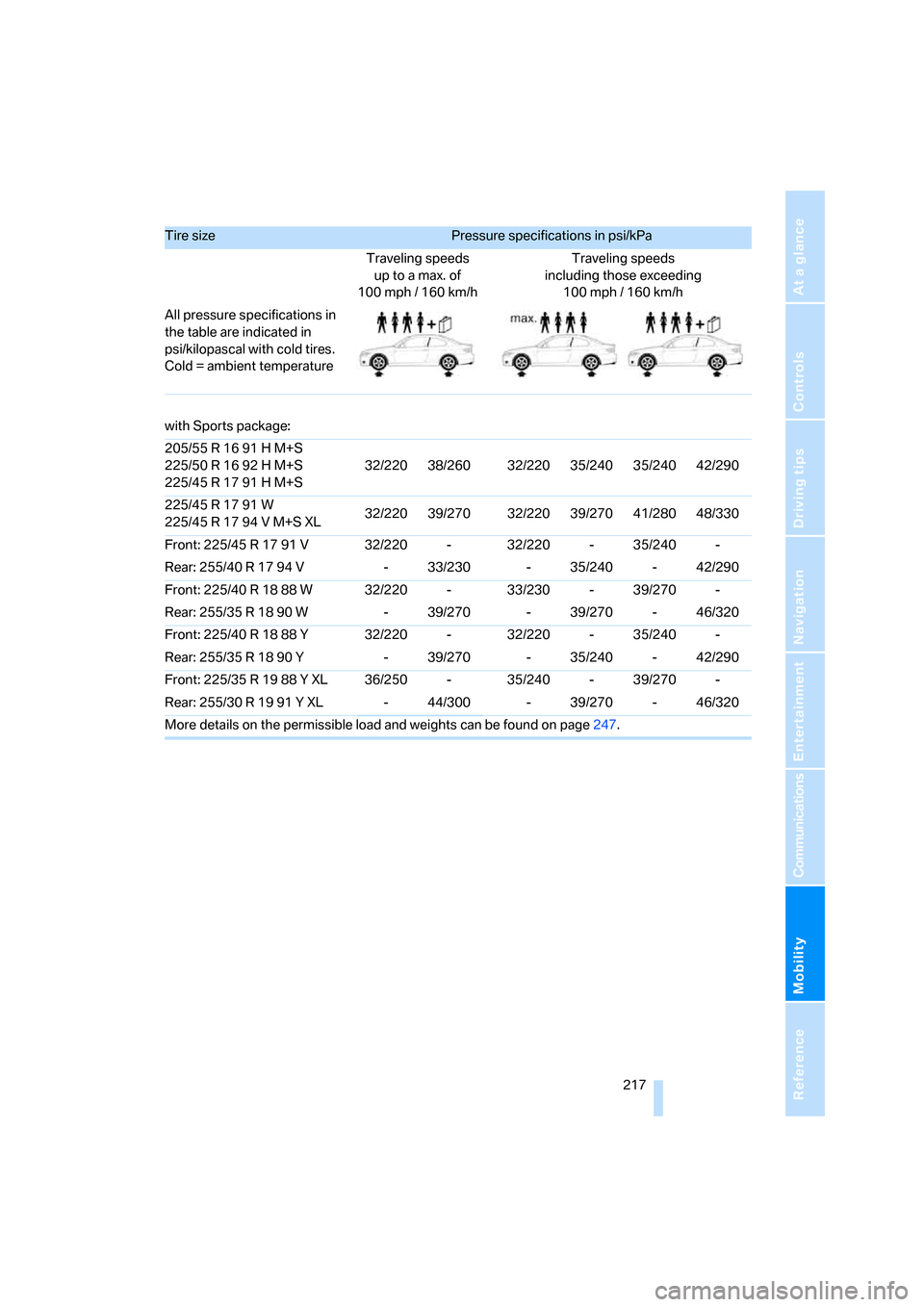
Mobility
217Reference
At a glance
Controls
Driving tips
Communications
Navigation
Entertainment
with Sports package:
205/55 R 16 91 H M+S
225/50 R 16 92 H M+S
225/45 R 17 91 H M+S32/220 38/260 32/220 35/240 35/240 42/290
225/45 R 17 91 W
225/45 R 17 94 V M+S XL32/220 39/270 32/220 39/270 41/280 48/330
Front: 225/45 R 17 91 V 32/220 - 32/220 - 35/240 -
Rear: 255/40 R 17 94 V - 33/230 - 35/240 - 42/290
Front: 225/40 R 18 88 W 32/220 - 33/230 - 39/270 -
Rear: 255/35 R 18 90 W - 39/270 - 39/270 - 46/320
Front: 225/40 R 18 88 Y 32/220 - 32/220 - 35/240 -
Rear: 255/35 R 18 90 Y - 39/270 - 35/240 - 42/290
Front: 225/35 R 19 88 Y XL 36/250 - 35/240 - 39/270 -
Rear: 255/30 R 19 91 Y XL - 44/300 - 39/270 - 46/320
More details on the permissible load and weights can be found on page247.
Tire size Pressure specifications in psi/kPa
Traveling speeds
up to a max. of
100 mph / 160 km/hTraveling speeds
including those exceeding
100mph / 160km/h
All pressure specifications in
the table are indicated in
psi/kilopascal with cold tires.
Cold = ambient temperature