2007 AUDI R8 service
[x] Cancel search: servicePage 64 of 210
Lights and vision 62Changing wiper blades
Good wiper blades are essential for clear vision.Taking off the wiper blade
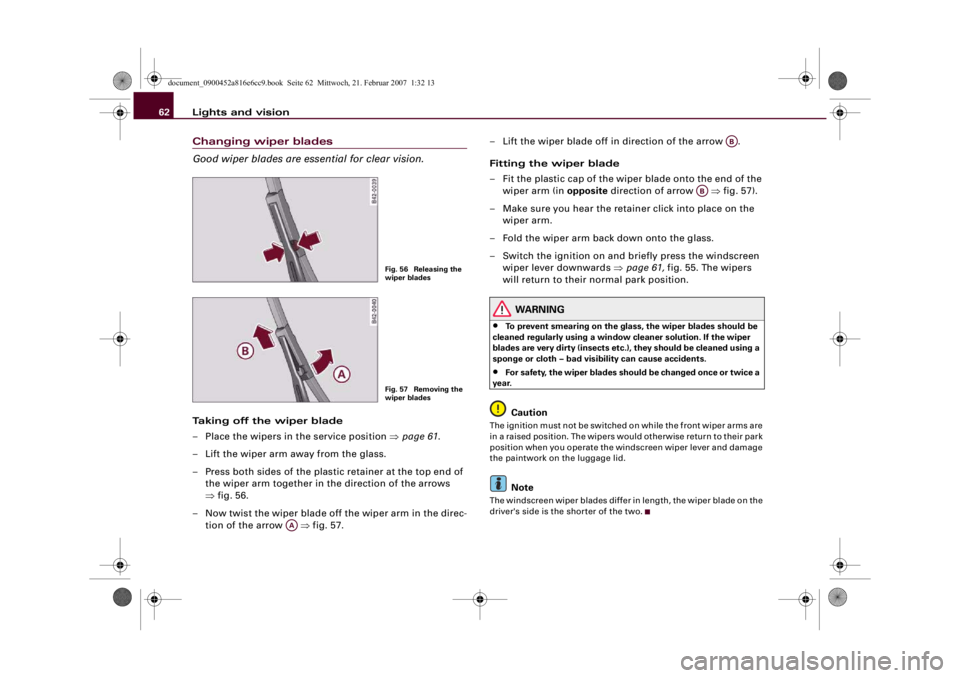
– Place the wipers in the service position ⇒page 61.
– Lift the wiper arm away from the glass.
– Press both sides of the plastic retainer at the top end of
the wiper arm together in the direction of the arrows
⇒fig. 56.
– Now twist the wiper blade off the wiper arm in the direc-
tion of the arrow ⇒fig. 57.– Lift the wiper blade off in direction of the arrow .
Fitting the wiper blade
– Fit the plastic cap of the wiper blade onto the end of the
wiper arm (in opposite direction of arrow ⇒fig. 57).
– Make sure you hear the retainer click into place on the
wiper arm.
– Fold the wiper arm back down onto the glass.
– Switch the ignition on and briefly press the windscreen
wiper lever downwards ⇒page 61, fig. 55. The wipers
will return to their normal park position.
WARNING
•
To prevent smearing on the glass, the wiper blades should be
cleaned regularly using a window cleaner solution. If the wiper
blades are very dirty (insects etc.), they should be cleaned using a
sponge or cloth – bad visibility can cause accidents.
•
For safety, the wiper blades should be changed once or twice a
year.Caution
The ignition must not be switched on while the front wiper arms are
in a raised position. The wipers would otherwise return to their park
position when you operate the windscreen wiper lever and damage
the paintwork on the luggage lid.
Note
The windscreen wiper blades differ in length, the wiper blade on the
driver's side is the shorter of the two.
Fig. 56 Releasing the
wiper bladesFig. 57 Removing the
wiper blades
AA
AB
AB
document_0900452a816e6cc9.book Seite 62 Mittwoch, 21. Februar 2007 1:32 13
Page 78 of 210

Heating and cooling 76The compressor also switches off if the coolant temperature is
excessively high, to ensure adequate engine cooling under extreme
loads.
The functions can be set by turning the rotary control and are
switched on and off by briefly pressing the buttons. The LEDs in the
buttons light up when the function is switched on.
Pollution filter
The pollution filter (a particle filter) serves as a barrier against impu-
rities in the outside air, including dust and pollen. The air is also
filtered when the air recirculation mode is activated.
For the air conditioner to work with maximum efficiency, the pollu-
tion filter element must be replaced at the intervals specified in the
Service Schedule.
If the vehicle is driven in areas with a high level of air pollution and
the filter is no longer fully effective, it may be necessary to change
the filter element more frequently.
WARNING
For safety reasons it is important that all the windows are kept
free of ice, snow and condensation. These can cause poor visibility
and lead to an accident. Please familiarise yourself with the oper-
ating controls for the air conditioner, including the demist/defrost
functions for the windows.
Caution
•
If you suspect that the air conditioner is damaged, switch it off
to prevent further damage and have the system checked by a quali-
fied workshop.
•
Repairs to the air conditioning system require specialist knowl-
edge and special tools. For this reason, please contact a qualified
workshop if the system is not working properly.Note
•
Keep the air intake slots in front of the windscreen clear of snow,
ice and leaves to ensure unimpaired heating and cooling, and to
prevent the windows misting over.
•
The air conditioner operates most effectively with the windows
closed. However, if the vehicle has heated up after standing in the
sun for some time, the air inside can be cooled more quickly by
opening the windows for a short time.
Te m p e r a t u r e s e l e c t i o n– Turn the rotary control ⇒page 75, fig. 69 to the
required temperature setting.Turn the rotary control to the left to reduce the temperature. Turn
the rotary control to the right to increase the temperature. There are
several intermediate positions, allowing you to adjust the tempera-
ture as required.
Buttons
Function
Page
Rotary control
Temperature selection
⇒page 76
Rotary control
Switches air conditioner
on/off
Blower
⇒page 77
Rotary control
Air distribution
⇒page 77
Defrosting windows
⇒page 78
Heated rear window
⇒page 79
Seat heating* (driver's
side/front passenger's
side)
⇒page 80
Air recirculation mode
⇒page 78
Switching the air condi-
tioner on
⇒page 79
A1A2
A3
- +AC
A1
document_0900452a816e6cc9.book Seite 76 Mittwoch, 21. Februar 2007 1:32 13
Page 117 of 210

Airbag system115
Controls
Safety
Driving tips
General maintenance
Self-help
Technical data
Airbag systemDescription of airbag systemGeneral notes on airbag system
The airbag is an integral part of the car's passive safety
system.In conjunction with the three-point seat belts, the airbag system
gives the front occupants additional protection for the head and
chest in the event of a severe frontal collision.
In a side collision the side airbags reduce the risk of injury to the
areas of the body facing the impact ⇒.
In addition to their normal function of protecting the occupants in a
collision, the seat belts also hold them in a position where the
airbags can inflate properly and provide maximum protection.
The airbag system will only work with the ignition on. The airbag
system is monitored electronically; the airbag warning lamp indi-
cates whether the system is functioning properly.
The main parts of the airbag system are:•
the electronic monitoring system (control unit and sensors),
•
the two front airbags,
•
The two side airbags,
•
The airbag warning lamp in the instrument cluster.
There is a fault in the airbag system if the warning
lamp
•
does not come on when the ignition is switched on,
•
does not go out about 3 seconds after the ignition is switched
on,
•
goes out and then comes on again after the ignition is switched
on,
•
comes on or flickers while the car is moving.
WARNING
•
The airbags are not a substitute for the seat belts; they are an
integral part of the car's overall passive safety system. The airbags
can only offer effective protection if the occupants are wearing
their seat belts. For this reason it is very important to wear the
seat belts at all times ⇒page 109, “Why is it so important to use
seat belts?”.
•
The seat belts and airbags can only provide maximum protec-
tion if the occupants are seated correctly ⇒page 67, “Seats and
storage”.
•
If you do not wear a seat belt, if you lean forward, or are not
seated correctly while the vehicle is in motion, you are at greater
risk of injury should the airbag system be triggered in an accident.
•
Components of the airbag system are located in various parts
of the vehicle. If repairs to other vehicle components make it
necessary to perform work on the airbag system or to remove or
install parts of the airbag system, this may cause damage to the
airbag system. As a result, the airbags may not inflate correctly or
may not be triggered at all in an accident situation.
•
If a fault should occur in the airbag system, have the system
checked immediately by a qualified workshop. Otherwise the
system may fail to trigger in an accident.
•
Do not attempt to modify components of the airbag system in
any way.
•
Never make any alterations to the front bumper or the body.
•
The airbag system can only be activated once; if the airbag has
been triggered, the system must be replaced. Should the airbag
system or airbag modules have to be replaced, the qualified work-
shop carrying out the replacement will document all details in the
appropriate section of the Service Schedule.
document_0900452a816e6cc9.book Seite 115 Mittwoch, 21. Februar 2007 1:32 13
Page 118 of 210

Airbag system 116•
If you sell the vehicle, please remember to pass on the
complete Service Wallet to the new owner. If the front passenger's
airbag has been deactivated, it is important that the new owner is
also given the relevant documents.
•
The relevant safety requirements must be observed when the
vehicle or components of the airbag or belt tensioner systems are
scrapped.
•
In an accident in which one or more airbags are triggered the
alternator and the starter are - for safety reasons - both discon-
nected from the battery via a pyrotechnic circuit breaker.
−Any repairs to the pyrotechnic circuit breaker must always
be performed by a qualified workshop (accident risk).
−The relevant safety requirements must be observed when
the vehicle or the circuit breaker are scrapped.
When are the airbags triggered?
The airbag system is triggered in collisions with a severe
impact.The airbag system is designed so that the airbags for the driver and
front passenger are triggered in a severe frontal collision.
In severe side collisions the side airbags are triggered on the impact
side of the vehicle.
In certain types of accident the front airbags and the side airbags
may be triggered together.
The airbag system is not triggered in minor frontal or side collisions,
or in rear collisions or if the car overturns. In these situations the
occupants are protected by wearing the seat belts.
Factors determining the triggering response
It is not possible to define the exact triggering response of the
airbag system in all possible situations, since the circumstances in different types of accident will vary considerably. Important factors
include, for example, the nature (hard or soft) of the object which
the car hits, the angle of impact, vehicle speed and so on.
Whether the airbags are triggered depends primarily on the vehicle
deceleration rate resulting from the collision. By processing the
signals from the sensors located in the vehicle, the electronic
control unit is immediately able to evaluate the severity of the colli-
sion and activate the restraint systems accordingly. If the decelera-
tion rate is below the predefined reference value in the control unit
the airbags will not be triggered, even though the accident may
cause extensive damage to the car.
Note
The airbag releases a fine dust when it inflates. This is quite normal
and does not mean there is a fire in the vehicle.Front airbagsDescription of front airbags
The airbag system is not a substitute for the seat belts.
WARNING (continued)
Fig. 95 Driver's airbag
in steering wheel
document_0900452a816e6cc9.book Seite 116 Mittwoch, 21. Februar 2007 1:32 13
Page 138 of 210

Intelligent technology 136front wheels is not obstructed, otherwise the brakes can overheat. Power steeringThe power steering assists the driver when turning the
steering wheel (with the engine running).The power steering assists the driver by reducing the force needed
to turn the steering wheel.
The power steering does not function when the engine is switched
off. In this case the steering wheel is very hard to turn.
If the steering is held at its turning limit when the car is stationary,
this will place an excessive load on the power steering system. In
this case, the power steering system will make noises. It will also
reduce the idling speed of the engine.
Caution
Do not keep the steering in the full-lock position for longer than
15 seconds when the engine is running – this could cause damage
to the power steering system.
Note
•
If the power steering should fail at any time or the engine is
switched off (for instance when being towed), the car can still be
steered. However, more effort will be required to turn the steering
wheel.
•
If the system is leaking or malfunctioning, please take the car to
a qualified workshop as soon as possible.
•
The power steering requires a special hydraulic fluid. The
container for the fluid is located in the engine compartment. The
correct fluid level in the reservoir is important for the power
steering to function properly. The hydraulic fluid level is checked at
the Inspection Service.
Four-wheel drive (quattro®)On quattro models the engine power is distributed to all
four wheelsGeneral notes
On four-wheel drive vehicles, the engine power is distributed to all
four wheels. The distribution of power is controlled automatically
according to your driving style and the road conditions. Also refer
to ⇒page 132.
Winter tyres
Thanks to its four-wheel drive, your car will have plenty of traction
in winter conditions, even with the standard tyres. Nevertheless, we
still recommend that winter tyres should be fitted on all four wheels
when winter road conditions are expected, mainly because this will
give a better braking response.
Snow chains
On roads where snow chains are mandatory, this also applies to cars
with four-wheel drive ⇒page 171, “Snow chains”.
Replacing tyres
The dimensions of the wheels and tyres used on four-wheel drive
vehicles must comply with the manufacturer's specifications
⇒page 168, “Replacing wheels and tyres”.
WARNING
•
Even with four-wheel drive, you should always adjust your
speed to suit the conditions. Do not let the extra safety provided
tempt you into taking any risks when driving – this can cause acci-
dents.
•
The braking ability of your car is limited by the grip of the tyres.
In this respect, your car is no different from a car without four-
wheel drive. So do not be tempted to drive too fast on icy or slip-
document_0900452a816e6cc9.book Seite 136 Mittwoch, 21. Februar 2007 1:32 13
Page 159 of 210

Checking and topping up fluids157
Controls
Safety
Driving tips
General maintenance
Self-help
Technical data
Engine oilGeneral notesWe recommend that you have the oil change carried out by an
Audi R8 dealership or qualified workshop according to the intervals
stated in the Service Schedule or according to the service interval
display in the instrument cluster.
Whether your vehicle is serviced at flexible service intervals or fixed
service intervals is shown in the Service Schedule.
The correct oil specifications for your engine are listed in the Te c h -
nical data section ⇒page 198, “Performance, weights and dimen-
sions”.
Check that the specifications quoted (VW standards) appear on the
container either singly or in combination with other specifications.
Flexible service intervals (LongLife Service*)
Special engine oils ⇒page 198, “Performance, weights and dimen-
sions” have been developed as part of the Audi LongLife Service
(⇒“Service Schedule”).
This type of oil must be used if you intend to take advantage of the
extended maintenance intervals allowed by Audi's LongLife Service.•
Do not mix the LongLife oil with oil intended for fixed service
intervals, as the requirements for the extended service intervals are
then no longer guaranteed.
•
In exceptional circumstances, if the engine oil level is too low
⇒page 157 and you cannot obtain the specified LongLife oil, you
can put in a small quantity of oil for fixed service intervals -
⇒page 198, “Performance, weights and dimensions”. This should
not be done more than once and no more than 0.5 litres should be
used.Fixed service intervals (Inspection Service*)
If you do not take advantage of the LongLife service for your car, you
can use the oils for fixed service intervals - ⇒page 198, “Perform-
ance, weights and dimensions”. In this case, your car must be serv-
iced after a fixed interval of 1 year / 15,000 km (10,000 miles) – see
Service Schedule.
•
In exceptional circumstances, if the engine oil level is too low
⇒page 157 and you cannot obtain the oil specified for your vehicle,
you can put in a small quantity of oil conforming to the specification
ACEA A2 or ACEA A3. This should not be done more than once and
no more than 0.5 litres should be used.
Checking the oil level
Fig. 117 Instrument
cluster: Engine oil
temperature displayFig. 118 Markings on
oil dipstick
document_0900452a816e6cc9.book Seite 157 Mittwoch, 21. Februar 2007 1:32 13
Page 163 of 210
Checking and topping up fluids161
Controls
Safety
Driving tips
General maintenance
Self-help
Technical data If a lot of coolant has been lost, wait for the engine to cool down
before putting in cold coolant. Failure to do so could result in
serious engine damage.
WARNING
The coolant and coolant additive can be a health hazard. Store the
coolant additive in the original container in a safe place out of
reach of children – risk of poisoning.
For the sake of the environment
Drained off coolant should not be used again. Drain off the used
coolant into a suitable container and dispose of it in the proper
manner (observe environmental regulations).Radiator fan
The radiator fan can start running spontaneously.The radiator fan is powered electrically. The speed of the fan is
varied according to the temperature registered by a thermostat.
The radiator fan or auxiliary fan can continue to run for as long as
10 minutes after stopping the engine – even after the ignition is
switched off. It may also start running suddenly after a while if•
residual heat raises the coolant temperature, or
•
the hot engine compartment is additionally heated up by the
sun.
Brake fluidNote
When required, the brake fluid should be changed by a
competent mechanic with the proper equipment.Brake fluid gradually absorbs moisture from the atmosphere. If the
water content in the brake fluid is too high, this may cause corrosion
in the brake system over time. In addition, the boiling point of the
brake fluid will be considerably reduced. This could adversely affect
the braking ability in certain circumstances.
For this reason the brake fluid must be changed periodically.
Your vehicle's Service Schedule will tell you when the brake fluid has
to be changed.
The brake fluid is replaced by your Audi R8 dealer as part of the
Inspection Service. They are familiar with the procedure and have
the necessary special tools and spare parts as well as the proper
facilities for disposing of the old fluid.
Use only the genuine brake fluid specified by the factory Qualified
workshops know that the brake fluid “DOT 4” is approved by Audi.
The brake fluid must be fresh and unused.
WARNING
Heavy use of the brakes may cause a vapour lock if the brake fluid
is left in the system for too long. This would seriously affect the
efficiency of the brakes and the safety of the car – risk of
accident.
document_0900452a816e6cc9.book Seite 161 Mittwoch, 21. Februar 2007 1:32 13
Page 164 of 210

Checking and topping up fluids 162BatteryGeneral notes
All work on batteries requires specialist knowledge.The battery is located behind the cover in the luggage compart-
ment. To remove the cover, slide it to the left and lift it out.
The battery is virtually maintenance-free and is checked in the
Inspection Services.
We recommend that you replace a battery once it is older than 5
years.
Disconnecting the battery
If the battery is disconnected, some of the vehicle's functions will
become inoperative (e.g. electric windows). These functions will
require resetting after the battery is reconnected. For this reason,
the battery should only be disconnected from the vehicle's electrical
system when absolutely necessary.
If the vehicle is not used for long periods
The battery will gradually lose its charge because certain electrical
equipment continues to draw current even when the ignition is off.
If you park the vehicle for long periods of time in winter you should
have your Audi R8 dealer take the battery out of the vehicle and keep
it in a frost-proof room. This ensures that it cannot “freeze up” and
be damaged. At warm outside temperatures it is sufficient to
disconnect the negative terminal of the battery. Even when the
battery is not connected you should charge it from time to time.
Winter conditions
The battery is drained more in cold weather, which means that the
starting power is reduced. For this reason, have the battery checked
and charged if necessary before the start of winter.Replacing the battery
A replacement battery must have the same capacity, voltage and
current rating. It must also have the same dimensions as the orig-
inal, factory-fitted battery and have sealed caps. The Audi batteries
which have been specially developed fulfil the maintenance,
performance and safety specifications for your vehicle.
We recommend to use only maintenance-free batteries or deep-
cycle resistant and leakproof batteries which comply with the
standards TL 825 06 (dated December 1997 or later) and VW 7 50 73
(August 2001 or later).
Since the battery is difficult to access, we recommend having it
replaced by an Audi R8 dealer or qualified workshop.
WARNING
•
All work on batteries requires specialist knowledge. For queries
regarding the vehicle battery please contact an Audi R8 dealership
or other qualified workshop (risk of chemical burns / risk of explo-
sion).
•
The battery must not be opened. Do not attempt to make any
changes to the electrolyte level of the battery. Otherwise, there is
a risk that a mixture of oxygen and hydrogen gas can accumulate
and cause an explosion.Caution
•
The battery holder and clamps must always be correctly secured.
•
Before starting any work on the battery, always observe the
warnings listed under ⇒ in “Important safety warnings for
handling a car battery” on page 163.For the sake of the environment
Batteries contain toxic substances including sulphuric acid and
lead. They must be disposed of appropriately and must not be put
together with ordinary household waste. Make sure the battery
document_0900452a816e6cc9.book Seite 162 Mittwoch, 21. Februar 2007 1:32 13