Page 156 of 272

155 VEHICLE INACTIVITY
If the vehicle is to be left inactive for
long periods the following precautions
should be noted:
– House the vehicle under a cover in a
dry and possibly ventilated place.
– Engage a gear.
– Release the handbrake.
– Clean and protect the paintwork by
applying silicon wax.
– Cover the rubber windscreen wiper
blades with talcum powder and raise
them off the glass.
– Open the windows slightly.
– Cover the vehicle with a cloth or per-
forated plastic cover. Do not use compact
plastic covers which prevent the humidity
on the surface of the vehicle from evapo-
rating.
– Inflate the tyres to a pressure of 0.5
bars above normal. If possible rest the
tyres on wooden planks and periodically
check the pressure.– Switch off the alarm system (if fit-
ted) with the remote control, then deacti-
vate it with the emergency key.
– Disconnect the terminals from the
battery poles (negative pole first) and
check the battery charge. When the vehi-
cle is in storage, this check should be car-
ried out once a month. If the no-load volt-
age is less than 12.5V, recharge the bat-
tery.
REMOVING FROM STORAGE
Before using your vehicle after a long
period of inactivity the following opera-
tions should first be carried out:
– Do not dust the outside of the vehi-
cle.
– Visually check that there are no
leaks (oil, brake and clutch fluid, engine
coolant etc.).
– Replace the engine oil and filter.
– Check:
Gearbox-differential oil level
Brake-clutch fluid level
Level of engine coolant fluid.– Check the air cleaner and replace if
necessary.
– Check tyre pressure and ensure that
they are not damaged, cracked or cut. If
they are they must be replaced.
– Check the state of the drive belts in
the engine bay.
– Connect the cables of the battery af-
ter checking that the charge is adequate.
– Re-activate the alarm system, if fit-
ted, using the emergency key.
– With the gear lever in neutral start
the engine and allow the engine to run
for a few seconds whilst repeatedly
pumping the clutch pedal.
Page 193 of 272

192
System/Component Fuse no. Ampere Location
Conditioner compressor 13 7.5A fig. 89
Cruise Control 5 10A fig. 86
Diesel fuel filter warming 23 30Afig. 89
(JTD versions) 5 40Afig. 89
Door mirror defrosting 2 7.5A fig. 93
Electrochromic driving mirror 15 10A fig. 93
Electronic injection control unit 20 10A fig. 89
21 15A fig. 89
22 20A fig. 89
Electronic injection system 16 5A fig. 86
Engine control unit 18 7.5A fig. 89
Engine cooling control unit 16 5A fig. 86
Engine cooling radiator fan 4 60A fig. 89
System/Component Fuse no. Ampere Location
Engine cooling radiator fan 5 40A fig. 89
EOBD system (socket) 18 5A fig. 86
Front LH power window
(ABI control unit) 18 20Afig. 93
Front RH power window
(ABI control unit) 3 20Afig. 93
Front LH seat electric adjustment 6 30A fig. 93
Front RH seat electric adjustment 5 30A fig. 93
Front LH seat warming 9 10A fig. 93
Front RH seat warming 8 10A fig. 93
Fuel pump 19 15A fig. 89
Fuel pump relay coil
(engine bay box) 16 5Afig. 86
Glow plug (JTD versions) 8 60A fig. 89
Headlight washer (intermittent) 12 20A fig. 86
Horns 11 15A fig. 89
I.C.S. system 5 10A fig. 86
6 7.5A fig. 86
7 20A fig. 86
18 5A fig. 86
Instrument panel 6 7.5A fig. 86
18 5A fig. 86
Page 194 of 272
193
System/Component Fuse no. Ampere Location
Rearscreen heating 1 30A fig. 93
Relay coil T21, T22, T23 (boot box) 3 5A fig. 86
Relay coil T24 (boot box) 5 10A fig. 86
Remote control receiver 15 10A fig. 93
Sound amplifier 20 25A fig. 93
Sound system 4 15A fig. 86
Sound system controls on steering wheel 5 10Afig. 86
Starter motor 1 30A fig. 89
Trailer presetting 12 10A fig. 93
Windscreen heating 7 15A fig. 93
Windscreen wiper 14 25A fig. 86
System/Component Fuse no. Ampere Location
Navigator 18 5A fig. 86
Parking sensors (control unit) 15 10A fig. 93
Power windows (driver's control
LOCK warning light) 15 10A fig. 93
Powered sunroof 10 20A fig. 93
Presetting 4 – fig. 93
11 – fig. 93
Rain sensor 15 10A fig. 93
Rear current socket 16 20A fig. 93
Rear LH power window (ABI control unit) 14 20Afig. 93
Rear RH power window (ABI control unit) 17 20Afig. 93
Page 206 of 272
205
thousands of kilometres 20 40 60 80 100 120 140 160 180
Change fuel filter (diesel versions)•••••••••
Change air cleaner cartridge (petrol versions)••••
Change air cleaner cartridge (diesel versions)•••••••••
Check and top up, if required, fluid levels (brakes/hydraulic clutch, power steering,
windscreen washer, battery, engine coolant, etc.)•••••••••
Replacement of timing gear drive belt (*) and Poly-V accessory drive belt•
Replacement of spark plugs (petrol versions)•
Check operation of engine control systems (through diagnostics socket)••••
Check manual gearbox and differential oil level (petrol versions)••
Change engine oil and oil filter •••••••••
Change brake fluid (or every 24 months)•••
Check dust/pollen filter•••••••••
(*)Or every 4 years in harsh conditions (cold climates, stop and go city traffic).
Or every 5 years, regardless of the mileage.
Page 207 of 272

206 ANNUAL INSPECTION
PLAN
An annual inspection plan has
been established for cars that cov-
er less than 20,000 km a year
(e.g. 10,000 km). It consists of
the following:
– Checking the condition/wear of tyres,
and adjusting pressure (including the com-
pact spare wheel, where applicable).
– Checking the lighting system (head-
lights, turn indicators, hazard warning
lights, boot light, passenger compart-
ment, warning lights of instrument panel,
etc.).
– Checking the working order of the
windscreen wiper-washer and adjusting
the nozzles.
– Checking the positioning/wear of the
windscreen wipers.
– Checking the condition and wear of
the front brake pad.– Sight inspect the conditions of: en-
gine, gearbox, transmission, pipes and
hoses (exhaust - fuel - brakes), rubber
parts (boots, sleeves, bushes, etc.).
– Check for bonnet and boot lock clean-
ness, lever cleanness and lubrication.
– Check battery charge and fluid level
(electrolyte).
– Visually checking the condition of the
belts and various controls.
– Checking and topping up, if neces-
sary, the level of liquids (coolant, brake
fluid, windscreen washer fluid, battery
etc.).
– Change engine oil and oil filter, if re-
quired.
– Check and replace pollen filter, if re-
quired.
– Check and replace air cleaner, if re-
quired.
ADDITIONAL OPERATIONS
Every 1000 kmor before long jour-
neys check and if necessary top up:
– the engine coolant fluid level
– brake fluid/hydraulic clutch control
fluid level
– power steering fluid level
– windscreen washer and headlamp
washer fluid level
– tyre pressure and conditions.
– check light system operation (head-
lights, direction indicators, hazard lights,
etc.).
– check windscreen wiper/washer op-
eration and windscreen/rear window
blade position/wear.
Every 3000 kmcheck the level of
the engine oil and top up if necessary.
Every 5000 km(only for fuel oil en-
gines): drain the condensation water
from the filter. You are recommended to
use products of the FL Selenia, de-
signed and developed expressly for Alfa
Romeo cars (see the table “Fluids and lu-
bricants” in the Technical specifications”
chapter).
Page 208 of 272

207
IMPORTANT - Engine oil
Change the engine oil more frequently
than stated in the Scheduled Mainte-
nance Programme if the car is used pre-
vailingly in one of the following particular-
ly harsh conditions:
– trailer or caravan towing
– dusty roads
– short, repeated journeys (less than 7-
8 km) with an outside temperature of be-
low freezing point.
– engine idling frequently or driving
long distances at low speed (e.g. taxi or
door-to-door deliveries) or in the case of
prolonged inactivity.
IMPORTANT - Air cleaner
Using the car on dusty roads, change
the air cleaner more frequently than stat-
ed in the Scheduled Maintenance Pro-
gramme.
For any doubts about the intervals be-
tween engine oil and air cleaner changes
in relation to how the car is used, contact
Authorised Alfa Romeo Services.IMPORTANT - Fuel oil filter
The variety of the degree of purity of
the fuel oil in commerce may make it
necessary to change the fuel oil filter
more frequently than stated in the Sched-
uled Maintenance Programme. If the en-
gine is “sobbing” it is a sign that the fil-
ter needs changing.
IMPORTANT - Pollen filter
If the car is used frequently in dusty or
heavily polluted environments, you are
recommended to change the activated
carbon filtering element more frequently;
in particular, it should be changed if a
lower flow of air admitted to the passen-
ger compartment is noted.IMPORTANT - Batteries
You are recommended to have the bat-
tery charge conditions checked, prefer-
ably at the onset of winter, to avoid the
possibility of freezing the electrolyte.
This check should be carried out more
frequently if the car is used prevailingly
for short journeys, or if it is fitted with
services that absorb high amounts of cur-
rent permanently with the ignition key
off, especially if installed in the after mar-
ket.
In the case of use of the car in hot cli-
mates or particularly harsh conditions, it
is wise to check the level of the battery
fluid (electrolyte) at more frequent inter-
vals than stated in the Scheduled Mainte-
nance Programme.
IMPORTANT - Remote control
If when pressing the remote control but-
ton of the key, the operating led on the
key flashes briefly only once, the battery
need replacing with other of the same
type.
Page 210 of 272
209
3.2 V6 24V version
fig. 1
k
1)engine oil
π
2)brake and
clutch fluid
+
3)windscreen
washer fluid
n
4)engine coolant
fluid
∂
5)power steering
fluid
A0D0099m
CHECKING LEVELS
Page 211 of 272
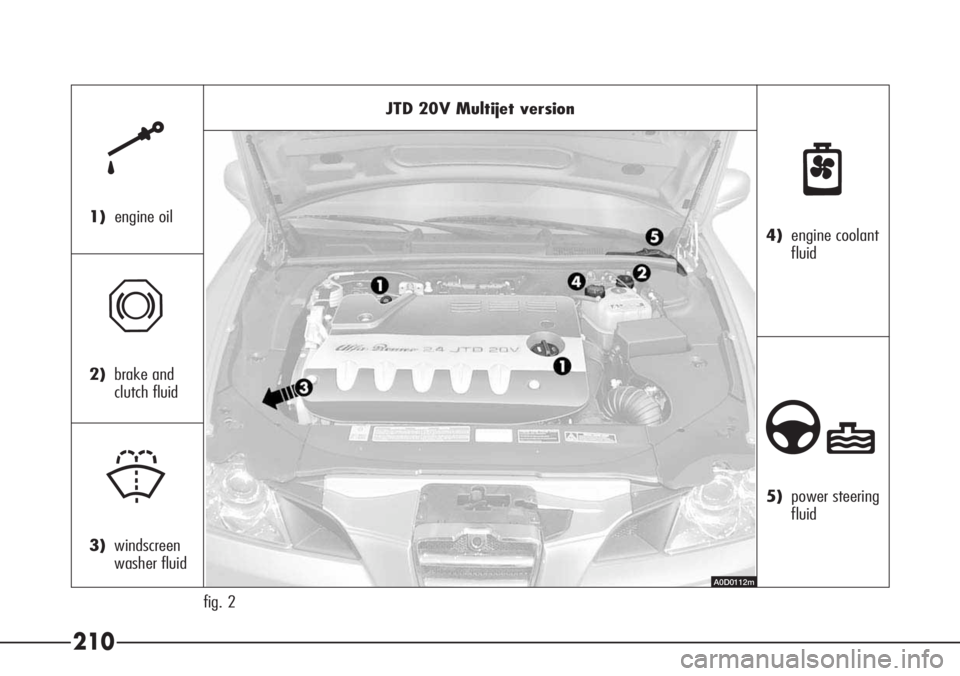
210
JTD 20V Multijet version
fig. 2
k
1)engine oil
π
2)brake and
clutch fluid
+
3)windscreen
washer fluid
n
4)engine coolant
fluid
∂
5)power steering
fluid
A0D0112m