Page 58 of 442
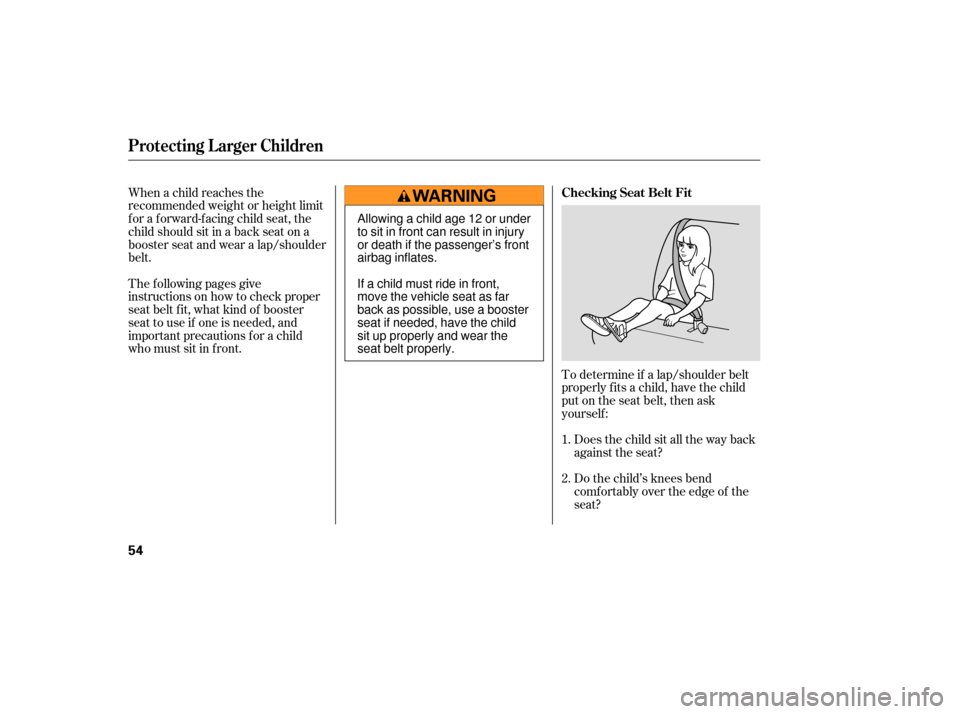
When a child reaches the
recommended weight or height limit
for a forward-facing child seat, the
child should sit in a back seat on a
booster seat and wear a lap/shoulder
belt.
The f ollowing pages give
instructions on how to check proper
seat belt f it, what kind of booster
seat to use if one is needed, and
important precautions f or a child
who must sit in f ront.To determine if a lap/shoulder belt
properly f its a child, have the child
put on the seat belt, then ask
yourself :Does the child sit all the way back
against the seat?
Do the child’s knees bend
comf ortably over the edge of the
seat?
1.
2. Checking Seat Belt Fit
Protecting L arger Children
54
Allowing a child age 12 or under
to sit in front can result in injury
or death if the passenger’s front
airbag inflates.
If a child must ride in front,
move the vehicle seat as far
back as possible, use a booster
seat if needed, have the child
sit up properly and wear the
seat belt properly.
�����—�����—�
���y�
�������������y���
�(�)� �������y���������y
Page 60 of 442

If a child who uses a booster seat
must ride in front, move the vehicle
seat as far back as possible and be
sure the child is wearing the seat
belt properly.
A child may continue using a booster
seat until the tops of their ears are
even with the top of the vehicle’s or
booster’s seat-back. A child of this
height should be tall enough to use
the lap/shoulder belt without a
booster seat. The National Highway Traffic Safety
Administration and Transport
Canada recommend that all children
ag
ed 12 and under be p roperly
restrained in a back seat.
If the passenger’s front airbag
inflates in a moderate to severe
frontal collision, the airbag can cause
serious injuries to a child who is
unrestrained, improperly restrained,
sitting too close to the airbag, or out
of position.
A side airbag also poses ri sks. If any
part of a larger child’s body is in the
path of a deploying side ai rbag, the
child could receive possibly serious
injuries. Of course, children vary widel
y. And
while age m ay be one indicator of
when a child can safely ride in front,
there are other important factors you
should consider.
Physically, a child must be large
enough for the lap/shoulder belt to
properly fit (see pages and ). If
the seat belt does not f it properly,
with or without the child sitting on a
booster seat, the child should not sit
in f ront.
To saf ely ride in f ront, a child must
be able to f ollow the rules, including
sitting properly, and wearing the seat
belt properly throughout a ride. 16 54
When Can a L arger Child Sit in
Front
Physical Size
Maturity
Protecting L arger Children
56
�����—�����—�
���y�
�������������y���
�(�)� �������y�������
�y
Page 326 of 442

When climbing hills, closely watch
your temperature gauge (see pages
and ). If it nears the H (Hot)
mark, turn the A/C of f , reduce
speed and, if necessary, pull to the
side of the road to let the engine cool.
When driving down hills, reduce
your speed, and shif t down to S
position, or use the puddle shif t to
the lower gear (3, 2 or 1)in the S
position. When towing a trailer, do
not ‘‘ride’’ the brakes, and remember,
it will take longer to slow down and
stop when towing a trailer.
Drive slower than normal in all
driving situations, and obey posted
speed limits f or vehicles with trailers.
Use the D position when towing a
trailer on level roads. See ‘‘
’’ in the next column f or
additional gear inf ormation. Do not
exceed 55 mph (88 km/h). At higher
speeds, the trailer may sway or
af f ect vehicle handling.
Make turns more slowly and wider
than normal. The trailer tracks a
smaller arc than your vehicle, and it
canhitorrunoversomethingthe
vehicle misses. Allow more time and
distance f or braking. Do not brake or
turn suddenly as this could cause the
trailer to jackknif e or turn over.
The added weight, length, and
height of a trailer will af f ect your
vehicle’s handling and perf ormance,
so driving with a trailer requires
some special driving skills and
techniques.
Foryoursafetyandthesafetyof
others,taketimetopracticedriving
maneuvers bef ore heading f or the
open road, and f ollow the guidelines
in this section.
8378
Driving on Hills
T owing Speeds and Gears
Driving on
Hills
Making T urns and BrakingDriving Saf ely With a T railer
Towing a Trailer
322
�����—�����—�
���y�
���������
���y���
�(�)� �������y���������y