Page 45 of 442

�µ
If a child wraps a loose
seat belt around their neck, they
can be seriously or fatally injured.
(S ee pages and for how to
activate and deactivate the
lockable retractor.)
Leaving children without
adult supervision is illegal in most
states and Canadian provinces,
and can be very hazardous.
For example, infants and small
childrenleftinavehicleonahot
day can die from heatstroke. A
child left alone with the key in the
ignition switch can accide ntally set
the vehicle in motion, possibly
injuring themselves or others.
This can prevent
children from accidentally falling
out (see page ).
If you are not wearing a
seat belt in a crash, you could be
thrown forward and crush the
child against the dashboard or a
seat-back. If you are wearing a
seat belt, the child can be torn
from your arms and be seriously
hurt or killed.
During a crash, the belt
could press deep into the child and
cause serious or f atal injuries.
If they do, they
could be very seriously injured in a
crash. Children who play in vehicles can
accidentally get trapped inside.
Teach your children not to play in
or around vehicles.
Even very young
children learn how to unlock
vehicle doors, turn on the ignition
switch, and open the tailgate,
which can lead to accidental injury
or death.
51 52
132
Make sure any unused seat belt t hat a child can reach is buckled,the lockable retractor is activated,and the belt is f ully retracted andlocked.
Do not leave children alone in avehicle.
Use t he childproof door locks t o prevent children f rom opening t herear doors.
Neverholdaninfantorchildon
your lap.
Never put a seat belt over yourselfor a child.
Never let two children use thesame seat belt . Lock all doors and the tailgate
when your vehicle is not in use.
K eep vehicle keys/remot etransmitters out of the reach ofchildren.Additional Saf ety Precautions
Protecting Children General Guidelines
Driver and Passenger Saf ety
41
�����—�����—�
���y�
�������������y���
�(�)� �������y���������y
Page 49 of 442

When buying a child seat, you need
to choose either a conventional child
seat, or one designed for use with
the lower anchors and tethers for
children (LATCH) system. Since
LATCH-compatible child seats
are easier to install and reduce the
possibility of improper installation,
we recommend selecting this style.
We also recommend selecting a
LATCH-compatible seat with a rigid,
rather than a f lexible, anchor (see
page ).
In seating positions and vehicles not
equipped with LATCH, a LATCH-
compatible child seat can be installed
using a seat belt. Whatever type of seat you choose, to
provide proper protection, a child
seat should meet three
requirements:
Look f or FMVSS
213 or CMVSS 213 on the box.
Rear-facing for infants, forward-
f acing f or small children.
Bef ore purchasing a conventional
child seat, or using a previously
purchased one, we recommend that
you test the seat in the specif ic
vehicle seating position or positions
where the seat will be used.
Conventional child seats must be
secured to a vehicle with a seat belt,
whereas LATCH-compatible seats
are secured by attaching the seat to
hardware built into the rear seating
positions.
48
T he child seat should meet U.S. or
Canadian Mot or Vehicle Saf et ySt andard 213.
T he child seat should be of theproper type and size to f it the child.
T he child seat should f it thevehicle seat ing posit ion (orposit ions) where it will be used.
1.
2.3.
Selecting a Child Seat
Driver and Passenger Saf ety
45
�����—�����—�
���y�
�������������y���
�(�)� �������y���������y
Page 50 of 442

Af ter selecting a proper child seat
and a good place to install the seat,
there are three main steps in
installing the seat:All child seats must be
secured to the vehicle with the lap
part of a lap/shoulder belt or with
the LATCH (lower anchors and
tethers for children) system. A
child whose seat is not properly
secured to the vehicle can be
endangered in a crash.
Af ter installing a child
seat, push and pull the seat
f orward and f rom side-to-side to
verify that it is secure. A child seat secured with a seat belt
should be installed as f irmly as
possible. However, it does not need
to be ‘‘rock solid.’’ Some side-to-side
movement can be expected and
should not reduce the child seat’s
ef f ectiveness.
If the child seat is not secure, try
installing it in a dif f erent seating
position, or use a dif f erent style of
child seat that can be f irmly secured.
Make sure the child is properly
strappedinthechildseat
according to the child seat maker’s
instructions. A child who is not
properly secured in a child seat
can be seriously injured in a crash.
The f ollowing pages provide
guidelines on how to properly install
a child seat. A f orward-f acing child
seat is used in all examples, but the
instructions are the same f or rear-
f acing child seats.
Installing a Child Seat
Properly secure t he child seat t o the vehicle.
Make sure t he child seat is f irmlysecured. Secure the child in the child seat.
1.
2. 3.
46
�����—�����—�
���y�
�������������y���
�(�)� �������y�������
�y
Page 51 of 442

Your vehicle is equipped with
LATCH (lower anchors and tethers
for children) at the rear seats to
secure a child seat in any seating
position: one in each outer seating
position, or one in the center.
Thefiveloweranchorsarelocated
between the seat-back and seat
bottom, and are to be used only with
a child seat designed f or use with
LATCH.The location of each lower anchor is
indicated by a small button above the
anchor point.
When you install a child seat in the
rear center seating position, use the
center LATCH as shown in the
illustration. To install a child seat in
the outer seating position, use either
LATCH. You can install up to two
child seat at a time with outer
LATCH. To install a LATCH-compatible child
seat in either of the rear outer seats:
Move the seat belt buckle or
tongue away f rom the lower
anchors.
Make sure there are no objects
near the anchors that could
prevent a secure connection
between the child seat and the
anchors.
1.
2.
CONT INUED
Installing a Child Seat with
LATCHUsing t he Out er L A T CH
Installing a Child Seat
Driver and Passenger Saf ety
47
LOWER ANCHORS
FOR OUTER LATCH BUTTON LOWER ANCHORS
FOR CENTER LATCH
OUTER LOWER ANCHORS
�����—�����—�
���y�
�������������y���
�(�)� �������y���������y
Page 53 of 442
Attach the tether strap hook to the
tether anchor, then tighten the
strap as instructed by the child
seat maker.
Push and pull the child seat
forward and from side-to-side to
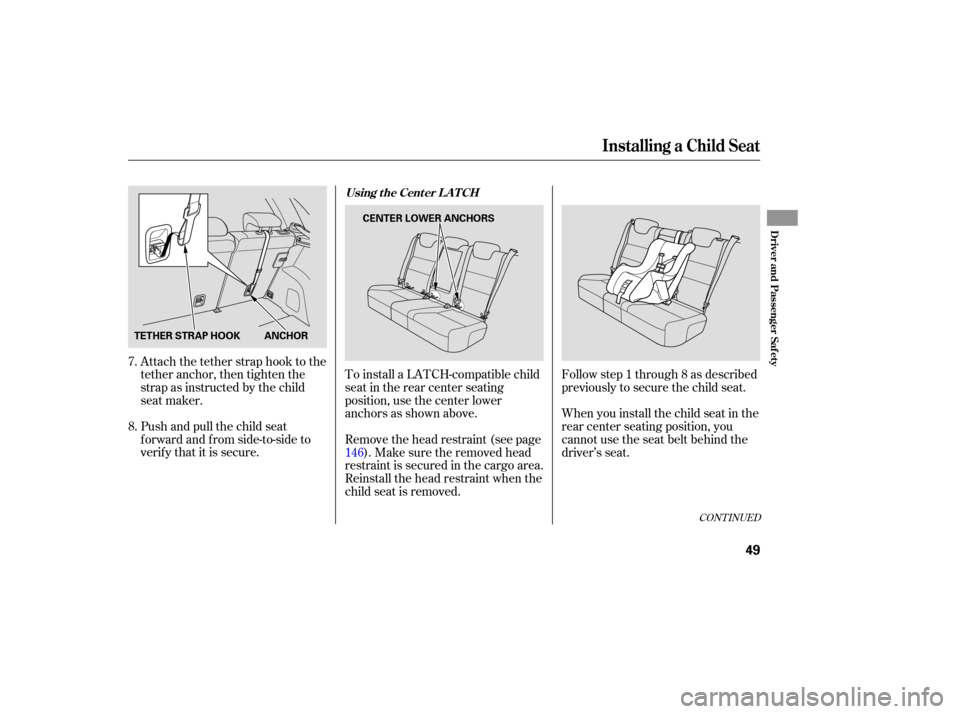
verify that it is secure. To
install a LATCH-compatible child
seat in the rear center seating
position, use the center lower
anchorsasshownabove. Follow
step 1 through 8 as described
previously to secu re the child seat.
When you install the child seat in the
rear center seating position, you
cannotusetheseatbeltbehindthe
driver’s seat.
Remove the head restraint (see page
). Make sure the removed head
restraint is secured in the cargo area.
Reinstall the head restraint when the
child seat is removed.
7.
8.
146
CONT INUED
Using t he Cent er L A T CH
Installing a Child Seat
Driver and Passenger Saf ety
49
CENTER LOWER ANCHORS
TETHER STRAP HOOK ANCHOR
�����—�����—�
���y�
�������������y���
�(�)� �������y���������y
Page 55 of 442
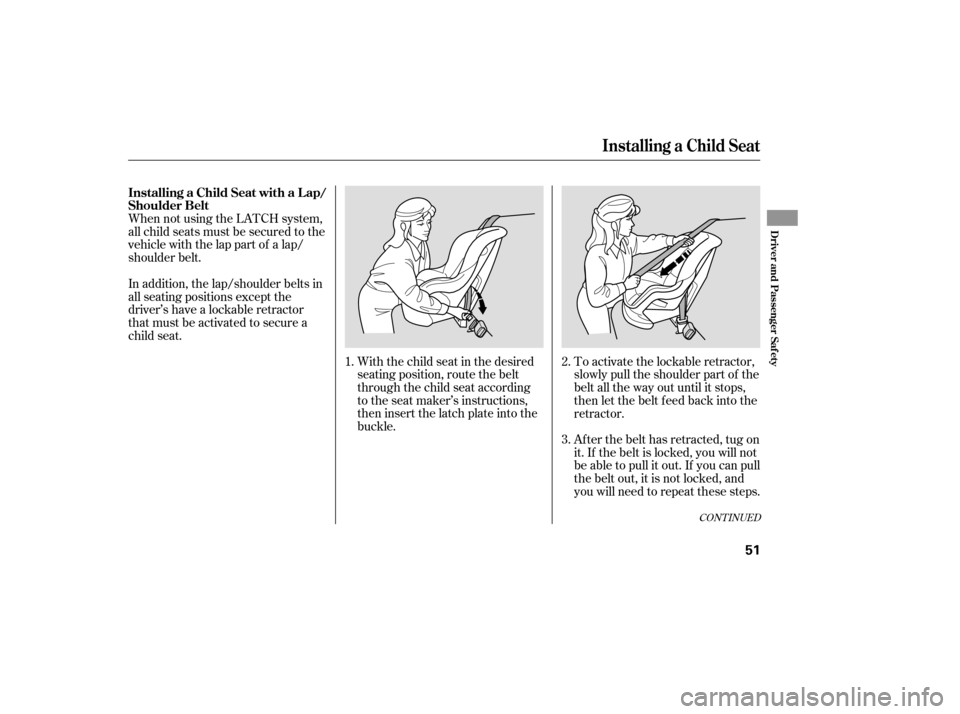
When not using the LATCH system,
all child seats must be secured to the
vehicle with the lap part of a lap/
shoulder belt.With the child seat in the desired
seating position, route the belt
through the child seat according
to the seat maker’s instructions,
then insert the latch plate into the
buckle.To activate the lockable retractor,
slowly pull the shoulder part of the
belt all the way out until it stops,
then let the belt f eed back into the
retractor.
Af ter the belt has retracted, tug on
it. If the belt is locked, you will not
be able to pull it out. If you can pull
thebeltout,itisnotlocked,and
you will need to repeat these steps.
In addition, the lap/shoulder belts in
all seating positions except the
driver’s have a lockable retractor
that must be activated to secure a
child seat.
2.
1.
3.
CONT INUED
Installing a Child Seat with a L ap/
Shoulder Belt
Installing a Child Seat
Driver and Passenger Saf ety
51
�����—�����—�
���y�
�������������y���
�(�)� �������y���������y
Page 56 of 442
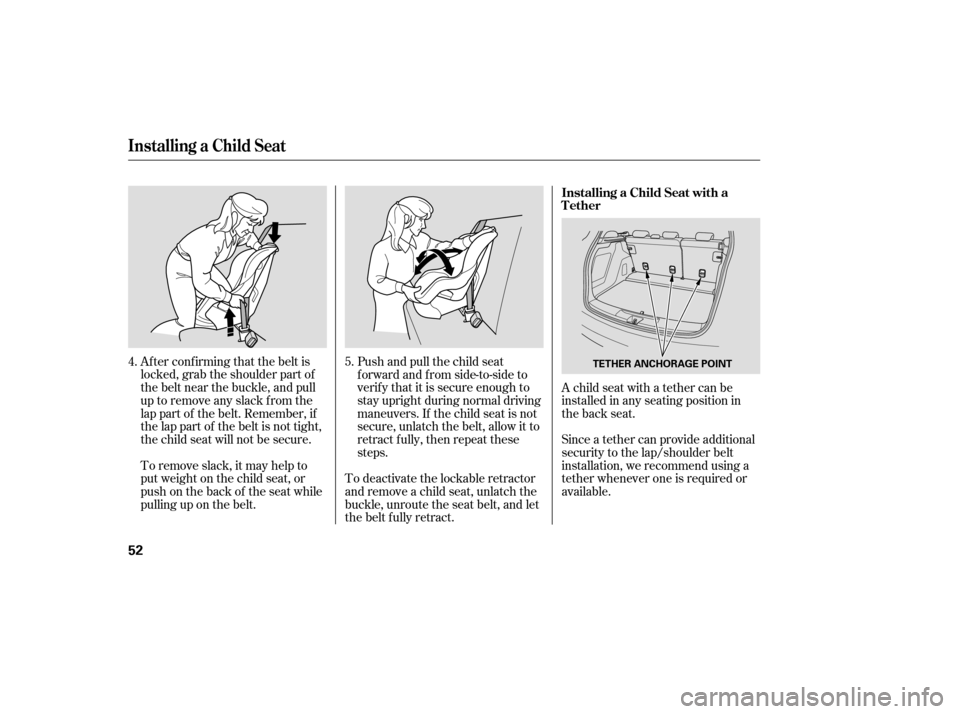
Af ter conf irming that the belt is
locked, grab the shoulder part of
the belt near the buckle, and pull
up to remove any slack from the
lap part of the belt. Remember, if
the lap part of the belt is not tight,
the child seat will not be secure.Push and pull the child seat
f orward and f rom side-to-side to
verify that it is secure enough to
stay upright during normal driving
maneuvers. If the child seat is not
secure, unlatch the belt, allow it to
retract f ully, then repeat these
steps.
To remove slack, it may help to
putweightonthechildseat,or
push on the back of the seat while
pulling up on the belt. To deactivate the lockable retractor
and remove a child seat, unlatch the
buckle, unroute the seat belt, and let
the belt fully retract. A child seat with a tether can be
installed in any seating position in
the back seat.
Since a tether can provide additional
security to the lap/shoulder belt
installation, we recommend using a
tether whenever one is required or
available.
4.
5.
Installing a Child Seat
Installing a Child Seat with a
Tether
52
TETHER ANCHORAGE POINT
�����—�����—�
���y�
�������������y���
�(�)� �������y���������y
Page 57 of 442
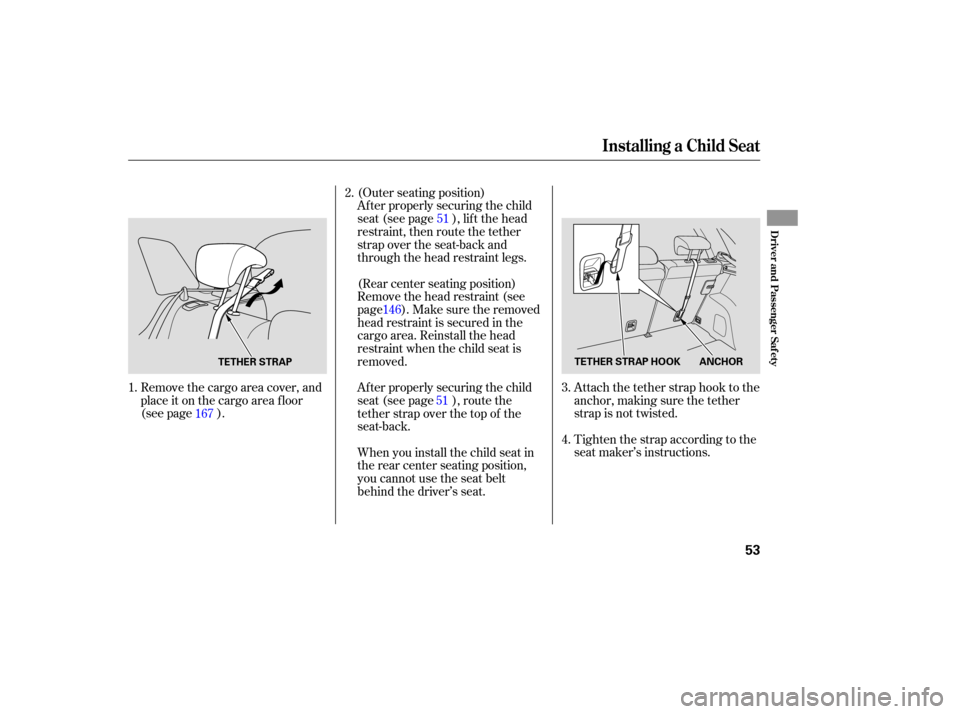
Tighten the strap according to the
seat maker’s instructions.
Attach
the tether strap hook to the
anchor, making sure the tether
strap is not twisted.
Remove
the cargo area cover, and
place it on the cargo area floor
(see page ). After
properly securing the child
seat (see page ), lift the head
restraint, then route the tether
strap over the seat-back and
th rough the head restraint legs.
Remove the head restraint (see
page ). Make sure the removed
he ad restraint is secured in the
cargo area. Reinstall the head
restraint when the child seat is
removed.
After properly securing the child
seat (see page ), route the
tether strap over the top of the
seat-back.
When you install the child seat in
the rear center seating position,
you cannot use the seat belt
behind the driver’s seat.
1.
4.
2.
3.
(Outer seating position)
(Rear center seating position)
51
146 51
167
Installing a Child Seat
Driver and Passenger Saf ety
53
TETHER STRAP HOOK
TETHER STRAP ANCHOR
�����—�����—�
���y�
���������
���y���
�(�)� �������y���������y