Page 47 of 442
In any of these situations, we
strongly recommend that you install
the child seat directly behind the
f ront passenger’s seat, move the seat
as far forward as needed, and leave it
unoccupied. Or, you may wish to get
a smaller rear-f acing child seat.A child who is at least one year old,
and who fits within the child seat
maker’s weight and height limits,
should be restrained in a f orward-
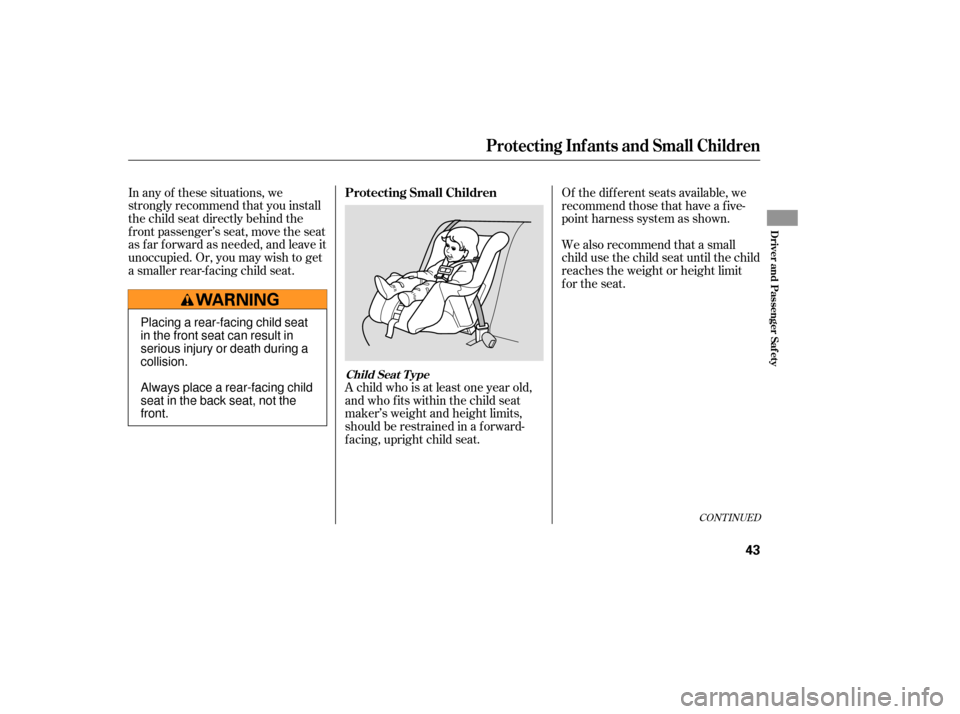
f acing, upright child seat.Of the different seats available, we
recommend those that have a f ive-
point harness system as shown.
We also recommend that a small
child use the child seat until the child
reaches the weight or height limit
for the seat.
CONT INUED
Protecting Small Children
Child Seat T ype
Protecting Inf ants and Small Children
Driver and Passenger Saf ety
43
Placing a rear-facing child seat
in the front seat can result in
serious injury or death during a
collision.
Always place a rear-facing child
seat in the back seat, not the
front.
�����—�����—�
���y�
�������������y���
�(�)� �������y���������y
Page 56 of 442
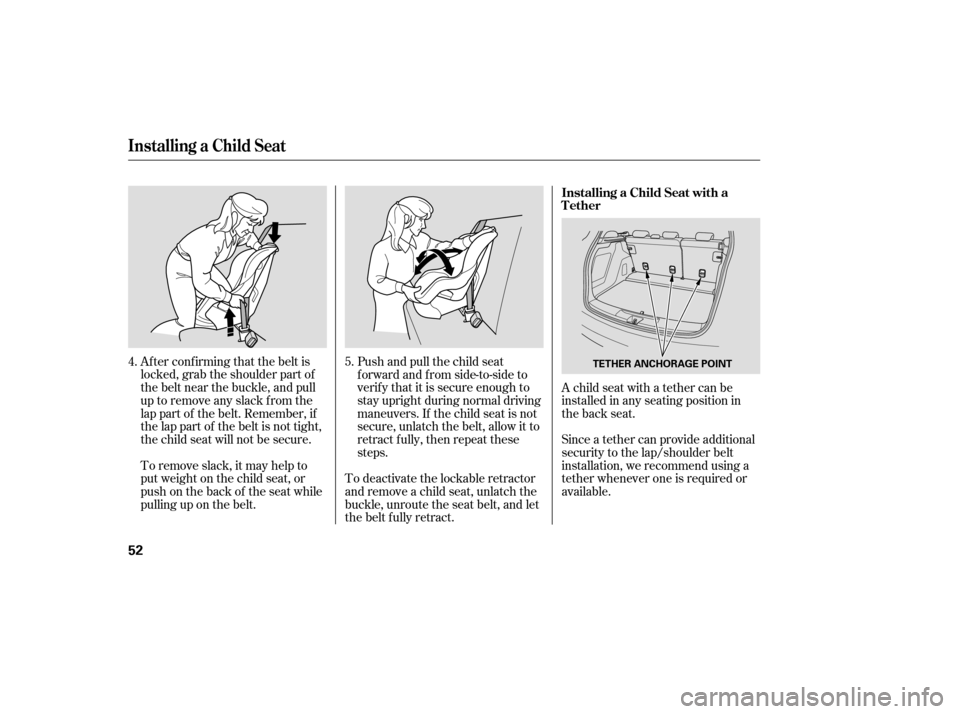
Af ter conf irming that the belt is
locked, grab the shoulder part of
the belt near the buckle, and pull
up to remove any slack from the
lap part of the belt. Remember, if
the lap part of the belt is not tight,
the child seat will not be secure.Push and pull the child seat
f orward and f rom side-to-side to
verify that it is secure enough to
stay upright during normal driving
maneuvers. If the child seat is not
secure, unlatch the belt, allow it to
retract f ully, then repeat these
steps.
To remove slack, it may help to
putweightonthechildseat,or
push on the back of the seat while
pulling up on the belt. To deactivate the lockable retractor
and remove a child seat, unlatch the
buckle, unroute the seat belt, and let
the belt fully retract. A child seat with a tether can be
installed in any seating position in
the back seat.
Since a tether can provide additional
security to the lap/shoulder belt
installation, we recommend using a
tether whenever one is required or
available.
4.
5.
Installing a Child Seat
Installing a Child Seat with a
Tether
52
TETHER ANCHORAGE POINT
�����—�����—�
���y�
�������������y���
�(�)� �������y���������y
Page 58 of 442
When a child reaches the
recommended weight or height limit
for a forward-facing child seat, the
child should sit in a back seat on a
booster seat and wear a lap/shoulder
belt.
The f ollowing pages give
instructions on how to check proper
seat belt f it, what kind of booster
seat to use if one is needed, and
important precautions f or a child
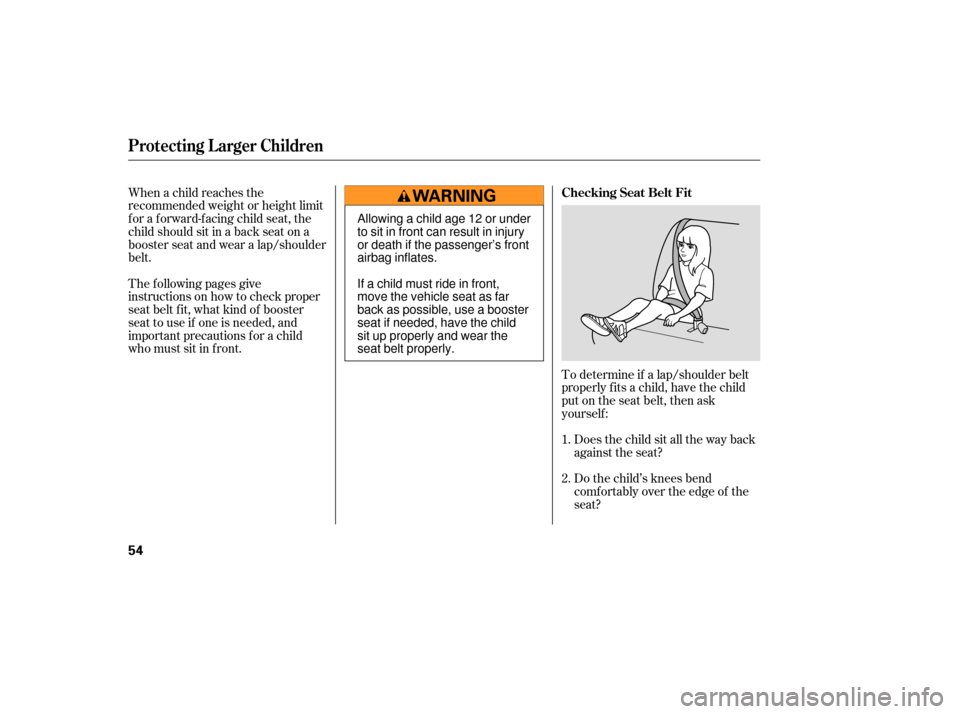
who must sit in f ront.To determine if a lap/shoulder belt
properly f its a child, have the child
put on the seat belt, then ask
yourself :Does the child sit all the way back
against the seat?
Do the child’s knees bend
comf ortably over the edge of the
seat?
1.
2. Checking Seat Belt Fit
Protecting L arger Children
54
Allowing a child age 12 or under
to sit in front can result in injury
or death if the passenger’s front
airbag inflates.
If a child must ride in front,
move the vehicle seat as far
back as possible, use a booster
seat if needed, have the child
sit up properly and wear the
seat belt properly.
�����—�����—�
���y�
�������������y���
�(�)� �������y���������y
Page 59 of 442
CONTINUED
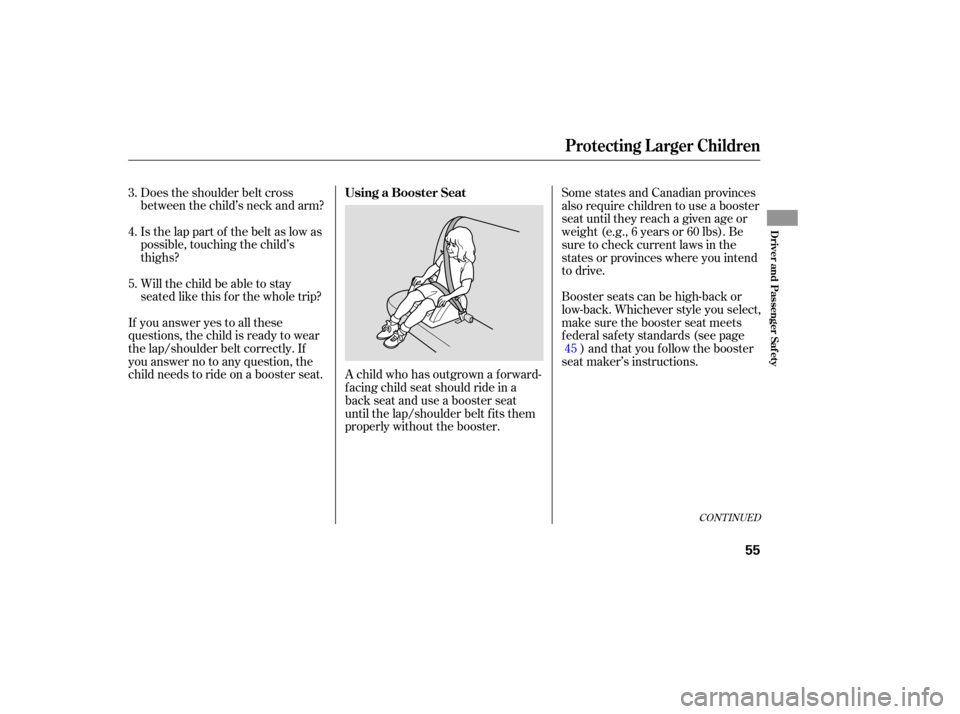
Does the shoulder belt cross
between the child’s neck and arm?
Is the lap part of the belt as low as
possible, touching the child’s
thighs?
Will the child be able to stay
seated like this for the whole trip?
If you answer yes to all these
questions, the child is ready to wear
the lap/shoulder belt correctly. If
you answer no to any question, the
child needs to ride on a booster seat. A child who has outg rown a forward-
facing child seat should ride in a
back seat and use a booster seat
until the lap/shoulder belt fits them
properly without the booster. Booster
seats can be high-back or
low-back. Whichever style you select,
make sure the booster seat meets
f ederal saf ety standards (see page ) and that you f ollow the booster
seat maker’s instructions. Some states and Canadian provinces
also require children to use a booster
seat until they reach a given age or
weight (e.g., 6 years or 60 lbs). Be
sure to check current laws in the
states or provinces where you intend
to drive.
3.
4.
5.
45
Protecting L arger Children
Using a Booster Seat
Driver and Passenger Saf ety
55
�����—�����—�
���y�
�������������y���
�(�)� �������y���������y
Page 70 of 442

You will also see a ‘‘CHECK
CHARGING SYSTEM’’ message on
the multi-information display (see
page ). This
indicator monitors the
temperature of the automatic
transmission fluid. If it comes on
while driving, it means the
transmission fluid temperature is too
high. Pull to the side of the road
wh en it is safe, shift to Park, and let
the engine idle until the indicator
goes out.
You will also see a ‘‘CHECK
TRANSMISSION’’ message on the
multi-info rmation display (see page
).
If
this indicator comes on when the
engine is running, the battery is not
being charged. For more information,
see page . This
indicator comes on for several
seconds when you turn the ignition
switch to the ON (II) position. If it
comes on at any other time, it
indicates a poten tial problem with
your front airbags. This indicator will
also alert you to a poten tial problem
with your side airbags, passenger’s
side airbag automa tic cutoff system,
side curtain airbags, automatic seat
belt tensioners, driver’s seat position
sensor, or the front passenger’s
weight sensors. For more
info rmation, see page .
You will also see a ‘‘CHECK
AIRBAG SYSTEM’’ message on the
multi-info rmation display (see page
).
393
85
85
33
84
On RDX with Technology Package
model
On RDX with Technology Package
model
On RDX with Technology Packagemodel
Instrument Panel Indicators
Charging System
Indicator A/T Temperature
IndicatorSupplemental Restraint
System (SRS) Indicator
66
Continuing to drive with the A/T
temperature indicator on may cause
serious damage to the transmission.
�����—�����—�
���y�
�������������y���
�(�)� �������y�������
�y
Page 153 of 442

Do not put any heavy items on the
seat-back when it is folded down.
Ma ke sure all items in the cargo area
are secured. Loose items can fly
forward and cause injury if you have
to brake hard (See
on page ).
Make sure that the folded down rear
seat does not interfere with the front
passenger’s seat-back. This will
cause the front passenger’s weight
sensors and the front passenger’s
seat belt reminder indicator to work
improperly (see pages and ).
Also check the passenger airbag of f
indicator to assure proper operation
of the passenger’s front airbag. To return the seat-back to the
upright position, tug on the seat-back
to make sure it is latched. If the seat-
back is not latched f ully, the seat belt
will not work properly and you will
seetheredindicatorbehindthe
release lever as shown.To return the seat cushion to its
original position, lif t up the seat
cushion, then place the rear of the
seat cushion at the base of the seat-
back. Use the seat buckles as guides.
Lower the f ront of the seat cushion
until it locks into place.
Make sure the seat-back and seat
cushion are locked securely and all
rear shoulder belts are positioned in
front of the rear seat-backs.
34
287
21
Seats
Carrying Cargo
Inst rument s and Cont rols
149
RELEASE
LEVERINDICATOR
�����—�����—�
���y�
����
��������y���
�(�)� �������y���
�����y
Page 166 of 442
Open the glove box by pulling the
handle to the lef t. Close it with a f irm
push. Lock or unlock the glove box
with the master key.The glove box light comes on when
the parking lights are on.
The interior of each f ront door has
an extendable pocket f or maps and
other small, lightweight items. For
saf ety, be sure both f ront door
pockets are closed while driving.
Glove Box
Front Door Pockets
Interior Convenience Items
162
Lock FRONT DOOR POCKET
An open glove box can cause
serious injury to your passenger
inacrash,evenifthe
passenger is wearing the seat
belt.
Always keep the glove box
closed while driving.
�����—�����—�
���y�
�������������y���
�(�)� �������y���
�����y
Page 288 of 442
Combine several short trips into
one.
The air conditioning puts an extra
load on the engine which makes it
usemorefuel.Usethefresh-air
ventilation when possible.
Drive
moderately. Rapid
acceleration, abrupt cornering,
and hard braking use more fuel.
Always drive in the highest gear
possible.
Try to maintain a constant speed.
Everytimeyouslowdownand
speed up, your vehic le uses extra
fuel. Use cruise control when
appropriate.
Always
maintain your vehicle
according to the maintenance
messages. See (page ).
an underinf lated tire
causes more ‘‘rolling resistance,’’
which uses more f uel.
The build-up of snow or mud on
your vehicle’s underside adds
weight and rolling resistance.
Frequent cleaning helps your f uel
mileage and reduces the chance of
corrosion. 342
For example,
Improving Fuel Economy
Owner’s
Maintenance Checks
Fuel Economy
284
�����—�����—�
���y�
���������
���y���
�(�)� �������y���������y

