Page 17 of 84
INSTRUMENT AND CONTROL FUNCTIONS
3-3
3
EAU11851
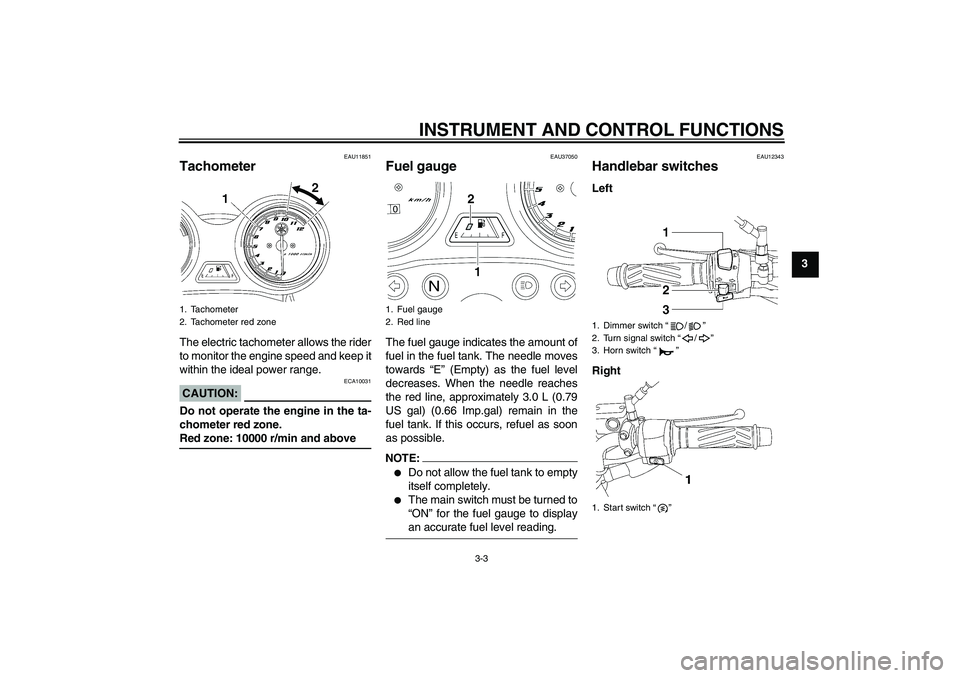
Tachometer The electric tachometer allows the rider
to monitor the engine speed and keep it
within the ideal power range.CAUTION:
ECA10031
Do not operate the engine in the ta-
chometer red zone.Red zone: 10000 r/min and above
EAU37050
Fuel gauge The fuel gauge indicates the amount of
fuel in the fuel tank. The needle moves
towards “E” (Empty) as the fuel level
decreases. When the needle reaches
the red line, approximately 3.0 L (0.79
US gal) (0.66 Imp.gal) remain in the
fuel tank. If this occurs, refuel as soon
as possible.NOTE:�
Do not allow the fuel tank to empty
itself completely.
�
The main switch must be turned to
“ON” for the fuel gauge to displayan accurate fuel level reading.
EAU12343
Handlebar switches Left
Right
1. Tachometer
2. Tachometer red zone
1. Fuel gauge
2. Red line
1. Dimmer switch “/”
2. Turn signal switch “/”
3. Horn switch “”
1. Start switch “”
U3D9E0E0.book Page 3 Saturday, December 25, 2004 11:35 AM
Page 18 of 84
INSTRUMENT AND CONTROL FUNCTIONS
3-4
3
EAU12400
Dimmer switch “/”
Set this switch to “” for the high
beam and to “” for the low beam.
EAU12460
Turn signal switch “/”
To signal a right-hand turn, push this
switch to “”. To signal a left-hand
turn, push this switch to “”. When re-
leased, the switch returns to the center
position. To cancel the turn signal
lights, push the switch in after it has re-
turned to the center position.
EAU12500
Horn switch “”
Press this switch to sound the horn.
EAU12710
Start switch “”
Push this switch to crank the engine
with the starter.CAUTION:
ECA10050
See page 5-1 for starting instruc-tions prior to starting the engine.
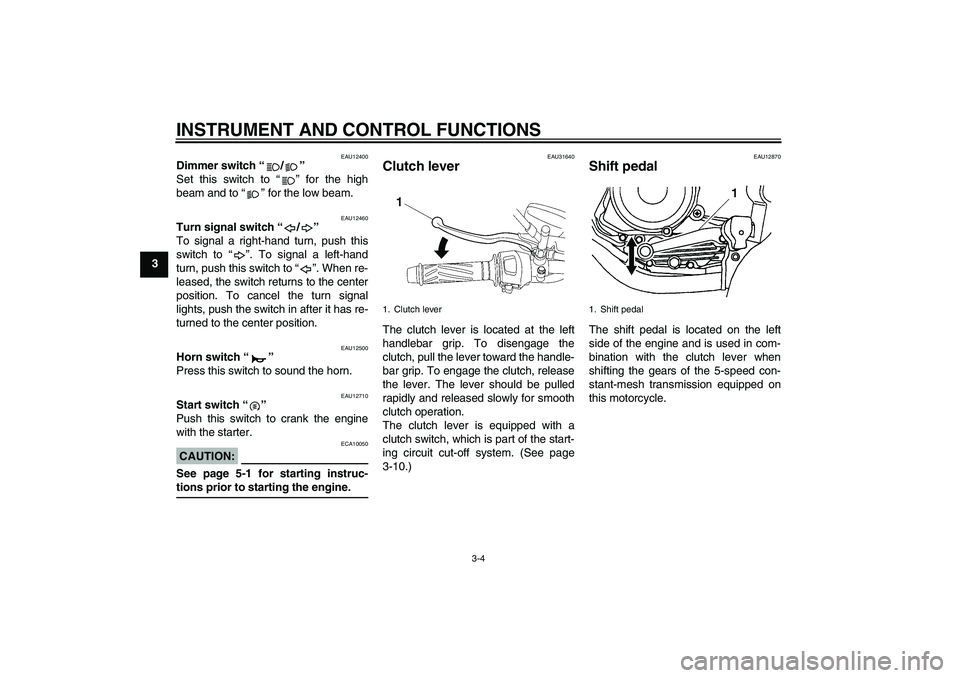
EAU31640
Clutch lever The clutch lever is located at the left
handlebar grip. To disengage the
clutch, pull the lever toward the handle-
bar grip. To engage the clutch, release
the lever. The lever should be pulled
rapidly and released slowly for smooth
clutch operation.
The clutch lever is equipped with a
clutch switch, which is part of the start-
ing circuit cut-off system. (See page
3-10.)
EAU12870
Shift pedal The shift pedal is located on the left
side of the engine and is used in com-
bination with the clutch lever when
shifting the gears of the 5-speed con-
stant-mesh transmission equipped on
this motorcycle.
1. Clutch lever
1. Shift pedal
U3D9E0E0.book Page 4 Saturday, December 25, 2004 11:35 AM
Page 19 of 84
INSTRUMENT AND CONTROL FUNCTIONS
3-5
3
EAU12890
Brake lever The brake lever is located at the right
handlebar grip. To apply the front
brake, pull the lever toward the handle-
bar grip.
EAU12941
Brake pedal The brake pedal is on the right side of
the motorcycle. To apply the rear
brake, press down on the brake pedal.
EAU13000
Fuel tank cap To remove the fuel tank cap
Insert the key into the lock and turn it
1/4 turn clockwise. The lock will be re-
leased and the fuel tank cap can be re-
moved.
To install the fuel tank cap
1. Push the fuel tank cap into position
with the key inserted in the lock.
2. Turn the key counterclockwise to
the original position, and then re-
move it.
1. Brake lever
1. Brake pedal
1. Unlock.
U3D9E0E0.book Page 5 Saturday, December 25, 2004 11:35 AM
Page 31 of 84

OPERATION AND IMPORTANT RIDING POINTS
5-3
5
CAUTION:
ECA10260
�
Even with the transmission in
the neutral position, do not
coast for long periods of time
with the engine off, and do not
tow the motorcycle for long dis-
tances. The transmission is
properly lubricated only when
the engine is running. Inade-
quate lubrication may damage
the transmission.
�
Always use the clutch while
changing gears to avoid damag-
ing the engine, transmission,
and drive train, which are not
designed to withstand theshock of forced shifting.
EAU16800
Tips for reducing fuel
consumption Fuel consumption depends largely on
your riding style. Consider the following
tips to reduce fuel consumption:�
Turn the starter (choke) off as
soon as possible.
�
Shift up swiftly, and avoid high en-
gine speeds during acceleration.
�
Do not rev the engine while shifting
down, and avoid high engine
speeds with no load on the engine.
�
Turn the engine off instead of let-
ting it idle for an extended length of
time (e.g., in traffic jams, at traffic
lights or at railroad crossings).
EAU16841
Engine break-in There is never a more important period
in the life of your engine than the period
between 0 and 1600 km (1000 mi). For
this reason, you should read the follow-
ing material carefully.
Since the engine is brand new, do not
put an excessive load on it for the first
1600 km (1000 mi). The various parts in
the engine wear and polish themselves
to the correct operating clearances.
During this period, prolonged full-throt-
tle operation or any condition that might
result in engine overheating must be
avoided.
EAU37250
0–500 km (0–300 mi)
Avoid prolonged operation above 6000
r/min.
After every hour of operation, stop the
engine, and then let it cool for five to ten
minutes.
Vary the engine speed from time to
time. Do not operate the engine at one
set throttle position.
U3D9E0E0.book Page 3 Saturday, December 25, 2004 11:35 AM