Page 27 of 86
INSTRUMENT AND CONTROL FUNCTIONS
3-13
3
EAU13210
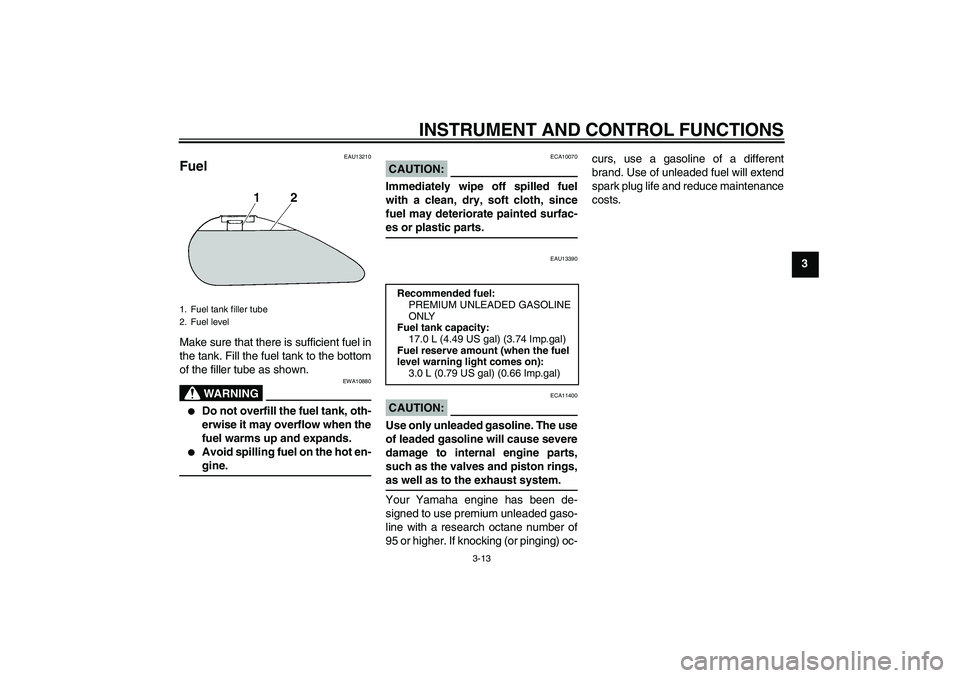
Fuel Make sure that there is sufficient fuel in
the tank. Fill the fuel tank to the bottom
of the filler tube as shown.
WARNING
EWA10880
�
Do not overfill the fuel tank, oth-
erwise it may overflow when the
fuel warms up and expands.
�
Avoid spilling fuel on the hot en-gine.
CAUTION:
ECA10070
Immediately wipe off spilled fuel
with a clean, dry, soft cloth, since
fuel may deteriorate painted surfac-es or plastic parts.
EAU13390
CAUTION:
ECA11400
Use only unleaded gasoline. The use
of leaded gasoline will cause severe
damage to internal engine parts,
such as the valves and piston rings,as well as to the exhaust system.
Your Yamaha engine has been de-
signed to use premium unleaded gaso-
line with a research octane number of
95 or higher. If knocking (or pinging) oc-curs, use a gasoline of a different
brand. Use of unleaded fuel will extend
spark plug life and reduce maintenance
costs.
1. Fuel tank filler tube
2. Fuel level
Recommended fuel:
PREMIUM UNLEADED GASOLINE
ONLY
Fuel tank capacity:
17.0 L (4.49 US gal) (3.74 Imp.gal)
Fuel reserve amount (when the fuel
level warning light comes on):
3.0 L (0.79 US gal) (0.66 Imp.gal)
U5C4E0E0.book Page 13 Monday, March 13, 2006 10:29 AM
Page 28 of 86

INSTRUMENT AND CONTROL FUNCTIONS
3-14
3
EAU13410
Fuel tank breather hose Before operating the motorcycle:�
Check the fuel tank breather hose
connection.
�
Check the fuel tank breather hose
for cracks or damage, and replace
it if damaged.
�
Make sure that the end of the fuel
tank breather hose is not blocked,
and clean it if necessary.
EAU13431
Catalytic converter This model is equipped with a catalytic
converter in the exhaust system.
WARNING
EWA10860
The exhaust system is hot after op-
eration. Make sure that the exhaust
system has cooled down before do-ing any maintenance work.CAUTION:
ECA10700
The following precautions must be
observed to prevent a fire hazard or
other damages.�
Use only unleaded gasoline.
The use of leaded gasoline will
cause unrepairable damage to
the catalytic converter.
�
Never park the vehicle near pos-
sible fire hazards such as grass
or other materials that easily
burn.
�
Do not allow the engine to idletoo long.
EAU34042
Rider seat To remove the rider seat
1. Insert the key into the seat lock,
and then turn it counterclockwise.
2. While holding the key in that posi-
tion, lift the front of the seat up, and
then pull the seat off.
To install the rider seat
1. Insert the projection on the rear of
the seat into the seat holder as
shown.
1. Fuel tank breather hose
1. Seat lock
2. Unlock.
U5C4E0E0.book Page 14 Monday, March 13, 2006 10:29 AM
Page 29 of 86

INSTRUMENT AND CONTROL FUNCTIONS
3-15
3
2. Push the front of the seat down to
lock it in place.
3. Remove the key.
NOTE:Make sure that the seat is properly se-cured before riding.
EAU38341
Helmet holder The helmet holder is located under the
rider seat. A helmet holding cable is
provided beside the owner’s tool kit to
secure a helmet to the helmet holder.
To secure a helmet to the helmet
holder
1. Remove the rider seat. (See page
3-14.)
2. Pass the helmet holding cable
through the buckle on the helmet
strap as shown, and then hook the
cable loop over the helmet holder.3. Place the helmet on the left side of
the vehicle, and then install the rid-
er seat.
CAUTION:
ECA15330
Be sure to place the helmet on the
left side of the vehicle. Some hel-
mets may contact the muffler when
placed on the right side because oftheir size or shape.
WARNING
EWA10160
Never ride with a helmet attached to
the helmet holder, since the helmet
may hit objects, causing loss of con-trol and possibly an accident.
1. Projection
2. Seat holder
1. Helmet holder
2. Helmet holding cable
1. Helmet holding cable
2. Helmet
U5C4E0E0.book Page 15 Monday, March 13, 2006 10:29 AM
Page 31 of 86

INSTRUMENT AND CONTROL FUNCTIONS
3-17
3 With each complete turn of the ad-
justing nut, distance A is changed
by 2.0 mm (0.08 in).
3. Tighten the locknut to the specified
torque.
CAUTION:
ECA10120
Always tighten the locknut against
the adjusting nut, and then tightenthe locknut to the specified torque.
WARNING
EWA10220
This shock absorber contains highly
pressurized nitrogen gas. For prop-
er handling, read and understand
the following information before
handling the shock absorber. The
manufacturer cannot be held re-
sponsible for property damage or
personal injury that may result from
improper handling.�
Do not tamper with or attempt to
open the gas cylinder.
�
Do not subject the shock ab-
sorber to an open flame or other
high heat sources, otherwise it
may explode due to excessive
gas pressure.
�
Do not deform or damage the
gas cylinder in any way, as this
will result in poor damping per-
formance.
�
Always have a Yamaha dealerservice the shock absorber.
1. Distance ASpring preload:
Minimum (hard):
Distance A = 162 mm (6.38 in)
Standard:
Distance A = 171 mm (6.73 in)
Maximum (soft):
Distance A = 171 mm (6.73 in)
Tightening torque:
Locknut:
30 Nm (3.0 m·kgf, 22 ft·lbf)
U5C4E0E0.book Page 17 Monday, March 13, 2006 10:29 AM
Page 32 of 86

INSTRUMENT AND CONTROL FUNCTIONS
3-18
3
EAU15281
EXUP system This model is equipped with Yamaha’s
EXUP (EXhaust Ultimate Power valve)
system. This system boosts engine
power by means of a valve that regu-
lates the diameter of the exhaust pipe.
The EXUP system valve is constantly
adjusted in accordance with the engine
speed by a computer-controlled servo-
motor.CAUTION:
ECA10191
�
The EXUP system has been set
and extensively tested at the
Yamaha factory. Changing
these settings without sufficient
technical knowledge may result
in poor performance of or dam-
age to the engine.
�
If the EXUP system cannot be
heard when the main switch is
turned on, have a Yamaha deal-er check it.
EAU15301
Sidestand The sidestand is located on the left side
of the frame. Raise the sidestand or
lower it with your foot while holding the
vehicle upright.NOTE:The built-in sidestand switch is part of
the ignition circuit cut-off system, which
cuts the ignition in certain situations.
(See further down for an explanation ofthe ignition circuit cut-off system.)
WARNING
EWA10240
The vehicle must not be ridden with
the sidestand down, or if the side-
stand cannot be properly moved up
(or does not stay up), otherwise the
sidestand could contact the ground
and distract the operator, resulting
in a possible loss of control.
Yamaha’s ignition circuit cut-off
system has been designed to assist
the operator in fulfilling the respon-
sibility of raising the sidestand be-
fore starting off. Therefore, check
this system regularly as describedbelow and have a Yamaha dealer re-
pair it if it does not function proper-
ly.
U5C4E0E0.book Page 18 Monday, March 13, 2006 10:29 AM
Page 33 of 86
INSTRUMENT AND CONTROL FUNCTIONS
3-19
3
EAU15311
Ignition circuit cut-off system The ignition circuit cut-off system (com-
prising the sidestand switch, clutch
switch and neutral switch) has the fol-
lowing functions.�
It prevents starting when the trans-
mission is in gear and the side-
stand is up, but the clutch lever is
not pulled.
�
It prevents starting when the trans-
mission is in gear and the clutch le-
ver is pulled, but the sidestand is
still down.
�
It cuts the running engine when the
transmission is in gear and the sid-
estand is moved down.
Periodically check the operation of the
ignition circuit cut-off system according
to the following procedure.WARNING
EWA10250
If a malfunction is noted, have a
Yamaha dealer check the system be-fore riding.
U5C4E0E0.book Page 19 Monday, March 13, 2006 10:29 AM
Page 35 of 86
INSTRUMENT AND CONTROL FUNCTIONS
3-21
3
EAU38350
Auxiliary DC connector A 12-V accessory connected to the
auxiliary DC connector under the rider
seat can be used when the key is in the
“ON” position.CAUTION:
ECA15310
The accessory connected to the
auxiliary DC connector should not
be used with the engine turned off,
and the load must never exceed 36
W (3 A), otherwise the battery maydischarge.
WARNING
EWA12531
To prevent electrical shock or short-
circuiting, make sure that the cap is
installed when the auxiliary DC con-nector is not being used.
1. Auxiliary DC connector
U5C4E0E0.book Page 21 Monday, March 13, 2006 10:29 AM
Page 36 of 86
PRE-OPERATION CHECKS
4-1
4
EAU15591
The condition of a vehicle is the owner’s responsibility. Vital components can start to deteriorate quickly and unexpectedly,
even if the vehicle remains unused (for example, as a result of exposure to the elements). Any damage, fluid leakage or loss
of tire air pressure could have serious consequences. Therefore, it is very important, in addition to a thorough visual inspec-
tion, to check the following points before each ride.NOTE:Pre-operation checks should be made each time the vehicle is used. Such an inspection can be accomplished in a very shorttime; and the added safety it assures is more than worth the time involved.
WARNING
EWA11150
If any item in the Pre-operation check list is not working properly, have it inspected and repaired before operatingthe vehicle.U5C4E0E0.book Page 1 Monday, March 13, 2006 10:29 AM


