Page 89 of 124

8-18
8 5. Wash the sponge material gently but thor-
oughly in solvent.
WARNING
EWB01940Always use parts cleaning solvent to clean the
sponge material. Never use low-flash-point
solvents or gasoline to clean the sponge mate-
rial because the engine could catch fire or ex-plode.
6. Squeeze the excess solvent out of the sponge
material and let it dry.
CAUTION:ECB00440Do not twist the sponge material when squeez-ing it.
7. Check the sponge material and replace it if
damaged.
8. Apply a quality foam air filter oil to the sponge
material.NOTE:The sponge material should be wet but not drip-ping.
9. Pull the sponge material over the air filter ele-
ment frame, and then install the lock plate.
10. Insert the air filter element into the air filter
case, and then install the air filter case cover
by hooking the holders onto the air filter case.
11. Install the seat.NOTE:The air filter element should be cleaned every 20–
40 hours. It should be cleaned and lubricated more
often if the ATV is operated in extremely dusty ar-
eas. Each time the air filter element maintenance
is performed, check the air inlet of the air filter case
for obstructions. Check the air filter case rubber
joint to the carburetor fittings and the rubber joint
1. Air filter element frame
2. Sponge material
3. Air filter element lock plateU3D560E0.book Page 18 Tuesday, December 27, 2005 12:13 PM
Page 96 of 124

8-25
8Observe these precautions:
�When checking the fluid level, make sure that
the top of the brake fluid reservoir is level.�Use only the recommended quality brake fluid,
otherwise the rubber seals may deteriorate,
causing leakage and poor braking performance.�Refill with the same type of brake fluid. Mixing
fluids may result in a harmful chemical reaction
and lead to poor braking performance.
�Be careful that water does not enter the brake
fluid reservoir when refilling. Water will signifi-
cantly lower the boiling point of the fluid and may
result in vapor lock.�Brake fluid may deteriorate painted surfaces or
plastic parts. Always clean up spilled fluid imme-
diately.�As the brake pads wear, it is normal for the brake
fluid level to gradually go down. However, if the
brake fluid level goes down suddenly, have a
Yamaha dealer check the cause.EBU24280Changing the brake fluid Have a Yamaha dealer change the brake fluid at
the intervals specified in the NOTE after the peri-
odic maintenance and lubrication chart. In addi-
tion, have the oil seals of the brake master cylinder
and calipers as well as the brake hoses replaced at
the intervals listed below or whenever they are
damaged or leaking.�Oil seals: Replace every two years.�Brake hoses: Replace every four years.
1. Minimum level markRecommended brake fluid:
DOT 4
U3D560E0.book Page 25 Tuesday, December 27, 2005 12:13 PM
Page 101 of 124

8-30
8 3. Install the panel.
EBU24900Checking and lubricating the cables The operation and the condition of all control ca-
bles should be checked before each ride, and the
cables and cable ends should be lubricated if nec-
essary. If a cable is damaged or does not move
smoothly, have a Yamaha dealer check or replace
it.
WARNING
EWB02130Inspect cables frequently and replace if dam-
aged. Corrosion can result when the cable
sheaths become damaged, and cables can
also become frayed or kinked, which could re-
strict the operation of controls and lead to anaccident or injury.EBU24911Checking and lubricating the front and
rear brake levers The operation of the front and rear brake levers
should be checked before each ride, and the lever
pivots should be lubricated if necessary.
1. Brake light switch
2. Brake light switch adjusting nutRecommended lubricant:
Engine oil
Recommended lubricant:
Lithium-soap-based grease (all-purpose
grease)
U3D560E0.book Page 30 Tuesday, December 27, 2005 12:13 PM
Page 103 of 124

8-32
8
EBU25060Lubricating the knuckle pivots The knuckle pivots must be lubricated at the inter-
vals specified in the periodic maintenance and lu-
brication chart.EBU25080Lubricating the knuckle shafts The knuckle shafts must be lubricated at the inter-
vals specified in the periodic maintenance and lu-
brication chart.EBU25100Lubricating the steering shaft The steering shaft must be lubricated at the inter-
vals specified in the periodic maintenance and lu-
brication chart.
EBU25222Battery This model is equipped with a sealed-type (MF)
battery, which does not require any maintenance.
There is no need to check the electrolyte or to add
distilled water. Check and, if necessary, tighten the
battery lead connections.CAUTION:ECB00620Never attempt to remove the battery cell seals,as this would permanently damage the battery.
WARNING
EWB02160Battery electrolyte is poisonous and danger-
ous, as it contains sulfuric acid, which can
cause severe burns. Avoid contact with skin,
eyes or clothing. Always shield your eyes
when working near batteries.
Antidote:
EXTERNAL: Flush with water.
INTERNAL: Drink large quantities of water or
milk. Follow with milk of magnesia, beaten egg
or vegetable oil. Call a physician immediately. Recommended lubricant:
Lithium-soap-based grease
Recommended lubricant:
Lithium-soap-based grease
Recommended lubricant:
Lithium-soap-based greaseRecommended lubricant:
Lithium-soap-based grease
U3D560E0.book Page 32 Tuesday, December 27, 2005 12:13 PM
Page 107 of 124

8-36
8 3. Remove the defective bulb from the headlight
unit by pulling it out.
WARNING
EWB02220A headlight bulb is hot when it is on and imme-
diately after it is turned off. Wait for the bulb to
cool before touching or removing it. You can
be burned or a fire could start if the bulb touch-es something flammable.
4. Install a new headlight bulb into the headlight
unit by aligning the projection on the bulb with
the groove in the headlight unit.
CAUTION:ECB00650Do not touch the glass part of the headlight
bulb to keep it free from oil, otherwise the
transparency of the glass, the luminosity of the
bulb, and the bulb life will be adversely affect-
ed. Thoroughly clean off any dirt and finger-
prints on the headlight bulb using a clothmoistened with alcohol or thinner.
5. Install the headlight bulb holder by aligning the
projections with the holes in the headlight unit,
pushing it inward, and turning it clockwise until
it stops.
1. Headlight bulb holder
1. Do not touch the glass part of the bulb.
U3D560E0.book Page 36 Tuesday, December 27, 2005 12:13 PM
Page 114 of 124

9-2
9
WARNING
EWB02310Wet brakes may have reduced stopping ability,
increasing the chance of an accident. Test the
brakes after washing. Apply the brakes several
times at slow speeds to let friction dry out thelinings.EBU25932Storage Short-term
Always store your ATV in a cool, dry place and, if
necessary, protect it against dust with a porous
cover.CAUTION:ECB00720�Storing the ATV in a poorly ventilated room
or covering it with a tarp while it is still wet,
will allow water and humidity to seep in and
cause rust.�To prevent corrosion, avoid damp cellars,
stables (because of the presence of ammo-
nia) and areas where strong chemicals arestored.Long-term
Before storing your ATV for several months:
1. Follow all the instructions in the “Cleaning”
section of this chapter.
2. Turn the fuel cock lever to “OFF”.
3. Drain the carburetor float chamber by loosen-
ing the drain bolt; this will prevent fuel deposits
from building up. Pour the drained fuel into the
fuel tank.
4. Fill up the fuel tank and add fuel stabilizer (if
available) to prevent the fuel from deteriorat-
ing.
5. Perform the following steps to protect the cyl-
inder, piston rings, etc. from corrosion.
a. Remove the spark plug cap and spark
plug.
b. Pour a teaspoonful of engine oil into the
spark plug bore. Specified amount:
7.5 ml of stabilizer to each liter of fuel (or 1 oz
of stabilizer to each gallon of fuel)
U3D560E0.book Page 2 Tuesday, December 27, 2005 12:13 PM
Page 115 of 124

9-3
9 c. Install the spark plug cap onto the spark
plug, and then place the spark plug on the
cylinder head so that the electrodes are
grounded. (This will limit sparking during
the next step.)
d. Turn the engine over several times with the
starter. (This will coat the cylinder wall with
oil.)
e. Remove the spark plug cap from the spark
plug, and then install the spark plug and
the spark plug cap.
6. Lubricate all control cables and the pivoting
points of all levers and pedals.
7. Check and, if necessary, correct the tire air
pressure, and then block up the ATV so that
all of its wheels are off the ground. Alternative-
ly, turn the wheels a little every month in order
to prevent the tires from becoming degraded
in one spot.
8. Cover the muffler outlet with a plastic bag to
prevent moisture from entering it.
9. Remove the battery and fully charge it. Store
it in a cool, dry place and charge it once a
month. Do not store the battery in an exces-
sively cold or warm place [less than 0 °C (30°F) or more than 30 °C (90 °F)]. For more in-
formation on storing the battery, see page
8-32.
NOTE:Make any necessary repairs before storing theATV.
U3D560E0.book Page 3 Tuesday, December 27, 2005 12:13 PM
Page 116 of 124
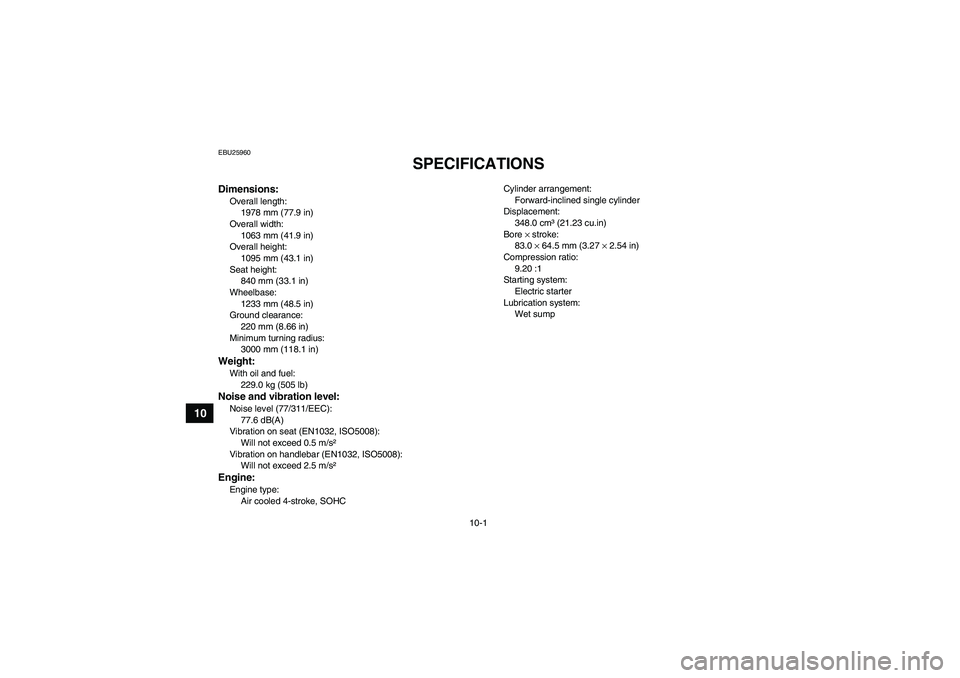
10-1
10
EBU25960
SPECIFICATIONS
Dimensions:Overall length:
1978 mm (77.9 in)
Overall width:
1063 mm (41.9 in)
Overall height:
1095 mm (43.1 in)
Seat height:
840 mm (33.1 in)
Wheelbase:
1233 mm (48.5 in)
Ground clearance:
220 mm (8.66 in)
Minimum turning radius:
3000 mm (118.1 in)Weight:With oil and fuel:
229.0 kg (505 lb)Noise and vibration level:Noise level (77/311/EEC):
77.6 dB(A)
Vibration on seat (EN1032, ISO5008):
Will not exceed 0.5 m/s²
Vibration on handlebar (EN1032, ISO5008):
Will not exceed 2.5 m/s²Engine:Engine type:
Air cooled 4-stroke, SOHCCylinder arrangement:
Forward-inclined single cylinder
Displacement:
348.0 cm³ (21.23 cu.in)
Bore × stroke:
83.0 × 64.5 mm (3.27 × 2.54 in)
Compression ratio:
9.20 :1
Starting system:
Electric starter
Lubrication system:
Wet sump
U3D560E0.book Page 1 Tuesday, December 27, 2005 12:13 PM