2006 VOLVO S60 rear view mirror
[x] Cancel search: rear view mirrorPage 5 of 132
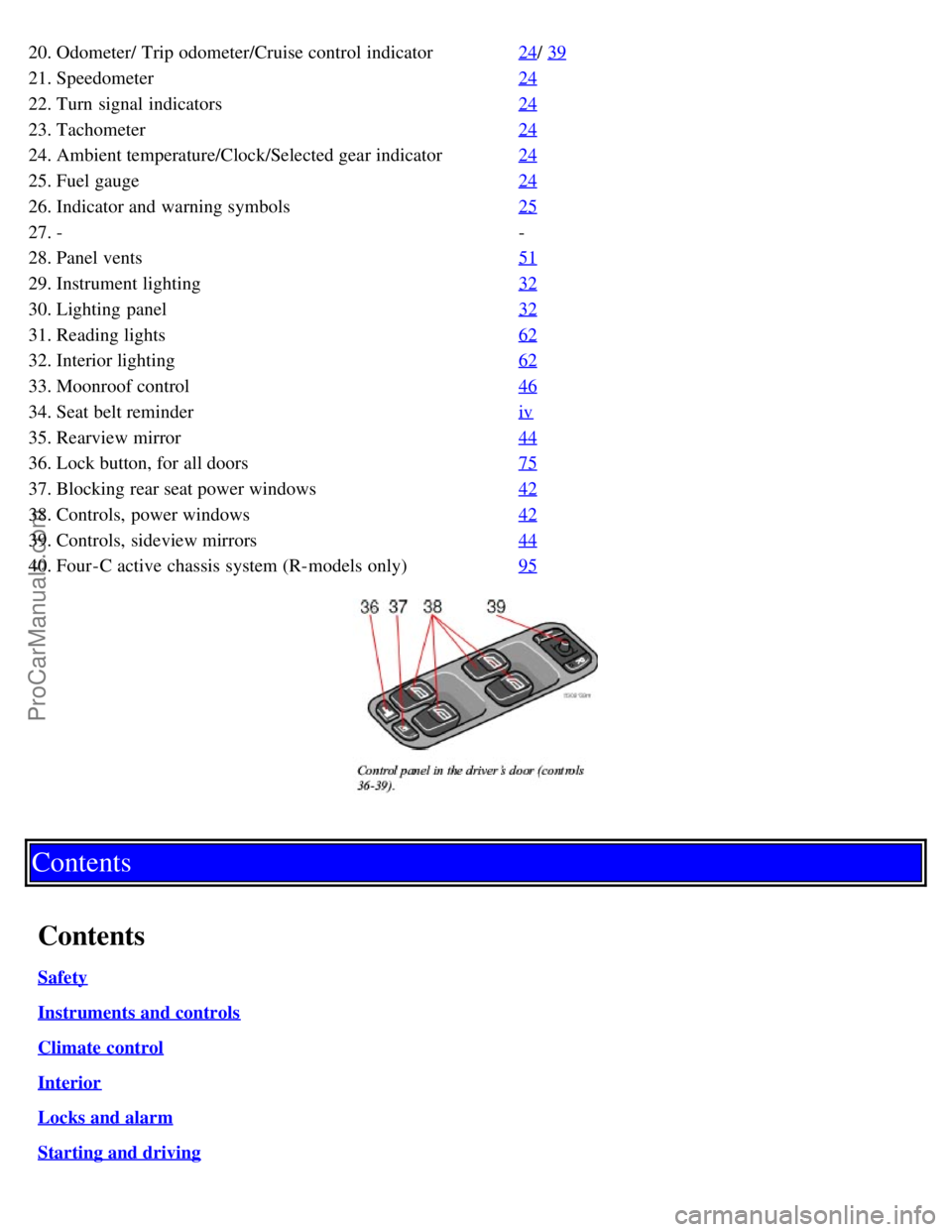
20. Odometer/ Trip odometer/Cruise control indicator24/ 39
21. Speedometer24
22. Turn signal indicators24
23. Tachometer24
24. Ambient temperature/Clock/Selected gear indicator24
25. Fuel gauge24
26. Indicator and warning symbols25
27. --
28. Panel vents 51
29. Instrument lighting32
30. Lighting panel32
31. Reading lights62
32. Interior lighting62
33. Moonroof control46
34. Seat belt reminderiv
35. Rearview mirror44
36. Lock button, for all doors75
37. Blocking rear seat power windows42
38. Controls, power windows42
39. Controls, sideview mirrors44
40. Four-C active chassis system (R-models only)95
Contents
Contents
Safety
Instruments and controls
Climate control
Interior
Locks and alarm
Starting and driving
ProCarManuals.com
Page 9 of 132

Buckling a seat belt
Pull the belt out far enough to insert the latch plate into the receptacle until a distinct click is heard. The seat belt
retractor is normally "unlocked" and you can move freely, provided that the shoulder belt is not pulled out too far.
The retractor will lock up as follows:
if the belt is pulled out rapidly
during braking and acceleration
if the vehicle is leaning excessively
when driving in turns
When wearing the seat belt remember:
The belt should not be twisted or turned.
The lap section of the belt must be positioned low on the hips (not pressing against the abdomen).
Make sure that the shoulder belt is rolled up into its retractor and that the shoulder and lap belts are taut.
Sample label found on all seat belts with tensioners
Unbuckling the seat belt
To remove the seat belt, press the red section on the seat belt receptacle. Before exiting the vehicle, check that the seat
belt retracts fully after being unbuckled. If necessary, guide the belt back into the retractor slot.
Seat belt reminder
The seat belt reminder consists of an audible signal, an indicator light above the rearview mirror, and a symbol in the
instrument panel that alert the driver and front seat passenger if their seat belts are not fastened.
Seat belt maintenance
Check periodically that the seat belts are in good condition. Use water and a mild detergent for cleaning. Check seat
belt mechanism function as follows: attach the seat belt and pull rapidly on the strap.
pg. 4 Safety
WARNING!
- Never use a seat belt for more than one occupant.
- Never wear the shoulder portion of the belt under the arm, behind the back or otherwise out of position. Such use
could cause injury in the event of an accident.
- Seat belts lose much of their strength when exposed to violent stretching and should be replaced after any
collision, even if they appear to be undamaged.
- Never repair the belt yourself; have this work done by an authorized Volvo service technician only.
- Any device used to induce slack into the shoulder belt portion of the three-point belt system will have a detrimental
effect on the amount of protection available to you in the event of a collision.
- The seat back should not be tilted too far back. The shoulder belt must be taut in order to function properly.
ProCarManuals.com
Page 17 of 132

2 0 0 6
VOLVO S60
Instruments and controls
pg. 23 Instruments and controls
Instrument panel 24
Indicator and warning symbols25
Switches in the center console29
Steering wheel adjustment31
Lighting panel32
Manually unlocking the fuel filler door33
Left-side steering wheel lever34
Right-side steering wheel lever35
Hazard warning flashers, rear window/sideview mirror defroster, heated front seats37
Trip computer (option)38
Cruise control39
Parking brake, electric socket/cigarette lighter41
Electrically operated windows42
Rearview mirror/sideview mirrors44
Power moonroof (option)46
pg. 24 Instruments and controls
Instrument panel
1. Turn signal indicators - right/left
2. Text window
The text window displays information and warning messages.
3. Temperature gauge
The pointer should be approximately midway on the gauge when driving. Do not drive the car if the warning light is
ProCarManuals.com
Page 29 of 132

frequently) or down (the wipers will sweep the windshield less frequently).
Activating the rain sensor:
1. Turn the ignition key to at least position I and put the windshield wiper lever in position 0.
2. Press button 2.
An LED in the button will light up to indicate that the rain sensor is active.
Deactivating the rain sensor:
Press button 2.
or
Move the windshield wiper lever down to another position.
Moving the lever up will not deactivate the rain sensor. Doing so will cause the wipers to sweep the windshield until
the lever is released, at which time the wipers return to rain sensor mode.
Continuous wiper function
Wipers operate at "high" speed
CAUTION:
The rain sensor should be deactivated when washing the car in an automatic car wash, etc. If the rain sensor function is
left on, the wipers will start inadvertently in the car wash and could be damaged.
pg. 36 Instruments and controls
Headlight wiper/washer (certain models)
When the lever is pulled to wash the windshield, high pressure jets mounted in the bumper will spray the headlights.
CAUTION:
Use ample washer fluid when washing the windshield to avoid scratching the glass.
To conserve washer fluid in driving conditions where the windshield washers are used frequently, the headlights will
only be washed once for every five times the windshield is washed within a 10- minute period.
When approximately 1 US quart (1 liter) remains in the washer fluid reservoir, the headlights will not be washed
when the lever is pulled to conserve washer fluid for the windshield.
NOTE: R-models are also equipped with headlight wipers, which are activated along with the washer function.
pg. 37 Instruments and controls
Hazard warning flashers, rear window/sideview mirror defroster, heated
front seats
ProCarManuals.com
Page 30 of 132

Hazard warning flashers
The four-way flasher should be used to indicate that the vehicle has become a traffic hazard. To activate the flashers,
press the triangular button in the center dash. Press the button again to turn off the flashers.
NOTE: Regulations regarding the use of the hazard warning flasher may vary, depending on where you live.
Sideview mirror and rear window defroster
Press the switch to start heating the rear window and sideview mirrors to remove ice or condensation. An LED in the
switch will light up.
A timer automatically switches off the heating to the sideview mirrors after approximately 6 minutes and to the rear
window after approximately 12 minutes. The LED will go out correspondingly.
Heated front seats (option)
The front seat heating can be switched on and off as required.
Press the switch once for maximum seat heating. Both LEDs in the switch will be lit.
Press the switch a second time for comfort heating. One LED in the switch will be lit.
Press the switch a third time to turn the heating off completely. The seat heating for the passenger seat should be
switched off when the seat is not occupied.
pg. 38 Instruments and controls
Trip computer (option)
The trip computer stores information gathered from several systems in your car and has four menus that can be
displayed in the text window.
Driving distance on current fuel reserve
Average fuel consumption
Current fuel consumption
Average speed
ProCarManuals.com
Page 35 of 132

Cutout switch for rear windows
Cutout switch for rear windows
The electrically operated rear door windows can be disabled by a switch located on the driver's door (see illustration).
If the LED in the switch is OFF: The rear door windows can be raised or lowered with the buttons on the rear door
armrests or with the buttons on the driver's door armrest.
If the LED in the switch is ON: The rear door windows can only be raised or lowered with the buttons on the driver's
door armrest.
pg. 43 Instruments and controls
Electrically operated window on the front passenger's side
The control for the electrically operated window on the front passenger's seat operates that window only.
Electrically operated windows in the rear doors.
The rear door windows can be operated with the control on each door and the switch on the driver's door. If the LED
in the switch for blocking electrically operated windows in the rear doors (located in the driver's door control panel) is
on, the rear door windows can only be operated from the driver's door.
pg. 44 Instruments and controls
Rearview mirror/sideview mirrors
ProCarManuals.com
Page 36 of 132

Rearview mirror
A Normal position
B Night position, reduces glare from following headlights
Autodim function (option)
The autodim function reacts to headlights from following traffic and automatically reduces glare.
NOTE: This function is automatically switched off when the gear selector is placed in the Reverse position.
Electrically operated sideview mirrors
The mirror control switches are located on the driver's door armrest.
Driver's side: Press the L switch (an LED in the switch will light up) to activate the adjustment control and then use
this control to adjust the driver's door mirror.
Passenger's door: Press the R switch (an LED in the switch will light up) and then use the adjustment control to
adjust the passenger's door mirror.
After you have adjusted the mirror(s), press the L or R switch again (the LED will go out) to deactivate the adjustment
control.
WARNING!
The mirrors should always be adjusted prior to driving. Objects seen in the passenger's side wide -angle sideview
mirror are closer than they appear to be.
Remote central locking and sideview mirror memory-option
If you lock the car and later unlock it with the same remote control and open the driver's door, the sideview mirrors
(and the driver's seat) will automatically move to the position they were in when you left the car. This feature will
work in the same way with all of the remote control transmitters (up to 3) that you use with your car. This feature will
not function if you lock your car with the key.
Water repellent glass-option
ProCarManuals.com
Page 37 of 132

The sideview mirrors and side door windows can be treated with a water repellent coating. The optional laminated side
windows always have this coating.
The coating improves vision by causing the water to run off quickly.
pg. 45 Instruments and controls
Rearview mirror/sideview mirrors (contd)
See page 131 for information on cleaning this type of glass.
CAUTION:
- Use the heating function to remove ice, snow, or mist from the mirrors.
- Use only suitable plastic scrapers to remove ice or snow from the mirrors. Using a metal ice scraper could damage
the water repellent coating.
pg. 46 Instruments and controls
Power moonroof (option)
Power moonroof
To operate the moonroof, turn the ignition key to position I or II, or start the engine. The moonroof can be operated in
two ways:
A. Tilt position
B. Sliding moonroof
A. Tilt position
Open: With the moonroof closed, push up the rear edge of the switch (position 5 in the illustration below).
Close: Pull down and hold the rear edge of the switch (position 6 in the illustration below) until the moonroof has
closed completely.
ProCarManuals.com