Page 132 of 182

Automatic washing - simple and quick
We do NOT recommend washing your car in an automatic wash during the first six months (because the paint will
not have hardened sufficiently).
An automatic wash is a simple and quick way to clean your car, but it is worth remembering that it may not be as
thorough as when you yourself go over the car with sponge and water. Keeping the underbody clean is most important,
especially in the winter. Some automatic washers do not have facilities for washing the underbody.
pg. 149 Vehicle care
Washing and cleaning the car
CAUTION!
Before driving into an automatic carwash, turn off the optional rain sensor to avoid damaging the windshield wipers.
Make sure that side view mirrors, auxiliary lamps, etc, are secure, and that any antenna(s) are retracted or removed.
Otherwise there is risk of the machine dislodging them.
WARNING!
When the car is driven immediately after being washed, apply the brakes several times in order to remove any
moisture from the brake linings.
Engine cleaning agents should not be used when the engine is warm. This constitutes a fire risk.
Polishing and Waxing
Normally, polishing is not required during the first year after delivery, however, waxing may be beneficial.
Before applying polish or wax the vehicle must be washed and dried. Tar spots can be removed with kerosene or tar
remover. Difficult spots may require a fine rubbing compound.
After polishing use liquid or paste wax.
Several commercially available products contain both polish and wax.
Waxing alone does not substitute for polishing a dull surface.
A wide range of polymer-based waxes can be purchased today. These waxes are easy to use and produce a long-
lasting, high-gloss finish that protects the bodywork against oxidation, road dirt and fading.
Do not polish or wax your vehicle in direct sunlight (the surface of the vehicle should not be warmer than 113° F
(45° C).
CAUTION!
Volvo does not recommend the use of long-life or durable paint protection coatings, some of which may claim to
prevent pitting, fading, oxidation, etc. These coatings have not been tested by Volvo for compatibility with your
vehicle's clear coat. Some of them may cause the clear coat to soften, crack, or cloud. Damage caused by application
of paint protection coatings may not be covered under your vehicle's paint warranty.
pg. 150 Vehicle care
Washing and cleaning the car
Upholstery care
Fabric
ProCarManuals.com
Page 144 of 182

pg. 162 Maintenance and servicing
Battery
Battery maintenance
Driving habits and conditions, climate, the number of starts, etc., all affect the service life and function of the battery.
In order for your battery to perform satisfactorily, keep the following in mind:
Check the fluid level in each cell in the battery every 24 months or every 15,0001 miles (24,000 km), whichever is
sooner. The fluid should be at the level shown in the illustration above (A). Do not overfill.
Use a screw driver to open the caps and a flashlight to inspect the level.
If necessary, add distilled water. The level should never be above the indicator (A).
The fluid level should be checked if the battery has been recharged.
After inspection, be sure the cap over each battery cell is securely in place.
Check that the battery cables are correctly connected and properly tightened.
Never disconnect the battery when the engine is running, or when the key is in the ignition. This could damage the
vehicle's electrical system.
ProCarManuals.com
Page 150 of 182
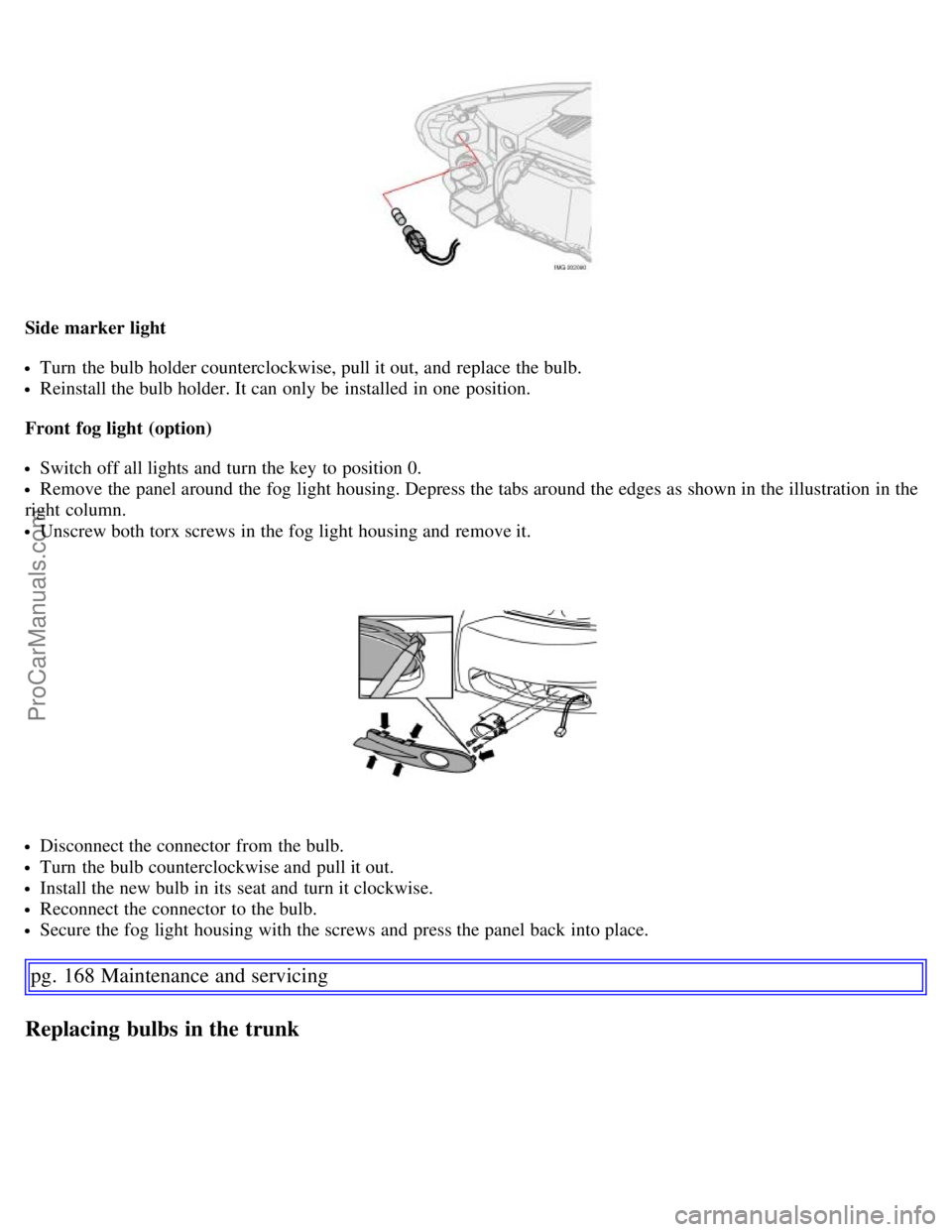
Side marker light
Turn the bulb holder counterclockwise, pull it out, and replace the bulb.
Reinstall the bulb holder. It can only be installed in one position.
Front fog light (option)
Switch off all lights and turn the key to position 0.
Remove the panel around the fog light housing. Depress the tabs around the edges as shown in the illustration in the
right column.
Unscrew both torx screws in the fog light housing and remove it.
Disconnect the connector from the bulb.
Turn the bulb counterclockwise and pull it out.
Install the new bulb in its seat and turn it clockwise.
Reconnect the connector to the bulb.
Secure the fog light housing with the screws and press the panel back into place.
pg. 168 Maintenance and servicing
Replacing bulbs in the trunk
ProCarManuals.com
Page 155 of 182

12. Feed to heated rear window, 30A
13. Starter motor relay, 30A
14. Trailer connector, 40A
15. Power retractable hard top, 30A
16. Feed to audio system, 30A
17.Windshield wipers, 30A
18. Feed to passenger compartment fuse box, 40A
19. Not in use
20. Horn, 15A
21. Not in use
22. Subwoofer, 25A
23. Engine control module (ECM)/transmission control module (TCM), 10A
24. Not in use
25. Not in use
26. Ignition switch, 15A
27. A/C compressor 10A
28. Not in use
29. Front fog lights (option), 15A
30. Not in use
31. Not in use
32. Fuel injectors, 10A
33. Heated oxygen sensor, vacuum pump, 20A
34. Ignition coils, engine control module, climate unit pressure sensor, 10A
35. Engine sensor valves, A/C relay, 15A
36. Engine control module (ECM), throttle sensor, 10A
pg. 172 Maintenance and servicing
Fuses
Fuse box in the passenger compartment
The fuse box in the passenger compartment is located under the glove compartment.
To access the fuses:
1. Remove the upholstery covering the fuse box by first pressing in the center pins in the mounting clips approximately
0.5 in (1 cm) with a small screwdriver and then pulling the pins out.
2. Turn both retaining screws (2) counterclockwise until they release.
3. Fold down the fuse box (3) half way. Pull it toward the seat until it stops. Fold it down completely. The fuse box can
be unhooked completely.
4. Replace the blown fuse.
5. Close the fuse box in reverse order.
6. Pull the center pins fully out of the mounting clips, secure the upholstery with the mounting clips and press the pins
ProCarManuals.com
Page:
< prev 1-8 9-16 17-24