Page 366 of 480
’06_SEQUOIA_U (L/O 0508)
356Ti r e relat ed ter m
Meaning
Vehicle normal load on the tire
the load on an individual tire that is determined by distributing to each axle
its share of the curb weight, accesso
ry weight, and normal occupant weight
(distributed in accordance with Table 1 that follows) and dividing by two
Weather sidethe surface area of the rim no t covered by the inflated tire
Table 1—Occupant loading and distribution for vehicle normal load for various designated seating capacities
Designated seating capacity,number of occupants
Vehicle normal load, number of occupantsOccupant distribution in a normallyloaded vehicle
2 through 422 in front
5 through 1032 in front, 1 in second seat
Page 367 of 480

’06_SEQUOIA_U (L/O 0508)
357
Vehicle load limits include total load
capacity, seating capacity, towing ca-
pacity and cargo capacity. Follow the
load limits shown below. Total load ca-
pacity and seating capacity are also
described on the tire and loading in-
formation label. For location of the tire
and loading information label, see
“Checking tire infl
at ion pr es s ur e” on
page 431.
Total load capacity: 567 kg (1250 lb.)
Total load capacity means combined
weight of occupants, cargo and lug-
gage. Tongue load is included when
trailer towing. Seating capacity:
Vehicles with bench type second
seats: Total 8 (Front 2, Rear 6)
Vehicles with separate type second
seats: Total 7 (Front 2, Rear 5)
Seating capacity means the maximum
number of occupants whose esti-
mated average weight is 68 kg (150
lb.) per person. Depending on the
weight of each person, the seating ca-
pacity given may exceed the total
load capacity.
NOTICE
Even if the number of occupants
are within the seating capacity,
do not exceed the total load ca-
pacity.
Towing capacity:Tw o −wheel drive models
2948 kg (6500 lb.)
Four −wheel drive models
2812 kg (6200 lb.)
Towing capacity means the maximum
gross trailer weight (trailer weight plus
its cargo weight) that your vehicle is
able to tow.
Cargo capacity
Cargo capacity may increase or de-
crease depending on the size (weight)
and the number of occupants. For de-
tails, see “Capacity and distribution”
that follows.
CAUTION
Do not apply the load more than
each load limit. That may cause
not only damage to the tires, but
also deterioration to the steering
ability and braking ability, which
may cause an accident.
Veh icle lo ad limit s
Page 368 of 480

’06_SEQUOIA_U (L/O 0508)
358 When stowing cargo and luggage in
the vehicle, observe the following:� Put cargo and luggage in the lug-
gage compartment when at all
possible. Be sure all items are se-
cured in place.
� Be careful to keep the vehicle bal-
anced. Locating the weight as far
forward as possible helps maintain
balance.
� For better fuel economy, do not
carry unneeded weight.
CAUTION
�To prevent cargo and l uggage
from sliding forward during
braking, do not stack anything
in the luggage compartment
higher than the seatbacks.
Keep cargo and luggage low,
as close to the floor as pos-
sible.
� Never allow anyone to ride in
the luggage compartment. It is
not designed for passengers.
They should ride in their seats
with their seat belts properly
fastened. Otherwise, they are
much more likely to suffer seri-
ous bodily injury, in the event
of sudden braking or a colli-
sion.
� Do not drive with objects left
on top of the instrument panel.
They may interfere with the
driver’s field of view. Or they
may move during sharp vehicle
acceleration or turning, and im-
pair the driver’s control of the
vehicle. In an accident they
may injure the vehicle occu-
pants.Cargo capacity depends on the to-
tal weight of the occupants.
(Cargo capacity) = (Total load capac-
ity) – (Total weight of occupants)
STEPS FOR DETERMINING
CORRECT LOAD LIMIT
1. Locate the statement “The com- bined weight of occupants and
cargo should never exceed XXX
pounds” on your vehicle’s placard.
2. Determine the combined weight of the driver and passengers that will
be riding in your vehicle.
3. Subtract the combined weight of the driver and passengers from
XXX kilograms or XXX pounds.
4. The resulting figure equals the available amount of cargo and lug-
gage load capacity. For example,
if the “XXX” am ount equals 1400
lbs. and there will be five 150 lb.
passengers in your vehicle, the
amount of available cargo and lug-
gage load capacity is 650 lbs.
(1400–750 (5x150)=650 lbs).
Cargo and luggage—
—Stowage precautions —Capacity and distribution
Page 369 of 480

’06_SEQUOIA_U (L/O 0508)
359
5. Determine the combined weight of
luggage and cargo being loaded
on the vehicle. That weight may
not safely exceed the available
cargo and luggage load capacity
calculated in Step 4.
6. If your vehicle will be towing a trailer, load from your trailer will
be transferred to your vehicle.
Consult this manual to determine
how this reduces the available car-
go and luggage load capacity of
your vehicle.
For details about trailer towing, see
page 370.
Cargo
capacity
Total load
capacity
EXAMPLE ON YOUR VEHICLE
In case that 2 people with the com-
bined weight of 166 kg (366 lb.) are
riding in your vehicle with the total
load capacity of 567 kg (1250 lb.), the
available amount of cargo and lug-
gage load capacity will be as follows:
567 kg – 166 kg = 401 kg.
(1250 lb. – 366 lb. = 884 lb.)
From this condition, if 3 more passen-
gers with the combined weight of 176
kg (388 lb.) get on , the av ailable car-
go and luggage load will be reduced
as follows: 401 kg – 176 kg = 225 kg.
( 884 lb. – 388 lb. = 496 lb. )
As shown in the above example, if the
number of occupants increases, the
cargo and luggage load equaling the
combined weight of occupants who
got on later must be reduced. In other
words, if the incr
ease in the number
of occupants causes the excess of
the total load capacity (combined
weight of occupants plus cargo and
luggage load), you have to reduce the
cargo and luggage on your vehicle.
For details about total load capacity,
see “Vehicle load limits” on page 357.
Page 370 of 480

’06_SEQUOIA_U (L/O 0508)
360
CAUTION
Even if the total load of occu-
pant’s weight and the cargo load
is less than the total load capac-
ity, do not apply the load uneven-
ly. That may cause not only dam-
age to the tire but also deteriora-
tion to the steering ability due to
unbalance of the vehicle, causing
an accident.
Cargo
capacityWeight of the
r em ov ed thir d seat
SEATING CONFIGURATION
VARIATION
In case of removing the rear seats,
it is possible to load as much cargo
as the weight of the removed seats.
(Cargo capacity) = (Total load capac-
ity) − (Total weight of occupants) +
(Weight of the removed rear seats)
Rear seats weights:
Right side 24 kg (53 lb.)
Left side 24 kg (53 lb.) Determine what kind of tires your
vehicle is originally equipped with.
1. Summer tires
Summer tires are high −speed capabil-
ity tires best suited to highway driving
under dry conditions.
Since summer tires do not have the
same traction performance as snow
tires, summer tires are inadequate for
driving on snow −covered or icy roads.
For driving on snow −covered or icy
roads, we recommend using snow
tires. If installing snow tires, be sure
to replace all four tires.
2. All season tires
All season tires are designed to pro-
vide better traction in snow and to be
adequate for driving in most winter
conditions, as well as for use all year
round.
Types of tires
Page 381 of 480

’06_SEQUOIA_U (L/O 0508)
371
WEIGHT LIMITS
Before towing, make sure the total trail-
er weight, gross combination weight,
gross vehicle weight, gross axle weight
and trailer tongue load are all within
the limits.
The total trailer weight and tongue load
can be measured with platform scales
found at a highway weighing station, build-
ing supply company, trucking company,
junk yard, etc.
CAUTION
�The maximum gross trailer weight
(trailer weight plus cargo weight)
must never exceed the following.Twowheel drive models2948 kg (6500 lb.)
Fourwheel drive models 2812 kg (6200 lb.)
If towing a trailer and cargo weigh-
ing over 907 kg (2000 lb.), it is
necessary to use a sway control
device with sufficient capacity. The
combination of the gross trailer
weight added to the total weight of
the vehicle, occupants and vehicle
cargo must never exceed a total of
5352 kg. (11800 lb.)
Exceeding the maximum weight of
the trailer, the vehicle, or the ve-
hicle and trailer combination, can
cause an accident resulting in seri-
ous personal injuries.
�Trailer hitch assemblies have differ-
ent weight capacities established by
the hitch manufacturer. Even though
the vehicle may be physically capa-
ble of towing a higher weight, the
operator must determine the maxi-
mum weight rating of the particular
hitch assembly and never exceed
the maximum weight rating speci-
fied for the trailerhitch. Exceeding
the maximum weight rating set by
the trailer hitch manufacturer can
cause an accident resulting in seri-
ous personal injuries.
Page 382 of 480

’06_SEQUOIA_U (L/O 0508)
372
�The gross vehicle weight must not
exceed the Gross Vehicle Weight
Rating (GVWR) indicated on the
Certification Label. The gross vehi-
cle weight is the sum of weights of
the unloaded vehicle, driver, pas-
sengers, luggage, hitch and trailer
tongue load. It also includes the
weight of any special equipment
installed on your vehicle.
�The load on either the front or rear
axle resulting from distribution of
the gross vehicle weight on both
axles must not exceed the Gross
Axle Weight Rating (GAWR) listed
on the Certification Label.� 100 = 9 to 11%
Total trailer weight Tongue load
Tongue load
Total trailer weightCAUTION
�The trailer cargo load should be
distributed so that the tongue load
is 9 to 11% of the total trailer
weight, not exceeding the maximum
load of the following. Never load
the trailer with more weight in the
back than in the front. About 60%
of the trailer load should be in the
front half of the trailer and the re-
maining 40% in the rear. Weight carrying hitch or distribut-
ing hitchTwowheel drive models
295 kg (650 lb.)
Fourwheel drive models
281 kg (620 lb.)
Page 383 of 480
’06_SEQUOIA_U (L/O 0508)
373
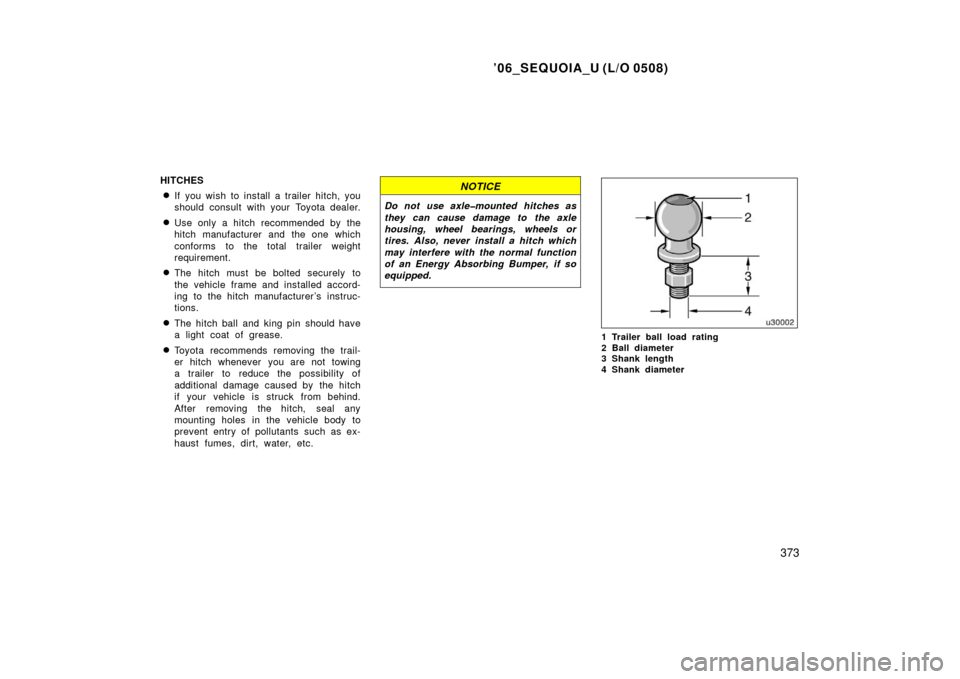
HITCHES
�If you wish to install a trailer hitch, you
should consult with your Toyota dealer.
�Use only a hitch recommended by the
hitch manufacturer and the one which
conforms to the total trailer weight
requirement.
�The hitch must be bolted securely to
the vehicle frame and installed accord-
ing to the hitch manufacturer ’s instruc-
tions.
�The hitch ball and king pin should have
a light coat of grease.
�Toyota recommends removing the trail-
er hitch whenever you are not towing
a trailer to reduce the possibility of
additional damage caused by the hitch
if your vehicle is struck from behind.
After removing the hitch, seal any
mounting holes in the vehicle body to
prevent entry of pollutants such as ex-
haust fumes, dirt, water, etc.
NOTICE
Do not use axlemounted hitches as
they can cause damage to the axle
housing, wheel bearings, wheels or
tires. Also, never install a hitch which
may interfere with the normal function
of an Energy Absorbing Bumper, if so
equipped.
1 Trailer ball load rating
2 Ball diameter
3 Shank length
4 Shank diameter
