Page 39 of 324
’06 MATRIX_U (L/O 0508)
29
CAUTION
After inserting the support rod into
the slot, make sure the rod supports
the hood securely from falling down
on to your head or body.
NOTICE
Be sure to return the support rod to
its clip before closing the hood. Clos-
ing the hood with the support rod up
could cause the hood to bend.
This indicates that the fuel filler door
is on the left side of your vehicle.1. To open the fuel filler door, pull thelever up.
When refueling, turn off the engine.
CAUTION
�Do not smoke, cause sparks or al-
low open flames when refueling.
The fumes are flammable.
�When opening the cap, do not re-
move the cap quickly. In hot weath-
er, fuel under pressure could cause
injury by spraying out of the filler
neck if the cap is suddenly re-
moved.
Fuel tank cap
Page 40 of 324
’06 MATRIX_U (L/O 0508)
30
2. To remove the fuel tank cap, turnthe cap slowly counterclockwise,
then pause slightly before removing
it. After removing the cap, hang it
on the cap hanger.
It is not unusual to hear a slight swoosh
when the cap is opened. When installing,
turn the cap clockwise till you hear a
click.
If the cap is not installed securely, the
malfunction indicator lamp comes on.
Make sure the cap is tightened securely.
The indicator lamp goes off after driving
several times. If the indicator lamp does
not go off, contact your Toyota dealer as
soon as possible.
CAUTION
�Make sure the cap is installed se-
curely to prevent fuel sp illage in
the event of an accident.
�Use only a genuine Toyota fuel tank
cap for replacement. It is designed
to regulate fuel tank pressure.
Sliding operation
Tilting operation
Electric moon roof
Page 48 of 324
’06 MATRIX_U (L/O 0508)
38
You can use the front passenger ’s seat-
back as a temporary table only when the
vehicle is stopped.
CAUTION
To avoid serious injury:
�Do not set up the seatback table
while the vehicle is moving.
�Do not sit on the seatback table.
NOTICE
To prevent damage to the seat, avoid
putting heavy loads on the temporary
table.
CAUTION
When returning the seatback to the
upright position, make sure the seat-
back is securely locked by pushing
forward and rearward on the top of
the seatback. Failure to do so will
prevent seat belt from operating prop-
erly.
Lower the head restraints to the lowest
position. Pull up the lock release button
and fold the seatback down.
Each seatback can be folded separately.
This will enlarge the luggage compartment
as far as the seatbacks. See “—Stowage
precautions” on page 206 in Section 2 for
precautions when loading luggage.
Folddown rear seat
Page 49 of 324
’06 MATRIX_U (L/O 0508)
39
You can use the rear right side seatback
as a temporary table only when the ve-
hicle is stopped.
CAUTION
To avoid serious injury:
�Do not set up the seatback table
while the vehicle is moving.
�Do not sit on the seatback table.
NOTICE
To prevent damage to the seat, avoid
putting heavy loads on the temporary
table.
CAUTION
When returning the seatback to the
upright position, observe the follow-
ing precautions in order to prevent
personal injury in a collision or sud-
den stop:
�Make sure the seatback is securely
locked by pushing forward and rear-
ward on the top of the seatback
and that the red mark at the button
on the top of the seatback cannot
be seen. Failure to do so will pre-
vent seat belt from operating prop-
erly.
�Make sure the seat belts are not
twisted or caught in the seatback
and are arranged in the proper
position and are ready to use.
Front
Rear
Head restraints
Page 50 of 324

’06 MATRIX_U (L/O 0508)
40
For your safety and comfort, adjust the
head restraint before driving.
To raise: Pull it up.
To lower: Push it down while pressing the
lock release button.
The head restraint is most effective when
it is close to your head. Therefore, using
a cushion on the seatback is not recom-
mended.
CAUTION
�Adjust the center of the head re-
straint so that it is closest to the
top of your ears.
�After adjusting the head restraint,
make sure it is locked in position.
�Do not drive with the head re-
straints removed.
Toyota strongly urges that the driver and
passengers in the vehicle be properly re-
strained at all times with the seat belts
provided. Failure to do so could increase
the chance of injury and/or the severity of
injury in accidents.
The seat belts provided for your vehicle
are designed for people of adult size,
large enough to properly wear them.
Child. Use a child restraint system ap-
propriate for the child until the child be-
comes large enough to properly wear the
vehicle’s seat belts. See “Child restraint”
on page 67 in this Section for details.
If a child is too large for a child restraint
system, the child s hould sit in the rear
seat and must be restrained using the
vehicle’s seat belt. According to accident
statistics, the child is safer when properly
restrained in the rear seat than in the
front seat.
If a child must sit in the front seat, the
seat belts should be worn properly. If an
accident occurs and the seat belts are not
worn properly, the force of the rapid infla-
tion of the airbag may cause death or
serious injury to the child. Do not allow any children to stand up or
kneel on either rear or front seats. An
unrestrained child could suffer serious in-
jury or death during emergency braking or
a collision. Also, do not let the child sit
on your lap. Holding a child in your arms
does not provide sufficient restraint.
Pregnant woman.
Toyota recommends the
use of a seat belt. Ask your doctor for
specific recommendations. The lap belt
should be worn securely and as low as
possible over the hips and not on the
waist.
Injured person. Toyota recommends the
use of a seat belt. Depending on the inju-
ry, first check with your doctor for specific
recommendations.
Seat belts—
—Seat belt precautions
Page 52 of 324
’06 MATRIX_U (L/O 0508)
42
When a passenger ’s shoulder belt is com-
pletely extended and is then retracted
even slightly, the belt is locked in that
position and cannot be extended. This fea-
ture is used to hold the child restraint
system securely. (For details, see “Child
restraint” on page 67 in this Section.) To
free the belt again, fully retract the belt
and then pull the belt out once more.
If the seat belt cannot be pulled out of the
retractor, firmly pull the belt and release
it. You will then be able to smoothly pull
the belt out of the retractor.
CAUTION
�After inserting the tab, make sure
the tab and buckle are locked and
that the belt is not twisted.
�Do not insert coins, clips, etc. in
the buckle as this may prevent you
from properly latching the tab and
buckle.
�If the seat belt does not function
normally, immediately contact your
Toyota dealer. Do not use the seat
until the seat belt is fixed, because
it cannot protect an adult occupant
or your child from death or serious
injury.
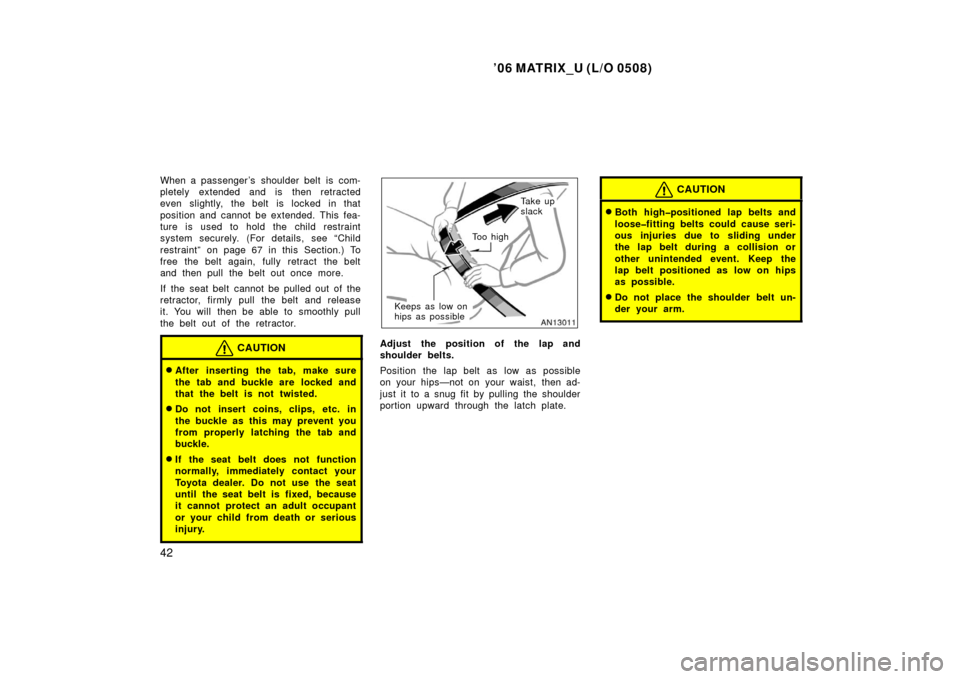
Ta k e u p
slack
To o h i g h
Keeps as low on
hips as possible
Adjust the position of the lap and
shoulder belts.
Position the lap belt as low as possible
on your hips—not on your waist, then ad-
just it to a snug fit by pulling the shoulder
portion upward through the latch plate.
CAUTION
�Both highpositioned lap belts and
loosefitting belts could cause seri-
ous injuries due to sliding under
the lap belt during a collision or
other unintended event. Keep the
lap belt positioned as low on hips
as possible.
�Do not place the shoulder belt un-
der your arm.
Page 55 of 324

’06 MATRIX_U (L/O 0508)
45
�Do not use the seat belt extender
when installing a child restraint
system on the front or rear passen-
ger seat. If installing a child re-
straint system with the seat belt
extender connected to the seat belt,
the seat belt will not securely hold
the child restraint system, which
could cause death or serious injury
to the child or other passengers in
the event of collision.
To connect the extender to the seat
belt, insert the tab into the seat belt
buckle so that the “PRESS” signs on
the buckle release buttons of the ex-
tender and the seat belt are both facing
outward as shown.
You will hear a click when the tab locks
into the buckle.
When releasing the seat belt, press on
the buckle release button on the extender,
not on the seat belt. This helps prevent
damage to the vehicle interior and extend-
er itself.As far as the seat belt extender on the
front passenger side is concerned, do not
fail to disconnect the extender from the
seat belt after the above operation in or-
der to activate the front passenger airbag
correctly when getting into the vehicle
next time.
When not in use, remove the extender
and store in the vehicle for future use.
CAUTION
�After inserting the tab, make sure
the tab and buckle are locked and
that the lap and shoulder portions
of the belt and the seat belt extend-
er are not twisted.
�Do not insert coins, clips, etc. in
the buckle as this may prevent you
from properly latching the tab and
buckle.
�If the seat belt does not function
normally, immediately contact your
Toyota dealer. Do not use the seat
until the seat belt is fixed, because
it cannot protect an adult occupant
or your child from injury.
Page 56 of 324

’06 MATRIX_U (L/O 0508)
46
The driver and front passenger seat
belt pretensioners are designed to be
activated in response to a severe fron-
tal impact.
When the sensor detects a severe frontal
impact, the front seat belts are quickly
drawn back by the retractors so that the
belts snugly restrain the occupants.The front passenger ’s seat belt pretension-
er will not activate if no passenger is
detected in the front passenger seat by
the front passenger occupant classification
system. However, the front passenger’s
seat belt pretensioner may activate if lug-
gage is put on the seat, or the seat belt
is buckled up regardless of the presence
of an occupant in the seat. (As for the
front passenger occupant classification
system, see “—Front pass
enger occupant
classification system” on page 63 in this
Section.)
The seat belt pretensioners and SRS air-
bags may not operate together in all colli-
sions.The seat belt pretensioner system mainly
consists of the following components and
their locations are shown in the illustra-
tion.
1. Front airbag sensors
2. SRS warning light
3. Front passenger occupant classification indicator light
4. Front passenger occupant classification system (ECU and sensors)
5. Seat belt pretensioner assemblies
6. Front passenger ’s seat belt buckle switch
7. Airbag sensor assembly
—Seat belt pretensioners


