2006 SUBARU TRIBECA weight
[x] Cancel search: weightPage 261 of 377
8-16 Driving tips
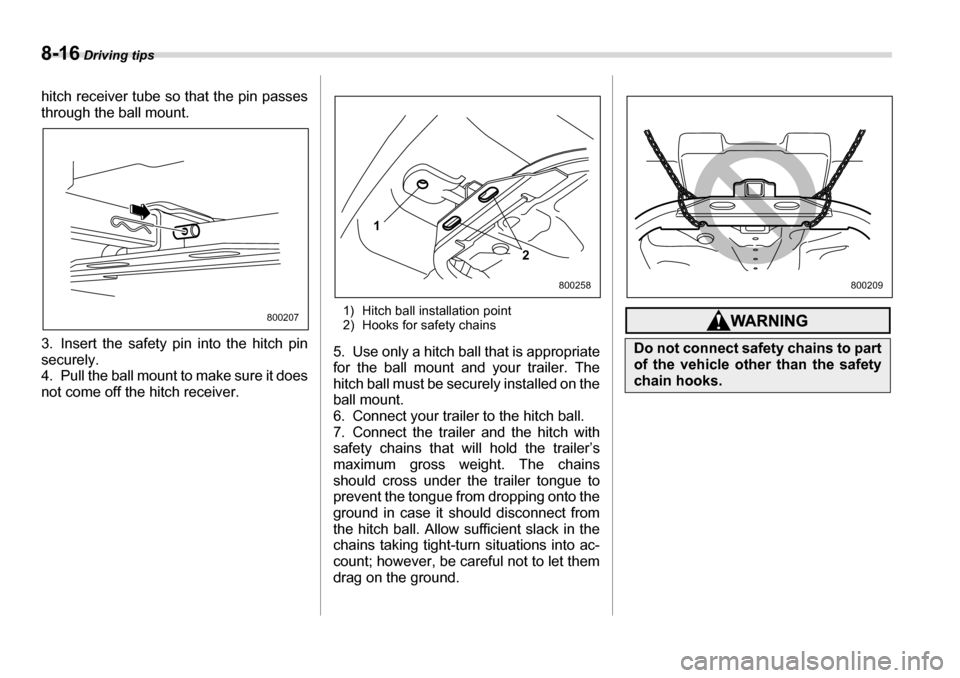
hitch receiver tube so that the pin passes
through the ball mount.
3. Insert the safety pin into the hitch pin securely.
4. Pull the ball mount to make sure it does
not come off the hitch receiver. 1) Hitch ball installation point
2) Hooks for safety chains
5. Use only a hitch ball that is appropriate
for the ball mount and your trailer. The
hitch ball must be securely installed on the
ball mount.
6. Connect your trailer to the hitch ball.
7. Connect the trailer and the hitch with
safety chains that will hold the trailer’s
maximum gross weight. The chains
should cross under the trailer tongue to
prevent the tongue from dropping onto the
ground in case it should disconnect from
the hitch ball. Allow sufficient slack in the
chains taking tight-turn situations into ac-
count; however, be careful not to let them
drag on the ground.
800207
1
2
800258
Do not connect safety chains to part
of the vehicle other than the safety
chain hooks.
800209
Page 263 of 377
8-18 Driving tips
required due to the additional load. (Refer
to “Maintenance schedule under severe
driving conditions” in the “Warranty and
Maintenance Booklet”.)
Under no circumstances should a trailer
be towed with a new vehicle or a vehicle
with any new powertrain component (en-
gine, transmission, differential, wheel
bearings, etc.) for the first 1,000 miles
(1,600 km) of driving. „Maximum load limits
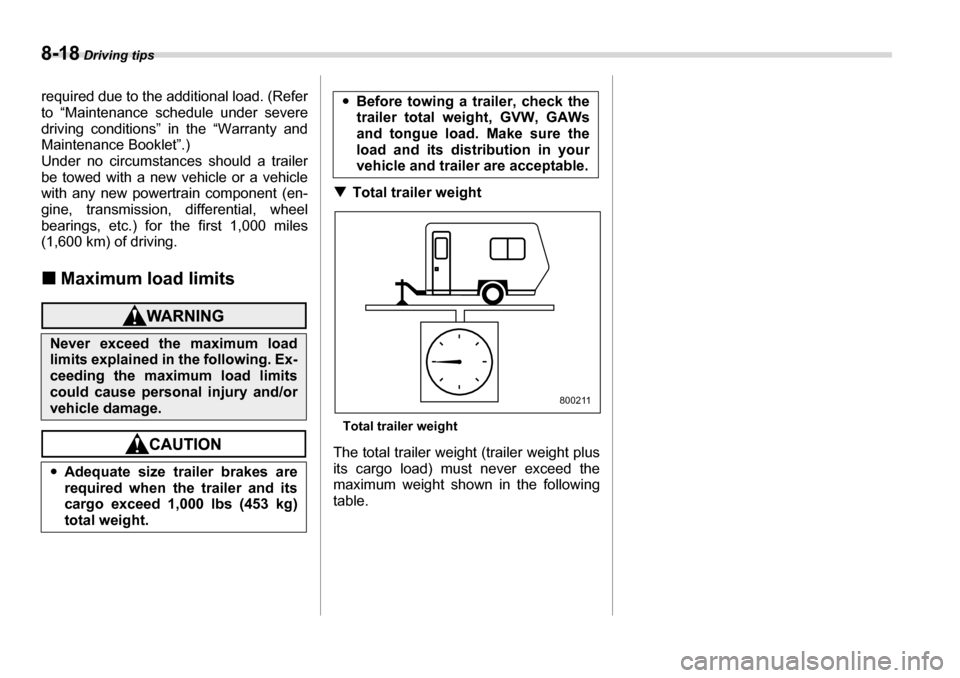
TTotal trailer weight
Total trailer weight
The total trailer weight (trailer weight plus
its cargo load) must never exceed the
maximum weight shown in the following
table.
Never exceed the maximum load
limits explained in the following. Ex-
ceeding the maximum load limits
could cause personal injury and/or
vehicle damage. y Adequate size trailer brakes are
required when the trailer and its
cargo exceed 1,000 lbs (453 kg)
total weight.
yBefore towing a trailer, check the
trailer total weight, GVW, GAWs
and tongue load. Make sure the
load and its distribution in your
vehicle and trailer are acceptable.
800211
Page 264 of 377
Driving tips 8-19
– CONTINUED –
Vehicle without cooling kit
Vehicle with cooling kit Conditions Maximum total trailer weight
When towing a trailer without brakes. 1,000 lbs (453 kg)
When towing a trailer with brakes. 2,000 lbs (906 kg)
When towing a trailer on a long uphill grade con-
tinuously for over 5 miles (8 km) with an outside
temperature of 104 °F (40 °C) or above. 1,000 lbs (453 kg)
Conditions Maximum total trailer weight
When towing a trailer without brakes. 1,000 lbs (453 kg)
When towing a trailer with brakes. 3,500 lbs (1,587 kg)
When towing a trailer on a long uphill grade con-
tinuously for over 5 miles (8 km) with an outside
temperature of 104 °F (40 °C) or above. 1,750 lbs (794 kg)T
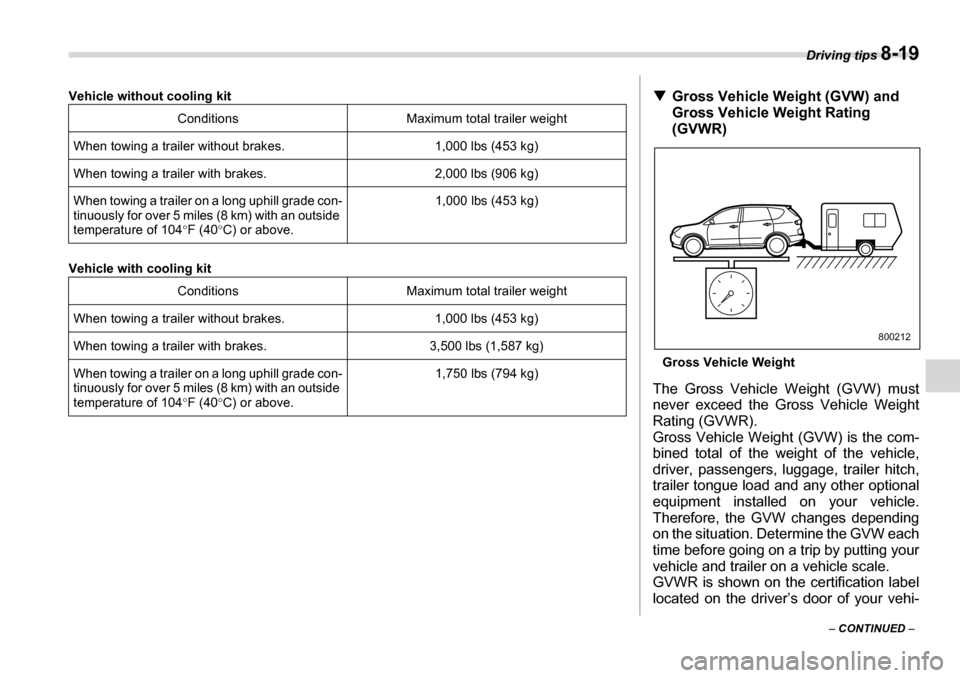
Gross Vehicle Weight (GVW) and
Gross Vehicle Weight Rating (GVWR)
Gross Vehicle Weight
The Gross Vehicle Weight (GVW) must
never exceed the Gross Vehicle Weight
Rating (GVWR).
Gross Vehicle Weight (GVW) is the com-
bined total of the weight of the vehicle,
driver, passengers, luggage, trailer hitch,
trailer tongue load and any other optional
equipment installed on your vehicle.
Therefore, the GVW changes depending
on the situation. Determine the GVW each
time before going on a trip by putting your
vehicle and trailer on a vehicle scale.
GVWR is shown on the certification label
located on the driver’s door of your vehi-
800212
Page 265 of 377
8-20 Driving tips
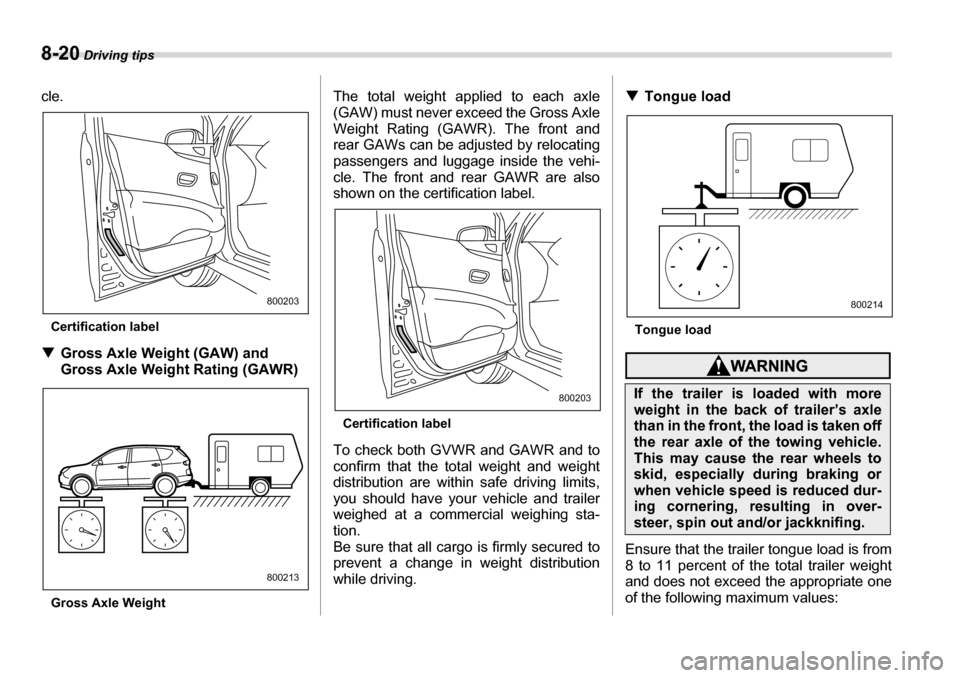
cle.
Certification label
T Gross Axle Weight (GAW) and
Gross Axle Weight Rating (GAWR)
Gross Axle Weight The total weight applied to each axle
(GAW) must never exceed the Gross Axle
Weight Rating (GAWR). The front and
rear GAWs can be adjusted by relocating
passengers and luggage inside the vehi-
cle. The front and rear GAWR are also
shown on the certification label.
Certification label
To check both GVWR and GAWR and to
confirm that the total weight and weight
distribution are within safe driving limits,
you should have your vehicle and trailer
weighed at a commercial weighing sta-
tion.
Be sure that all cargo is firmly secured to
prevent a change in weight distribution
while driving. T
Tongue load
Tongue load
Ensure that the trailer tongue load is from
8 to 11 percent of the total trailer weight
and does not exceed the appropriate one
of the following maximum values:
800203
800213
800203If the trailer is loaded with more
weight in the back of trailer’s axle
than in the front, the load is taken off
the rear axle of the towing vehicle.
This may cause the rear wheels to
skid, especially during braking or
when vehicle speed is reduced dur-
ing cornering, resulting in over-
steer, spin out and/or jackknifing.
800214
Page 266 of 377
Driving tips 8-21
– CONTINUED –
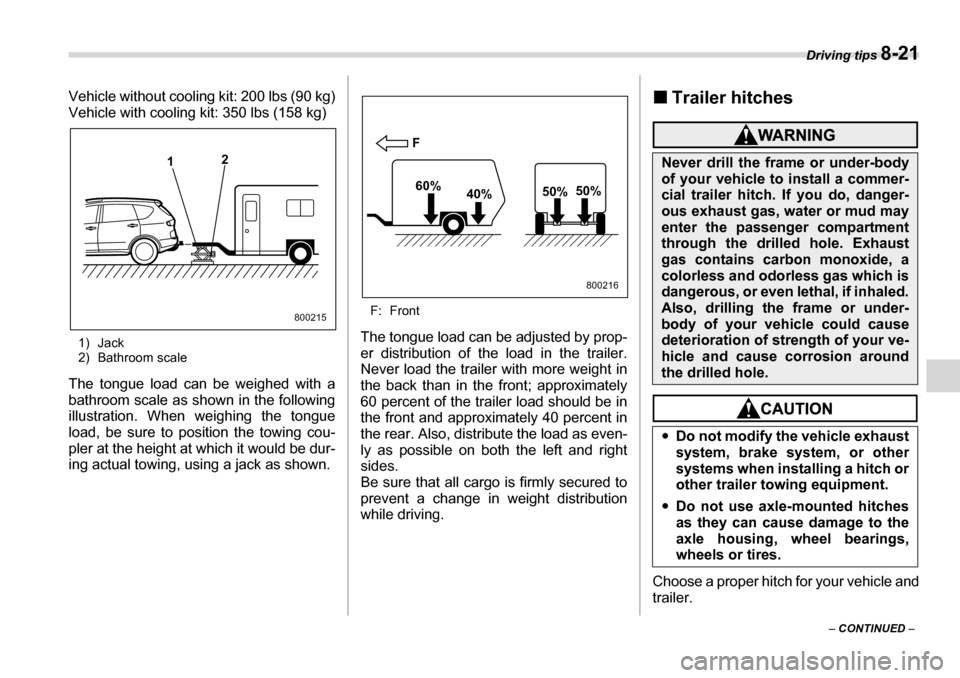
Vehicle without cooling kit: 200 lbs (90 kg)
Vehicle with cooling kit: 350 lbs (158 kg)
1) Jack
2) Bathroom scale
The tongue load can be weighed with a
bathroom scale as shown in the following
illustration. When weighing the tongue
load, be sure to position the towing cou-
pler at the height at which it would be dur-
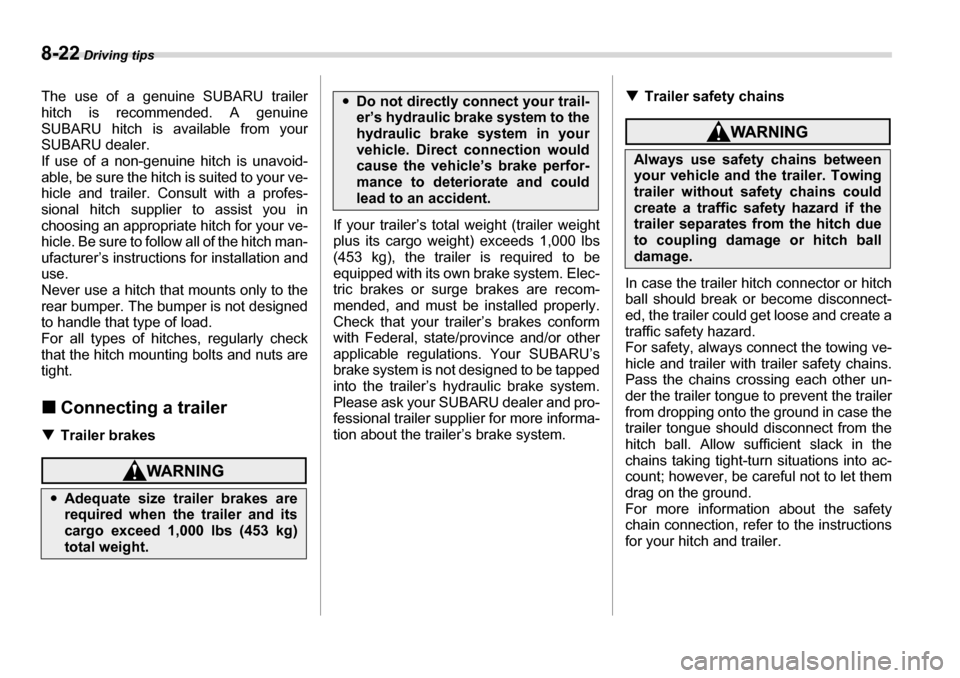
ing actual towing, using a jack as shown. F: Front
The tongue load can be adjusted by prop-
er distribution of the load in the trailer.
Never load the trailer with more weight in
the back than in the front; approximately
60 percent of the trailer load should be in
the front and approximately 40 percent in
the rear. Also, distribute the load as even-
ly as possible on both the left and rightsides.
Be sure that all cargo is firmly secured to
prevent a change in weight distribution
while driving. „
Trailer hitches
Choose a proper hitch for your vehicle and
trailer.
1 2
800215
F
60% 40% 50%
50%
800216
Never drill the frame or under-body
of your vehicle to install a commer-
cial trailer hitch. If you do, danger-
ous exhaust gas, water or mud may
enter the passenger compartment
through the drilled hole. Exhaust
gas contains carbon monoxide, a
colorless and odorless gas which is
dangerous, or even lethal, if inhaled.
Also, drilling the frame or under-
body of your vehicle could cause
deterioration of strength of your ve-
hicle and cause corrosion around
the drilled hole. y
Do not modify the vehicle exhaust
system, brake system, or other
systems when installing a hitch or
other trailer towing equipment.
y Do not use axle-mounted hitches
as they can cause damage to the
axle housing, wheel bearings,
wheels or tires.
Page 267 of 377
8-22 Driving tips
The use of a genuine SUBARU trailer
hitch is recommended. A genuine
SUBARU hitch is available from your
SUBARU dealer.
If use of a non-genuine hitch is unavoid-
able, be sure the hitch is suited to your ve-
hicle and trailer. Consult with a profes-
sional hitch supplier to assist you in
choosing an appropriate hitch for your ve-
hicle. Be sure to follow all of the hitch man-
ufacturer’s instructions for installation and use.
Never use a hitch that mounts only to the
rear bumper. The bumper is not designed
to handle that type of load.
For all types of hitches, regularly check
that the hitch mounting bolts and nuts are tight. „Connecting a trailer
T Trailer brakes
If your trailer’s total weight (trailer weight
plus its cargo weight) exceeds 1,000 lbs
(453 kg), the trailer is required to be
equipped with its own brake system. Elec-
tric brakes or surge brakes are recom-
mended, and must be installed properly.
Check that your trailer’s brakes conform
with Federal, state/province and/or other
applicable regulations. Your SUBARU’s
brake system is not designed to be tapped
into the trailer’s hydraulic brake system.
Please ask your SUBARU dealer and pro-
fessional trailer supplier for more informa-
tion about the trailer’s brake system. T
Trailer safety chains
In case the trailer hitch connector or hitch
ball should break or become disconnect-
ed, the trailer could get loose and create a
traffic safety hazard.
For safety, always connect the towing ve-
hicle and trailer with trailer safety chains.
Pass the chains crossing each other un-
der the trailer tongue to prevent the trailer
from dropping onto the ground in case the
trailer tongue should disconnect from the
hitch ball. Allow sufficient slack in the
chains taking tight-turn situations into ac-
count; however, be careful not to let them
drag on the ground.
For more information about the safety
chain connection, refer to the instructions
for your hitch and trailer.
yAdequate size trailer brakes are
required when the trailer and its
cargo exceed 1,000 lbs (453 kg)
total weight.
yDo not directly connect your trail-
er’s hydraulic brake system to the
hydraulic brake system in your
vehicle. Direct connection would
cause the vehicle’s brake perfor-
mance to deteriorate and could
lead to an accident.
Always use safety chains between
your vehicle and the trailer. Towing
trailer without safety chains could
create a traffic safety hazard if the
trailer separates from the hitch due
to coupling damage or hitch ball
damage.
Page 269 of 377
8-24 Driving tips
TBefore starting out on a trip
y Check that the vehicle and vehicle-to-
hitch mounting are in good condition. If
any problems are apparent, do not tow the
trailer. y Check that the vehicle sits horizontally
with the trailer attached. If the vehicle is
tipped sharply up at the front and down at
the rear, check the total trailer weight,
GVW, GAWs and tongue load again, then
confirm that the load and its distribution
are acceptable. y Check that the tire pressures are cor-
rect. y Check that the vehicle and trailer are
connected properly. Confirm that – the trailer tongue is connected prop-
erly to the hitch ball.
– the trailer lights connector is connect-
ed properly and trailer’s brake lights illu-
minate when the vehicle’s brake pedal
is pressed, and that the trailer’s turn sig-
nal lights flash when the vehicle’s turn
signal lever is operated.
– the safety chains are connected prop- erly.
– all cargo in the trailer is secured safe- ty in position.
– the side mirrors provide a good rear-
ward field of view without a significant
blind spot.
y Sufficient time should be taken to learn the “feel” of the vehicle/trailer combination
before starting out on a trip. In an area free
of traffic, practice turning, stopping and
backing up. T
Driving with a trailer
y You should allow for considerably more
stopping distance when towing a trailer.
Avoid sudden braking because it may re-
sult in skidding or jackknifing and loss of control.y Avoid uneven steering, sharp turns and
rapid lane changes.y Slow down before turning. Make a long-
er than normal turning radius because the
trailer wheels will be closer than the vehi-
cle wheels to the inside of the turn. In a
tight turn, the trailer could hit your vehicle.y Crosswinds will adversely affect the
handling of your vehicle and trailer, caus-
ing sway. Crosswinds can be due to
weather conditions or the passing of large
trucks or buses. If swaying occurs, firmly
grip the steering wheel and slow down im-
mediately but gradually. y When passing other vehicles, consider-
able distance is required because of the
added weight and length caused by at-
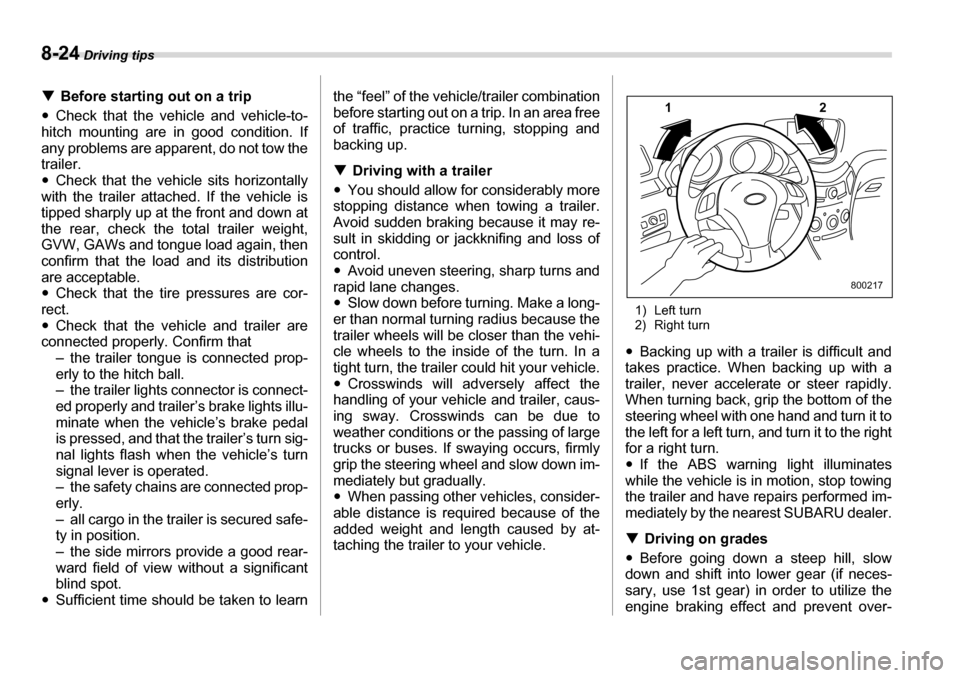
taching the trailer to your vehicle. 1) Left turn
2) Right turn
y Backing up with a trailer is difficult and
takes practice. When backing up with a
trailer, never accelerate or steer rapidly.
When turning back, grip the bottom of the
steering wheel with one hand and turn it to
the left for a left turn, and turn it to the right
for a right turn. y If the ABS warning light illuminates
while the vehicle is in motion, stop towing
the trailer and have repairs performed im-
mediately by the nearest SUBARU dealer. T Driving on grades
y Before going down a steep hill, slow
down and shift into lower gear (if neces-
sary, use 1st gear) in order to utilize the
engine braking effect and prevent over-12
800217
Page 326 of 377
Maintenance and service 11 - 2 9
„Wheel replacement
When replacing wheels due, for example,
to damage, make sure the replacement
wheels match the specifications of the
wheels that are fitted as standard equip-
ment. Replacement wheels are available
from SUBARU dealers.
Aluminum wheels
Aluminum wheels can be scratched and
damaged easily. Handle them carefully to
maintain their appearance, performance,
and safety. y When any of the wheels is removed and
replaced for tire rotation or to change a
flat, always check the tightness of the
wheel nuts after driving approximately 600
miles (1,000 km). If any nut is loose, tight-
en it to the specified torque.y Never apply oil to the threaded parts,
wheel nuts, or tapered surface of the
wheel.y Never let the wheel rub against sharp
protrusions or curbs.y Be sure to fit tire chains on uniformly
and completely around the tire, otherwise
the chains may scratch the wheel. y When wheel nuts, balance weights, or
the center cap is replaced, be sure to re-
place them with genuine SUBARU parts
designed for aluminum wheels.
y All four tires must be the same in
terms of manufacturer, brand
(tread pattern), construction, de-
gree of wear, speed symbol, load
index and size. Mixing tires of dif-
ferent types, sizes or degrees of
wear can result in damage to the
vehicle’s power train. Use of dif-
ferent types or sizes of tires can
also dangerously reduce control-
lability and braking performance
and can lead to an accident.
yUse only radial tires. Do not use
radial tires together with belted
bias tires and/or bias-ply tires. Do-
ing so can dangerously reduce
controllability, resulting in an ac-
cident.
Use only those wheels that are
specified for your vehicle. Wheels
not meeting specifications could in-
terfere with brake caliper operation
and may cause the tires to rub
against the wheel well housing dur-
ing turns. The resulting loss of vehi-
cle control could lead to an acci-
dent.