2006 SUBARU OUTBACK tire
[x] Cancel search: tirePage 240 of 425

7Starting and operatingFuel ...................................................................... 7-2 Fuel requirements .................................................. 7-2
Fuel filler lid and cap .............................................. 7-4
State emission testing (U .S. only) .................... 7-6
Preparing to drive .............................................. 7-7
Starting the engine ............................................. 7-8 Manual transmission vehicle ................................. 7-8
Automatic transmission vehicle ............................ 7-8
Stopping the engine ........................................... 7-9
Manual transmission ......................................... 7-9 Shifting speeds ....................................................... 7-10
Driving tips .............................................................. 7-11
Automatic transmission – 4- speed ................... 7-11Selector lever .......................................................... 7-12
Selector lever reverse inhibiting function ............ 7-13
Selection of manual mode ..................................... 7-14
Maximum speeds .................................................... 7-15
Driving tips .............................................................. 7-16
SPORT mode ........................................................... 7-16
Shift lock release . ........................................... ........ 7-16
Automatic transmission – 5- speed ................... 7-17Selector lever .......................................................... 7-18
Selector lever reverse inhibiting function ............ 7-19
Selection of manual mode ..................................... 7-20
Maximum speeds .................................................... 7-22
Driving tips .............................................................. 7-23
SPORT mode ........................................................... 7-23
Shift lock release . ........................................... ........ 7-23 Rear viscous limited slip differential (LSD)
(if equipped) ..................................................... 7-24
Power steering .................................................... 7-25
Braking ................................................................ 7-25 Braking tips ............................................................. 7-25
Brake system .......................................................... 7-25
Disc brake pad wear warning in dicators .... .......... 7-26
ABS (Anti-lock Brake System) .......................... 7-26 ABS system self-check ......... ............................. .... 7-26
ABS warning light ................................................... 7-27
Electronic Brake Force Distribution (EBD)
system .............................................................. 7-28 Steps to take if EBD system fails .......................... 7-28
Vehicle Dynamics Control system
(if equipped) ..................................................... 7-29 Vehicle Dynamics Control system monitor .......... 7-31
Vehicle Dynamics Control OFF switch ................. 7-32
Tire pressure monitoring system (TPMS)
(if equipped) ..................................................... 7-33
Parking your vehicle .......................................... 7-35
Cruise control ..................................................... 7-36 To set cruise control .............................................. 7-37
To temporarily cancel the cruise control ............. 7-37
To turn off the cruise control ................................. 7-38
To change the cruising speed ............................... 7-38
Cruise control indicator light ................................. 7-39
Cruise control set indicator light .......................... 7-39
Page 246 of 425
Starting and operating
7-7Under no circumstances should the rear
wheels be jacked off the ground, nor
should the driveshaft be disconnected for
state emission testing.
The EPA has issued regulations for in-
specting the On-Board Diagnostic (OBD)
system as part of the state emissions in-
spection. The OBD system is designed to
detect engine and transmission problems
that might cause vehicle emissions to ex-
ceed allowable limits. These inspections
apply to all 1996 model year and newer
passenger cars and li ght trucks. Over 30
states plus the Distr ict of Columbia have
implemented the OBD system inspection.
y The inspection of the OBD system con-
sists of a visual operational check of the
“ CHECK ENGINE ” warning light/malfunc-
tion indicator lamp (MIL) and an examina-
tion of the OBD system with an electronic
scan tool while the engine is running.
y A vehicle passes
the OBD system in-
spection if proper the “ CHECK ENGINE ”
warning light/MIL illumination is observed,
there is no stored diagnostic trouble
codes, and the OBD system readiness
monitors are complete.
y A vehicle fails
the OBD inspection if the
“ CHECK ENGINE ” warning light/MIL is
not properly operating or there is one or
more diagnostic trouble codes stored in vehicle’s computer with the “ CHECK EN-
GINE ” warning light/MIL illuminated.
y A state emission inspection may reject
(not pass or fail) a vehicle if the number of
OBD system readiness monitors “ Not
Ready ” is greater than one. Under this
condition, the vehicle operator should be
instructed to drive his/her vehicle for a few
days to set the monitors and return for an
emission re-inspection.
y Owners of rejected or failing vehicles
should contact their SUBARU Dealer for
service. Preparing to drive You should perform the following checks
and adjustments every day before you
start driving.
1. Check that all windows, mirrors, and
lights are clean and unobstructed.
2. Check the appearance and condition of
the tires. Also check tires for proper infla-
tion.
3. Look under the vehicle for any sign of
leaks.
4. Check that the hood, trunk (Sedan)
and rear gate (Station wagon) are fully
closed.
5. Check the adjustment of the seat.
6. Check the adjustment of the inside and
outside mirrors.
7. Fasten your seatbelt. Check that your
passengers have fastened their seatbelts.
8. Check the operation of the warning and
indicator lights when the ignition switch is
turned to the “ON” position.
9. Check the gauges, indicator and warn-
ing lights after starting the engine.
NOTE Engine oil, engine coolant, brake fluid,
washer fluid and other fluid levels
should be checked daily, weekly or at
fuel stops.
Page 263 of 425
7-24 Starting and operating
To override the shift lock:
1. Set the parking brake and stop the en-
gine.
2. Take out the screwdriver from the tool
bucket.
3. Remove the cover by prying on the
edge with a flat-head screwdriver. 4. Insert the screwdriver into the hole.
5. Push down on the screwdriver and
move the selector leve r from the “P” to the
“N” position.
6. Remove the screwdriver from the hole.
Depress the brake pedal and start the en-
gine.
Take your vehicle to the nearest SUBARU
dealer immediately to have the system re-
paired. Rear viscous limited slip dif-
ferential (LSD) (if equipped)
The LSD provides optimum distribution of
power according to the difference in revo-
lutions between the right and left rear
wheels that may be caused by certain
driving conditions, thereby improving driv-
ing stability on snow-covered, muddy or
other slippery roads.700346 700347
y Never start the engine while a tire
on one side is jacked up, as the
vehicle may move.
y If one rear tire is spinning in mud,
avoid continued spinning at high
speed as this could adversely af-
fect the LSD.
y If a different size rear tire is tem-
porarily used (as in an emergen-
cy), it will adversely affect the
LSD. Always replace it with a reg-
ular size tire as soon as possible.
Page 264 of 425
Starting and operating
7-25
– CONTINUED –Power steering
The power steering system operates only
when the engine is running.
If you lose power stee ring assist because
the engine stops or the system fails to
function, you can steer but it will take
much more effort.
NOTE Right after the engine has been started
and before it has warmed up, you may
hear a noise coming from areas adja-
cent to the power st eering pump which
is located at the right-front area of the
engine compartment. This noise is nor-
mal. It does not indicate power steering
system trouble. Braking „ Braking tips
T When the brakes get wet
When driving in rain or after washing the
vehicle, the brakes may get wet. As a re-
sult, brake stopping distance will be long-
er. To dry the brakes, drive the vehicle at
a safe speed while lightly depressing the
brake pedal to heat up the brakes.
T Use of engine braking
Remember to make use of engine braking
in addition to foot braking. When descend-
ing a grade, if only the foot brake is used,
the brakes may start working improperly
because of brake fluid overheating,
caused by overheated brake pads. To
help prevent this, shift into a lower gear to
get stronger engine braking.
T Braking when a tire is punctured
Do not depress the brake pedal suddenly when a tire is punctured. This could cause
a loss of control of the vehicle. Keep driv-
ing straight ahead while gradually reduc-
ing speed. Then slowly pull off the road to
a safe place.
„ Brake system T Two separate circuits
Your vehicle has a dual circuit brake sys-
tem. Each circuit works diagonally across
the vehicle. If one circuit of the brake sys-
tem should fail, the other half of the sys-
tem still works. If one circuit fails, the
brake pedal will go down much closer to
the floor than usual and you will need to
press it down much harder. And a much
longer distance will be needed to stop the
vehicle.
T Brake booster
The brake booster uses engine manifold
vacuum to assist braking force. Do not
turn off the engine while driving because
that will turn off the brake booster, result-
ing in poor braking power.
The brakes will continue to work even
when the brake booster completely stops
functioning. If this happens, however, you
will have to push the pedal much harder
than normal and the braking distance will
increase.Do not hold the steering wheel at the
fully locked position left or right for
more than five seconds. This may
damage the power steering pump. Never rest your foot on the brake
pedal while driving. This can cause
dangerous overheating of the
brakes and needless wear on the
brake pads and linings.
Page 268 of 425
Starting and operating
7-29
– CONTINUED –Vehicle Dynamics Control
system (if equipped)y Driving with the brake system
warning light on is dangerous.
This indicates your brake system
may not be working properly. If
the light remains on, have the
brakes inspected by a SUBARU
dealer immediately.
y If at all in doubt about whether the
brakes are operating properly, do
not drive the vehicle. Have your
vehicle towed to the nearest
SUBARU dealer for repair. Always use the utmost care in driv-
ing – overconfidence because you
are driving with a Vehicle Dynamics
Control system equipped vehicle
could easily lead to a serious acci-
dent.
y Even if your vehicle is equipped
with Vehicle Dynamics Control,
winter tires or snow chains
should be used when driving on
snow-covered or icy roads; in ad-
dition, vehicle speed should be re-
duced considerably. Simply hav-
ing a Vehicle Dynamics Control
system does not guarantee that
the vehicle will be able to avoid
accidents in any situation. y Activation of the Vehicle Dynam-
ics Control system is an indica-
tion that the ro ad being travelled
on has a slippery surface; since
having Vehicle Dynamics Control
is no guarantee that full vehicle
control will be maintained at all
times and under all conditions, its
activation should be seen as a
sign that the speed of the vehicle
should be reduced considerably.
y Whenever suspension compo-
nents, steering components, or an
axle are removed from a vehicle
equipped with Vehicle Dynamics
Control, have an authorized
SUBARU dealer perform an in-
spection of that system.
y The following precautions should
be observed in order to ensure
that the Vehicle Dynamics Control
system is operating properly:
– All four wheels should be fitted
with tires of the same size, type,
and brand. Furthermore, the
amount of wear should be the
same for all four tires.
Page 269 of 425
7-30 Starting and operating
In the event of wheelspin and/or skidding
on a slippery road surface and/or during
cornering and/or an evasive maneuver,
the Vehicle Dynamics Control system ad-
justs the engine’s output and the wheels’
respective braking forces to help maintain
traction and directional control.
y Traction Control Function
The traction control function is designed to
prevent spinning of the driving wheels on
slippery road surfaces, thereby helping to
maintain traction and directional control.
Activation of this function is shown by
steady illumination of the Vehicle Dynam-
ics Control operation indicator light.
y Skid Suppression Function
The skid suppression function is designed
to help maintain directional stability by
suppressing the wheels’ tendency to slide
sideways during steering operations. Acti-
vation of this function is shown by flashing
of the Vehicle Dynamics Control operation
indicator light.
NOTE
y Slight twitching of the brake pedal may be felt when the Vehicle Dynamics
Control system operates; a small de-
gree of vehicle or st eering wheel shak-
ing may also be noticed in this situa-
tion. These are normal characteristics
of Vehicle Dynamics Control operation
and are no cause for alarm.
y When driving off immediately after
starting the engine, a short-lived oper-
ation noise may be noticed coming
from the engine compartment. This
noise is generated as a result of a
check being performed on the Vehicle
Dynamics Control system and is nor-
mal.
y Depending on the timing of activa-
tion of the brakes, certain situations
may occur just after driving off where
the brake pedal seems to exhibit a jolt-
ing motion. This too is a consequence
of the Vehicle Dynamics Control opera-
tional check and is normal.
y In the circumstances listed in the fol-
lowing, the vehicle may be more unsta-
ble than it feels to the driver. The Vehi-
cle Dynamics Control System may
therefore operate. Such operation does
not indicate a system fault.
y on gravel-covered or rutted roads
y on unfinished roads
y when the vehicle is towing a trailer
y when the vehicle is fitted with snow tires or winter tires
y Activation of the Vehicle Dynamics
Control system will cause operation of
the steering wheel to feel slightly dif-
ferent compared to that for normal con-
ditions.
y Even if the vehicle is equipped with a
Vehicle Dynamics Control system, it is
important that winter tires be used
when driving on snow-covered or icy
roads. (All four wheels should be fitted
with tires of the same size and brand).
Furthermore, if snow chains are to be
used, they should be fitted on the front
wheels. When a vehicle is fitted with
snow chains, however, the effective-
ness of the Vehicle Dynamics Control
system is reduced and this should be
taken into account when driving the ve-
hicle in such a condition.
y It is always important to reduce
speed when approaching a corner,
even if the vehicle is equipped with Ve-
hicle Dynamics Control.
y All four wheels shou ld be fitted with
tires of the same size, type, and brand;
furthermore, the amount of wear
should be the same for all four tires. If
these precautions are not observed
and non-matching tires are used, it is
quite possible that the Vehicle Dynam-
ics Control system will be unable to op-– Keep the tire pressure at the
proper level as shown on the
vehicle placard attached to the
driver’s side door pillar.
Page 270 of 425

Starting and operating
7-31
– CONTINUED –erate correctly as intended.
y Always turn off the engine before re-
placing a tire as failure to do so may
render the Vehicle Dynamics Control
system unable to operate correctly.
„ Vehicle Dynamics Control
system monitorT Vehicle Dynamics Control operation
indicator light
The indicator light turns on when the igni-
tion switch is turned to the ON position; it
turns off approximately two seconds later.
This indicator light flashes during activa-
tion of the skid suppression function and is
illuminated steadily during activation of
the traction cont rol function. The following two situations could indicate
a malfunction of the Vehicle Dynamics
Control system; if either should occur,
have an authorized SUBARU dealer carry
out an inspection of that system at the first
available opportunity.
y The indicator light does not turn on
when the ignition switch is turned to the
ON position.
y The indicator light does not turn off ap-
proximately two seconds after the ignition
switch has been turned to the ON position.
T Vehicle Dynamics Control warning
light/Vehicle Dynamics Control OFF
indicator light
This single light has the function of indicat-
ing malfunctions in the Vehicle Dynamics
Control system and the function of indicat- ing that the Vehicle Dynamics Control sys-
tem is not operating. It comes on in the
event of a malfunction in the system and is
illuminated whenever the system is not
operating.
V Vehicle Dynamics Control warning
The warning light comes on when the igni-
tion switch is turned to the “ON” position
and goes off several seconds after engine
startup. This lighting pattern indicates that
the Vehicle Dynamics Control system is
operating normally.
The following situations could indicate a
malfunction of the Vehicle Dynamics Con-
trol system; if any should occur, have an
authorized SUBARU dealer carry out an
inspection of the system at the first avail-
able opportunity.
y The warning light does not turn on when
the ignition switch is turned to the ON po-
sition.
y The warning light turns on while the ve-
hicle is being driven.
y When a malfunction has occurred in the
Vehicle Dynamics Control electrical sys-
tem, only the warning light will turn on. In
such an event, the ABS will still be operat-
ing normally.
y The warning light will also turn on when
a problem occurs with the ABS or Vehicle
Dynamics Control electronic control sys-700350
700351
Page 272 of 425
Starting and operating
7-33
– CONTINUED –The Vehicle Dynamics Control system will
be deactivated and the vehicle will behave
like a model not equipped with the Vehicle
Dynamics Control system. When the
switch is pressed again to reactivate the
Vehicle Dynamics Control system, the in-
dicator light goes off.
With the Vehicle Dynamics Control sys-
tem deactivated, traction and stability en-
hancement offered by Vehicle Dynamics
Control system is unavailable. Therefore
you should not deactivate the Vehicle Dy-
namics Control syst em except under
above-mentioned situations.
NOTE y When the switch has been pressed
to deactivate the Vehicle Dynamics
Control system, the Vehicle Dynamics
Control system automatically reacti-
vates itself the next time the ignition
switch is turned to the OFF position
and the engine is restarted.
y If the switch is held down for 10 sec-
onds or longer, the indicator light goes
off, the Vehicle Dynamics Control sys-
tem is activated, and the system ig-
nores any further pressing of the
switch. To make the switch usable
again, turn the igni tion switch to the
OFF position and restart the engine.
y When the switch is pressed to deac- tivate the Vehicle Dynamics Control
system, the vehicle’s running perfor-
mance is comparable with that of a ve-
hicle that does not have a Vehicle Dy-
namics Control system. Do not deacti-
vate the Vehicle Dynamics Control sys-
tem except when absolutely neces-
sary.
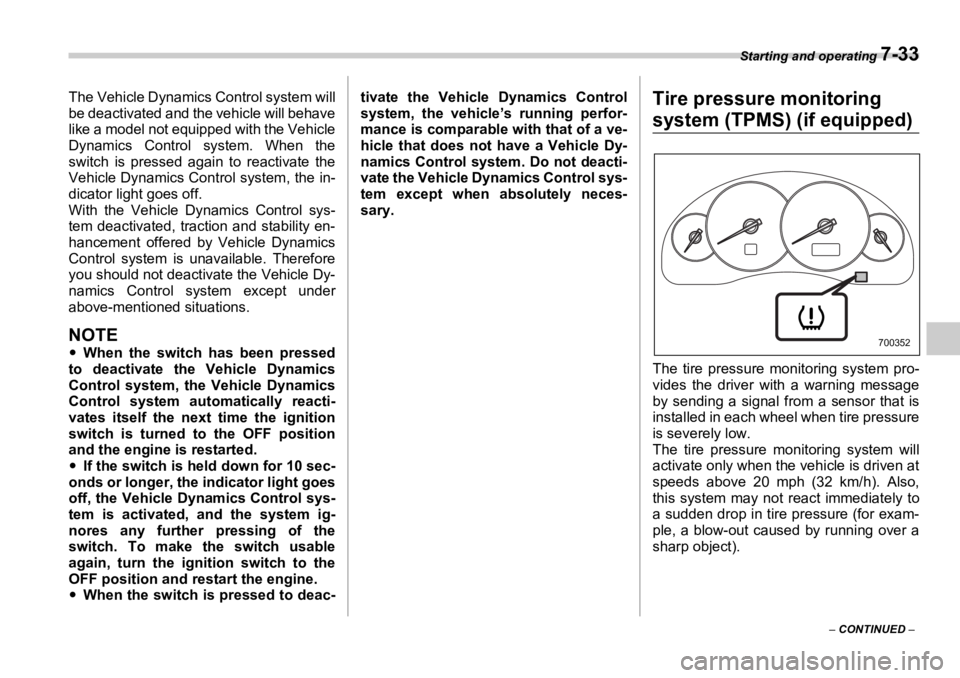
Tire pressure monitoring
system (TPMS) (if equipped)
The tire pressure monitoring system pro-
vides the driver with a warning message
by sending a signal from a sensor that is
installed in each wheel when tire pressure
is severely low.
The tire pressure mo nitoring system will
activate only when the vehicle is driven at
speeds above 20 mph (32 km/h). Also,
this system may not react immediately to
a sudden drop in tire pressure (for exam-
ple, a blow-out caused by running over a
sharp object). 700352