2006 SUBARU LEGACY body
[x] Cancel search: bodyPage 37 of 425
1-12 Seat, seatbelt and SRS airbags
Your vehicle is equipped with a crash
sensing and diagnostic module, which will
record the use of the seatbelt(s) by the
driver and front passenger when any of
the SRS frontal, side and curtain airbags
deploys. TInfants or small children
Use a child restraint system that is suit-
able for your vehicle. See information on
“Child restraint systems” section in this
chapter. T Children
If a child is too big for a child restraint sys- tem, the child should sit in the rear seat
and be restrained using the seatbelts. Ac- cording to accident st
atistics, children are
safer when properly restrained in the rear
seating positions than in the front seating
positions. Never allow a child to stand up
or kneel on the seat.
If the shoulder portion of the belt crosses
the face or neck, adjust the shoulder belt
anchor height (window-side seating posi-
tions only) and then if necessary move the
child closer to the belt buckle to help pro-
vide a good shoulder belt fit. Care must be
taken to securely place the lap belt as low
as possible on the hips and not on the
child’s waist. If the shoulder portion of the
belt cannot be properly positioned, a child
restraint system shou ld be used. Never
place the shoulder belt under the child’s
arm or behind the child’s back. T
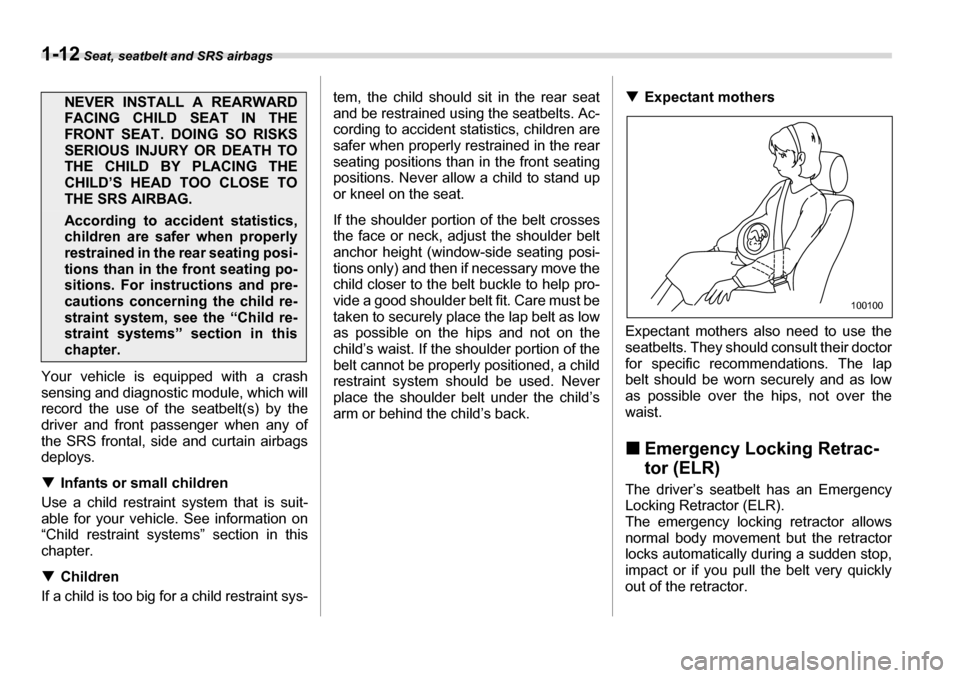
Expectant mothers
Expectant mothers also need to use the
seatbelts. They should consult their doctor
for specific recommendations. The lap
belt should be worn securely and as low
as possible over the hips, not over the waist.
„ Emergency Locking Retrac- tor (ELR)
The driver’s seatbelt has an Emergency
Locking Retractor (ELR).
The emergency locking retractor allows
normal body movement but the retractor
locks automatically during a sudden stop,
impact or if you pull the belt very quickly out of the retractor.
NEVER INSTALL A REARWARD
FACING CHILD SEAT IN THE FRONT SEAT. DOING SO RISKS
SERIOUS INJURY OR DEATH TO
THE CHILD BY PLACING THE
CHILD’S HEAD TOO CLOSE TO
THE SRS AIRBAG.
According to accident statistics,
children are safer when properly
restrained in the rear seating posi-
tions than in the front seating po-
sitions. For instructions and pre-
cautions concerning the child re-
straint system, see the “Child re-
straint systems” section in this
chapter.
100100
Page 58 of 425
Seat, seatbelt and SRS airbags 1-33
– CONTINUED –
Some types of child restraint systems can
be installed on the rear seat of your vehi-
cle without use of the seatbelts. Such child
restraint systems are secured to the dedi-
cated anchorages provided on the vehicle
body.
The lower and tether anchorages are
sometimes referred to as the LATCH sys-tem ( Lower Anchors and Tethers for CHil-
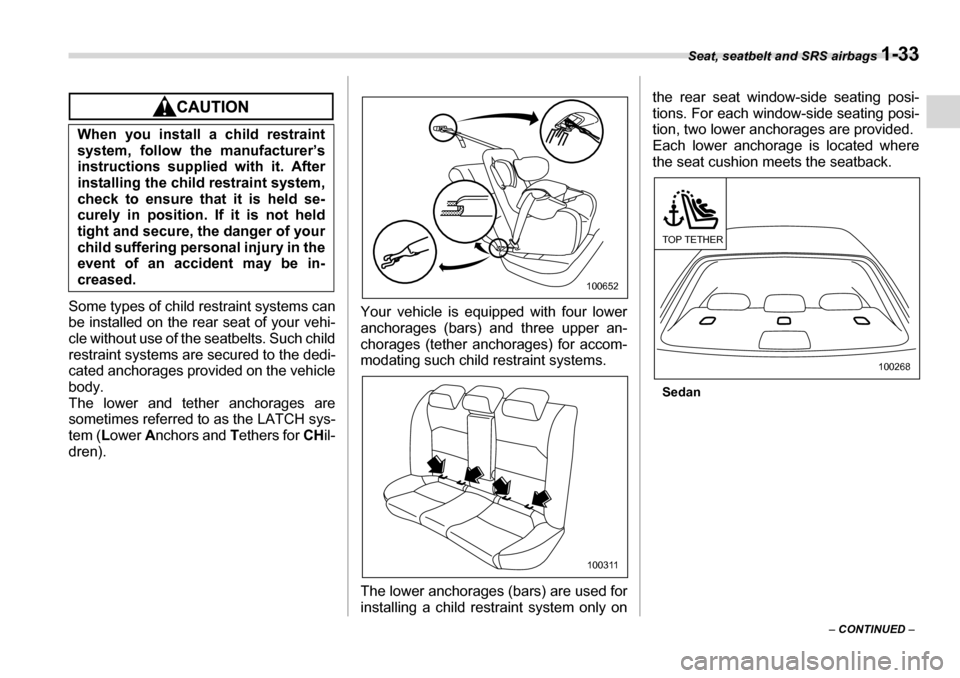
dren). Your vehicle is equipped with four lower
anchorages (bars) and three upper an-
chorages (tether anchorages) for accom-modating such chil
d restraint systems.
The lower anchorages (bars) are used for
installing a child restraint system only on the rear seat window-side seating posi-
tions. For each window-side seating posi-
tion, two lower anchorages are provided.
Each lower anchorage is located where
the seat cushion meets the seatback.
Sedan
When you install a child restraint
system, follow the manufacturer’s
instructions supplied with it. After
installing the child restraint system,
check to ensure that it is held se-
curely in position. If it is not held
tight and secure, the danger of your
child suffering personal injury in the
event of an accident may be in-
creased.
100652
100311
TOP TETHER
100268
Page 64 of 425
Seat, seatbelt and SRS airbags 1-39
– CONTINUED –
senger, and window-side rear passen-
gers)
These SRS airbags are designed only
as a supplement to the primary protec-
tion provided by the seatbelt.
The system also controls front seatbelt
pretensioners. For operation instructions
and precautions conc
erning the seatbelt
pretensioner, see the “Front seatbelt pre-
tensioners” section in this chapter.
yTo obtain maximum protection in
the event of an accident, the driv-
er and all passengers in the vehi-
cle should always wear seatbelts
when the vehicle is moving. The
SRS airbag is designed only as a
supplement to the primary protec-
tion provided by the seatbelt. It
does not do away with the need to
fasten seatbelts. In combination
with the seatbelts, it offers the
best combined protection in case
of a serious accident.
Not wearing a seatbelt increases
the chance of severe injury or
death in a crash even when the ve-
hicle has the SRS airbag.
For instructions and precautions
concerning the seatbelt system,
see the “Seatbelts” section in this
chapter.
yDo not sit or lean unnecessarily
close to the SRS airbag. Because
the SRS airbag deploys with con-
siderable speed – faster than the
blink of an eye – and force to pro-
tect in high speed collisions, the
force of an airbag can injure an
occupant whose body is too close to SRS airbag.
It is also important to wear your
seatbelt to help avoid injuries that
can result when the SRS airbag
contacts an occupant not in prop-
er position such as one thrown
forward during pre-accident brak-
ing.
Even when properly positioned,
there remains a possibility that an
occupant may suffer minor injury
such as abrasions and bruises to
the face or arms because of the
SRS airbag deployment force.
yThe SRS airbags deploy with con-
siderable speed and force. Occu-
pants who are out of proper posi-
tion when the SRS airbag deploys
could suffer very serious injuries.
Because the SRS airbag needs
enough space for deployment, the
driver should always sit upright
and well back in the seat as far
from the steering wheel as practi-
cal while still maintaining full ve-
hicle control and the front passen-
ger should move the seat as far
back as possible and sit upright
and well back in the seat.
yDo not place any objects over or
near the SRS airbag cover or be-
tween you and the SRS airbag. If
the SRS airbag deploys, those ob-
jects could interfere with its prop-
er operation and could be pro-
pelled inside the vehicle and
cause injury.
Page 79 of 425
1-54 Seat, seatbelt and SRS airbags
The SRS side airbag and SRS cur-
tain airbag are designed as only a
supplement to the primary protec-
tion provided by the seatbelt. They
do not do away with the need to fas-
ten seatbelts. It is also important to
wear your seatbelt to help avoid in-
juries that can result when an occu-
pant is not seated in a proper up-
right position.
100164
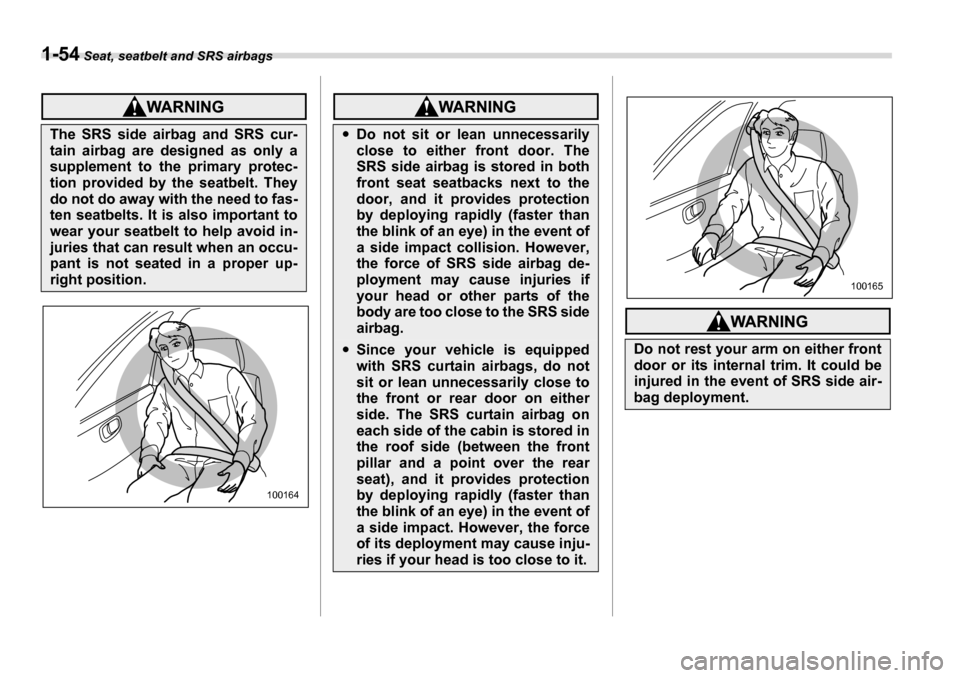
yDo not sit or lean unnecessarily
close to either front door. The
SRS side airbag is stored in both
front seat seatbacks next to the
door, and it provides protection
by deploying rapidly (faster than
the blink of an eye) in the event of
a side impact collision. However,
the force of SRS side airbag de-
ployment may cause injuries if
your head or other parts of the
body are too close to the SRS side
airbag.
y Since your vehicle is equipped
with SRS curtain airbags, do not
sit or lean unnecessarily close to
the front or rear door on either
side. The SRS curtain airbag on
each side of the cabin is stored in
the roof side (between the front
pillar and a point over the rear
seat), and it provides protection
by deploying rapidly (faster than
the blink of an eye) in the event of
a side impact. However, the force
of its deployment may cause inju-
ries if your head is too close to it.Do not rest your arm on either front
door or its internal trim. It could be
injured in the event of SRS side air-
bag deployment.
100165
Page 80 of 425
Seat, seatbelt and SRS airbags 1-55
– CONTINUED –
100166
100167
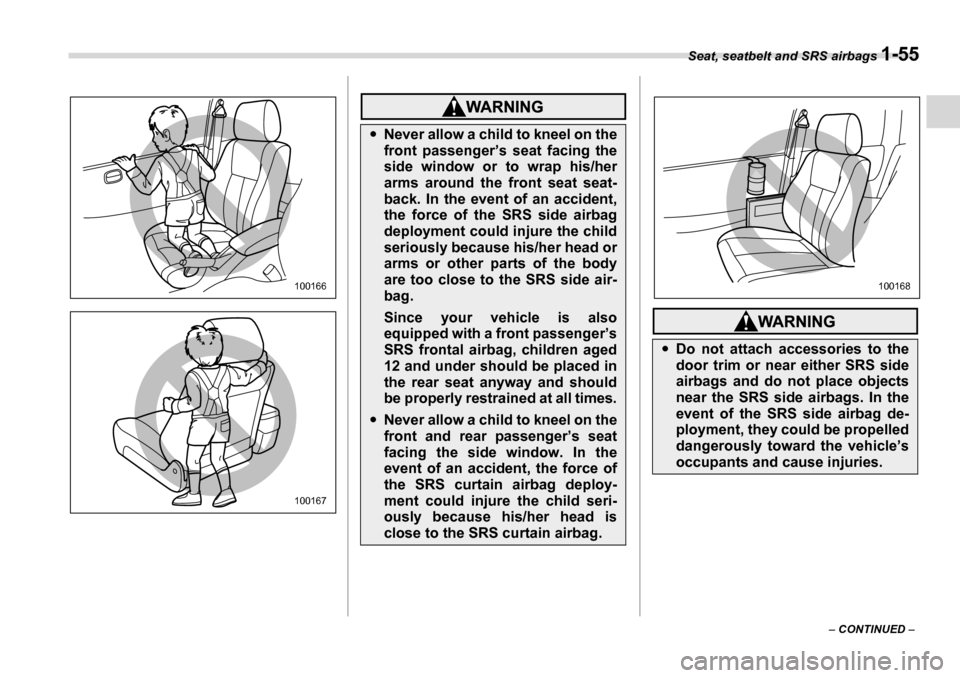
yNever allow a child to kneel on the
front passenger’s seat facing the
side window or to wrap his/her
arms around the front seat seat-
back. In the event of an accident,
the force of the SRS side airbag
deployment could injure the child
seriously because his/her head or
arms or other parts of the body
are too close to the SRS side air-
bag.
Since your vehicle is also
equipped with a front passenger’s
SRS frontal airbag, children aged
12 and under should be placed in
the rear seat anyway and should
be properly restrained at all times.
y Never allow a child to kneel on the
front and rear passenger’s seat
facing the side window. In the
event of an accident, the force of
the SRS curtain airbag deploy-
ment could injure the child seri-
ously because his/her head is
close to the SRS curtain airbag.
yDo not attach accessories to the
door trim or near either SRS side
airbags and do not place objects
near the SRS side airbags. In the
event of the SRS side airbag de-
ployment, they could be propelled
dangerously toward the vehicle’s
occupants and cause injuries.
100168
Page 87 of 425
1-62 Seat, seatbelt and SRS airbags
Always consult your SUBARU dealer if
you want to install any accessory parts on
your vehicle.
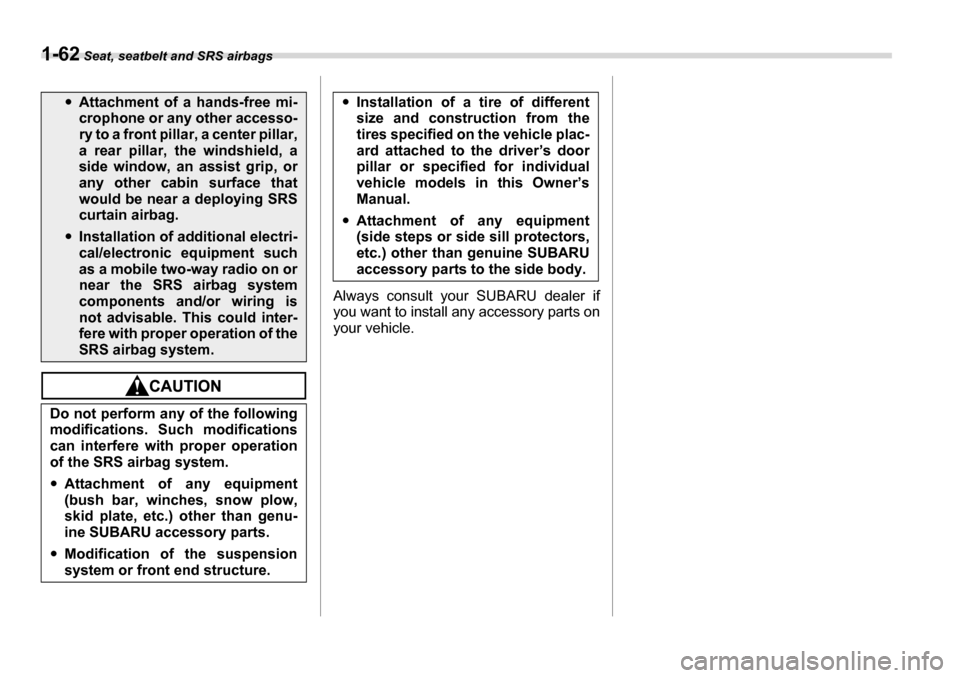
yAttachment of a hands-free mi-
crophone or any other accesso- ry to a front pillar , a center pillar,
a rear pillar, the windshield, a
side window, an assist grip, or
any other cabin surface that
would be near a deploying SRS
curtain airbag.
y Installation of additional electri-
cal/electronic equipment such
as a mobile two-way radio on or
near the SRS airbag system
components and/or wiring is
not advisable. This could inter-
fere with proper operation of the
SRS airbag system.
Do not perform any of the following
modifications. Such modifications
can interfere with proper operation
of the SRS airbag system. y Attachment of any equipment
(bush bar, winches, snow plow,
skid plate, etc.) other than genu-
ine SUBARU accessory parts.
y Modification of the suspension
system or front end structure.
yInstallation of a tire of different
size and construction from the
tires specified on the vehicle plac-
ard attached to the driver’s door
pillar or specified for individual
vehicle models in this Owner’s
Manual.
y Attachment of any equipment
(side steps or side sill protectors,
etc.) other than genuine SUBARU
accessory parts to the side body.
Page 112 of 425

Keys and doors 2-25
– CONTINUED –
NOTE
Should the rear gate be unable to be
unlocked due to a discharged battery,
a fault in the door locking/unlocking
system or other causes, you can un-
lock it by manually operating the rear
gate lock release lever.
For the procedure, refer to “Rear gate
(Station wagon) – if the rear gate can-
not be unlocked” section in chapter 9.
Moonroof (if equipped)
The moonroof has both tilting and sliding
functions.
The moonroofs operate only when the ig-
nition switch is in the “ON” position.
y
Do not jam a plastic bag in or
place cellophane tape on the rear
gate stays or scratch the stays
while loading or unloading cargo.
That could cause leakage of gas
from the stays, which may result
in their inability to hold the rear
gate open.
y Be careful not to hit your head or
face on the rear gate when open-
ing or closing the rear gate and
when loading or unloading cargo.
yNever let anyone’s hands, arms,
head or any objects protrude from
the moonroof. A person could be
seriously injured if the vehicle
stops suddenly or turns sharply
or if the vehicle is involved in an
accident.
To avoid serious personal injury
caused by entrapment, you must
do the following.
yBefore closing the moonroof,
make sure that no one’s hands,
arms, head or other objects will be
accidentally caught in the moon- roof.
yBefore leaving the vehicle, always
remove the key from the ignition
switch for safety and never allow
an unattended child to remain in
the vehicle. Failure to follow this
procedure could result in injury to
a child operating the moonroof.
y Never try to check the anti-entrap-
ment function by deliberately
placing part of your body in the moonroof.
yDo not sit on the edge of the open
moonroof.
y Do not operate the moonroof if
falling snow or extremely cold
conditions have caused it to
freeze shut.
y The anti-entra pment function
does not operate when the moon-
roof is being tilted down. Be sure
to confirm that it is safe to do so
before tilting the moonroof down.
Page 284 of 425

Driving tips 8-5
Driving tips for AWD vehicles
All-Wheel Drive distributes the engine
power to all four wheels. AWD vehicles provide better traction when driving on
slippery, wet or snow-covered roads and
when moving out of mud, dirt and sand. By
shifting power between the front and rear
wheels, SUBARU AWD can also provide
added traction during acceleration, and
added engine braking force during decel-
eration.
Therefore, your SUBARU AWD vehicle
may handle differently than an ordinary
two wheel drive vehicle and it contains
some features unique to AWD. For safety
purposes as well as to avoid damaging
the AWD system, you should keep the fol-
lowing tips in mind: y
An AWD vehicle is better able to climb
steeper roads under snowy or slippery
conditions than a two wheel drive vehicle.
There is little difference in handling, how-
ever, during extremely sharp turns or sud-
den braking. Therefore, when driving
down a slope or turning corners, be sure
to reduce your speed and maintain an am-
ple distance from other vehicles. y When replacing a ti re, make sure you
use only the same si ze, circumference,
construction, brand, and load range as the
original tires listed on the tire placard. Us-
ing other sizes, circumferences or con-
struction may result in severe mechanical
damage to the drive train of your vehicle
and may affect ride, handling, braking, speedometer/odometer calibration, and
clearance between the body and tires. It
also may be dangerous and lead to loss ofvehicle control. y
If you use a temporary spare tire to re-
place a flat tire, be sure to use the original
temporary spare tire stored in the vehicle.
Using other sizes may result in severe
mechanical damage to the drive train ofyour vehicle. y Always check the cold tire pressure be-
fore starting to drive. The recommended
tire pressure is provided on the tire plac-
ard, which is located under the door latch
on the driver’s side.y Tire chains should always be placed on
the front wheels only.y There are some precautions that you
must observe when towing your vehicle.
For detail information, see “Towing” sec-
tion in chapter 9.
y Always maintain a safe driving
speed according to the road and
weather conditions in order to
avoid having an accident on a
sharp turn, during sudden braking
or under other similar conditions.
yAlways use the utmost care in
driving – overconfidence because
you are driving an All-Wheel Drive
vehicle could easily lead to a seri-
ous accident.
800004