Page 160 of 365
Climate control 4-11
CONTINUED
Do not subject the sensors to impact.
Keep water away from the sensors.
Do not cover the sensors.
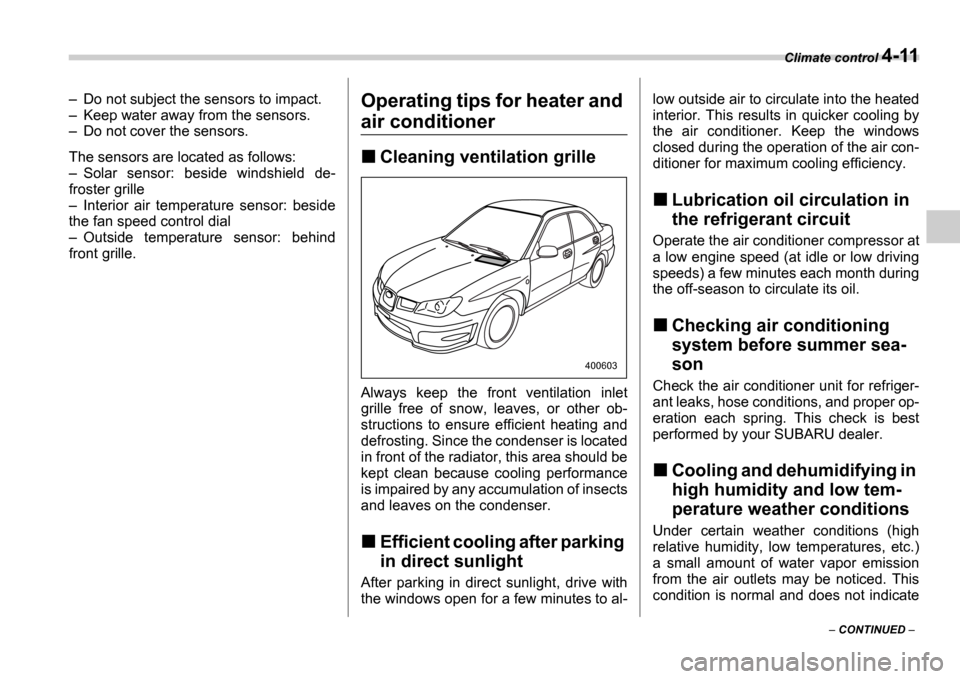
The sensors are located as follows: Solar sensor: beside windshield de-
froster grille Interior air temperature sensor: beside
the fan speed control dial Outside temperature sensor: behind
front grille.
Operating tips for heater and
air conditioner
Cleaning ventilation grille
Always keep the front ventilation inlet
grille free of snow, leaves, or other ob-
structions to ensure efficient heating and
defrosting. Since the condenser is located
in front of the radiator, this area should be
kept clean because cooling performance
is impaired by any accumulation of insects
and leaves on the condenser.
Efficient cooling after parking
in direct sunlight
After parking in direct sunlight, drive with
the windows open for a few minutes to al- low outside air to circulate into the heated
interior. This results in quicker cooling by
the air conditioner. Keep the windows
closed during the operation of the air con-
ditioner for maximum cooling efficiency.
Lubrication oil circulation in
the refrigerant circuit
Operate the air conditioner compressor at
a low engine speed (at idle or low driving
speeds) a few minutes each month during
the off-season to circulate its oil.
Checking air conditioning
system before summer sea-
son
Check the air conditioner unit for refriger-
ant leaks, hose conditions, and proper op-
eration each spring. This check is best
performed by your SUBARU dealer.
Cooling and dehumidifying in
high humidity and low tem-
perature weather conditions
Under certain weather conditions (high
relative humidity, low temperatures, etc.)
a small amount of water vapor emission
from the air outlets may be noticed. This
condition is normal and does not indicate
400603
Page 161 of 365
4-12 Climate control
any problem with the air conditioning sys-
tem.
Air conditioner compressor
shut-off when engine is
heavily loaded
To improve acceleration and gas mileage,
the air conditioner compressor is de-
signed to temporarily shut off during air
conditioner operation whenever the accel-
erator is fully depressed such as during
rapid acceleration or when driving on a
steep upgrade.
Refrigerant for your climate
control system
Your air conditioner uses ozone friendly
refrigerant HFC134a. Therefore, the
method of adding, changing or checking
the refrigerant is different from the method
for CFC12 (Freon). Consult your
SUBARU dealer for service. Repairs
needed as a result of using the wrong re-
frigerant are not covered under warranty.
Air filtration system
If your vehicle s air conditioning system is
equipped with an air filtration system, re-
place the filter element according to the
replacement schedule shown in the fol-
lowing. This schedule should be followed
to maintain the filter s dust collection abili-
ty. Under extremely dusty conditions, the
filter should be replaced more frequently.
It is recommended that you have your fil-
ter checked or replaced by your SUBARU
dealer. For replacement, use only a genu-
ine SUBARU air filter kit.
Replacement schedule:
Every 12 months or 7,500 miles (12,000
km) whichever comes first
Replacing an air filter
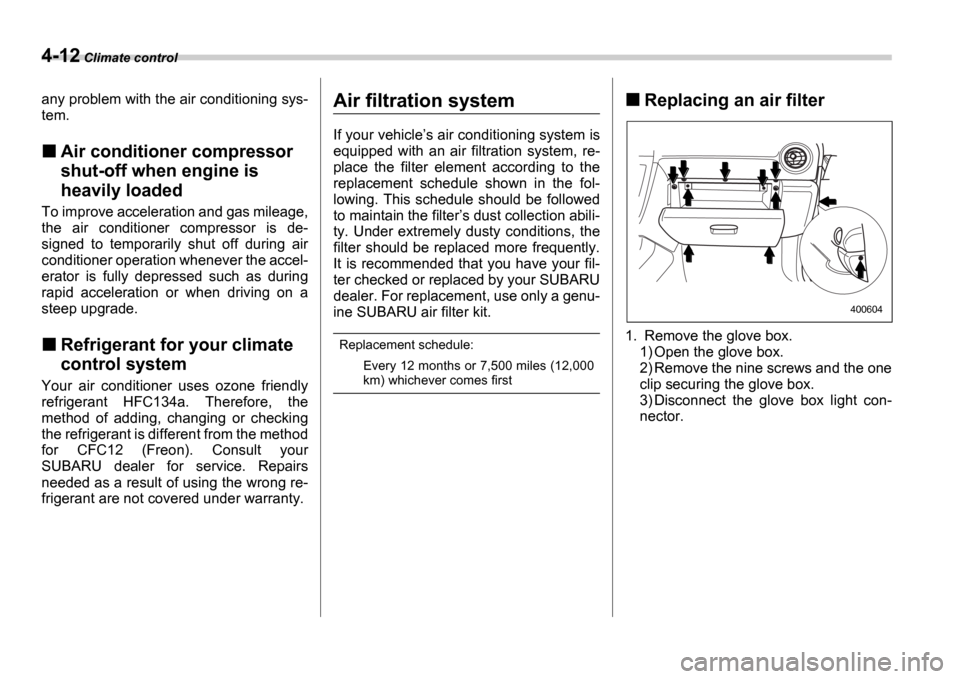
1. Remove the glove box.1) Open the glove box.
2) Remove the nine screws and the one
clip securing the glove box.
3) Disconnect the glove box light con-
nector.
400604
Page 162 of 365
Climate control 4-13
CONTINUED
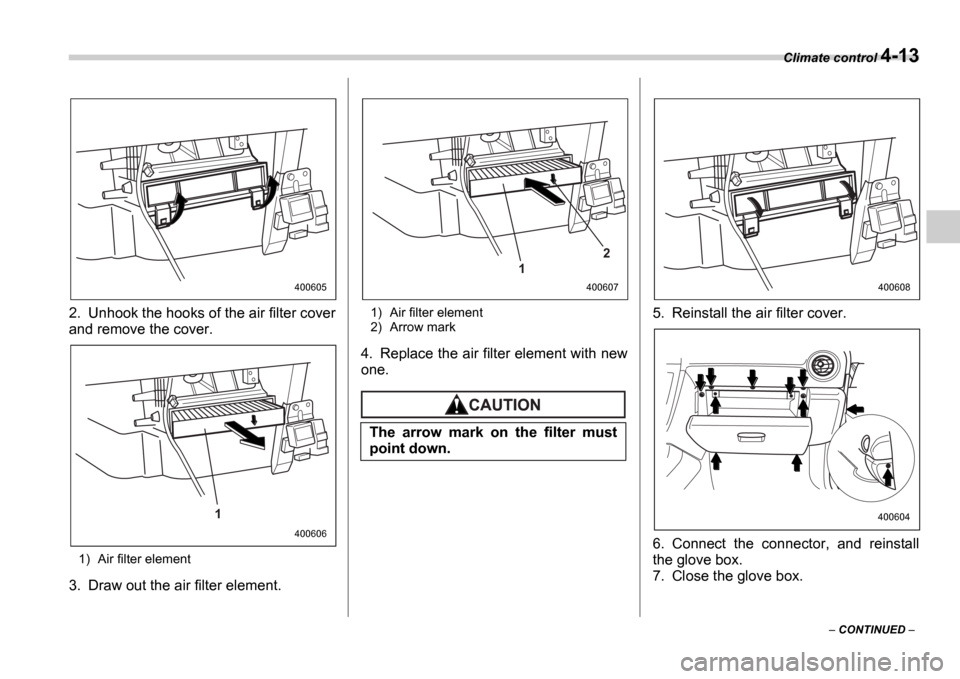
2. Unhook the hooks of the air filter cover
and remove the cover.
1) Air filter element
3. Draw out the air filter element.
1) Air filter element
2) Arrow mark
4. Replace the air filter element with new
one.
5. Reinstall the air filter cover.
6. Connect the connector, and reinstall
the glove box.
7. Close the glove box.
400605
1
400606
The arrow mark on the filter must
point down.
1
2
400607400608
400604
Page 163 of 365
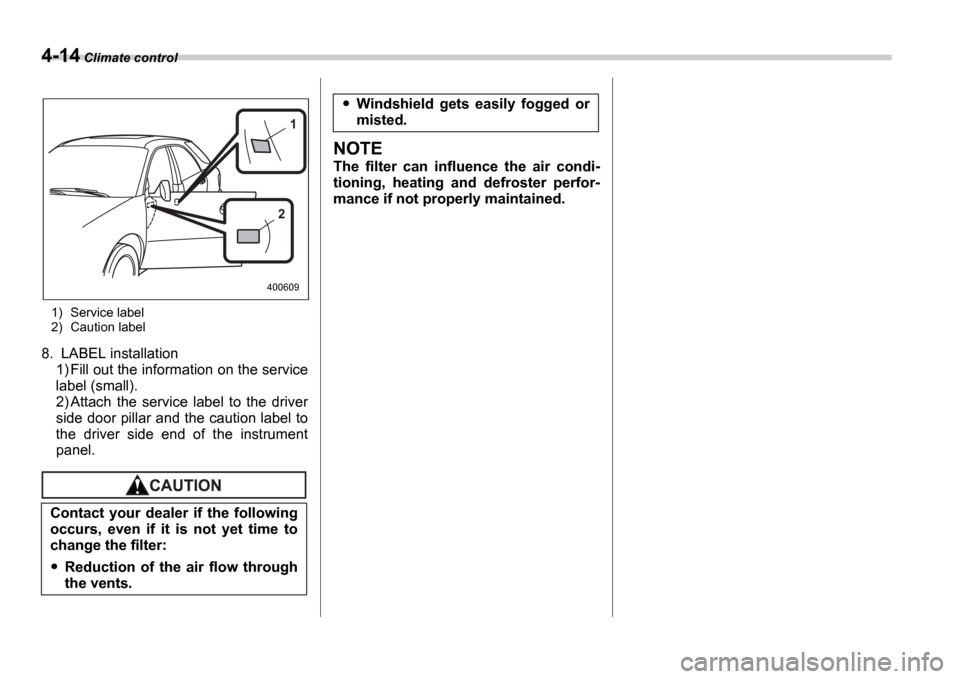
4-14 Climate control
1) Service label
2) Caution label
8. LABEL installation
1) Fill out the information on the service
label (small).
2) Attach the service label to the driver
side door pillar and the caution label to
the driver side end of the instrument
panel.
NOTE
The filter can influence the air condi-
tioning, heating and defroster perfor-
mance if not properly maintained.
Contact your dealer if the following
occurs, even if it is not yet time to
change the filter:
Reduction of the air flow through
the vents.
2 1
400609
Windshield gets easily fogged or
misted.
Page 193 of 365
6-8 Interior equipment
If the socket has been used for electrical
appliances, damage may have been done
to the internal mechanism that causes a
cigarette lighter to pop out after its ele-
ment has been heated. For that reason, a
cigarette lighter, even if it is a genuine
part, should not be used in the socket. If
you want to use the socket for a cigarette
lighter again, or to protect your purchaser
before you sell your vehicle, have your
SUBARU dealer replace the socket with a
new one.
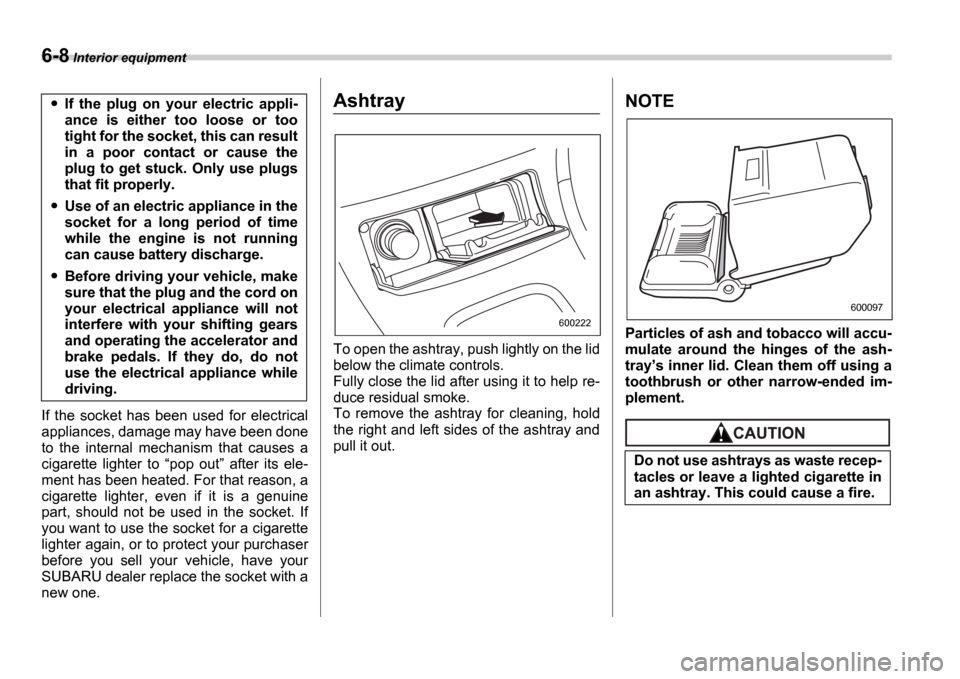
Ashtray
To open the ashtray, push lightly on the lid
below the climate controls.
Fully close the lid after using it to help re-
duce residual smoke.
To remove the ashtray for cleaning, hold
the right and left sides of the ashtray and
pull it out.
NOTE
Particles of ash and tobacco will accu-
mulate around the hinges of the ash-
tray s inner lid. Clean them off using a
toothbrush or other narrow-ended im-
plement.
If the plug on your electric appli-
ance is either too loose or too
tight for the socket, this can result
in a poor contact or cause the
plug to get stuck. Only use plugs
that fit properly.
Use of an electric appliance in the
socket for a long period of time
while the engine is not running
can cause battery discharge.
Before driving your vehicle, make
sure that the plug and the cord on
your electrical appliance will not
interfere with your shifting gears
and operating the accelerator and
brake pedals. If they do, do not
use the electrical appliance while
driving.
600222
Do not use ashtrays as waste recep-
tacles or leave a lighted cigarette in
an ashtray. This could cause a fire.
600097
Page 274 of 365
10
Appearance care
Exterior care ....................................................... 10-2
Washing ........................................... ........................ 10-2
Waxing and polishing .............................. ............... 10-3
Cleaning aluminum wheels .......................... .......... 10-3
Corrosion protection .............................. ............ 10-4
Most common causes of corrosion ................... ... 10-4
To help prevent corrosion ......................... ............ 10-4
Cleaning the interior ............................. ............. 10-5
Seat fabric ....................................... ........................ 10-5
Leather seat materials ............................ ................ 10-5
Synthetic leather upholstery ...................... ........... 10-5
Climate control panel, audio panel, instrument panel, console panel, and switches ............... ... 10-6
Page 278 of 365

Appearance care 10-5
CONTINUED
soon as you find them.
Check the interior of the vehicle for water
and dirt accumulation under the floor mats
because that could cause corrosion. Oc-
casionally check under the mats to make
sure the area is dry.
Keep your garage dry. Do not park your
vehicle in a damp, poorly ventilated ga-
rage. In such a garage, corrosion can be
caused by dampness. If you wash the ve-
hicle in the garage or put the vehicle into
the garage when wet or covered with
snow, that can cause dampness.
If your vehicle is operated in cold weather
and/or in areas where road salts and other
corrosive materials are used, the door
hinges and locks, trunk lid lock, and hood
latch should be inspected and lubricated
periodically.
Cleaning the interior
Use a soft, damp cloth to clean the climate
control panel, audio equipment, instru-
ment panel, center console, combination
meter panel, and switches. (Do not use or-
ganic solvents.)
Seat fabric
Remove loose dirt, dust or debris with a
vacuum cleaner. If the dirt is caked on the
fabric or hard to remove with a vacuum
cleaner, use a soft blush then vacuum it.
Wipe the fabric surface with a tightly
wrung cloth and dry the seat fabric thor-
oughly. If the fabric is still dirty, wipe using
a solution of mild soap and lukewarm wa-
ter then dry thoroughly.
If the stain does not come out, try a com-
mercially-available fabric cleaner. Use the
cleaner on a hidden place and make sure
it does not affect the fabric adversely. Use
the cleaner according to its instructions.
NOTE
When cleaning the seat, do not use
benzine, paint thinner, or any similar
materials.
Leather seat materials
The leather used by SUBARU is a high
quality natural product which will retain its
distinctive appearance and feel for many
years with proper care.
Allowing dust or road dirt to build up on the
surface can cause the material to become
brittle and to wear prematurely. Regular
cleaning with a soft, moist, natural fiber
cloth should be performed monthly, taking
care not to soak the leather or allow water
to penetrate the stitched seams.
A mild detergent suitable for cleaning
woolen fabrics may be used to remove dif-
ficult dirt spots, rubbing with a soft, dry
cloth afterwards to restore the luster. If
your SUBARU is to be parked for a long
time in bright sunlight, it is recommended
that the seats and headrests be covered,
or the windows shaded, to prevent fading
or shrinkage.
Minor surface blemishes or bald patches
may be treated with a commercial leather
spray lacquer. You will discover that each
leather seat section will develop soft folds
or wrinkles, which is characteristic of gen-
uine leather.
Synthetic leather upholstery
The synthetic leather material used on the
SUBARU may be cleaned using mild soap
or detergent and water, after first vacuum-
ing or brushing away loose dirt. Allow the
soap to soak in for a few minutes and wipe
Page 279 of 365
10-6 Appearance care
off with a clean, damp cloth. Commercial
foam-type cleaners suitable for synthetic
leather materials may be used when nec-
essary.
NOTE
Strong cleaning agents such as sol-
vents, paint thinners, window cleaner
or gasoline must never be used on
leather or synthetic interior materials.
Climate control panel, audio
panel, instrument panel, con-
sole panel, and switches
Use a soft, damp cloth to clean the climate
control panel, audio equipment, instru-
ment panel, center console, combination
meter panel, and switches.
NOTE
Do not use organic solvents such as
paint thinners or gasoline, or strong
cleaning agents that contain those sol-
vents.