2006 SUBARU IMPREZA WRX Turbo
[x] Cancel search: TurboPage 199 of 365
7-2 Starting and operating
Starting and operatingFuel
Fuel requirements
2.5-liter non-turbo models
The 2.5-liter non-turbo engine is designed
to operate using unleaded gasoline with
an octane rating of 87 AKI or higher.
WRX
The 2.5-liter turbo engine is designed to
operate using premium unleaded gasoline
with an octane rating of 91 AKI or higher.
If premium unleaded gasoline is not avail-
able, regular unleaded gasoline with an
octane rating of 87 AKI or higher may be
temporarily used. For optimum engine
performance and driveability, it is required
that you use premium grade unleaded
gasoline.
NOTE
Be sure to use premium unleaded gas-
oline of 91 AKI or higher for WRX. If
other gasoline (lower than 91 AKI) is
used, knocking, reduced output and poor accelerator response will result.
WRX-STI
The 2.5-liter turbo engine is designed to
operate using super-premium unleaded
gasoline with an octane rating of 93 AKI or
higher. If super-premium unleaded gaso-
line with an octane rating of 93 AKI or
higher is not available, premium unleaded
gasoline with an octane rating of 91 AKI or
higher may be temporarily used. For opti-
mum engine performance and driveability,
it is required that you use super-premium
grade unleaded gasoline with an octane
rating of 93 AKI or higher.
NOTE
Be sure to use super-premium unlead-
ed gasoline of 93 AKI or higher for
WRX-STI. If other gasoline (lower than
93 AKI) is used, knocking, reduced out-
put and poor accelerator response will
result.
Fuel octane rating
This octane rating is the average of the
Research Octane and Motor Octane num-
bers and is commonly referred to as the
Anti Knock Index (AKI).
Using a gasoline with a lower octane rat-
ing can cause persistent and heavy
knocking, which can damage the engine.
Do not be concerned if your vehicle some- times knocks lightly when you drive up a
hill or when you accelerate. See your
dealer or a qualified service technician if
you use a fuel with the specified octane
rating and your vehicle knocks heavily or
persistently.
Unleaded gasoline
The neck of the fuel filler pipe is designed
to accept only an unleaded gasoline filler
nozzle. Under no circumstances should
leaded gasoline be used because it will
damage the emission control system and
may impair driveability and fuel economy.
Gasoline for California-certified LEV
Your vehicle was certified to California s
low emission vehicle (LEV) standards as
indicated on the underhood tune-up label,
it is designed to optimize engine and
emission performance with gasoline that
meets the clean burning low-sulfur Califor-
nia gasoline specifications. If you live in
any other state than California, your vehi-
cle will operate on gasoline meeting Fed-
eral specifications. Gasoline sold outside
California is permitted to have higher sul-
fur levels, which may affect the perfor-
mance of your vehicle s catalytic convert-
er and may produce a sulfur exhaust odor
or smell. SUBARU recommends that you
try a different brand of unleaded gasoline
having lower sulfur to determine if the
Use of a fuel which is low in quality
or use of an inappropriate fuel addi-
tive may cause engine damage.
Page 201 of 365
7-4 Starting and operating
Fuel filler lid and cap
Refueling0
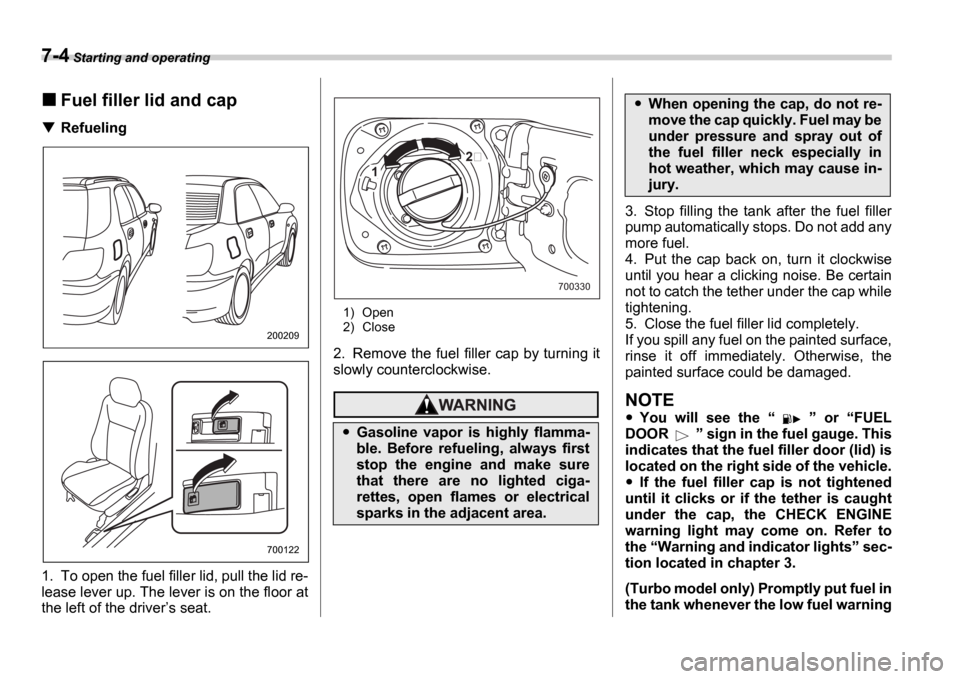
1. To open the fuel filler lid, pull the lid re-
lease lever up. The lever is on the floor at
the left of the driver s seat.
1) Open
2) Close
2. Remove the fuel filler cap by turning it
slowly counterclockwise.
3. Stop filling the tank after the fuel filler
pump automatically stops. Do not add any
more fuel.
4. Put the cap back on, turn it clockwise
until you hear a clicking noise. Be certain
not to catch the tether under the cap while
tightening.
5. Close the fuel filler lid completely.
If you spill any fuel on the painted surface,
rinse it off immediately. Otherwise, the
painted surface could be damaged.
NOTE
You will see the or FUEL
DOOR sign in the fuel gauge. This
indicates that the fuel filler door (lid) is
located on the right side of the vehicle.
If the fuel filler cap is not tightened
until it clicks or if the tether is caught
under the cap, the CHECK ENGINE
warning light may come on. Refer to
the Warning and indicator lights sec-
tion located in chapter 3.
(Turbo model only) Promptly put fuel in
the tank whenever the low fuel warning
200209
700122
Gasoline vapor is highly flamma-
ble. Before refueling, always first
stop the engine and make sure
that there are no lighted ciga-
rettes, open flames or electrical
sparks in the adjacent area.
1
700330
When opening the cap, do not re-
move the cap quickly. Fuel may be
under pressure and spray out of
the fuel filler neck especially in
hot weather, which may cause in-
jury.
Page 208 of 365
Starting and operating 7-11
CONTINUED
Manual transmission 5
speeds (except WRX-STI)
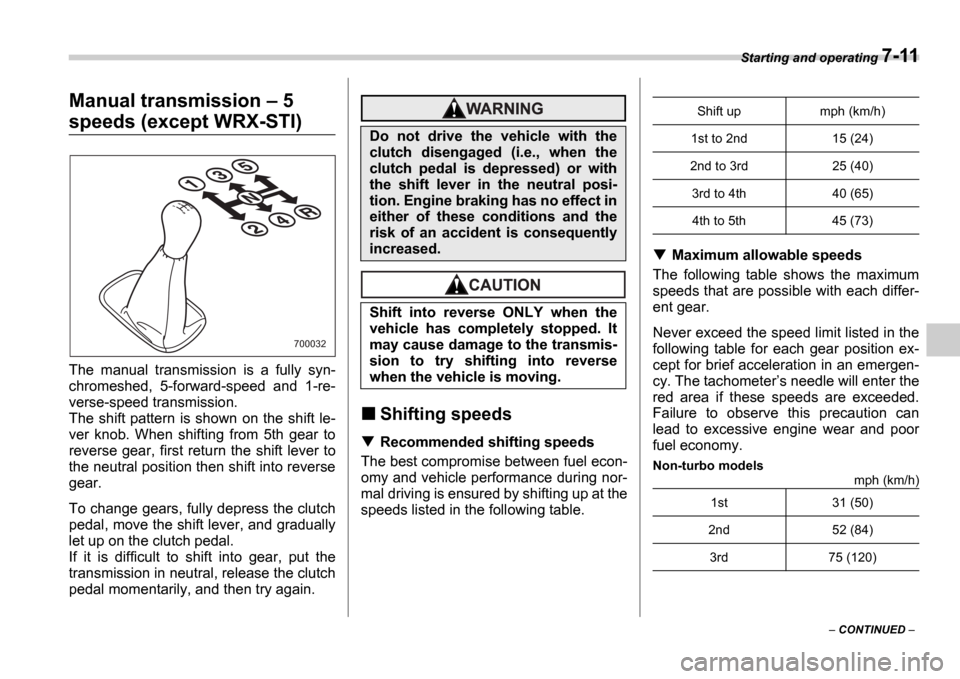
The manual transmission is a fully syn-
chromeshed, 5-forward-speed and 1-re-
verse-speed transmission.
The shift pattern is shown on the shift le-
ver knob. When shifting from 5th gear to
reverse gear, first return the shift lever to
the neutral position then shift into reverse
gear.
To change gears, fully depress the clutch
pedal, move the shift lever, and gradually
let up on the clutch pedal.
If it is difficult to shift into gear, put the
transmission in neutral, release the clutch
pedal momentarily, and then try again.
Shifting speeds
Recommended shifting speeds
The best compromise between fuel econ-
omy and vehicle performance during nor-
mal driving is ensured by shifting up at the
speeds listed in the following table.
Maximum allowable speeds
The following table shows the maximum
speeds that are possible with each differ-
ent gear.
Never exceed the speed limit listed in the
following table for each gear position ex-
cept for brief acceleration in an emergen-
cy. The tachometer s needle will enter the
red area if these speeds are exceeded.
Failure to observe this precaution can
lead to excessive engine wear and poor
fuel economy.
Non-turbo models mph (km/h)
700032
Do not drive the vehicle with the
clutch disengaged (i.e., when the
clutch pedal is depressed) or with
the shift lever in the neutral posi-
tion. Engine braking has no effect in
either of these conditions and the
risk of an accident is consequently
increased.
Shift into reverse ONLY when the
vehicle has completely stopped. It
may cause damage to the transmis-
sion to try shifting into reverse
when the vehicle is moving.
Shift up mph (km/h)
1st to 2nd 15 (24)
2nd to 3rd 25 (40) 3rd to 4th 40 (65)4th to 5th 45 (73)
1st 31 (50)
2nd 52 (84)
3rd 75 (120)
Page 209 of 365
7-12 Starting and operating
Turbo models
mph (km/h)
Driving tips
Do not drive with your foot resting on the
clutch pedal and do not use the clutch to
hold your vehicle at a standstill on an up-
grade. Either of those actions may cause clutch damage.
Do not drive with your hand resting on the
shift lever. This may cause wear on the
transmission components.
When it is necessary to reduce vehicle
speed due to slow traffic, turning corners,
or driving up steep hills, downshift to a
lower gear before the engine starts to la-
bor.
On steep downgrades, downshift the
transmission to 4th, 3rd or 2nd gear as
necessary; this helps to maintain a safe
speed and to extend brake pad life.
In this way, the engine provides a braking
effect. Remember, if you
ride (over use)
the brakes while descending a hill, they
may overheat and not work properly.
The engine may, on rare occasions, knock
when the vehicle rapidly accelerates or
rapidly pulls away from a standstill. This
phenomenon is not an indication of a
problem in your vehicle.
Driver s Control Center Dif-
ferential (DCCD) (WRX-STI)1st 34 (54)
2nd 59 (95)
3rd 85 (136)
When shifting down a gear, ensure
that the vehicle is not travelling at a
speed exceeding the Maximum Al-
lowable Speed for the gear which is
about to be selected. Failure to ob-
serve this precaution can lead to en-
gine over-revving and this in turn
can result in engine damage.
In addition, sudden application of
engine brakes when the vehicle is
travelling on a slippery surface can
lead to wheel locking; as a conse-
quence, control of the vehicle may
be lost and the risk of an accident in-
creased.
Always use the utmost care when
driving. Being overconfident be-
cause you are driving a vehicle with
a driver s control center differential
could easily lead to a serious acci-
dent.
700379
Page 215 of 365
7-18 Starting and operating
the original gear position.
While climbing a grade
When driving up hill, undesired upshift to
4th gear is prevented from taking place
when the accelerator pedal is released.
This minimizes the chances of subse-
quent downshifting to a lower gear when
accelerating again. This prevents repeat-
ed upshifting and downshifting resulting in
a smoother operation of the vehicle.
NOTE
The transmission may downshift to
2nd or 1st gear, depending on the way
the accelerator pedal is pressed to ac-
celerate the vehicle again.
While going down a hill
When descending a steep hill, depressing
the brake pedal will cause the transmis-
sion to downshift to 3rd gear, thus apply-
ing engine braking. Reacceleration for a
short time will cause the transmission to
upshift normally.
NOTE
In some cases, depressing the brake
pedal on a downhill grade does not re-
sult in an automatic downshift to 3rd
gear. This can happen when the auto-
matic transmission fluid temperature is
very low, for example, during driving shortly after the vehicle has been
parked for an extended period of time.
When the ATF temperature has risen to
a certain level, automatic downshift
normally takes place. In the meantime,
downshift manually for engine braking
as required.
Also, downshifting when braking
downhill will not occur at speeds
above approximately 48 mph (78 km/h).
3 (Third)
This position is for using engine braking
when going down a hill or for climbing a
grade.
The transmission automatically shifts into
a suitable gear from 1st to 3rd according
to the vehicle speed and the acceleration
you require.
When more acceleration is required in this
position, press the accelerator pedal fully
to the floor and hold that position. The
transmission will automatically downshift
to 2nd or 1st gear. When you release the
pedal, the transmission will return to the
original gear position.
2 (Second)
This position is for using engine braking
when going down a hill or for climbing a
steep grade.
In this position, the transmission holds in the 2nd gear.
Use this position when starting off from a
standstill on slippery road surfaces such
as mud or snow. It will ensure greater trac-
tion.
1 (First)
This position is for driving up or down very
steep grades, or driving through mud or
sand, or on slippery surfaces. In this posi-
tion, the transmission holds in the 1st
gear.
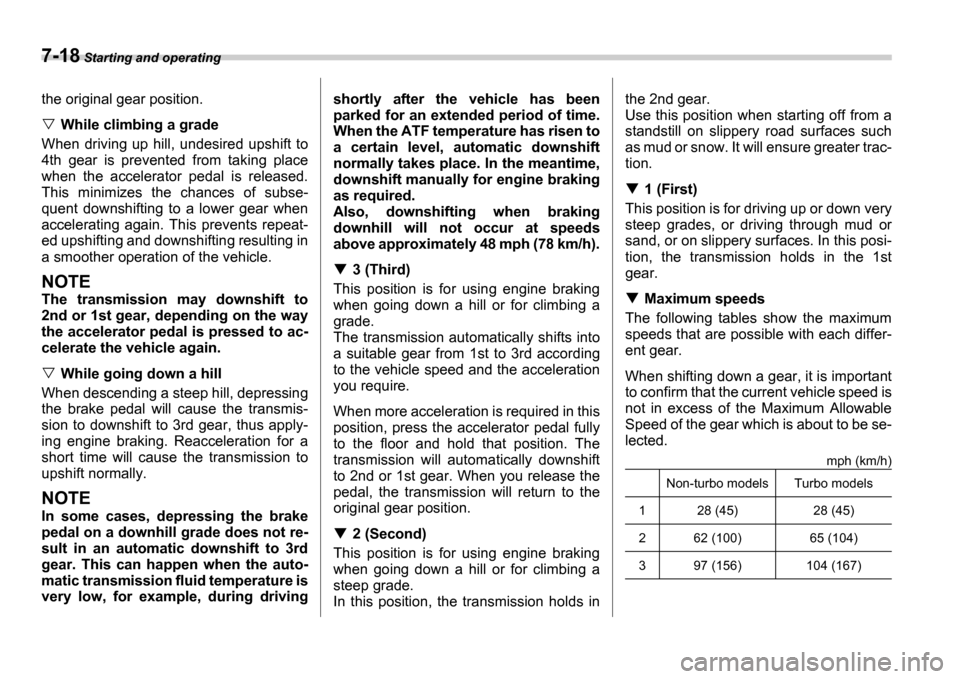
Maximum speeds
The following tables show the maximum
speeds that are possible with each differ-
ent gear.
When shifting down a gear, it is important
to confirm that the current vehicle speed is
not in excess of the Maximum Allowable
Speed of the gear which is about to be se-
lected.
mph (km/h)
Non-turbo models Turbo models
1 28 (45) 28 (45)
2 62 (100) 65 (104)
3 97 (156) 104 (167)
Page 230 of 365
Driving tips 8-3
CONTINUED
NOTE
Due to the expansion and contraction
of the metals used in the manufacture
of the exhaust system, you may hear a
crackling sound coming from the ex-
haust system for a short time after the
engine has been shut off. This sound is
normal.
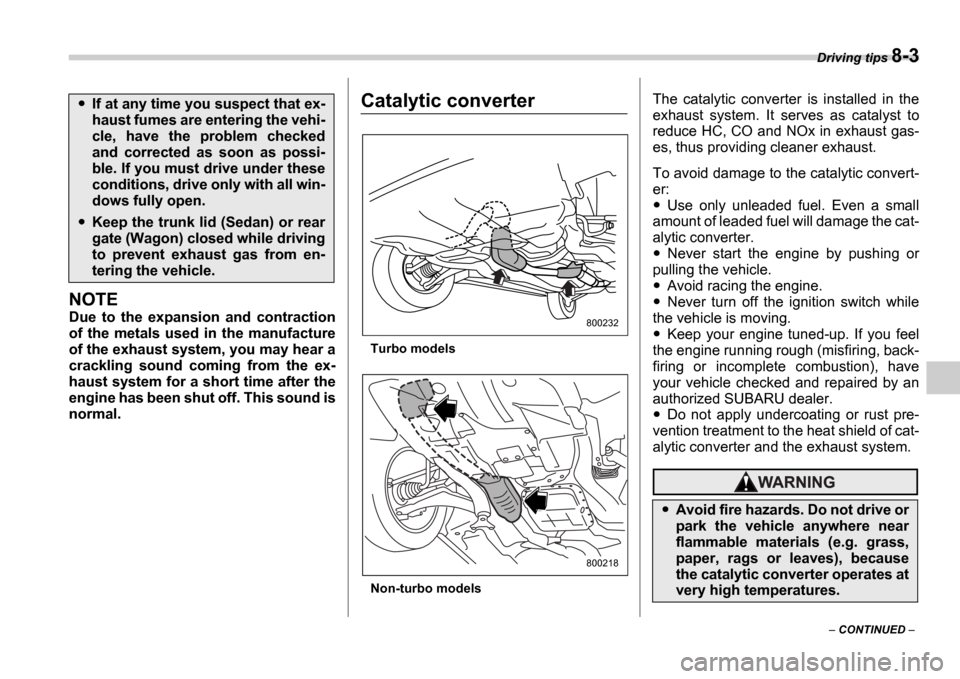
Catalytic converter
Turbo models
Non-turbo modelsThe catalytic converter is installed in the
exhaust system. It serves as catalyst to
reduce HC, CO and NOx in exhaust gas-
es, thus providing cleaner exhaust.
To avoid damage to the catalytic convert-
er:
Use only unleaded fuel. Even a small
amount of leaded fuel will damage the cat-
alytic converter.
Never start the engine by pushing or
pulling the vehicle.
Avoid racing the engine.
Never turn off the ignition switch while
the vehicle is moving.
Keep your engine tuned-up. If you feel
the engine running rough (misfiring, back-
firing or incomplete combustion), have
your vehicle checked and repaired by an
authorized SUBARU dealer.
Do not apply undercoating or rust pre-
vention treatment to the heat shield of cat-
alytic converter and the exhaust system.
If at any time you suspect that ex-
haust fumes are entering the vehi-
cle, have the problem checked
and corrected as soon as possi-
ble. If you must drive under these
conditions, drive only with all win-
dows fully open.
Keep the trunk lid (Sedan) or rear
gate (Wagon) closed while driving
to prevent exhaust gas from en-
tering the vehicle.
800232
800218
Avoid fire hazards. Do not drive or
park the vehicle anywhere near
flammable materials (e.g. grass,
paper, rags or leaves), because
the catalytic converter operates at
very high temperatures.
Page 258 of 365
In case of emergency 9-3
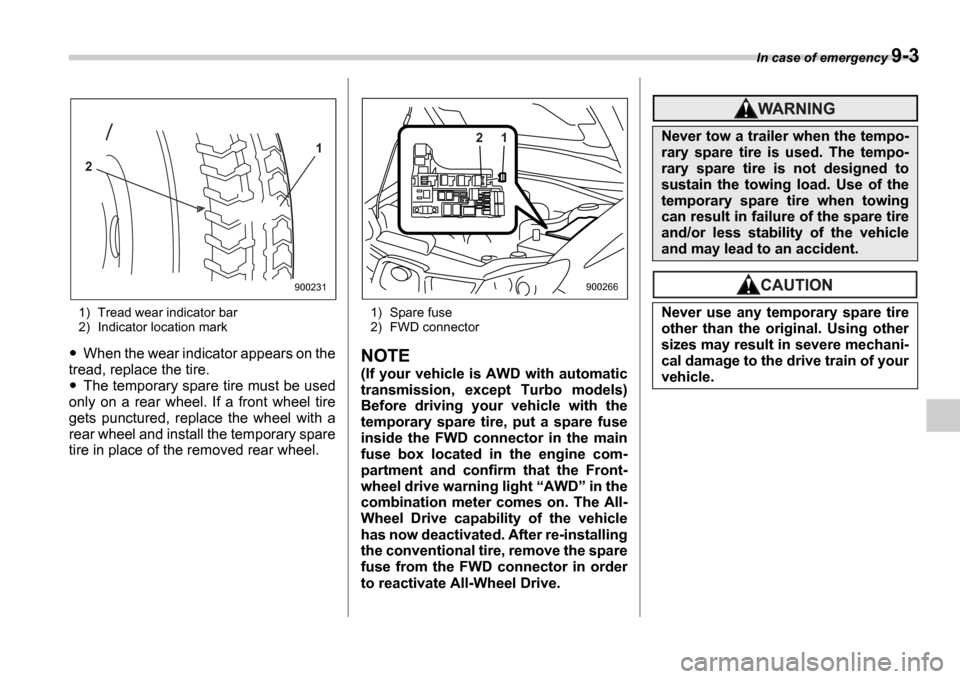
1) Tread wear indicator bar
2) Indicator location mark
When the wear indicator appears on the
tread, replace the tire.
The temporary spare tire must be used
only on a rear wheel. If a front wheel tire
gets punctured, replace the wheel with a
rear wheel and install the temporary spare
tire in place of the removed rear wheel.
1) Spare fuse
2) FWD connector
NOTE
(If your vehicle is AWD with automatic
transmission, except Turbo models)
Before driving your vehicle with the
temporary spare tire, put a spare fuse
inside the FWD connector in the main
fuse box located in the engine com-
partment and confirm that the Front-
wheel drive warning light AWD in the
combination meter comes on. The All-
Wheel Drive capability of the vehicle
has now deactivated. After re-installing
the conventional tire, remove the spare
fuse from the FWD connector in order
to reactivate All-Wheel Drive.
900231
1
22 1
900266
Never tow a trailer when the tempo-
rary spare tire is used. The tempo-
rary spare tire is not designed to
sustain the towing load. Use of the
temporary spare tire when towing
can result in failure of the spare tire
and/or less stability of the vehicle
and may lead to an accident.
Never use any temporary spare tire
other than the original. Using other
sizes may result in severe mechani-
cal damage to the drive train of your
vehicle.
Page 280 of 365

11
Maintenance and service
Maintenance schedule ....................................... 11-3
Maintenance precautions ........................... ....... 11-3
Before checking or servicing in the engine compartment ....................................... ................. 11-4
When you do checking or servicing in the engine
compartment while the engine is running ......... 11 -4
Engine hood ....................................... ................ 11-4
Engine compartment overview ....................... .. 11-6
Non-turbo models .................................. ................. 11-6
Turbo models ...................................... .................... 11-7
Engine oil ........................................ .................... 11-8
Checking the oil level ............................ ................. 11-8
Changing the oil and oil filter ................... ............. 11-8
Recommended grade and viscosity ................... .. 11-10
Recommended grade and viscosity under severe driving conditions ......................... ........... 11-11
Synthetic oil ..................................... ....................... 11-11
Cooling system .................................... .............. 11-12
Cooling fan, hose and connections ................. ..... 11-12
Engine coolant .................................... .................... 11-12
Air cleaner element ............................... ............. 11-15
Replacing the air cleaner element ................. ........ 11-15
Spark plugs ....................................... .................. 11-17
Recommended spark plugs ........................... ........ 11-17
Drive belts ....................................... .................... 11-18
Manual transmission oil ........................... ......... 11-18
Checking the oil level ............................ ................. 11-18
Recommended grade and viscosity ................... .. 11-19Automatic transmission fluid ......................
...... 11-20
Checking the fluid level .......................... ................ 11-20
Recommended fluid ................................. .............. 11-21
Front differential gear oil (AT vehicles) ......... ... 11-21
Checking the oil level ............................ ................. 11-21
Recommended grade and viscosity ................... .. 11-22
Rear differential gear oil ........................ ............ 11-22
Checking the gear oil level ....................... ............. 11-22
Recommended grade and viscosity ................... .. 11-23
Power steering fluid .............................. ............. 11-24
Checking the fluid level .......................... ................ 11-24
Recommended fluid ................................. .............. 11-24
Brake fluid ....................................... .................... 11-25
Checking the fluid level .......................... ................ 11-25
Recommended brake fluid ........................... .......... 11-25
Clutch fluid (MT vehicles) ........................ .......... 11-26
Checking the fluid level .......................... ................ 11-26
Recommended clutch fluid .......................... .......... 11-26
Brake booster ..................................... ................ 11-27
Brake pedal ....................................... .................. 11-27
Checking the brake pedal free play ................ ...... 11-27
Checking the brake pedal reserve distance ......... 11-27
Clutch pedal (MT vehicles) ........................ ........ 11-28
Checking the clutch function ...................... .......... 11-28
Checking the clutch pedal free play ............... ...... 11-28
Replacement of brake pad and lining ............... 11-28
Breaking-in of new brake pads and linings ......... . 11-29
Parking brake stroke .............................. ............ 11-29