2006 SUBARU BAJA fuel cap
[x] Cancel search: fuel capPage 313 of 487
8-20
Driving tips
door shows GVWR (Gross Vehicle Weight Rating)
and GAWR (Gross Axle Weight Rating).
The GVW (Gross Vehicle Weight) must never exceed
the GVWR. GVW is the combined total of weight of the
vehicle, fuel, driver, all
passengers, luggage, any op-
tional equipment and trailer tongue load. Therefore,
the GVW changes depending on the situation.
In addition, the total weight applied to each axle
(GAW) must never exceed the GAWR. The front and
rear GAWs can be adjusted by relocating luggage in- side the vehicle.
Even if the total weight of your luggage is lower than
the vehicle capacity weight, either front or rear GAW
may exceed the GAWR, depending on the distribution
of the luggage.
When possible, the load should be evenly distributed
throughout the vehicle.
If you carry heavy loads in the vehicle, you should con-
firm that GVW and front and rear GAWs are within the
GVWR and GAWR by putting your vehicle on a vehi-
cle scale, found at a commercial weighing station.
Do not use replacement tires with a lower load range
than the originals because they may lower the GVWR
and GAWR limitations. Replacement tires with a high-
er load range than the originals do not increase the
GVWR and GAWR limitations.Trailer hitch (if equipped)
y Never exceed the maximum weight specified
for the trailer hitch. Exceeding the maximum
weight could cause an accident resulting in se-
rious personal injuries. Permissible trailer
weight changes depending on the situation. Re-
fer to the next section “Trailer towing” for pos-
sible recommendations and limitations. y Trailer brakes are required when the towing
load exceeds 1,000 lbs (453 kg). Be sure your
trailer has safety chains and that each chain
will hold the trailer’s maximum gross weight.
Towing trailers without safety chains could cre-
ate a traffic safety hazard if the trailer separates
from the hitch due to coupling damage or hitch
ball damage. y Be sure to check the hitch pin and safety pin
for positive locking placement before towing a
trailer. If the ball moun t comes off the hitch re-
ceiver, the trailer could get loose and create a
traffic safety hazard.y Use only the ball mount supplied with this
hitch. Use the hitch only as a weight carrying
hitch. Do not use with any type of weight dis-
Page 381 of 487
11 - 1 6
Maintenance and service
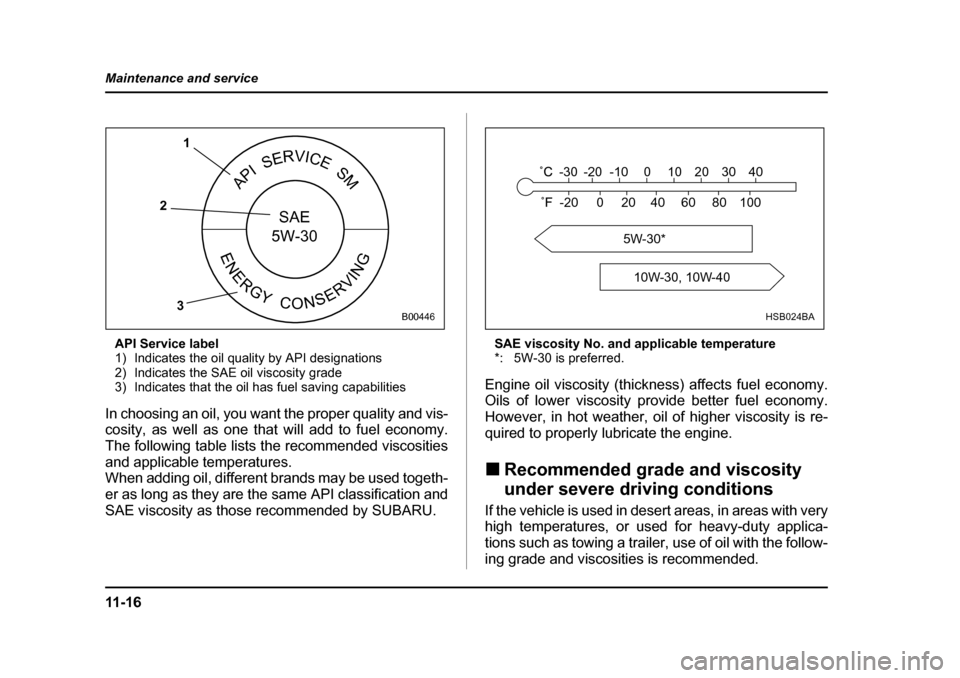
API Service label
1) Indicates the oil quality by API designations
2) Indicates the SAE oil viscosity grade
3) Indicates that the oil
has fuel saving capabilities
In choosing an oil, you want the proper quality and vis-
cosity, as well as one that will add to fuel economy.
The following table lists the recommended viscosities
and applicable temperatures.
When adding oil, different brands may be used togeth-
er as long as they are the same API classification and
SAE viscosity as those recommended by SUBARU. SAE viscosity No. and applicable temperature
*: 5W-30 is preferred.
Engine oil viscosity (thickness) affects fuel economy.
Oils of lower viscosity pr ovide better fuel economy.
However, in hot weather, oil of higher viscosity is re-
quired to properly lubricate the engine. „ Recommended grade and viscosity
under severe driving conditions
„Recommended
„ Oil grade and viscosityIf the vehicle is used in desert areas, in areas with very
high temperatures, or used for heavy-duty applica-
tions such as towing a trailer, use of oil with the follow-
ing grade and viscosities is recommended.
APISERVICESM
ENERGYCONSERVING
SAE
5W-30
1
2
3
B00446
5W-30*10W-30, 10W-40
-30 -20 -10 0 10 20 30 40
-20
06 0
20 80 100 40
HSB024BA
Page 383 of 487
11 - 1 8
Maintenance and service
ed parts. The alcohol contained in the engine
coolant may damage the paint surface.
„ Hose and connections
„Hose and connectionsYour vehicle employs an electric cooling fan which is
thermostatically controlled to operate when the engine
coolant reaches a s pecific temperature.
If the radiator cooling f an does not operate even when
the engine coolant temperature gauge exceeds the
normal operating range, the cooling fan circuit may be
defective. Check the fuse and replace it if necessary.
If the fuse is not blown, have the cooling system
checked by your SUBARU dealer.
If frequent addition of coolant is necessary, there may
be a leak in th e engine cooling syst em. It is recom-
mended that the cooling system and connections be
checked for leaks, damage, or looseness. „
Engine coolant
„
Engine
„ Coolant
TChecking the coolant level
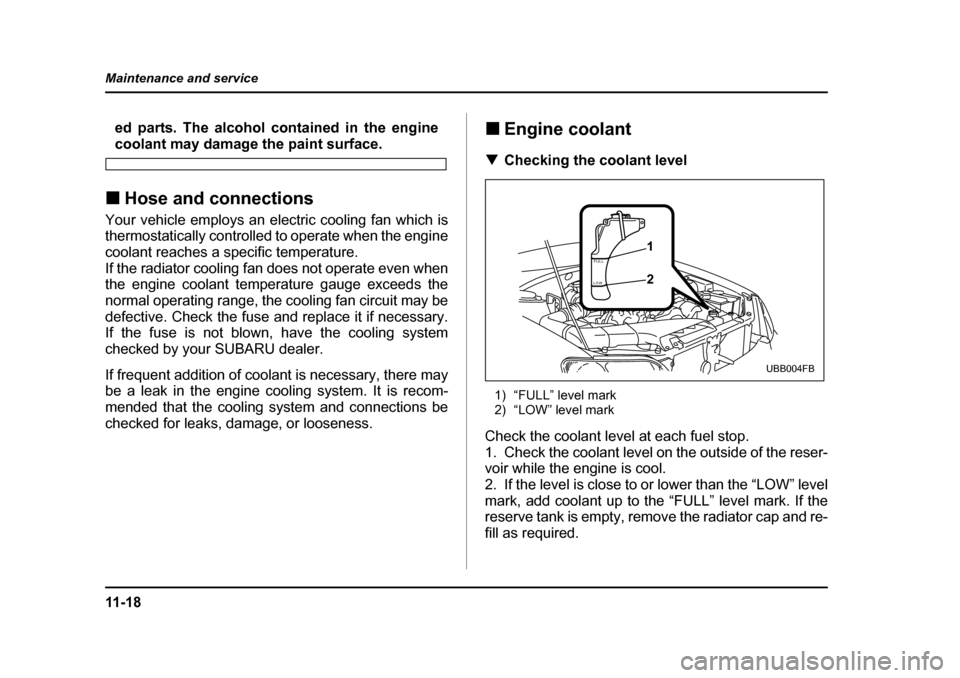
1) “FULL” level mark
2) “LOW” level mark
Check the coolant level at each fuel stop.
1. Check the coolant level on the outside of the reser-
voir while the engine is cool.
2. If the level is close to or lower than the “LOW” level
mark, add coolant up to the “FULL” level mark. If the
reserve tank is empty, remove the radiator cap and re-
fill as required.
FULL
LOW1 2
UBB004FB
Page 418 of 487
11 -5 3
Maintenance and service
– CONTINUED –
Aluminum wheelsAluminum wheels
Aluminum wheels can be scratched and damaged
easily. Handle them carefully to maintain their appear-
ance, performance, and safety. yWhen any of the wheels is removed and replaced
for tire rotation or to c hange a flat, always check the
tightness of the wheel nuts after driving approximately
600 miles (1,000 km). If any nut is loose, tighten it to
the specified torque. y Never apply oil to the threaded parts, wheel nuts, or
tapered surface of the wheel.y Never let the wheel rub against sharp protrusions or
curbs. y Be sure to fit tire chains on uniformly and completely
around the tire, otherwise t he chains may scratch the
wheel. y When wheel nuts, balance weights, or the center
cap is replaced, be sure to replace them with genuine
SUBARU parts designed for aluminum wheels.
Windshield washer fluidWindshield
Washer fluid
Never use engine coolant as washer fluid be-
cause it could cause paint damage.
Check the level of the washer fluid at each fuel stop. If
the level is low, fill the fluid up to the neck of the reser- voir.
Use windshield washer fluid. If windshield washer fluid
is unavailable use clean water.
In areas where water freezes in winter, use an anti-
UBB004IA
Page 450 of 487
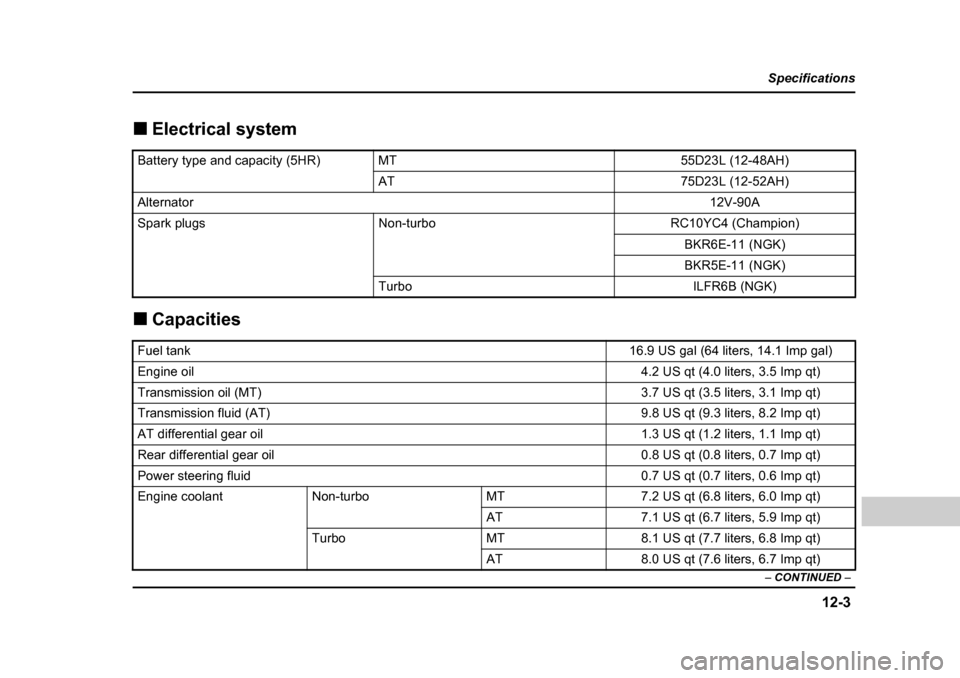
12-3
Specifications
– CONTINUED –
„Electrical system
„ Capacities
Battery type and capacity (5HR)MT55D23L (12-48AH)
AT75D23L (12-52AH)
Alternator12V-90A
Spark plugsNon-turboRC10YC4 (Champion)
BKR6E-11 (NGK)
BKR5E-11 (NGK)
TurboILFR6B (NGK)
Fuel tank16.9 US gal (64 liters, 14.1 Imp gal)
Engine oil4.2 US qt (4.0 liters, 3.5 Imp qt)
Transmission oil (MT)3.7 US qt (3.5 liters, 3.1 Imp qt)
Transmission fluid (AT)9.8 US qt (9.3 liters, 8.2 Imp qt)
AT differential gear oil1.3 US qt (1.2 liters, 1.1 Imp qt)
Rear differential gear oil0.8 US qt (0.8 liters, 0.7 Imp qt)
Power steering fluid0.7 US qt (0.7 liters, 0.6 Imp qt)
Engine coolantNon-turboMT7.2 US qt (6.8 liters, 6.0 Imp qt)
AT7.1 US qt (6.7 liters, 5.9 Imp qt)
TurboMT8.1 US qt (7.7 liters, 6.8 Imp qt)
AT8.0 US qt (7.6 liters, 6.7 Imp qt)
Page 479 of 487

14-4
Index
Differential gear oil
Front ........................................................... 11-32
Rear ............................................................ 11-33
Dimensions ........................................................ 12-2
Disarming the system ............................... 2-21, 2-23
Disc brake pad wear warning indicators ............ 7-32
Dome light ................................................ 6-2, 11-78
Door ajar warning lights ..................................... 3-15
Door locks ........................................................... 2-3
Drive belts ....................................................... 11-26
Driving
Car phone/cell phone ........................................ 8
Drinking ............................................................. 7
Drugs ................................................................. 7
Foreign countries ............. ............................... 8-6
Pets ................................................................... 8
Snowy and icy roads .................................... 8-13
Tips ..................................... 7-14, 7-19, 7-29, 8-7
Tired or sleepy ................................................... 8
E
Electrical system . ........................................... ... 12-3
Emergency Locking Retractor (ELR) ................. 1-16
Engine
Compartment overview ................................. 11-8
Coolant ....................................................... 11-18
Exhaust gas (Carbon monoxide) .................... 8-3 Hood ............................................................. 11-5
Oil ............................................................... 11-10
Overheating .................................................. 9-21
Starting ........................................................... 7-9
Stopping ....................................................... 7-11
Exterior care ..................... ................................. 10-2
F
Flat tires ............................................................ 9-12
Floor mat ........................................................... 6-15
Fluid level Automatic transmission ..... ......................... 11-29
Brake .......................................................... 11-38
Clutch ......................................................... 11-40
Power steering ........................................... 11-36
Folding down the rear seat ................................ 1-10
Front Differential gear oil ..................................... 11-32
Fog light ...................................................... 11-70
Fog light button ............................................. 3-24
Seatbelt pretensioners ................................. 1-24
Seats .............................................................. 1-2
Turn signal light, parking light and side
marker light .............................................. 11-71
Fuel ..................................................................... 7-2 Economy hints ................................................ 8-2
Filler door and cap .......................................... 7-4
Page 487 of 487

GAS STATION REFERENCE
Fuel: TNon-turbo models
Use only unleaded gasoline with an octane rat-
ing of 87 AKI or higher. T Turbo models
Use premium unleaded gasoline with an oc-
tane rating of 91 AKI or higher. If premium un-
leaded gasoline is not available, regular un-
leaded gasoline with octane rating of 87 AKI or
higher may be temporarily used. For optimum
engine performance and driveability, it is re-
quired that you use premium grade unleaded
gasoline. „ Fuel octane rating
This octane rating is the average of the Re-
search Octane and Motor Octane numbers and
is commonly referred to as the Anti Knock In- dex (AKI). Refer to “Fuel” section in this manu-
al.
Fuel capacity:
16.9 US gal (64 liters, 14.1 Imp gal) Engine oil:
Use only API classifica
tion SM with the words
“ENERGY CONSERVING” and the ILSAC cer-
tification mark (starburst mark) displayed on
the container (ILSAC GF-4). Engine oil capacity:
4.2 US qt (4.0 liters, 3.5 Imp qt)
Cold tire pressure:
Front 33 psi (230 kPa, 2.3 kgf/cm 2
)
Rear 33 psi (230 kPa, 2.3 kgf/cm 2
)