2006 SKODA OCTAVIA fog light
[x] Cancel search: fog lightPage 86 of 218

Setting the air conditioning system
Recommended basic settings of the control elements of the air conditioning sys-
tem for the respective operating modes:
Set-up Setting of the control dial
Button
Air outlet vents 3 A B C 1 4
Defrost/defog windscreen and
side windows
a) Desired tempera-
ture 3 or 4
Automatically
switched on Do not switch on Open and align with the side
window
The fastest heating To the right up to
the stop 3
Switched off Briefly switch on
Opening
Comfortable heating Desired tempera-
ture 2 or 3
Switched off Do not switch on
Opening
The fastest cooling To the left up to
the stop briefly 4, then
2 or 3 Activated Briefly switch on
Opening
Optimal cooling Desired tempera-
ture 1, 2 or 3
Activated Do not switch on Open and align to the roof
Fresh air mode - ventilation To the left up to
the stop Desired position
Switched off Do not switch on
Openinga)
We recommend that you do not use this setting in countries with high humidity levels. This can result in heavy cooling of the window glass and the following fogging from outside. Note
■ Controls A
» Fig. 89
on page 82, B
, C
and buttons 1
and 4
.
■ Air outlet vents 3 » Fig. 86 on page 80.
■ We recommend that you leave the air outlet vents 4 » Fig. 86 on page 80 in the
opened position. ÐRecirculated air mode
Recirculated air mode prevents polluted air outside the vehicle from getting into
the vehicle, for example when driving through a tunnel or when standing in a
traffic jam.
Switching on
› Press the button
4
» Fig. 89
on page 82 and the warning light in the but-
ton illuminates. Switching off
› Press the button
4
» Fig. 89
on page 82again - the warning light in the
button goes out.
Recirculated air mode is switched off automatically if the air distribution control C
» Fig. 89
on page 82 is turned to position . Recirculated air mode can be
switched on again from this setting by repeatedly pressing the button .
WARNING
Do not leave recirculated air mode on over a longer period of time, as “stale”
air can cause fatigue of the driver and passengers, reduce attention levels and
also cause the windows to mist up. The risk of having an accident increases.
Switch off recirculated air mode as soon as the windows start to mist up. Ð
84 Using the system
Page 159 of 218

■
Fuels with metallic content may not be used. There is a risk of causing consider-
able damage to parts of the engine or exhaust system!
■ The use of unsuitable fuel additives can cause considerable damage to parts of
the engine or the exhaust system. ÐEthanol E85
Fig. 130
MultiFuel - power socket
First read and observe the introductory information and safety warn-
ings on page 155.
Only valid for vehicles with the 1.6/75°kW MultiFuel engine.
Biofuel Ethanol E85 consists of 85 % bioethanol and 15 % unleaded petrol com-
plying with the standard (DIN) EN°228.
Biofuel Ethanol E85 in accordance with the standard (DIN) EN
228 can be mixed in
any desired ratio with unleaded petrol.
Drive the vehicle for at least 5 minutes without interruption, if biofuel Ethanol
E85 has been refuelled, so that the engine control unit can determine the share
of the biofuel in the fuel. During this period do not drive at top speed of your ve-
hicle or high engine speeds and not at full throttle. During this process decrease
the idling speed.
Operation in winter
If you use biofuel Ethanol E85 at very low temperatures, it is necessary to preheat
the engine before an engine start.
The power socket for the engine preheating is located in the front bumper next
to the fog light » Fig. 130.
ä The outside temperature
Duration of engine preheating
Below -10 °C We recommend up to 1 hour
Below -15 ℃ at least 1 hours.
Below -25 °C at least 2 hours. If an engine preheating is not possible at outside temperatures below -10 °C, the
share of unleaded petrol complying with EN 228 must be as high as possible.
Thus the cold start property of the engine is clearly improved.
If there is biofuel Ethanol E85 in the tank and the engine is not preheated, it can
lead at temperatures below -15 °C to very poor or no starting of the engine. CAUTION
■ Just filling the tank once with diesel fuel that does not comply with the stand-
ard, can cause severe damage to parts of the engine, the fuel and exhaust sys-
tem!
■ If you park the car for a lengthy period, fill with petrol complying with (DIN) EN
°228, because Ethanol E85 can contain low quantities of impurities, which can
lead to corrosion. For the sake of the environment
■ If you use Ethanol E85, the CO
2 emission of your vehicle is lowered up to 5 %.
■ The use of engine preheating at temperatures below -10 °C has a positive effect
on the fuel consumption and thus on the environment. Note
■ When operating with Ethanol E85, the fuel consumption increases by approx 33
%, as a lower quantity of energy is contained in the bioethanol than in unleaded
petrol. ■ Biofuel Ethanol E85 contains only a low quantity of additives in contrast to un-
leaded petrol. Therefore we recommend to fill up the tank with unleaded petrol
complying with EN 228 every 15 000 km (e.g. before the oil change) and run it
empty, so that the engine remains clean.
■ The interval of 15 000 km applies for the oil change.
■ An extension cable used for connecting to the electrical network is located in
the luggage compartment. Ð
157
Inspecting and replenishing
Page 181 of 218
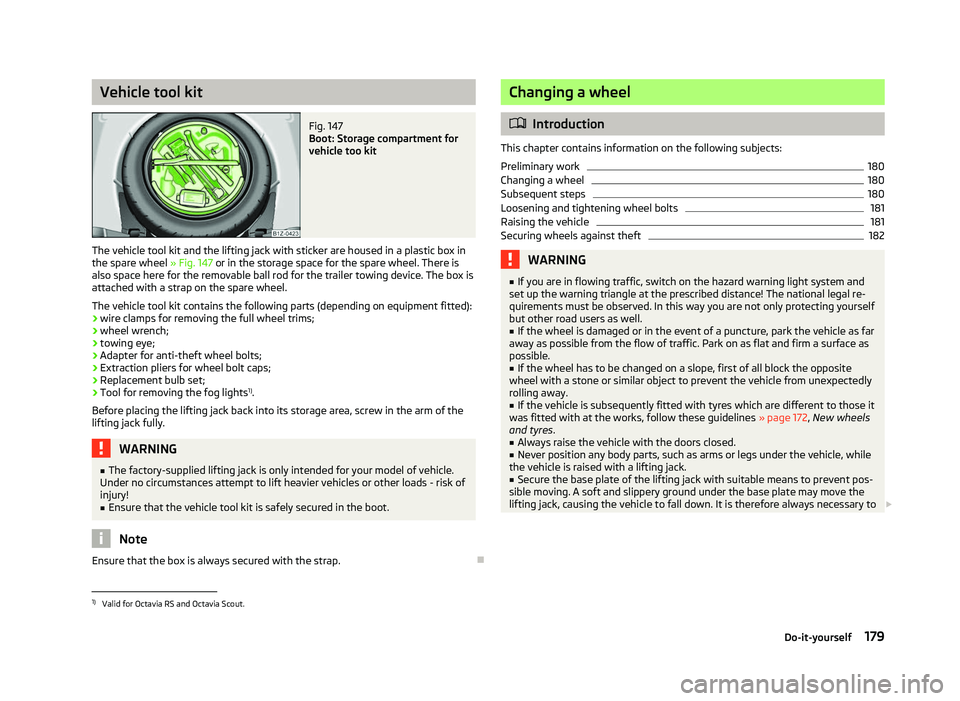
Vehicle tool kit
Fig. 147
Boot: Storage compartment for
vehicle too kit
The vehicle tool kit and the lifting jack with sticker are housed in a plastic box in
the spare wheel » Fig. 147 or in the storage space for the spare wheel. There is
also space here for the removable ball rod for the trailer towing device. The box is
attached with a strap on the spare wheel.
The vehicle tool kit contains the following parts (depending on equipment fitted):
› wire clamps for removing the full wheel trims;
› wheel wrench;
› towing eye;
› Adapter for anti-theft wheel bolts;
› Extraction pliers for wheel bolt caps;
› Replacement bulb set;
› Tool for removing the fog lights 1)
.
Before placing the lifting jack back into its storage area, screw in the arm of the
lifting jack fully. WARNING
■ The factory-supplied lifting jack is only intended for your model of vehicle.
Under no circumstances attempt to lift heavier vehicles or other loads - risk of
injury!
■ Ensure that the vehicle tool kit is safely secured in the boot. Note
Ensure that the box is always secured with the strap. Ð Changing a wheel
ä
Introduction
This chapter contains information on the following subjects:
Preliminary work 180
Changing a wheel 180
Subsequent steps 180
Loosening and tightening wheel bolts 181
Raising the vehicle 181
Securing wheels against theft 182
WARNING
■ If you are in flowing traffic, switch on the hazard warning light system and
set up the warning triangle at the prescribed distance! The national legal re-
quirements must be observed. In this way you are not only protecting yourself
but other road users as well.
■ If the wheel is damaged or in the event of a puncture, park the vehicle as far
away as possible from the flow of traffic. Park on as flat and firm a surface as
possible. ■ If the wheel has to be changed on a slope, first of all block the opposite
wheel with a stone or similar object to prevent the vehicle from unexpectedly
rolling away.
■ If the vehicle is subsequently fitted with tyres which are different to those it
was fitted with at the works, follow these guidelines » page 172, New wheels
and tyres .
■ Always raise the vehicle with the doors closed.
■ Never position any body parts, such as arms or legs under the vehicle, while
the vehicle is raised with a lifting jack. ■ Secure the base plate of the lifting jack with suitable means to prevent pos-
sible moving. A soft and slippery ground under the base plate may move the
lifting jack, causing the vehicle to fall down. It is therefore always necessary to £1)
Valid for Octavia RS and Octavia Scout.
179
Do-it-yourself
Page 189 of 218

Driver of the tow vehicle
›
Release the clutch particularly gently when starting off or depress the accelera-
tor particularly gently if the vehicle is fitted with an automatic gearbox.
› On vehicles with a manual transmission, only push down on the accelerator
pedal once the rope is taught.
The maximum towing speed is 50 km/h.
Driver of the towed vehicle
› Switch on the ignition so that the steering wheel is not blocked and so that the
turn signal lights, horn, windscreen wipers and windscreen washer system can
be switched on.
› Take the vehicle out of gear or move the selector lever into position
N if the
vehicle is fitted with an automatic gearbox.
Please note that the brake servo unit and power steering only operate if the en-
gine is running. If the engine is not running, significantly more physical force is re-
quired to depress the brake pedal and steer the vehicle.
If using a tow rope, ensure that it is always kept taught. CAUTION
■ Do not tow start the engine - danger of damaging the engine! On vehicles with
a catalytic converter, unburnt fuel may get into the catalytic converter where it
may ignite. This in turn may damage or destroy the catalytic converter. The bat-
tery from another vehicle can be used as a jump-start aid » page 185, Jump-start-
ing .
■ If the gearbox of your vehicle no longer contains any oil because of a defect,
your vehicle must only be towed in with the driven wheels raised clear of the
ground, or on a special vehicle transporter or trailer.
■ The vehicle must be transported on a special vehicle or trailer if it is not possible
to tow in the vehicle in the way described or if the towing distance is greater than
50 km. ■ To protect both vehicles when tow-starting or towing, the tow rope should be
elastic. Thus one should only use plastic fibre rope or a rope made out of a simi-
larly elastic material.
■ One should be constantly vigilant not to allow impermissibly high towing forces
or jerky loadings. There is always a risk of excessive stresses and damage result-
ing at the points to which you attach the tow rope or tow bar when you attempt
to tow a vehicle which is not standing on a paved road.
■ Attach the tow rope or the tow bar to the towing eyes or to the detachable ball
head of the towing device » page 187
or » page 188. Note
■ We recommend using a tow rope from
ŠKODA Original Accessories available
from a ŠKODA Service Partner. ■ Towing another vehicle requires a certain amount of practice. Both drivers
should be familiar with the particular points about towing a vehicle. Unskilled
drivers should not attempt to tow in another vehicle or to be towed in. ■ When towing, respect the national legal provisions, especially those which re-
late to the identification of the towing vehicle and the vehicle being towed. ■ The tow rope must not be twisted as it may in certain circumstances result in
the front towing eye being unscrewed out of your vehicle. Ð Front towing eye
Fig. 155
Front bumper: protective grille/installing the towing eye
First read and observe the introductory information and safety warn-
ings on page 186.
Remove the cap carefully as follows.
›
Insert your fingers into opening A
» Fig. 155 .
› By pulling in the direction of arrow 1
, first of all undo the cover in the upper
area on the side facing the fog light.
› Afterwards, undo the cover in the direction of arrow 2
on the other side too,
remove.
› Manually insert the towing eye in the direction of arrow 3
until the stop, tight-
en. For tightening purposes, we recommend, for example, using the wheel
wrench, towing eye from another vehicle or a similar object that can be pushed
through the eye. £
ä
187
Do-it-yourself
Page 190 of 218

›
In order to reinstall the cap after unscrewing the towing eye, first of all insert it
starting on the side facing the marking. Then press the cap on the side closest
to the fog light. The cap must engage firmly. CAUTION
The towing eye must always be screwed in fully and firmly tightened, otherwise
the towing eye can tear when towing in or tow-starting. ÐFront towing eye for Octavia RS and Octavia Scout
Fig. 156
Front bumper Octavia RS: Protective grille/Octavia Scout: Cap
First read and observe the introductory information and safety warn-
ings on page 186.
Octavia RS
›
Insert a finger into the opening A
» Fig. 156 of the grille.
› Unlock and remove the cap by pulling in the direction of arrow.
› Manually insert the towing eye in the direction of arrow 3
» Fig. 155
on
page 187 until the stop, tighten. For tightening purposes, we recommend, for
example, using the wheel wrench, towing eye from another vehicle or a similar
object that can be pushed through the eye.
› After unscrewing the towing eye, put the cap on and press into place. The cap
must engage firmly.
Octavia Scout
› Press on the top area of the cap B
» Fig. 156
, remove it.
› Manually insert the towing eye in the direction of arrow 3
»
Fig. 155
on
page 187 until the stop, tighten. For tightening purposes, we recommend, for
example, using the wheel wrench, towing eye from another vehicle or a similar
object that can be pushed through the eye.
ä ›
After unscrewing the towing eye, put the cap on and press into place. The cap
must engage firmly. CAUTION
The towing eye must always be screwed in fully and firmly tightened, otherwise
the towing eye can tear when towing in or tow-starting. Ð Rear towing eye
Fig. 157
Rear bumper: removing the cap/rear bumper: Installing the towing
eye
First read and observe the introductory information and safety warn-
ings on page 186.
›
Unlock the bottom part of the cap by pulling it downwards in direction of arrow 1
» Fig. 157.
› Unlock the upper area of the cap by pulling in the direction of the arrow 2
, re-
move the cap.
› Manually insert the towing eye in the direction of arrow 3
until the stop, tight-
en. For tightening purposes, we recommend, for example, using the wheel
wrench, towing eye from another vehicle or a similar object that can be pushed
through the eye.
› To re-insert the cap after removing the towing eye, first insert it with the upper
area, afterwards press the lower area too. The cap must engage firmly. CAUTION
The towing eye must always be screwed in fully and firmly tightened, otherwise
the towing eye can tear when towing in or tow-starting. Ð ä
188 Do-it-yourself
Page 194 of 218

Fog lights and daytime running lights 194
Fog lights Octavia RS, Octavia Scout 195
Changing the bulb for the licence plate light 195
Tail lamp assembly 196
Tail light (Combi) 196
Some manual skills are required to change a bulb. For this reason, if uncertain, we
recommend that bulbs are replaced by a ŠKODA specialist garage or other expert
help is sought.
› Switch off the ignition and all of the lights before replacing a bulb.
› Faulty bulbs must only be replaced with the same type of bulbs. The designa-
tion is located on the light socket or the glass bulb.
› A stowage compartment for replacement bulbs is located in a plastic box in the
spare wheel or underneath the floor covering in the boot. WARNING
■ Accidents can be caused if the road in front of the vehicle is not sufficiently
illuminated and the vehicle cannot or can only be seen with difficulty by other
road users.
■ Always read and observe the warnings before completing any work in the
engine compartment »
page 158, Engine compartment .
■ Bulbs H7 and H1 are pressurised and may burst when changing the bulb -
risk of injury! We therefore recommended wearing gloves and safety glasses
when changing a bulb. ■ Gas discharge bulbs (xenon bulbs) operate with a high voltage, professional
knowledge is required - danger to life! CAUTION
■ Do not take hold of the glass bulb with naked fingers (even the smallest
amount of dirt reduces the working life of the light bulb). Use a clean cloth, nap-
kin, or similar. ■ When removing and installing the headlight make sure that the paintwork of
the vehicle and the headlight are not damaged. Note
■ This Owner's Manual only describes the replacement of bulbs where it is possi-
ble to replace the bulbs on your own without any complications arising. Other
light bulbs should be changed by a
ŠKODA specialist garage.
■ We recommend that a box of replacement bulbs be always carried in the vehi-
cle. Replacement bulbs can be purchased from
ŠKODAOriginal Accessories.
■ We recommend that the headlight settings are checked by a ŠKODA specialist
garage after replacing a bulb in the main or low beam.
■ Gas discharge bulbs and LED diodes are replaced by a ŠKODA specialist garage. Ð Headlights
Fig. 160
Headlights: Bulb arrangement/removal
First read and observe the introductory information and safety warn-
ings on page 191.
Overview of the location of the bulbs
» Fig. 160. 1
- front turn signal light
2
- parking lights and low beam
3
- main beam light
The headlight must be removed in order to change the light bulb of the parking
lights, low beam lights and main beam lights as well as the turn signal lights.
Removing the main beam lights
› Open the bonnet
» page 160, Opening and closing the bonnet .
› Unscrew the plastic nuts A
» Fig. 160
.
› Pull the locking button B
upwards.
£
ä
192 Do-it-yourself
Page 196 of 218

Changing the bulb for the main beam
Fig. 163
Removing the bulb for the main
beam
First read and observe the introductory information and safety warn-
ings on page 191.
›
Remove the head light
» page 192.
› Remove the rubber cover 3
» Fig. 160
on page 192.
› Remove connector A
» Fig. 163.
› Press the circlip B
in the direction of the head lamp and then unhook to the
side.
› Remove the light bulb C
and insert a new light bulb in such a way that the fix-
ing lugs of the light bulb socket fit into the recesses at the reflector.
Installation is carried out in the reverse order. ÐFog lights and daytime running lights
Fig. 164
Front bumper: Protective grille/removing the fog light
ä
First read and observe the introductory information and safety warn-
ings on page 191.
Bulb arrangement
» Fig. 164. B
- Bulb for daytime running light
C
- Light bulb for fog lights
Removing the cap
› Insert your fingers into opening A
» Fig. 164 .
› By pulling in the direction of arrow 1
, first of all undo the cover in the upper
area on the side facing the fog light.
› Afterwards, undo the cover in the direction of arrow 2
on the other side too,
remove.
Replacing light bulbs for fog lights/daytime running lights
› Insert your hand into the opening left by the cap and press the lug D
»
Fig. 164
in the direction of the arrow.
› Remove the front fog lamp.
› Turn the connector with the bulb in
counter-clockwise up to the stop and re-
move.
› Replace the lamp, insert the connector with the new bulb and turn
clockwise
up to the stop.
› To re-install the fog light, first of all place the fog light with the lug on the side
opposite the licence plate.
› Press in the fog lamp on the side closest to the licence plate.
› In order to reinstall the cap, first of all insert it starting on the side facing the
marking. Then press the cap on the side closest to the fog light. The cap must
engage firmly. Ð
ä
194 Do-it-yourself
Page 197 of 218

Fog lights Octavia RS, Octavia Scout
Fig. 165
Front bumper: Octavia RS/Octavia Scout Fig. 166
Front bumper: Fog lights/fog lights: Replacing the light bulb
First read and observe the introductory information and safety warn-
ings on page 191.
Removing the cap and fog light
›
Insert a finger into the opening 1
» Fig. 165 (Octavia RS) and remove the cap.
› Insert the wire clamp
» page 179, Vehicle tool kit into the opening 2
(Octavia
Scout) above the fog light and remove the cap.
› Unscrew the screws with a screwdriver
» Fig. 166 - .
› Remove the front fog lamp.
Changing light bulbs and installing fog lights
› Press the locking button 1
» Fig. 166
of the plug A
and remove the plug from
the socket B
.
› Turn the socket B
with the bulb counter-clockwise up to the stop and remove.
ä ›
Replace the bulb, insert the socket with the new bulb and turn
clockwise up to
the stop.
› Insert the plug A
into the socket B
.
› Retighten the screws and insert the cap. The cap must engage firmly. Ð Changing the bulb for the licence plate light
Fig. 167
Remove the licence plate light
First read and observe the introductory information and safety warn-
ings on page 191.
›
Open the luggage compartment door and unscrew the glass cover
» Fig. 167.
› Remove the faulty bulb from the holder and insert a new one.
› Replace the glass cover and push in until the stop. Make sure that you install
the rubber seal in the right direction.
› Slightly screw the glass cover. Ð
ä
195
Fuses and light bulbs