2006 Seat Altea belt
[x] Cancel search: beltPage 50 of 288

Child safety
48Child seatsCategorisation of child seats into groups
Use only child seats that are officially approved and suitable
for the child.Child seats are covered by the European standard ECE R 44 (issued by the
Economic Commission of Europe).
The child seats are grouped into 5 categories:
Group 0: up to 10 kg
Group 0+ : up to 13 kg
Group 1: from 9 to 18 kg
Group 2: from 15 to 25 kg
Group 3: from 22 to 36 kg
Child seats that have been tested and approved under the ECE R 44 standard
bear the test mark on the seat (the letter E in a circle with the test number
below it).
Group 0 and 0+ child seats
A suitable child seat and a corr ectly adjusted seat belt can
help to protect your child.Group 0: For babies from about 9 months old and 10 kg in weight the most
suitable seats are those appearing in the illust ration ⇒ fig. 28.
Group 0+: For babies from about 18 months old and 13 kg in weight the most
suitable seats are those appearing in the illustration.
Follow the manufacturer's instructions and observe any statutory require-
ments when installing and using child seats.
We recommend that you include the manu facturer's directions for child seat
use in the vehicle wallet and always keep them in the vehicle.
WARNING
Read and always observe information and warnings concerning the use of
child seats ⇒ in “Safety notes on using child seats” on page 47.
Fig. 28 A group 0 rear-
facing child seat fitted on
the rear seat.
altea_ingles Seite 48 Dienstag, 4. Oktober 2005 6:57 18
Page 51 of 288

Child safety49
Safety First
Operating instructions
Tips and Maintenance
Te c h n i c a l D a t a
Group 1 child seats
A suitable child seat and a correctly adjusted seat belt can
help to protect your child.Child seats using the “ISOFIX” system or seats in which the child faces the
rear of the car are most appropriate for babies and small children weighing
between 9 and 18 kg.
Follow the manufacturer's instructions and observe any statutory require-
ments when installing and using child seats.
We recommend that you include the manufacturer's directions for child seat
use in the vehicle wallet and always keep them in the vehicle.
WARNING
Read and always observe information and warnings concerning the use of
child seats ⇒ in “Safety notes on using child seats” on page 47.
Group 2 and 3 child seats
A suitable child seat and a corr ectly adjusted seat belt can
help to protect your child.Follow the manufacturer's instructio ns and observe any statutory require-
ments when installing and using child seats.
We recommend that you include the manufacturer's directions for child seat
use in the vehicle wallet and always keep them in the vehicle.
Group 2 child seats
Children under 7 years of age weighing between 15 and 25 kg are best
protected by group 2 child seats in conjunction with properly adjusted seat
belts.
Group 3 child seats
Children over 7 years of age weighing between 22 and 36 kg but less than 1.5
metres tall are best protected by seat cushions with head restraints in
conjunction with properly worn seat belts ⇒fig. 30.
Fig. 29 A category 1
forward-facing child seat
fitted on the rear seat.
Fig. 30 Forward-facing
child seat installed on rear
seat.
altea_ingles Seite 49 Dienstag, 4. Oktober 2005 6:57 18
Page 52 of 288

Child safety
50
WARNING
•
The shoulder part of th e seat belt must lie approximately on the centre
of the shoulder, never across the neck or the arm. The seat belt must lie
close to the torso. The lap belt part must lie across the pelvis, not across
the stomach, and always fit closely. Pull the belt tight if necessary to take
up any slack ⇒page 24, “Seat belts”.
•
Read and always observe information and warnings concerning the use
of child seats ⇒ in “Safety notes on using child seats” on page 47.
altea_ingles Seite 50 Dienstag, 4. Oktober 2005 6:57 18
Page 53 of 288

Child safety51
Safety First
Operating instructions
Tips and Maintenance
Te c h n i c a l D a t a
Securing child seatsWays to secure a child seat
A child seat can be secured differently on th e rear seat and on the front passenger seat.You can secure a child seat to the rear seat or front passenger seat in the
following ways:
•
Child seats in groups 0 to 3 can be secured with a seat belt.
•
Group 0, 0+ and 1 child seats with the “ISOFIX” system can be secured to
the “ISOFIX” retaining rings without seat belts ⇒ page 52.
U: Suitable for approved universal retention systems for use with this age group (universal retention systems, ar e those that can be fitted using the
standard adult safety belt)
*: Move the passenger seat as far back as possible, to the highest setting and always turn the airbag off.
L: Suitable for anchored retention systems using the “ISOFIX” anchors
WARNING
•
When travelling, children must be secured in the vehicle with a
restraint system suitable for age, weight and size.
•
Never install a rear-facing child seat on the front passenger seat unless
the front passenger airbag has been disabled. Risk of potentially fatal inju-
ries to the child! If it is necessary in exceptional cases to transport a child on the front passenger seat, you must always disable the front passenger
airbag
⇒page 44, “Deactivating airbags*”.
•
Read and always observe information and warnings concerning the use
of child seats ⇒ in “Safety notes on using child seats” on page 47.
Weight class
Weight Seat locations
Front passenger Rear outerRear centre
Group 0 <10 kgU*U/L U
Group 0+ <13 kgU*U/L U
Group 1 9-18 kgU*U/L U
Group 2 / 3 15-36 kgU*UUWARNING (continued)
altea_ingles Seite 51 Dienstag, 4. Oktober 2005 6:57 18
Page 54 of 288

Child safety
52Securing child seat with the “ISOFIX” system
The child seat can be secured quickly, easily and safely on the
rear outer seats using the “ISOFIX” system.When removing or fitting the child seat, please be sure to follow the
manufacturer's instructions.
– Move the seat as far to rear as it will go.
– Press the child seat onto the “ISOFIX” retaining rings until the
child seat can be heard to engage securely.
– Pull on both sides of the child se at to ensure that it is secure.Two “ISOFIX” retaining rings are f itted on ea ch rear sea t. The “ISOFIX”
retaining rings are attached to the seat frames.
The “ISOFIX” system retaining rings may be found by locating the label on the
seat. Child seats with “ISOFIX” mountings are available from the Authorised
Service Centres.
WARNING
•
The retaining rings are designed only for use with “ISOFIX” child seats.
•
Never secure child seats without the “ISOFIX” system, retaining belts
or objects to the fastening rings – this c an result in potentially fatal injuries
to the child!
•
Ensure that the child seat is se cured correctly using the “ISOFIX”
anchors.
Fig. 31 ISOFIX securing
rings
altea_ingles Seite 52 Dienstag, 4. Oktober 2005 6:57 18
Page 75 of 288

Cockpit73
Safety First
Operating instructions
Tips and Maintenance
Te c h n i c a l D a t a
WARNING
•
Failure to observe warning lamps and warning messages can result in
serious personal injury or damage to your vehicle.
•
The risk of an accident increases if your vehicle breaks down. Use a
warning triangle to draw the attention of other road users to your
stationary vehicle so that it does not represent a danger.
Fasten seat belts! ⇒page 19
Tyre pressure ⇒page 78
Engine fault (petrol engine) ⇒ page 79
Glow plug system (diesel engine)
Lit up: Glow plug system switched on
Flashing: engine fault.
⇒ page 80
Airbag or belt tension device system fault or airbag disabled ⇒page 28 ⇒page 31
Fault in the emission control system ⇒page 80
Flashing: electronic stabilisation programme (ESP) in opera-
tion,
Lit up: ESP fault or switched off ⇒
page 80
Operate foot brake ⇒page 80
Electromechanical steering ⇒page 81
Brake pad wear indicator ⇒page 81
Door open indicator ⇒page 81
SAFE Electronic immobiliser ⇒page 81
Item
Symbol Meaning of warning and control lamps Further information
A15A16A17A17A18A19A20A21A22A23A24
WARNING (continued)
altea_ingles Seite 73 Dienstag, 4. Oktober 2005 6:57 18
Page 129 of 288

Seats and stowage127
Safety First
Operating instructions
Tips and Maintenance
Te c h n i c a l D a t a
Seats and stowageThe importance of correct seat adjustmentProper seat adjustment optimi ses the level of protection
offered by seat belts and airbags.Your vehicle has five passenger places, two individual front seats and three
places on the rear seat. Each seat is equipped with a three-point seat belt.
The driver seat and front passenger seat can be adjusted in many ways to suit
the physical requirements of the vehicle occupants. The correct seat position
is very important for:•
fast and easy operation of all controls on the instrument panel,
•
relaxed posture that does not cause drowsiness,
•
safe driving ⇒ page 7,
•
and to ensure that the seat belts and airbag system provide maximum
protection ⇒page 19.
WARNING
•
If the driver and passengers assume improper sitting positions, they
may sustain critical injuries.
•
Never transport more people than there are seats available in the
vehicle.
•
Every occupant in the vehicle must properly fasten and wear the seat
belt belonging to his or her seat. Children must be protected with an appro-
priate child restraint system ⇒page 46, “Child safety”.
•
The front seats and all head restraints must always be adjusted to body
size and the seat belt must always be properly adjusted to provide you and
your passengers with optimum protection.
•
Always keep your feet in the footwell when the vehicle is moving; never
rest them on the dash panel, out of the window or on the seat. This also
applies to passengers. An incorrect sitting position exposes you to an
increased risk of injury in the event of a braking manoeuvre or an accident.
If the airbag is triggered, you could sustain severe injuries due to an incor-
rect sitting position.
•
It is important for the driver and front passenger to maintain a distance
of at least 25 cm from the steering wheel or dash panel. Failure to respect
the minimum distance means that the airbag will not protect you. Risk of
fatal injury. The distance between the driver and the steering wheel or
between the front passenger and the dash panel should always be as great
as possible.
•
Adjust the driver or front passenger seat only when the vehicle is
stationary. This also applies to the forwards/backwards adjustment of the
rear seats. Otherwise your seat coul d move unexpectedly while the vehicle
is moving. This could increase the risk of an accident and therefore injury.
In addition, while adjusting your seat, you will assume an incorrect sitting
position. Risk of fatal accidents.
•
Special guidelines apply to installing a child seat on the front
passenger seat. When installing a child seat, observe the warning note in
the ⇒page 46, “Child safety”.WARNING (continued)
altea_ingles Seite 127 Dienstag, 4. Oktober 2005 6:57 18
Page 130 of 288
Seats and stowage
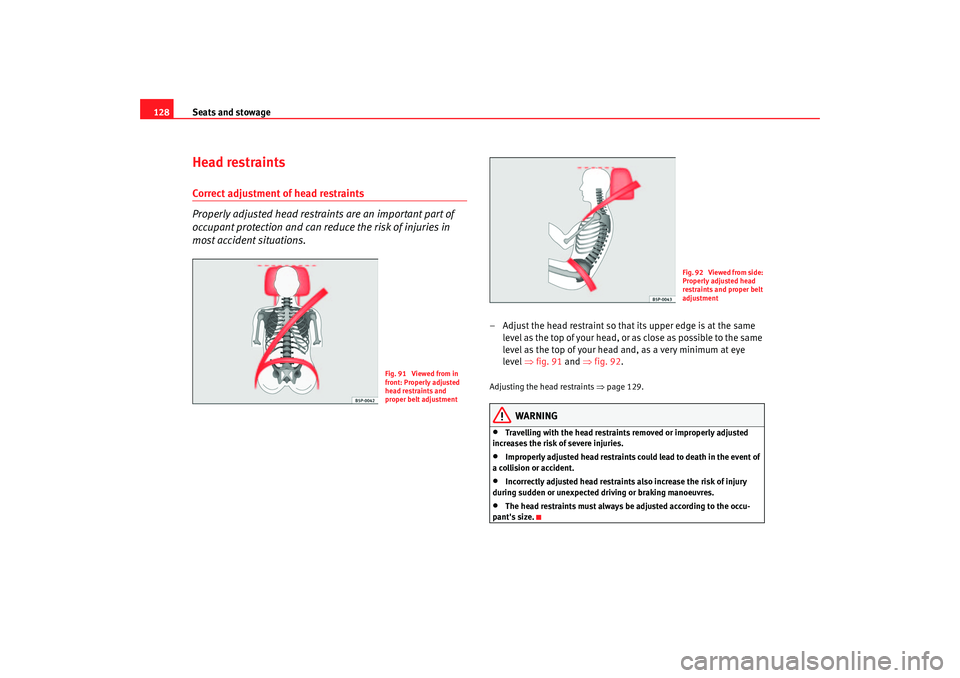
128Head restraintsCorrect adjustment of head restraints
Properly adjusted head restraints are an important part of
occupant protection and can redu ce the risk of injuries in
most accident situations.
– Adjust the head restraint so that its upper edge is at the same
level as the top of your head, or as close as possible to the same
level as the top of your head and, as a very minimum at eye
level ⇒ fig. 91 and
⇒ fig. 92.
Adjust ing the head restrain ts ⇒ pa
ge 129.
WARNING
•
Travelling with the head restraints removed or improperly adjusted
increases the risk of severe injuries.
•
Improperly adjusted head restraints could lead to death in the event of
a collision or accident.
•
Incorrectly adjusted head restraints also increase the risk of injury
during sudden or unexpected driving or braking manoeuvres.
•
The head restraints must always be adjusted according to the occu-
pant's size.
Fig. 91 Viewed from in
front: Properly adjusted
head restraints and
proper belt adjustment
Fig. 92 Viewed from side:
Properly adjusted head
restraints and proper belt
adjustment
altea_ingles Seite 128 Dienstag, 4. Oktober 2005 6:57 18