Page 199 of 288

Accessories, parts replacement and modifications197
Safety First
Operating instructions
Tips and Maintenance
Te c h n i c a l D a t a
WARNING
Incorrectly performed modifications or other work on your vehicle can lead
to malfunctions and cause accidents.Roof aerial*The vehicle may be fitted with a collapsible roof aerial* with antitheft
system*, which can be folded backwards, when, for example, going through
an automatic carwash.
To f o l d
Unscrew the aerial rod, tilting it backwards into a horizontal position and then
screw in again.
To return to working position
Continue in the reverse order to that given in the previous instruction.Mobile telephones and two-way radiosYou will require an external aerial for mobile phones and two-
way radios.SEAT has approved your vehicle for use with mobile telephones and two-way
radios providing the following conditions are observed:•
The correct installation of an external aerial,
•
transmitting power of maximum 10 watts.
An external aerial is needed to give the equipment its optimal range. First consult your Authorised Service Centre if you wish to use a mobile tele-
phone or a two-way radio with a transmitting power in excess of 10 watts.
Here you will receive information concerning the technical possibilities for
retro-fitting this equipment.
Mobile telephones and two-way radios
should be fitted only by a qualified
workshop, for example an Authorised Service Centre.
WARNING
•
Always concentrate primarily on driving. If you are distracted while
driving you could have an accident.
•
Never attach the telephone mountings to the surfaces covering the
airbag units or within the range of the airbags, danger of injury if the airbag
is triggered.
•
If you use mobile telephones or two-way radios in the vehicle without
an external aerial, electromagnetic ra diation in the vehicle could exceed
authorised limits. This also applies to external aerials that have not been
correctly installed.Caution
Failure to observe the above conditions could cause the electronics to
malfunction. The most common causes of faults are:•
no external aerial,
•
external aerial incorrectly installed,
•
transmitting power in excess of 10 watts.Note
Please observe the operating instructions of your mobile telephone / two-way
radio.
altea_ingles Seite 197 Dienstag, 4. Oktober 2005 6:57 18
Page 220 of 288

Checking and refilling levels
218BatteryWarnings on handling the battery
WARNING
Always be aware of the danger of injury and chemical burns as well as the
risk of accident or fire when working on the battery and the electrical
system:•
Wear eye protection. Protect your ey es, skin and clothing from acid and
particles containing lead.
•
Battery acid is very corrosive and caustic. Wear protective gloves and
eye protection. Do not tilt the batteries. This could spill acid through the
vents. Rinse battery acid from eyes immediately for several minutes with
clear water. Then seek medical care immediately. Neutralize any acid
splashes on the skin or clothing with a soapy solution, and rinse off with
plenty of water. If acid is swallowed by mistake, consult a doctor immedi-
ately.
•
Fires, sparks, naked lights and smoki ng are prohibited. When handling
cables and electrical equipment, avoid causing sparks and electrostatic charge. Never short the battery terminals. High-energy sparks can cause
injury.
•
A highly explosive mixture of gases is given off when the battery is
under charge. The batteries should be charged in a well-ventilated room
only.
•
Keep children away from acid and batteries.
•
Before working on the electrical system, you must switch off the
engine, the ignition and all consumers. The minus cable on the battery
must be disconnected. When a light bu lb is changed, you need only switch
off the light.
•
Deactivate the anti-theft alarm by unlocking the vehicle before you
disconnect the battery! The alar m will otherwise be triggered.
•
When disconnecting the battery from the vehicle electrical system,
disconnect first the negative ca ble and then the positive cable.
•
Switch off all electrical consumers before reconnecting the battery.
Reconnect first the positive cable and then the negative cable. Never
reverse the polarity of the connections. This could cause an electrical fire.
•
Never charge a frozen battery, or one which has thawed. This could
result in explosions and chemical burns. Always replace a battery which
has frozen. A flat battery can freeze at temperatures around 0
°C.
•
Ensure that the vent hose is always connected to the battery.
•
Never use a defective battery. This may be fatally explosive. Replace a
damaged battery immediately.Caution
•
Never disconnect the battery if the ignition is switched on or if the engine
is running. This could damage the elec trical system or electronic compo-
nents.
•
Do not expose the battery to direct sunlight over a long period of time, as
the intense ultraviolet radiation can damage the battery housing.
Wear eye protection
Battery acid is very corrosive and caustic. Wear protec-
tive gloves and eye protection!
Fires, sparks, naked lights and smoking are prohibited!
A highly explosive mixture of gases is given off when the
battery is under charge.
Keep children away from acid and batteries!
WARNING (continued)
altea_ingles Seite 218 Dienstag, 4. Oktober 2005 6:57 18
Page 239 of 288
If and when237
Safety First
Operating instructions
Tips and Maintenance
Te c h n i c a l D a t a
Fuses on left side of dash panelFuses
Number Electrical equipment Amperes
1 Electro-chromatic mirror / relay 50 5
2 Engine control unit 5
3 Lights switch / Headlight control unit / Right hand side headlight / Telephone 5
4 Telephone pre-installation 5
5 Flow meter, frequency tube 10
6A ir b ag 5
7 Vacant
8 Vacant
9 Power steering 5
10 Diagnosis, reverse gear switch 5
11 Heated windscreen 5
12 FSI measure 10
13 Trailer control unit 5
14 ESP/TCP, ABS/ESP control unit 5
15 Automatic gearbox 5
16 Heating controls / Climatronic / Pressure sensor / Heated seats 10
17 Engine 7,5
18 Vacant
19 Vacant
20 Engine fuse box supply 5
21 Gear lever 5
altea_ingles Seite 237 Dienstag, 4. Oktober 2005 6:57 18
Page 245 of 288

If and when243
Safety First
Operating instructions
Tips and Maintenance
Te c h n i c a l D a t a
Xenon headlights
19)
Dipped beam and full lights - D1S
20)
Light burst and additional full lights - H1
Position W5W
Indicators PY21W
Fog lights
Fog lights - H3
Upper rear light
Stop/Position - P21W
21)
Indicator - R10W
Lower rear light
Fog light - P21W
Reverse light - P21W
Side turn indicator
Side turn indicator - W5W
Registration plate light
Registration plate light - C5W
Note
•
Due to the difficulty in accessing the lamps, these must be changed by an
Authorised Service Centre. However, the following is a description of how to
change the lamps except for the fog lights* and interior lamps.
Main headlight lamps
Turn signals
Dipped headlights
Main beam headlights
Side lights
19)For these type of headlights, the bulbs must be changed by an Authorised Service
Centre, given that complex elements of the vehicle must be removed and that the au-
tomatic control system must be reset.20)Xenon discharge lamps emit 2.5 times as much light flux and have a useful life five
times greater than halogen lamps, this means that, except in case of an abnormal
fault, there is no need to change the bulbs during the vehicle life.21)Electronically controlled single filament lamp for Stop/Position lamp. If the lamp
blows it will not work in either position or Stop position
Fig. 173 Main headlight
lamps
AAABACAD
altea_ingles Seite 243 Dienstag, 4. Oktober 2005 6:57 18
Page 246 of 288
If and when
244Tu r n si g nal l a m ps– Raise the bonnet.
– Rotate the lamp holder ⇒fig. 174 to the left and pull.
– Remove the bulb by pressing on the lamp holder and rotating at the same time to the left.
– Installation is done in the reverse order.
Dipped beam lights–Raise the bonnet
Fig. 174 Turn signal
lamps
AA
Fig. 175 Dipped head-
lightsFig. 176 Dipped head-
lights
altea_ingles Seite 244 Dienstag, 4. Oktober 2005 6:57 18
Page 247 of 288
If and when245
Safety First
Operating instructions
Tips and Maintenance
Te c h n i c a l D a t a
– Remove the loops ⇒page 244, fig. 175 in the direction of
the arrow and remove the cover.
– Remove the connector ⇒page 244, fig. 176 from the lamp.
– Disengage the retainer spring ⇒ page 244, fig. 176 pressing
inwards and to the right.
– Extract the lamp and fit the replacement so that the rim of the attachment plate is on the reflector rebate.Main beam lights
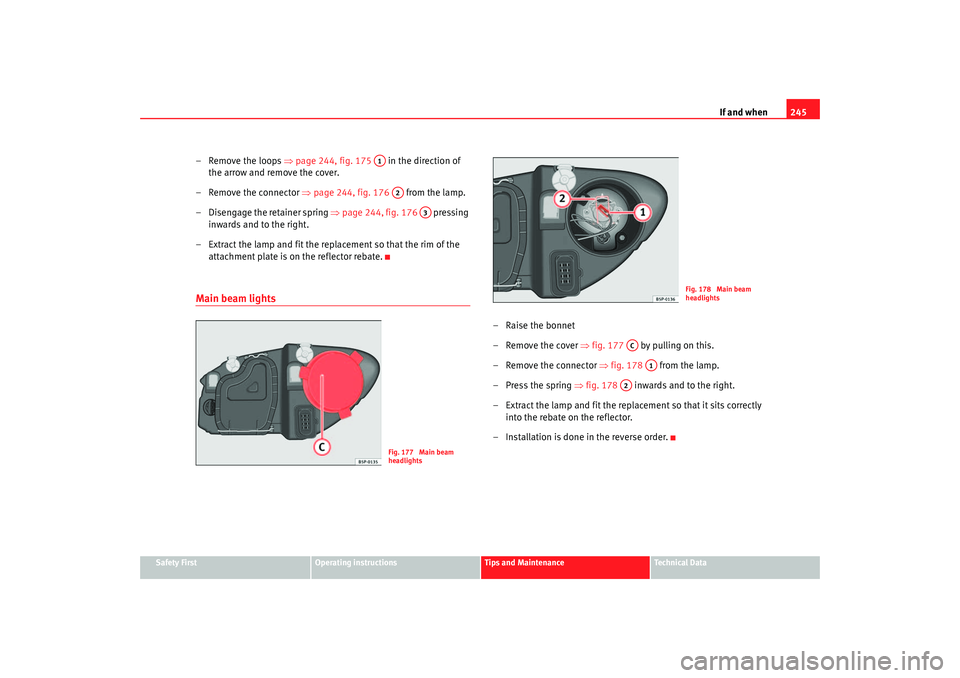
– Raise the bonnet
– Remove the cover ⇒fig. 177 by pulling on this.
– Remove the connector ⇒fig. 178 from the lamp.
– Press the spring ⇒fig. 178 inwards and to the right.
– Extract the lamp and fit the replac ement so that it sits correctly
into the rebate on the reflector.
– Installation is done in the reverse order.
A1
A2
A3
Fig. 177 Main beam
headlights
Fig. 178 Main beam
headlights
AC
A1
A2
altea_ingles Seite 245 Dienstag, 4. Oktober 2005 6:57 18
Page 248 of 288
If and when
246Side lights– Raise the bonnet.
– Remove the cover ⇒fig. 179 by pulling on this. – Extract the lamp holder
⇒fig. 180 outwards.
– Replace the bulb by pulling this out and inserting the replace- ment.
– Installation is done in the reverse order.
Rear lights•
Side lights
•
Brake lights
•
Turn signals
•
Reversing lights
•
Rear fog light
Fig. 179 Side lightsFig. 180 Side lights
AD
A1
altea_ingles Seite 246 Dienstag, 4. Oktober 2005 6:57 18
Page 249 of 288

If and when247
Safety First
Operating instructions
Tips and Maintenance
Te c h n i c a l D a t a
Side lights and brake lights– Open the tailgate
– Remove the bolts ⇒fig. 181 – Remove the cover of the luggage compartment lateral panel.
– Unscrew the plastic fitting
⇒fig. 182 securing the rear light.
Inserting a screwdriver under the plastic fitting may help to
loosen it.
– Partially remove the rear light from its casing taking care not to pull on the cable.
– Remove the lamp holder connector.
–Unscrew the bolts ⇒page 248, fig. 183 from the lamp holder
and pull on this.
– Press on the lamp and rotate to the left then fit the replacement.
– To refit follow the steps in reverse order, taking special care when fitting the lamp holder. The metal contacts of the lamp holder
ends should be correctly fitted with respect to the rear light
contacts.
Fig. 181 Side lights and
brake lightsFig. 182 Side lights and
brake lights
AA
ABAC
altea_ingles Seite 247 Dienstag, 4. Oktober 2005 6:57 18