2006 Seat Alhambra lock
[x] Cancel search: lockPage 145 of 299

Seats and stowage143
Safety FirstOperating instructionsTips and MaintenanceTe c h n i c a l D a t a
WARNING
Loose luggage and other objects in the luggage compartment can cause
serious injuries.
•Always stow objects in the luggage compartment and secure them on
the fastening rings.
•Use suitable specialist straps to secure heavy objects.
•During sudden manoeuvres or accidents, loose objects can be thrown
forward, injuring vehicle occupants. This increased risk of injury will be
further increased if a loose object is struck by an inflating airbag. If this
happens, objects can be transformed into “missiles”. Risk of fatal injury.
•Remember that transporting heavy objects modifies the driving condi-
tions as the centre of gravity has been altered. There is a risk of accident.
Therefore, it is essential to adjust your speed and driving style accordingly,
to avoid accidents.
•Never exceed the allowed axle loads or allowed maximum weight. If the
allowed axle load or the allowed total weight is exceeded, the driving char-
acteristics of the vehicle may change, leading to accidents, injuries and
damage to the vehicle.
•Never leave the vehicle unattended, especially when the tailgate is
open. Children could climb into the luggage compartment closing the door
behind them; they will remain trapped without help and there is a mortal
risk.
•Never allow children to play in or around the vehicle. Close and lock
both the tailgate and all the doors when you leave the vehicle. Before you
lock the vehicle, make sure that there are no adults or children in the
vehicle.
•Never transport passengers in the luggage compartment. Every
passenger must be properly belted in .
Caution
•Avoid overloading small areas by placing heavy objects on the vehicle
floor.
•The wires of the heating element in the rear window and the window aerial
in the rear side windows could be damaged if objects on the luggage
compartment cover rub against them.
•If you have removed the seats from the passenger compartment, you
should place a large, robust covering over the floor anchors to prevent
damage.
Note
•Air circulation in the vehicle helps reduce fogging of the windows. Used
air escapes through ventilation slits in the side trim of the luggage compart-
ment. Ensure that the ventilation slits are never covered.
•Straps for securing the load to the fastening rings are commercially
available.
Fastening rings
There are fastening rings in the luggage compartment which
can be used to secure luggage and other objects.
– Always use suitable undamaged belts for fastening the luggage
or any other object tot he anchorage rings Ÿ in “Loading the
luggage compartment” on page 142.
The retainers for the detachable seat belts for the third row of seats and the
floor anchors for the seats can be used as fastening rings for items of
luggage.
Page 147 of 299

Seats and stowage145
Safety FirstOperating instructionsTips and MaintenanceTe c h n i c a l D a t a
•Always stow objects safely in the vehicle and secure them on the
fastening rings if necessary.
•Use suitable specialist straps to secure heavy objects.
•Loose objects in the vehicle can move suddenly. As the centre of gravity
moves, safety is impaired and the vehicle becomes difficult to handle.
•During sudden manoeuvres or accidents, loose objects can be thrown
forward, injuring vehicle occupants. This increased risk of injury will be
further increased if a loose object is struck by an inflating airbag. If this
happens, objects can be transformed into “missiles”. Risk of fatal injury.
•Remember that transporting heavy objects modifies the driving condi-
tions as the centre of gravity has been altered. There is a risk of accident.
Therefore, it is essential to adjust your speed and driving style accordingly,
to avoid accidents.
•Never exceed the allowed axle loads or allowed maximum weight. If the
allowed axle load or the allowed total weight is exceeded, the driving char-
acteristics of the vehicle may change, leading to accidents, injuries and
damage to the vehicle.
•Never leave the vehicle unattended, especially when the tailgate is
open. Children could climb into the interior of the vehicle closing the door
behind them; they will remain trapped without help and there is a mortal
risk.
•Never allow children to play in or around the vehicle. Close and lock all
windows, the tailgate and all doors when you leave the vehicle.
•Never transport passengers in the luggage compartment. Every
passenger must be properly belted in.
Luggage compartment cover
The luggage compartment cover protects your luggage from
prying eyes.WARNING (continued)
Fig. 114 Luggage
compartment: holders on
the right
Fig. 115 Luggage
compartment: holders on
the left
Page 148 of 299
Seats and stowage 146
Opening the luggage compartment cover
– After fitting the luggage compartment cover, pull the handle on
the cover back and hook in the cover on the side.
Removing the luggage compartment cover
– Press the unlock button (with the luggage compartment cover
rolled up) Ÿpage 145, fig. 114 in the direction of the arrow
and remove the cover from the right holder upwards.
– Remove the cover from the left holder in the direction of the arrow
and remove from the vehicle.
Fitting the luggage compartment cover
– Push the luggage compartment cover to the stop in the direction
of the arrow Ÿpage 145, fig. 115 into the left-hand holder.
– Press the cover down into the right-hand holder until it engages
in position.
Light items of clothing or other objects on the luggage compartment cover
can restrict visibility through the rear window.
WARNING
•Never leave hard, heavy or sharp objects on the shelf (unrolled) or in the
pockets of clothing on the luggage compartment cover. Animals must
never be allowed onto the luggage compartment cover. During a sudden
braking or driving manoeuvre or an accident, these objects and animals
endanger all vehicle occupants. Risk of injury.
Caution
The wires of the heating element in the rear window and the window aerial in
the rear side windows could be damaged if objects on the luggage compart-
ment cover rub against them.
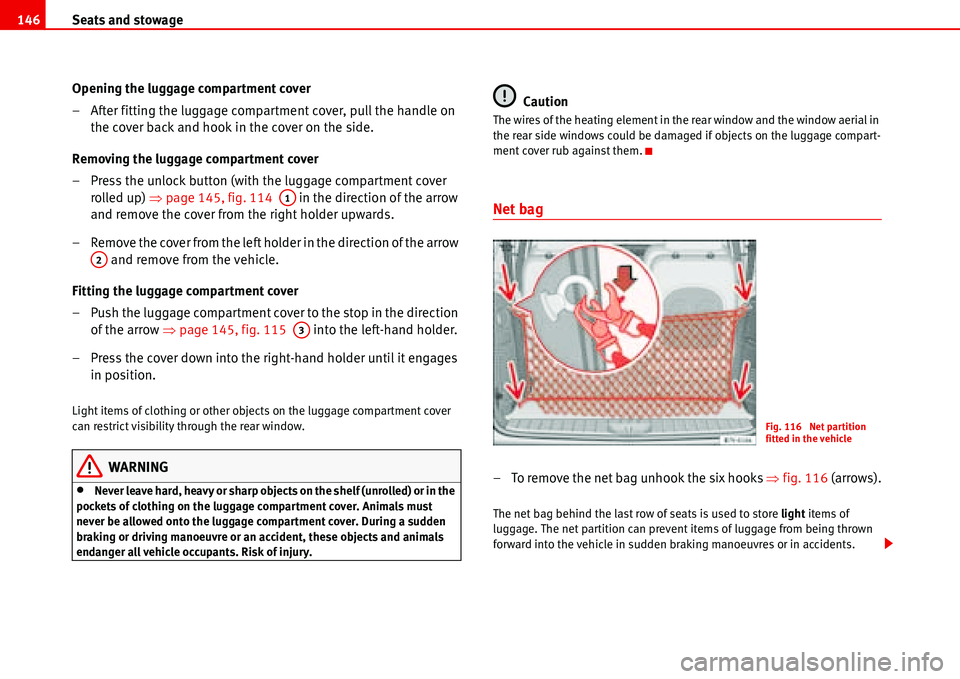
Net bag
– To remove the net bag unhook the six hooks Ÿfig. 116 (arrows).
The net bag behind the last row of seats is used to store light items of
luggage. The net partition can prevent items of luggage from being thrown
forward into the vehicle in sudden braking manoeuvres or in accidents.
A1
A2
A3
Fig. 116 Net partition
fitted in the vehicle
Page 162 of 299

Driving 160
•Adjust the driver seat or steering wheel so that there is a distance of at
least 25 cm between the steering wheel and your breast bone Ÿpage 159,
fig. 124. If you fail to observe the minimum distance, the airbag will not
protect you. Risk of fatal injury.
•If your physical constitution prevents you from maintaining the
minimum distance of 25 cm, contact an Authorised Service Centre. The
Authorised Service Centre will help you decide if special specific modifica-
tions are necessary.
•If you adjust the steering wheel so that it points towards your face, the
driver airbag will not protect you properly in the event of an accident. Make
sure that the steering wheel points towards your chest.
•When driving, always hold the steering wheel with both hands on the
outside of the ring at the 9 o'clock and 3 o'clock positions. Never hold the
steering wheel at the 12 o'clock position, or in any other manner (e.g. in
the centre of the steering wheel, or on the inside of the rim). In such cases,
you could receive severe injuries to the arms, hands and head.
Safety
Electronic stabilisation programme (ESP)
ESP helps make driving safer in certain situations.
The Electronic Stabilisation Programme (ESP) contains the electronic differ-
ential lock (EDL) and the traction control system (TCS). The ESP works
together with the anti-locking brake system (ABS). Both warning lamps will
light up if the ESP or ABS systems are faulty.
The ESP is started automatically when the engine is started.
In specific circumstances where you require less traction, you can switch off
the ESP by pressing button Ÿfig. 125 .
For example:
•when driving with snow chains,
•when driving in deep snow or on loose surfaces,
WARNING (continued)
Fig. 125 Section of the
dash panel: switch for ESP
%30
Page 163 of 299

Driving161
Safety FirstOperating instructionsTips and MaintenanceTe c h n i c a l D a t a
•when rocking the vehicle backwards and forwards to free it from mud, for
example.
You should press the button to switch the ESP back on when you no longer
need wheel spin.
The TCS and EDL are also switched off if the ESP is switched off. This means
that this technology is not available for as long as the ESP remains switched
off.
When does the inscription OFF light up on the button?
•It will light up continuously if there is a malfunction in the ESP.
•It will light up continuously if the ESP is switched off.
WARNING
•The electronic stabilisation program (ESP) cannot defy the laws of
physics. This should be kept in mind, particularly on slippery and wet
roads and when towing a trailer.
•Always adapt your driving style to suit the condition of the roads and
the traffic situation. Do not let the extra safety afforded by ESP tempt you
into taking any risks when driving, this can cause accidents.
•Please refer to the corresponding warning notes on ESP.
Ignition lock
Position of the ignition key
Ignition switched off, steering lock
In position Ÿfig. 126 the ignition is switched off, and the steering wheel
lock can be engaged.
To engage the steering wheel lock, take out the key and turn the wheel
slightly until you hear the pin engage. You should always lock the steering
wheel when you leave your vehicle. This makes vehicle theft more difficult
Ÿ.
Switching on the ignition or glow plug system
Tu rn the ignition key to this position and let go of the key. If the key canno t b e
turned or is difficult to turn from position to position , move the
steering wheel (to take the load off the steering lock mechanism) until the key
turns freely.
ESP
Fig. 126 Ignition key
positions
A1
A1
A2
A1A2
Page 164 of 299

Driving 162
Starting
The engine is started when the key is in this position. Electrical components
with a high power consumption are switched off temporarily.
Each time that the vehicle must be started, the ignition key must be turned to
the position . The repetitive start prevention lock of the ignition prevents
possible damage to the starter motor if the engine is already running.
WARNING
•Wait for the vehicle to come to a standstill before removing the ignition
key from the lock. The steering lock could be activated immediately - Risk
of accident!
•Always remove the key from the ignition lock when leaving the vehicle,
even if you only intend to be gone for a short period. This is especially
important if you must leave children or disabled people in the vehicle, they
could accidentally start the engine or work electrical equipment such as
the windows possibly resulting in an accident.
•Unsupervised use of the keys could result in the engine being started
or electrical systems, such as the electric windows, being used. This can
result in serious injury.
Caution
The starter must not be used unless the vehicle is at a standstill (key position
). If the starter is used as soon as the engine is switched off, the starter or
the engine could be damaged.
Safety interlock for ignition key
The ignition key can only be taken out of the ignition lock if the
selector lever is in position P.
After switching off the ignition, you can remove the ignition key only if the
automatic gearbox gear selector lever Ÿpage 167 is in position P. The
selector lever is blocked after the ignition key has been removed.
Electronic immobiliser
The immobiliser prevents unauthorised persons from driving
the vehicle.
Inside the key there is a chip that deactivates the electronic immobiliser auto-
matically when the key is inserted into the ignition.
The electronic immobiliser is automatically activated when you take the key
out of the ignition lock.
The engine can only be started using a genuine SEAT key with the correct
code.
Note
The vehicle cannot be operated properly if you do not have a genuine SEAT
key.
A3
A1
A3
Page 167 of 299

Driving165
Safety FirstOperating instructionsTips and MaintenanceTe c h n i c a l D a t a After the engine is switched off the radiator fan may run on for up to 10
minutes, even if the ignition is switched off. The radiator fan can start auto-
matically if the hot engine causes the coolant temperature to rise, or if the sun
heats the engine compartment.
WARNING
•Never switch off the engine until the vehicle is stationary.
•The brake servo and the power assisted steering work only when the
engine is running. You need more strength to steer and brake the vehicle
when the engine is switched off. As you cannot steer and brake in the
normal manner, there is a greater risk of accidents and serious injury.
•The steering lock can engage immediately when the key is removed
from the ignition lock. The vehicle cannot be steered. Risk of accident.
Caution
If the engine has been driven hard for a long period, the engine could over-
heat when it is switched off. Risk of engine damage. For this reason, you
should idle the engine for approx. 2 minutes before you switch it off.
Manual gearbox
Manual gearbox
Selecting the reverse gear
– The vehicle should be stationary with the engine idling. Press the
clutch right down.
– Put the gearlever Ÿfig. 127 in the middle (neutral).
– Press the gear stick down and then to the left and forwards into
the reverse position shown on the gear stick.
The reverse gear can only be engaged when the vehicle is stationary. When
the engine is running, before engaging this gear wait about 6 seconds with
the clutch pressed in fully in order to protect the gearbox.
When reverse gear is engaged and the ignition is switched on the following
takes place:
Fig. 127 Manual gearbox
with shift diagram
Page 168 of 299

Driving 166
•The reversing lights come on
•The heating or air conditioning automatically change to air recirculation
mode.
•The rear window heater switches on when the windscreen wiper is acti-
vated.
WARNING
•When the engine is running, the vehicle will start to move as soon as a
gear is engaged and the clutch released.
•Never select the reverse gear when the vehicle is in motion. Risk of acci-
dent.
Caution
•Do not rest your hand on the gear lever when driving. The pressure of your
hand could cause premature wear on the selector forks in the gearbox.
•When changing gear, you should always depress the clutch fully to avoid
unnecessary wear and damage.
•Do not hold the car “on the clutch” on hills. This causes premature wear
and damages the clutch. It can also prevent power being transferred from the
engine to the gearbox.
Automatic gearbox
Gearbox programs
The automatic gearbox has two gearbox programmes.
The gearbox management system is equipped with two driving programmes.
Depending on the driver or the driving situation, either a consumption
oriented programme or a more “sporty” programme will be selected.
The programme selection will be carried out automatically depending on how
the accelerator is used.
•The consumption-oriented programme will be selected if you use the
accelerator slowly or normally. This means that the gearbox will shift up
earlier and down later.
•A more “sporty” driving programme which shifts up gear later will be
selected if you use the accelerator more quickly.
Fig. 128 Section of
centre console: selector
lever with lock button