2006 Seat Alhambra roof
[x] Cancel search: roofPage 137 of 299
Seats and stowage135
Safety FirstOperating instructionsTips and MaintenanceTe c h n i c a l D a t a
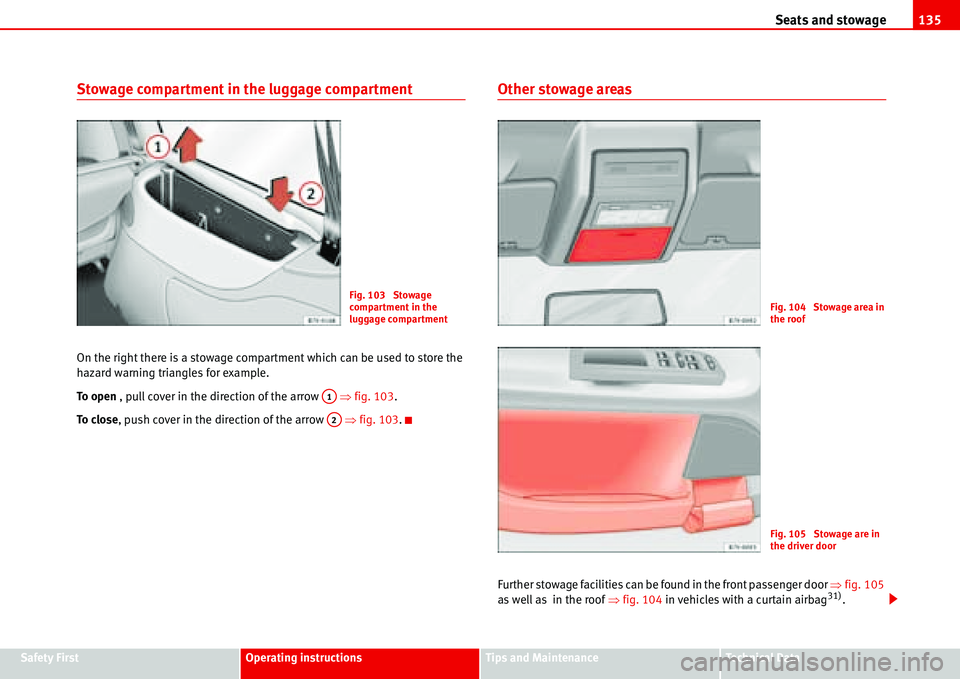
Stowage compartment in the luggage compartment
On the right there is a stowage compartment which can be used to store the
hazard warning triangles for example.
To o p e n , pull cover in the direction of the arrow Ÿfig. 103.
To c l o s e, push cover in the direction of the arrow Ÿfig. 103.
Other stowage areas
Further stowage facilities can be found in the front passenger door Ÿfig. 105
as well as in the roof Ÿfig. 104 in vehicles with a curtain airbag31).
Fig. 103 Stowage
compartment in the
luggage compartment
A1
A2
Fig. 104 Stowage area in
the roof
Fig. 105 Stowage are in
the driver door
Page 138 of 299

Seats and stowage 136
Coat hooks are located in the roof. They are integrated in the grab handles in
the passenger compartment.
Location of CD changer
31)
The CD changer, which can be factory fitted, is located either in the dash
panel or in the right-hand stowage compartment in the luggage compart-
ment.
WARNING
•Ensure that no objects can fall from the dash panel or other stowage
areas into the driver foot well while the vehicle is moving. In the event of a
sudden braking manoeuvre, you will not be able to use the brake, clutch or
accelerator. Risk of accident.
•Clothing hung on the coat hooks must not restrict the driver's view.
Risk of accident. The coat hooks are intended only for use with light arti-
cles of clothing. Do not leave any hard, sharp or heavy objects in hanging
articles of clothing. During sudden braking manoeuvres or accidents, espe-
cially those involving airbag deployment, these objects could injure the
vehicle occupants.
Cup holders
In the centre console: there are two cup holders
Opening cup holder
– Press the symbol on the cup holder briefly. The spring mecha-
nism will release the holder.
Closing the cup holder
– Push the cup holder up in the direction of the arrow Ÿfig. 106
until it engages.
WARNING
Improper use of the cup holders can cause injury.
•For reasons of safety, the cup holders should be used only for standard
drinks cans and bottles with a maximum capacity of 0.5 litres .
31)Optional equipment
Fig. 106 Cupholder in the
centre console
Page 149 of 299

Seats and stowage147
Safety FirstOperating instructionsTips and MaintenanceTe c h n i c a l D a t a
WARNING
Always fit the net partition carefully, observing the instructions. Risk of
injury.
•Heavy, pointed or sharp items which are not stowed securely can cause
injury in the event of sudden braking manoeuvres or accidents, even if the
net bag is correctly assembled.
•For reasons of safety, vehicle occupants must not travel behind a fitted
safety net.
Roof carrier
Safety notes on using the roof carrier
The roof carrier system must always be installed exactly
according to the instructions provided.
•Your vehicle has special roof rails on the right and left for fitting the
mounts. Therefore, standard roof carriers cannot be used.
•The mounts are the basis of a complete roof carrier system. Special
fixtures must then be added in order to safely transport luggage, bicycles,
skis, surf boards or boats on the roof. All these system components are avail-
able from SEAT Service. We recommend you use genuine SEAT roof carrier
systems. If you wish to use a different roof carrier, make sure that it can be
fitted securely to your vehicle and that it cannot damage your vehicle.
•We recommend that you keep the assembly instructions provided by the
roof carrier manufacturer in your vehicle wallet.
•Only the fitted retainers may be used to secure the carrier feet on vehicles
without a roof railing. These retainers are located underneath the plastic rain
channel between the markings.
•In vehicles with roof edging36), the basic supports can be fitted on the
edge making sure to adapt the distance between the supports to the objects
to be carried. On vehicles with a sliding/tilting roof
36), however, the front
carrier may not be fitted near the rear edge of the sliding/tilting roof when the
roof is open.
When should the roof carrier be removed?
•When it is not needed (to save fuel, reduce wind noise and avoid theft).
•Before cleaning in an automatic car wash.
WARNING
•If you do not use mounts approved by SEAT or fail to fit them according
to instructions, the load or the roof carrier itself may fall off the vehicle roof
and onto the street. Risk of accident or injury.
•The risk of an accident is increased by transporting heavy or bulky
loads on the roof, which affects the car's handling by shifting the centre of
gravity and increasing susceptibility to cross winds. Both circumstances
increase the risk of accident. Therefore you must adapt your driving style
and speed to the prevailing conditions - avoid sudden braking or driving
manoeuvres when there is a load on the roof carrier.
•The roof carrier system must always be installed exactly according to
the instructions provided.
Caution
•Check all bolted connections and fastenings for the roof carrier system
before every trip. If necessary, tighten bolted connections and check the
system at regular, appropriate intervals, e.g. at each stop during a long trip.
•The height of your vehicle is changed by the installation of the roof carrier
and the load secured on it. Bear this in mind when driving through garage
doors or low underpasses – there is danger of damage to the vehicle.
36)Optional equipment
Page 150 of 299

Seats and stowage 148
•Damage to the vehicle caused by incorrect installation of mounts or roof
carrier systems not approved by the factory are excluded from the vehicle
warranty.
Securing the load
Loads transported on the roof carrier must be securely
attached. The car's handling is affected when transporting
loads.
The maximum permissible roof load for your vehicle is 75 kg. The load limit
applies to the combined weight of the carrier system and the load itself.
Distribute the load evenly. However, if you are using a roof carrier with a lower
weight rating, you will not be able to carry the maximum roof load. Do not
exceed the maximum weight limit for the roof carrier which is listed in the
fitting instructions.
WARNING
•If damaged, fine or inadequate securing straps are used to fasten
objects carried on the roof, they could break in the event of sharp braking.
This could cause an accident and serious injury.
•Always use appropriate securing straps to secure objects on the roof
carrier against sliding or flying off. This could cause an accident. The load
must be correctly secured.
•Always respect the maximum authorised weight for the roof, the
maximum authorised weight on the axles and the total maximum author-
ised weight of the vehicle. Otherwise there is danger of causing an acci-
dent.
•The risk of an accident is increased by transporting heavy or bulky
loads on the roof, which affects the car's handling by shifting the centre of
gravity and increasing susceptibility to cross winds. Both circumstances increase the risk of accident. Therefore you must adapt your driving style
and speed to the prevailing conditions - avoid sudden braking or driving
manoeuvres when there is a load on the roof carrier.
Caution
Please take extra care not to let the tailgate or rear window strike the roof load
when open – there is a risk of damage to the vehicle.
For the sake of the environment
The roof carrier is often left on the roof for convenience even if it is not being
used. However, increased air resistance means that the vehicle uses more
fuel. For this reason you should always take off the roof carrier when it is not
in use.
Cooling and heating box*
Notes on usage
The cooling and heating box may only be installed in the posi-
tion of rear left seat in the third row.
Power can be supplied by any of the 12 Volt sockets in the vehicle. It
consumes approximately 33 watts and has a capacity of approximately
32 litres.
The battery will discharge if the cooling and heating box is used for a long
period while the engine is switched off.
WARNING (continued)
Page 158 of 299
Heating, Ventilation and Air conditioning 156
The Climatronic can be fitted either with or without an additional cooling
system 38) for the passenger compartment.
Climatronic for the passenger compartment without additional cooling
system
The temperature setting for the rear can be max. 3 °C higher than the temper-
ature in the passenger compartment. A lower temperature can not be set.
If the Climatronic detects that the passenger compartment has to be heated,
it activates the additional heat exchanger. The air outlets on the floor guide
warm air into the vehicle Ÿpage 156.
If the Climatronic detects that the passenger compartment has to be cooled,
cooled air is fed into the vehicle via the air outlets in the front of the vehicle
only Ÿpage 156.
Climatronic for the passenger compartment with additional cooling system
The temperature setting for the rear can be max. 3 °C lower than the temper-
ature in the passenger compartment.
If the Climatronic detects that the passenger compartment has to be heated,
it activates the additional heat exchanger. The air outlets on the floor guide
warm air into the vehicle Ÿpage 156.
If the Climatronic detects that the passenger compartment has to be cooled,
cooled air is fed into the rear of the vehicle via the open air outlets in the roof
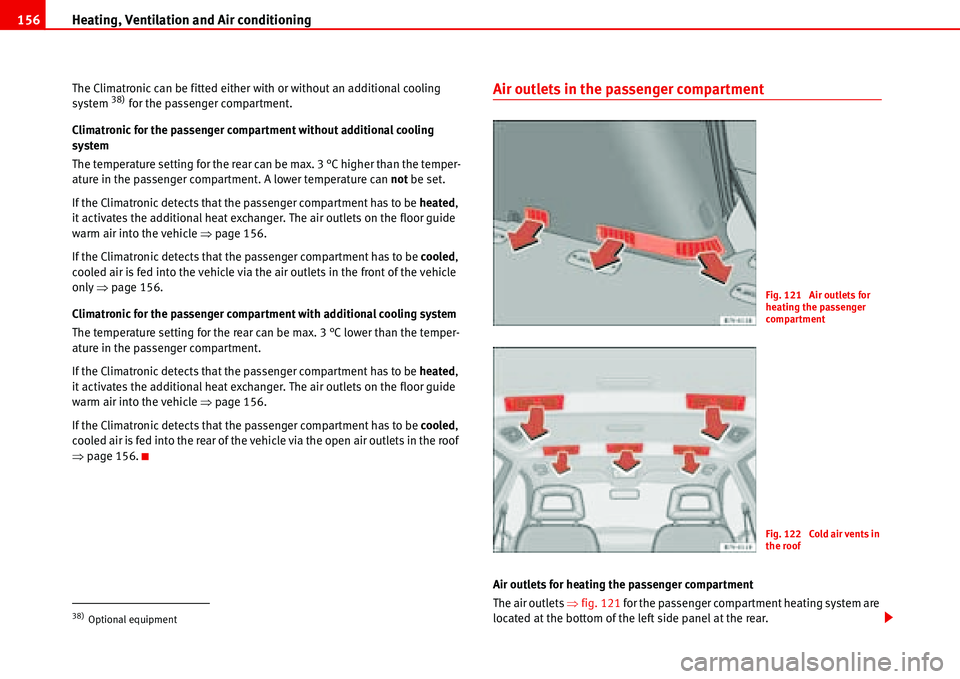
Ÿpage 156.Air outlets in the passenger compartment
Air outlets for heating the passenger compartment
The air outlets Ÿfig. 121 for the passenger compartment heating system are
located at the bottom of the left side panel at the rear.
38)Optional equipment
Fig. 121 Air outlets for
heating the passenger
compartment
Fig. 122 Cold air vents in
the roof
Page 159 of 299

Heating, Ventilation and Air conditioning157
Safety FirstOperating instructionsTips and MaintenanceTe c h n i c a l D a t a Air vents in the roof
In vehicles with a second cooling system
39) for ventilating the passenger
compartment, an air outlet is fitted in the roof above each rear seat
Ÿfig. 122.
The air outlets in the roof can be opened and closed individually and
adjusted by moving the grid.
Each air outlet has two thumb wheels. The left thumb wheel can be used to
open and close the air outlet. The right thumb wheel can be used to direct the
air towards the head and chest.
WARNING
Never leave objects, food or medicines in front of the air outlets in the rear
seats. The hot air could damage or destroy heat-sensitive objects, food or
medicines.
Caution
Do not use the area in front of the outlets to store objects. This could cause
the blower to overheat and switch off. The blower could also be damaged.
Note
In the cooling mode, at least one air outlet in the roof must be open. The
cooling system could otherwise ice over.
General notes
The pollen filter
The pollution filter serves as a barrier against impurities in the ambient air
(e.g. dust and pollen).
For the air conditioning system to work with maximum efficiency, the pollen
filter must be replaced at the intervals specified in the Service Schedule.
If the filter loses efficiency prematurely due to use in areas with very high
levels of air pollution, the pollen filter must be changed more frequently than
stated in the Service Schedule.
Instructions for use
If the air conditioning or Climatronic
40) is not switched on for a long period,
deposits on the evaporator can cause unpleasant smells. To prevent these
odours, the cooling system should be run at the highest blower setting at
least once a month when temperatures are over +5°C. Briefly open a window
at the same time.
Faults in the operation of the air conditioning
There is a fault if the all the symbols in the Climatronic flash for approx. 15
seconds when the ignition is switched on. Contact a specialist workshop.
If the air conditioning system cannot be switched on this may be caused by
the following reasons:
•the engine is not running.
•The blower is switched off.
•The outside temperature is lower than +5°C.
•the cooling system compressor has been temporarily switched off
because the engine coolant temperature is too high.
•The air conditioner fuse is faulty.
39)Optional equipment40)Optional equipment
Page 160 of 299

Heating, Ventilation and Air conditioning 158
•Another fault in the vehicle. Have the air conditioner checked by a quali-
fied workshop.
WARNING
Please note that when the Climatronic is switched off, no fresh air will enter
the vehicle interior. For this reason you should ensure that sufficient fresh
air is able to enter the vehicle by opening a window or the sliding/tilting
sunroof
40) when the Climatronic is switched off.
Caution
•If you suspect that the air conditioner is damaged, switch off the air condi-
tioner with button to prevent further damage and have it checked by a
qualified workshop.
•Repairs to the air conditioning system require specialist knowledge and
special tools. Therefore, we recommend that you take the vehicle to a quali-
fied workshop should problems occur.
Note
•If the humidity and temperature outside the vehicle are high, condensa-
tion can drip off the evaporator in the cooling system and form a pool under-
neath the vehicle, this is completely normal and there is no need to suspect
a leak.
•Keep the air intake slots in front of the windscreen free of snow, ice and
leaves to ensure heating and cooling is not impaired, and to prevent the
windows misting over.
•The air conditioning system operates most effectively with the windows
and the sliding /tilting roof 40) closed. However, if the sun has heated up the
vehicle, the air inside can be cooled more quickly by opening the windows for
a short period.
•Do not smoke while air recirculation mode is on, as smoke drawn into the
cooling system leaves a residue on the evaporator, producing a permanent
unpleasant odour.
ECON
Page 196 of 299

Cleaning and caring for your vehicle 194
Care of the vehicle exterior
Automatic car washes
The paint is so durable that the car can normally be washed without problems
in an automatic car wash. However, the effect on the paint depends to a large
extent on the design of the car wash, the brushes used, the filtering of the
wash water and the type of detergents and wax solutions used, etc.
After the car has been washed, the brakes could respond later than normal
as the brake discs and brake pads will be wet, or even frozen in winter. “Dry
” the brakes by applying the brakes carefully several times
WARNING
Moisture, ice and salt on the brakes may affect braking efficiency. Risk of
accident.
Washing by hand
Washing the vehicle
– First soften the dirt with plenty of water and rinse off.
– Clean the vehicle with a soft sponge, a glove or a brush. Start on
the roof and work your way down. Use only light pressure.
– Rinse the sponge or glove as much as possible.
– Special car shampoo should only be used for very stubborn dirt.
– Clean the wheels, sill panels etc. last using a different sponge or
glove.– Rinse the vehicle thoroughly with water.
– Dry the surface of the vehicle gently using a chamois leather.
–If it is cold, dry the rubber seals and the surfaces they touch with
a cloth to prevent them freezing. Apply silicone spray to the
rubber seals.
After cleaning the vehicle
– If possible, avoid sudden braking directly after washing the
vehicle. “Dry” the brakes by applying the brakes carefully several
times
WARNING
•The ignition must always be switched off before the vehicle is washed.
•Protect your hands and arms from cuts on sharp metal edges when
cleaning the underbody, the inside of the wheel housings etc. Risk of
injury.
•Moisture, ice and salt on the brakes may affect braking efficiency. Risk
of accident.
Caution
•Never attempt to remove dirt, mud or dust if the surface of the vehicle is
dry. Never use a dry cloth or sponge for cleaning purposes. This could scratch
the paintwork or glass on your vehicle.
•Washing the vehicle in cold weather: if the vehicle is rinsed with a hose,
do not direct the water into the lock cylinders or the gaps around the doors,
luggage compartment, or bonnet. This could cause them to freeze. Otherwise
there is a risk of malfunction.