2006 PORSCHE BOXSTER change
[x] Cancel search: changePage 3 of 296

3
Regularly check your vehicle for signs of da-
mage.
Damaged or missing aerodynamic compon-
ents such as spoilers or underside panels af-
fect the driving behavior and therefore must
be replaced immediately.
Your car may have all or some of the components
described in this manual.
Should you have difficulty understanding any of
the explanations of features or equipment installed
in your vehicle, contact your authorized Porsche
dealer. He/She will be glad to assist you. Also
check with your dealer on other available options
or equipment.
Throughout this booklet, left is designated as the
driver’s side of the vehicle, and right as the pas-
senger’s side of the vehicle.
Text, illustrations and specifications in this manual
are based on the information available at the time
of printing.
It has always been Porsche’s policy to continuous-
ly improve its products. Porsche, therefore, reser-
ves the right to make changes in design and spe-
cification, and to make additions or improvements
in its product without incurring any obligation to in-
stall them on products previously manufactured.
We wish you many miles of safe and pleasurable
driving in your Porsche.
Important
For your own protection and longer service life of
your car, please follow all operating instructions
and special warnings. These special warnings use
the safety alert symbol, followed by the words
Danger, Warning and Caution. These special
warnings contain important messages regarding
your safety and/or the potential for damage to
your Porsche. Ignoring them could result in se-
rious mechanical failure or even physical injury.
fDo not alter your Porsche. Any alteration could
create dangerous conditions or defeat safety
engineering features built into your car.
fDo not misuse your Porsche. Use it safely, and
consistently with the law, according to the dri-
ving conditions, and the instructions in this ma-
nual.
Alteration or misuse of your Porsche could
cause accidents and severe or fatal personal
injuries.
Note to owners In Canada, this manual is also available in French.
To obtain a copy contact your dealer or write to: Note aux proprietaires Au Canada, ce manuel est également disponible
en francais. Pour en obtenir un exemplaire, adres-
sez-vous à votre concessionnaire ou écrivez à
l’adresse ci-dessous.
Porsche Cars Canada, Ltd.
Automobiles Porsche Canada, LTEE
5045 Orbitor Drive
Building #8, Suite 200
Mississauga, Ontario
Canada L4W 4Y4
Telephone number for customer assistance:
1-800-PORSCHE / Option 3
Page 4 of 296

4Fuel Quality Your engine is designed to provide optimum performance and fuel economy using
unleaded premium fuel with an octane rating of 98 RON (93 CLC or AKI).
Porsche therefore recommends the use of these fuels in your vehicle.
Porsche also recognizes that these fuels may not always be available. Be assured that your vehicle will operate
properly on unleaded premium fuels with octane numbers of at least 95 RON (90 CLC or AKI),
since the engine’s “Electronic Oktane™ knock control” will adapt the ignition timing, if necessary. Fuels containing alcohol and ether Some areas of the U.S. require oxygenated fuels during certain portions of the year.
Oxygenated fuels are fuels which contain alcohols (such as methanol or ethanol) or ether (such as MTBE).
Under normal conditions, the amount of these compounds in the fuel will not affect driveability.
You may use oxygenated fuels in your Porsche, provided the octane requirements for your vehicle are met.
We recommend, however, to change to a different fuel or station if any of the following problems occur with your vehicle:
– Deterioration of driveability and performance.
– Substantially reduced fuel economy.
– Vapor lock and non-start problems, especially at high altitude or at high temperature.
– Engine malfunction or stalling. Fuels containing MMT Some North American fuels contain an octane enhancing additive called methylcyclopentadienyl manganese tricarbonyl (MMT).
If such fuels are used, your emission control system performance may be negatively affected.
The check engine warning lights on your instrument panel may turn on.
If this occurs, Porsche recommends you stop using fuels containing MMT.
Page 13 of 296

Controls, Instruments
13
In the driver’s seat... fCheck operation of the horn.
fPosition seat for easy reach of foot pedals and
controls.
To reduce the possibility of injury from the air-
bag deployment, you should always sit back as
far from the steering wheel as is practical,
while still maintaining full vehicle control.
fAdjust the inside and outside rear view mirrors.
fBuckle your safety belts.
fCheck operation of the foot and parking brake.
fCheck all warning and indicator lights with
ignition on and engine not running.
fStart engine and check all warning displays for
warning symbols.
fNever leave an idling car unattended.
fLock doors from inside, especially with child-
ren in the car to prevent inadvertent opening of
doors from inside or outside.
Drive with doors locked.
On the road... fNever drive after you have consumed alcohol
or drugs.
fAlways have your safety belt fastened.
fAlways drive defensively.
Expect the unexpected.
fUse signals to indicate turns and lane changes.
fTurn on headlights at dusk or when the driving
conditions warrant it.
fAlways keep a safe distance from the vehicle in
front of you, depending on traffic, road and
weather conditions.
fReduce speed at night and during inclement
weather.
Driving in wet weather requires caution and re-
duced speeds, particularly on roads with stan-
ding water, as the handling characteristics of
the vehicle may be impaired due to hydropla-
ning of the tires.
fAlways observe speed limits and obey road
signs and traffic laws.
fWhen tired, get well off the road, stop and take
a rest. Turn the engine off. Do not sit in the ve-
hicle with engine idling.
fPlease observe the chapter “ENGINE EX-
HAUST” on Page 8.fWhen parked, always set the parking brake.
Move the Tiptronic selector lever to ”P“ or the
gearshift lever to reverse or first gear.
On hills also turn the front wheels toward the
curb.
fWhen emergency repairs become necessary,
move the vehicle well off the road. Turn on the
emergency flasher and use other warning de-
vices to alert other motorists. Do not park or
operate the vehicle in areas where the hot ex-
haust system may come in contact with dry
grass, brush, fuel spill or other flammable ma-
terial.
fMake it a habit to have the engine oil checked
with every fuel filling.
Danger!
Danger of fire in engine compartment due to
burning cigars or cigarettes.
fDo not throw any lit cigars or cigarettes out of
the vehicle.
They can be blown into the air inlets by the air
flow and cause a fire in the engine compart-
ment.
fPlease observe the chapter “ASHTRAY” on Page 138.
Page 19 of 296

Controls, Instruments
19
Central Locking in Cars without
Alarm System This device complies with:
Part 15 of the FCC Rules
RSS-210 of Industry Canada.
Operation is subject to the following two condi-
tions:
1. This device may not cause harmful interfer-
ence, and
2. this device must accept any interference re-
ceived, including interference that may cause
undesired operation.
Note
The manufacturer is not responsible for any radio
or TV interference caused by unauthorized modifi-
cations to this equipment.
Such modification could void the user’s authority
to operate the equipment.
Warning!
Any changes or modifications not expressly appro-
ved by Porsche could void the user’s authority to
operate this equipment.
fPlease observe the chapter “LOAD SWITCH-
OFF AFTER 2 HOURS OR 7 DAYS” on Page
246.
fPlease observe the chapter “SEAT MEMORY”
on Page 36.fPlease observe the chapter “POWER WIN-
DOWS” on Page 28.
Both car doors and the filler flap can be centrally
unlocked or locked with the remote control.
Any person remaining in the locked car can
open the door with the inner door handle:
1. Pull inner door handle once to unlock door
lock.
2. Pull inner door handle again to open door.
Automatic relocking If the car is unlocked by remote control and none
of the car doors is opened within approx. 60 se-
conds, automatic relocking takes place.
This relocking time can be adapted to your indivi-
dual requirements (4 - 120 seconds) by an autho-
rized Porsche dealer.
Emergency operation – opening fUnlock the driver’s door with the key at the
door lock. Emergency operation – closing fLock the driver’s door with the key at the door
lock.
If there is a defect in the central locking sys-
tem, all functioning elements of the central lo-
cking system will be locked.
The fault should be remedied immediately at an
authorized Porsche dealer. Indication by emergency flasher If the remote control is used for unlocking or lo-
cking, a response is provided by the emergency
flasher:
– Unlocking – single flash.
– Locking – double flash. Overload protection If the central locking system is operated more
than ten times within a minute, further operation is
blocked for 30 seconds.
Page 21 of 296

Controls, Instruments
21
Central Locking in Cars with Alarm
System This device complies with:
Part 15 of the FCC Rules
RSS-210 of Industry Canada.
Operation is subject to the following two condi-
tions:
1. This device may not cause harmful interfer-
ence, and
2. this device must accept any interference re-
ceived, including interference that may cause
undesired operation.
Note
The manufacturer is not responsible for any radio
or TV interference caused by unauthorized modifi-
cations to this equipment.
Such modification could void the user’s authority
to operate the equipment.
Warning!
Any changes or modifications not expressly appro-
ved by Porsche could void the user’s authority to
operate this equipment.
fPlease observe the chapter “LOAD SWITCH-
OFF AFTER 2 HOURS OR 7 DAYS” on Page
246.
fPlease observe the chapter “SEAT MEMORY”
on Page 36.fPlease observe the chapter “POWER WIN-
DOWS” on Page 28.
Both car doors and the filler flap can be centrally
unlocked or locked with the remote control.
The vehicle cannot be locked if the driver’s door is
not completely closed.
A short signal from the alarm horn will draw
your attention to the fact that the following
components are not completely closed when you
try to lock the vehicle:
– Doors
– Luggage compartment lids
– Convertible-top lock
– Glove compartment
– Passenger compartment
Unlocking the vehicle by using the key in the door
lock and opening the door may activate the alarm
system within 10 seconds.
Note
On vehicles with the Sport Chrono package plus,
the PCM can be used to activate automatic door
locking.
fPlease observe the chapter “Individual Memo-
ry” in the separate PCM operating instructions.
Automatic relocking If the car is unlocked by remote control and none
of the car doors is opened within approx. 60 se-
conds, automatic relocking takes place.
This relocking time can be adapted to your indivi-
dual requirements (4 - 120 seconds) by an autho-
rized Porsche dealer.
Page 26 of 296

26
Controls, Instruments
A - Light-emitting diode for alarm system Alarm System,
Passenger Compartment
Monitoring This device complies with:
Part 15 of the FCC Rules
RSS-210 of Industry Canada.
Operation is subject to the following two condi-
tions:
1. This device may not cause harmful interfer-
ence, and this device must accept any interfer-
ence received, including interference that may
cause undesired operation.Note
The manufacturer is not responsible for any radio
or TV interference caused by unauthorized modifi-
cations to this equipment.
Such modification could void the user’s authority
to operate the equipment.
Warning!
Any changes or modifications not expressly appro-
ved by Porsche could void the user’s authority to
operate this equipment.
The alarm system and passenger compartment
monitoring system are switched on when the
doors are locked with the key or remote control.
fPlease observe the chapter “CENTRAL LO-
CKING IN CARS WITH ALARM SYSTEM” on
Page 21.
Unlocking the vehicle by using the key in the
door lock and opening the door may activate
the alarm system within 10 seconds.
Note
The passenger compartment monitoring system
is always switched off when the convertible top is
open.
Function indication If the alarm system is activated, light-emitting dio-
de A on the dashboard flashes.
If, after locking, the light-emitting diode does not
flash or, after ten seconds, it emits double flas-
hes, then not all alarm contacts are closed.
Additionally, a brief horn signal sounds.
When the doors are unlocked, the alarm system
and passenger compartment monitoring system
are switched off and the light-emitting diode goes
off.
Page 27 of 296

Controls, Instruments
27
When the alarm is armed, the following
areas are monitored –Doors
– Front and rear lids
– Convertible-top lock
– Glove compartment
– Passenger compartment
If one of these alarm contacts is interrupted, the
alarm horn sounds for approximately 3 minutes.
Additionally, the emergency flasher and the pas-
senger compartment light flash for approximately
four minutes.
When the alarm is triggered, the light-emitting dio-
de changes over to double flashes.
In order not to limit the action range of the passen-
ger compartment monitoring system:
fDo not fold the backrests forward.
Deactivating the passenger compartment
monitoring system for one locking
process If a person or animal remains in the car while it is
locked, the passenger compartment monitoring
system must be switched off.
fQuickly lock car twice.
The doors are locked but can be opened from
the inside:
1. Pull inner door handle once to unlock door
lock.
2. Pull inner door handle again to open door.
Note
Inform any person remaining in the car that the
alarm system will be triggered if the door is ope-
ned.
Fault indication A double horn signal during locking indicates a
defect in the central locking or alarm system.
fHave the defect remedied at an authorized
Porsche dealer.
Page 30 of 296
30
Controls, Instruments
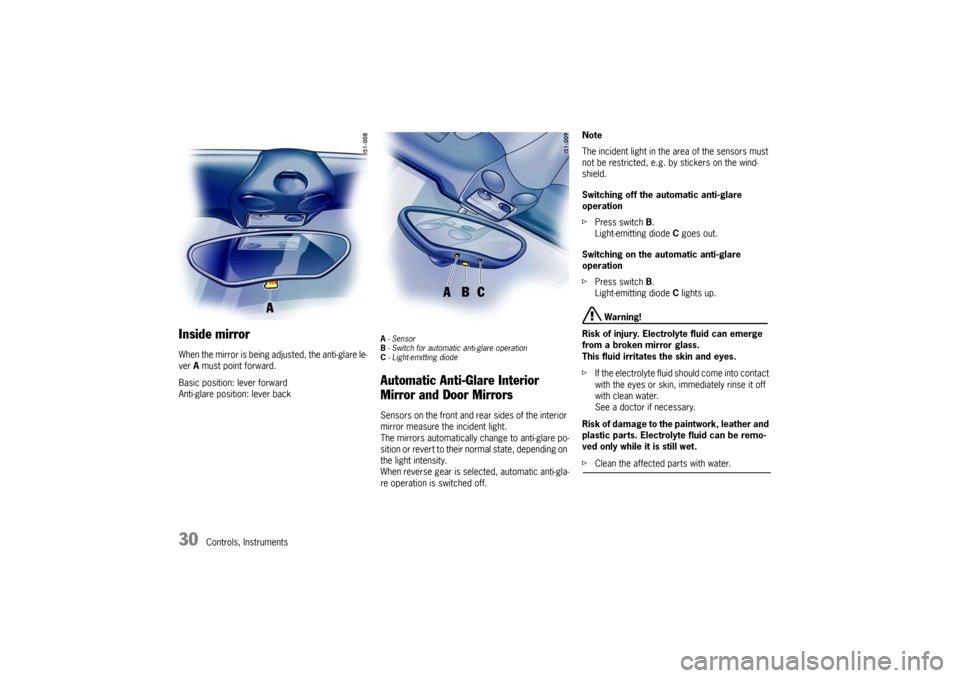
Inside mirror When the mirror is being adjusted, the anti-glare le-
ver A must point forward.
Basic position: lever forward
Anti-glare position: lever back
A - Sensor
B - Switch for automatic anti-glare operation
C - Light-emitting diode Automatic Anti-Glare Interior
Mirror and Door Mirrors Sensors on the front and rear sides of the interior
mirror measure the incident light.
The mirrors automatically change to anti-glare po-
sition or revert to their normal state, depending on
the light intensity.
When reverse gear is selected, automatic anti-gla-
re operation is switched off. Note
The incident light in the area of the sensors must
not be restricted, e.g. by stickers on the wind-
shield.
Switching off the automatic anti-glare
operation
fPress switch B.
Light-emitting diode C goes out.
Switching on the automatic anti-glare
operation
fPress switch B.
Light-emitting diode C lights up.
Warning!
Risk of injury. Electrolyte fluid can emerge
from a broken mirror glass.
This fluid irritates the skin and eyes.
fIf the electrolyte fluid should come into contact
with the eyes or skin, immediately rinse it off
with clean water.
See a doctor if necessary.
Risk of damage to the paintwork, leather and
plastic parts. Electrolyte fluid can be remo-
ved only while it is still wet.
fClean the affected parts with water.