2006 PORSCHE BOXSTER Lights operation
[x] Cancel search: Lights operationPage 131 of 296

Controls, Instruments
131
Defrost windshieldfPress button B (switch on or off).
The light-emitting diode in the button lights up.
The windshield is demisted or defrosted as
quickly as possible.
Air flows to the windshield only.Circulating-air mode
Warning!
Risk of accident due to hampered vision.
In circulating-air mode, the windows may
mist up.
fOnly select circulating-air mode for short
periods.
fIf the windows mist up, switch air-circulation
mode off immediately by pressing the
air-circulation button again and selecting the “Defrost windshield” function.
Switching circulating-air mode on or off
fPress circulating-air button C.
The light-emitting diode in the button lights up.
The outside-air supply is interrupted and only
the inside air is circulated.
ECO – switching the air-conditioning
compressor on and offThe air conditioning compressor switches off
automatically at temperatures below approx.
37°F/3°C and cannot be switched on, even
manually.
Whenever outside temperatures exceed approx.
37°F/3°C, the air-conditioning compressor can be
switched on or off manually.
The compressor can be switched off manuall to
save fuel.
fPress ECO button E.
The light-emitting diode in the button lights up.
The compressor is switched off.
fIf the interior temperature is too high, switch
on the compressor again.
To dry incoming air in damp weather, do not
switch off the air-conditioning compressor.
This prevents misting of windows.AC max operationIn AC max operation, the interior of your vehicle is
cooled as quickly as possible.
fPress AC max button H.
The light-emitting diode in the button lights up.
Air distributionThe individual air distributions can be combined as
desired.
If an air distribution is not selected, no symbol
appears in the display panel. Air flows then from
all vents as well as to the windshield.
Recommended setting in Summer –
Air distribution to central and side vents
Recommended setting in Winter –
Air distribution to footwell and windshield
Air distribution to footwell
fPress button I.
The selection appears on the display panel.
The air flows to the footwell.
Air distribution to center and side vents
fPress button J.
The selection appears on the display panel.
The air flows from the central and side vents.
Vents must be open.
Air distribution to windshield
fPress button K.
The selection appears on the display panel.
The air flows to the windshield.
Page 135 of 296

Controls, Instruments
135
Switching circulating-air mode on or off
fPress button C.
The outside-air supply is interrupted and only
the inside air is circulated.
The light-emitting diode in the button lights up.
Over approx. 37°F/3°C
If the air-conditioning compressor was off, it
switches on automatically. The duration of
circulating-air mode is not limited.
Below approx. 37°F/3°C
The air-conditioning compressor is switched off.
Circulating-air mode is automatically ended after
approx. 3 minutes.Air distributionThe individual air distributions can be combined as
desired.
Recommended setting in Summer –
Air distribution to central and side vents
Recommended setting in Winter –
Air distribution to footwell and windshield
Air distribution to footwell
fPress button J.
The air flows to the footwell.
The selection appears on the display panel.Air distribution to center and side vents
fPress button K.
The air flows from the central and side vents.
Vents must be open.
The selection appears on the display panel.
Air distribution to windshield
fPress button L.
The air flows to the windshield.
The selection appears on the display panel.
Note on operation
fOn vehicles with the Sport Chrono package
Plus, individual air conditioning settings can be
stored on your vehicle key.
Please observe the chapter “Individual
Memory” in the separate PCM operating
instructions.
Information on air-conditioning
compressor– May switch off briefly to ensure sufficient
engine cooling if the engine is operating under
extreme load.
– Operates most effectively with the windows
closed.
If the vehicle has been in the sun for a long
time, it is a good idea to ventilate the interior
briefly with the windows open.
– Depending on the outside temperature and
humidity, condensation can drip from the
evaporator and form a pool under the car.
This is normal and not a sign of leakage.
– If uncooled air flows out when the lowest
temperature has been set, switch off the air
conditioning compressor and have the fault
remedied.
Please contact your authorized Porsche dealer
for further information.
Page 141 of 296

Controls, Instruments
141
A - Orientation light
B - Interior light switch, footwell lightInterior lightsfPlease observe the chapter “LOAD SWITCH-
OFF AFTER 2 HOURS OR 7 DAYS” on Page
246.
Interior light, footwell lightsSwitching off
fPress left half of switch.
Switching to continuous illumination
fPress right half of switch.
Switching on and off automatically
fMove switch to center position.
The lights are switched on when a door is unlo-
cked or opened or when the ignition key is with-
drawn from the ignition lock.
The lights are switched off with a delay of ap-
prox. 30 seconds after the door is closed.
The lights go out immediately as soon as the igni-
tion key is inserted in the ignition lock or the vehic-
le is locked.
Orientation lightThe light-emitting diode in the interior light impro-
ves your orientation inside the vehicle when it is
dark.
Note on operation
On vehicles with Sport Chrono package, the
brightness of the orientation light can be changed
in PCM.
fPlease observe the chapter “Individual Memo-
ry” in the separate PCM operating instructions.
Page 149 of 296

Controls, Instruments
149
Danger!
Risk of accident.
If the warning message in the on-board com-
puter lights up when the vehicle is in motion,
the lid may impact in front of the windshield
and can tear off.
You can lose control of the vehicle.
fStop the vehicle immediately when the warning
message lights up.
fCheck the luggage compartment.
fClose the lid. Rear luggage compartment lid If the rear luggage compartment lid is unlocked
with unlocking handle A, the lid opens immediate-
ly.
fStop the vehicle immediately when the warning
message lights up.
fCheck the luggage compartment.
fClose the lid. Note
The front lid cannot be opened from the inside if
the battery is disconnected or empty.
Safety reasons therefore require that you un-
screw the latch striker of the front lid lock if
you plan to put the vehicle out of operation
for an extended period.
Please consult your authorized Porsche dealer.
They will advise you about the necessary measu-
res. Note
fWhen loading the luggage compartment, make
sure that items of luggage or other objects
cannot become caught on handle A.
This could cause the luggage compartment to
open unintentionally.
Page 157 of 296

Controls, Instruments
157
Car Telephone and
Aftermarket Alarms Important legal and safety information
regarding the use of cellular telephones:
Some states may prohibit the use of cellular tele-
phones while driving a vehicle. Check the laws and
regulations on the use of cellular telephones in the
areas where you drive.
Danger!
Risk of an accident.
Severe personal injury or death can result in
the event of an accident.
Looking away from the road or turning your
attention away from your driving can cause
an accident and serious or fatal injury.
When using your cellular telephone, you should al-
ways:
fGive full attention to your driving - pull off the
road and park before making or answering a
call if traffic conditions so require; and
fKeep both hands on the steering wheel - use
hands-free operation (if available) - pull off the
road and park before using a hand-held tele-phone. It is essential to observe the instructions of
the telephone manufacturer before putting
the telephone into operation.
Any portable telephone or radio transmitter which
is used in a Porsche must be properly installed in
accordance with the technical requirements of
Porsche.
The transmission power must not exceed
10 W.
The devices must possess a type approval for
your vehicle and have an “e” symbol.
If you should require equipment with transmission
power values greater than 10 W, please consult
your authorized Porsche dealer for this purpose.
He is familiar with the technical requirements for
installing devices of this kind.
The antennas for all radios and telephones with a
transmitting antenna must be externally mounted.
The improper installation of radios or telephones
or use of a radio or telephone with a transmitting
antenna inside the car may cause the warning
lights to come on.
Improper installation of such equipment can crea-
te a discharged battery or excessive current draw
from added equipment. If aftermarket systems are installed by non-dealer-
ship technicians or outside the selling dealer, pro-
blems may result. Installation of aftermarket
equipment is not covered under the New Car War-
ranty.
fConsult your authorized Porsche dealer about
the installation of non Porsche approved equip-
ment.
Reception quality
The reception quality of your car telephone will
change constantly when you are driving. Interfe-
rence caused by buildings, landscape and
weather is unavoidable. It may become particular-
ly difficult to hear when using the hands-free func-
tion due to external noise such as engine and wind
noise.
Automatic car-wash
fUnscrew the external antenna before using an
automatic car-wash.
Page 158 of 296
158
Controls, Instruments
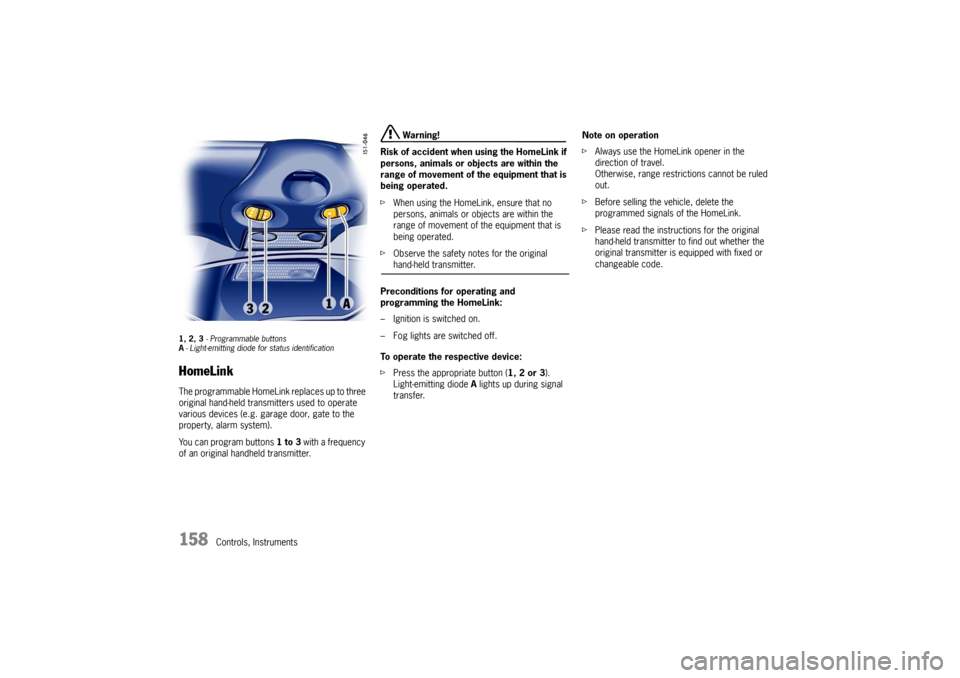
1, 2, 3 - Programmable buttons
A- Light-emitting diode for status identificationHomeLinkThe programmable HomeLink replaces up to three
original hand-held transmitters used to operate
various devices (e.g. garage door, gate to the
property, alarm system).
You can program buttons 1 to 3 with a frequency
of an original handheld transmitter.
Warning!
Risk of accident when using the HomeLink if
persons, animals or objects are within the
range of movement of the equipment that is
being operated.
fWhen using the HomeLink, ensure that no
persons, animals or objects are within the
range of movement of the equipment that is
being operated.
fObserve the safety notes for the original hand-held transmitter.
Preconditions for operating and
programming the HomeLink:
– Ignition is switched on.
– Fog lights are switched off.
To operate the respective device:
fPress the appropriate button (1, 2 or 3).
Light-emitting diode A lights up during signal
transfer.Note on operation
fAlways use the HomeLink opener in the
direction of travel.
Otherwise, range restrictions cannot be ruled
out.
fBefore selling the vehicle, delete the
programmed signals of the HomeLink.
fPlease read the instructions for the original
hand-held transmitter to find out whether the
original transmitter is equipped with fixed or
changeable code.
Page 251 of 296

Practical Tips, Emergency Service
251
Winter drivingThe capacity and ability of the battery to store
power decreases at low outside temperatures.
Moreover, the battery is more heavily loaded in the
winter months, e.g. by the heated rear window,
the more frequent use of additional lights, the
blower and the windshield wipers, etc.
fHave the battery checked before winter
begins.
Keep the battery well charged to prevent it from
freezing.
A discharged battery can freeze even at
23°F/-5 °
C, but a fully charged one only freezes at
-40°F/-40 °C.
Laying up the vehicleIf the vehicle stands for long periods in the garage
or workshop, the doors and lids should be closed.
fPlease observe the chapter “EMERGENCY
UNLOCKING OF THE FRONT LUGGAGE
COMPARTMENT LID” on Page 248.
fWithdraw the ignition key and, if necessary,
disconnect the battery.
When the battery is disconnected, the
alarm system ceases to function!
Even if you put your vehicle out of operation, the
battery still discharges.
fThe battery must be charged, i.e. connected
to a charger, approximately every 6 weeks in
order to preserve functioning.
Always observe the instructions of the charger
manufacturer.
fStore a battery that has been removed in a
dark, cool place, but not subject to frost.
Replacing the batteryThe battery is subject to normal wear: its service
life depends heavily on the care you give it,
climatic conditions and the conditions of use
(distances, loads).
It is not possible to use the details on the battery
case to determine a comparable battery that
meets all the specific requirements of Porsche.
fUse only a battery that meets the specific
requirements of your vehicle as a replacement.
We recommend that you use an Orignal
Porsche battery.
fPlease observe the disposal instructions for
batteries!
Page 252 of 296

252
Practical Tips, Emergency Service
Putting vehicle into operationAfter the battery is connected or after an exhaus-
tively discharged battery is charged, the multi-
functional PSM light lights up on the instrument
panel and a message appears on the on-board
computer to indicate a fault.
This fault can be remedied with a few simple
steps:
1. Start the engine.
2. With the vehicle stationary, perform a few
steering movements to the left and right and
then drive a short distance in a straight line
until the multifunctinal PSM light goes out and
the message on the on-board computer
disappears.
3. If the warnings do not disappear, then:
Drive carefully to the nearest qualified
specialist workshop.
Have the fault remedied.
4. After the warnings disappear, stop the vehicle
in a suitable place.
5. Perform adaptation of the power windows:
Please observe the chapter “STORING END
POSITION OF THE WINDOWS” on Page 29.Ignition key/ignition lock
fDo not insert the ignition key into the ignition
lock if the vehicle battery is discharged.
The ignition key can no longer be removed.
The key cannot be removed until the vehicle elec-
trical system is supplied with power again.
fPlease observe the chapter “EMERGENCY UN-
LOCKING OF THE FRONT LUGGAGE COMPART-
MENT LID” on Page 248.
6. Please observe the chapter “JUMP LEAD
STARTING” on Page 256.