2006 PONTIAC VIBE mirror
[x] Cancel search: mirrorPage 206 of 388

Skidding
In a skid, a driver can lose control of the vehicle.
Defensive drivers avoid most skids by taking reasonable
care suited to existing conditions, and by not overdriving
those conditions. But skids are always possible.
The three types of skids correspond to your vehicle’s
three control systems. In the braking skid, your wheels
are not rolling. In the steering or cornering skid, too much
speed or steering in a curve causes tires to slip and lose
cornering force. And in the acceleration skid, too much
throttle causes the driving wheels to spin.
A cornering skid and an acceleration skid are best
handled by easing your foot off the accelerator pedal.
If your vehicle starts to slide, ease your foot off the
accelerator pedal and quickly steer the way you want
the vehicle to go. If you start steering quickly enough,
your vehicle may straighten out. Always be ready
for a second skid if it occurs.Of course, traction is reduced when water, snow, ice,
gravel, or other material is on the road. For safety, you
will want to slow down and adjust your driving to
these conditions. It is important to slow down on slippery
surfaces because stopping distance will be longer and
vehicle control more limited.
While driving on a surface with reduced traction, try
your best to avoid sudden steering, acceleration,
or braking, including engine braking by shifting to a
lower gear. Any sudden changes could cause the tires
to slide. You may not realize the surface is slippery
until your vehicle is skidding. Learn to recognize warning
clues — such as enough water, ice, or packed snow
on the road to make a mirrored surface — and
slow down when you have any doubt.
If you have the Anti-Lock Brake System (ABS),
remember: It helps avoid only the braking skid. If you do
not have ABS, then in a braking skid, where the
wheels are no longer rolling, release enough pressure
on the brakes to get the wheels rolling again. This
restores steering control. Push the brake pedal down
steadily when you have to stop suddenly. As long as the
wheels are rolling, you will have steering control.
4-16
Page 207 of 388

Driving at Night
Night driving is more dangerous than day driving.
One reason is that some drivers are likely to be
impaired — by alcohol or drugs, with night vision
problems, or by fatigue.
Here are some tips on night driving.
Drive defensively.
Do not drink and drive.
Adjust the inside rearview mirror to reduce the glare
from headlamps behind you.
Since you cannot see as well, you may need to
slow down and keep more space between you
and other vehicles.
Slow down, especially on higher speed roads.
Your vehicle’s headlamps can light up only so much
road ahead.
In remote areas, watch for animals.
If you are tired, pull off the road in a safe place
and rest.
No one can see as well at night as in the daytime. But
as we get older these differences increase. A
50-year-old driver may require at least twice as much
light to see the same thing at night as a 20-year-old.What you do in the daytime can also affect your night
vision. For example, if you spend the day in bright
sunshine you are wise to wear sunglasses. Your eyes
will have less trouble adjusting to night. But if you
are driving, do not wear sunglasses at night. They may
cut down on glare from headlamps, but they also
make a lot of things invisible.
You can be temporarily blinded by approaching
headlamps. It can take a second or two, or even several
seconds, for your eyes to re-adjust to the dark. When
you are faced with severe glare, as from a driver
who does not lower the high beams, or a vehicle with
misaimed headlamps, slow down a little. Avoid
staring directly into the approaching headlamps.
Keep the windshield and all the glass on your vehicle
clean — inside and out. Glare at night is made much
worse by dirt on the glass. Even the inside of the glass
can build up a lm caused by dust. Dirty glass makes
lights dazzle and ash more than clean glass would,
making the pupils of your eyes contract repeatedly.
Remember that the headlamps light up far less of a
roadway when you are in a turn or curve. Keep
your eyes moving; that way, it is easier to pick out dimly
lighted objects. Just as the headlamps should be
checked regularly for proper aim, so should your eyes
be examined regularly. Some drivers suffer from
night blindness — the inability to see in dim
light — and are not even aware of it.
4-17
Page 211 of 388
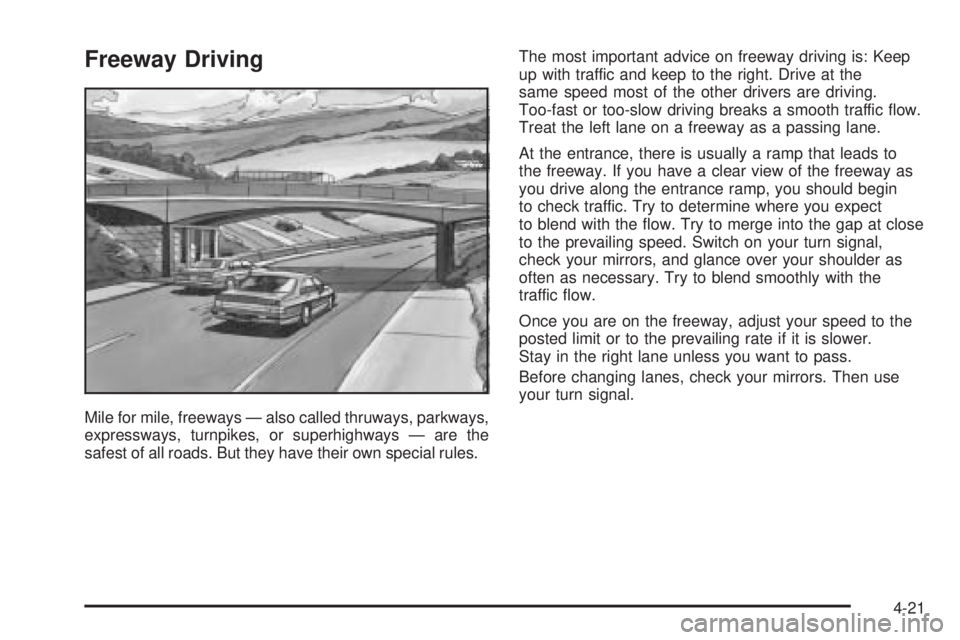
Freeway Driving
Mile for mile, freeways — also called thruways, parkways,
expressways, turnpikes, or superhighways — are the
safest of all roads. But they have their own special rules.The most important advice on freeway driving is: Keep
up with traffic and keep to the right. Drive at the
same speed most of the other drivers are driving.
Too-fast or too-slow driving breaks a smooth traffic ow.
Treat the left lane on a freeway as a passing lane.
At the entrance, there is usually a ramp that leads to
the freeway. If you have a clear view of the freeway as
you drive along the entrance ramp, you should begin
to check traffic. Try to determine where you expect
to blend with the ow. Try to merge into the gap at close
to the prevailing speed. Switch on your turn signal,
check your mirrors, and glance over your shoulder as
often as necessary. Try to blend smoothly with the
traffic ow.
Once you are on the freeway, adjust your speed to the
posted limit or to the prevailing rate if it is slower.
Stay in the right lane unless you want to pass.
Before changing lanes, check your mirrors. Then use
your turn signal.
4-21
Page 213 of 388

Here are some things you can check before a trip:
Windshield Washer Fluid:Is the reservoir full? Are
all windows clean inside and outside?
Wiper Blades:Are they in good shape?
Fuel, Engine Oil, Other Fluids:Have you checked
all levels?
Lamps:Are they all working? Are the lenses clean?
Tires:They are vitally important to a safe,
trouble-free trip. Is the tread good enough for
long-distance driving? Are the tires all inated to the
recommended pressure?
Weather Forecasts:What is the weather outlook
along your route? Should you delay your trip a
short time to avoid a major storm system?
Maps:Do you have up-to-date maps?
Highway Hypnosis
Is there actually such a condition as highway hypnosis?
Or is it just plain falling asleep at the wheel? Call it
highway hypnosis, lack of awareness, or whatever.
There is something about an easy stretch of road with
the same scenery, along with the hum of the tires on the
road, the drone of the engine, and the rush of the
wind against the vehicle that can make you sleepy. Do
not let it happen to you! If it does, your vehicle can
leave the road in less than a second, and you could
crash and be injured.
What can you do about highway hypnosis? First, be
aware that it can happen.
Then here are some tips:
Make sure your vehicle is well ventilated, with a
comfortably cool interior.
Keep your eyes moving. Scan the road ahead and
to the sides. Check your rearview mirrors and your
instruments frequently.
If you get sleepy, pull off the road into a rest,
service, or parking area and take a nap, get some
exercise, or both. For safety, treat drowsiness
on the highway as an emergency.
4-23
Page 234 of 388

Driving with a Trailer
Towing a trailer requires a certain amount of experience.
Before setting out for the open road, you’ll want to get
to know your rig. Acquaint yourself with the feel of
handling and braking with the added weight of the trailer.
And always keep in mind that the vehicle you are
driving is now a good deal longer and not nearly as
responsive as your vehicle is by itself.
Before you start, check the trailer hitch, platform and
attachments, safety chains, electrical connector, lamps,
tires and mirror adjustment. If the trailer has electric
brakes, start your vehicle and trailer moving and then
apply the trailer brake controller by hand to be sure
the brakes are working. This lets you check your
electrical connection at the same time.
During your trip, check occasionally to be sure that the
load is secure, and that the lamps and any trailer
brakes are still working.
Following Distance
Stay at least twice as far behind the vehicle ahead as
you would when driving your vehicle without a trailer.
This can help you avoid situations that require
heavy braking and sudden turns.
Passing
You’ll need more passing distance up ahead when
you’re towing a trailer. And, because you’re a good deal
longer, you’ll need to go much farther beyond the
passed vehicle before you can return to your lane.
Backing Up
Hold the bottom of the steering wheel with one hand.
Then, to move the trailer to the left, just move that hand
to the left. To move the trailer to the right, move your
hand to the right. Always back up slowly and, if possible,
have someone guide you.
Making Turns
Notice:Making very sharp turns while trailering
could cause the trailer to come in contact with the
vehicle. Your vehicle could be damaged. Avoid
making very sharp turns while trailering.
When you’re turning with a trailer, make wider turns than
normal. Do this so your trailer won’t strike soft shoulders,
curbs, road signs, trees or other objects. Avoid jerky or
sudden maneuvers. Signal well in advance.
4-44
Page 329 of 388

Fuses Usage
Empty Not Used
ECU-IGCruise Control, Anti-lock Brakes,
Theft Deterrent System, Automatic
Transaxle Control System, Electric
Cooling Fan
RR WIPERRear Window Wiper, Rear
Window Defogger
A/C Air Conditioning
INV Power Outlets
P/POINT Power Outlets
ECU-B Daytime Running Lamps
CIGCigarette Lighter, Power Rearview
Mirrors, Power Outlets, Audio
System, Automatic Transaxle
Control SystemFuses Usage
GAUGEGauges and Meters, Back-Up
Lamps, Charging System, Power
Door Locks, Power Windows,
Sunroof, Air Conditioning,
Cruise Control
WASHER Windshield Washers
M-HTR/DEF
1–UPEngine Control System
HTR Air Conditioning System
DEFRear Window Defogger,
M-HTR/DEF 1–UP Fuse
POWER Power Windows, Electric Moon Roof
5-93
Page 382 of 388

M
Maintenance, Normal Replacement Parts............5-98
Maintenance Schedule
At Each Fuel Fill.........................................6-13
At Least Once a Month................................6-13
At Least Once a Year..................................6-14
At Least Twice a Year..................................6-14
Brake System Inspection..............................6-18
Engine Cooling System Inspection.................6-18
Exhaust System Inspection...........................6-17
Fuel System Inspection................................6-18
How This Section is Organized....................... 6-3
Introduction.................................................. 6-2
Maintenance Requirements............................. 6-2
Part A - Scheduled Maintenance Services......... 6-4
Part B - Owner Checks and Services.............6-13
Part C - Periodic Maintenance Inspections......6-17
Part D - Recommended Fluids and Lubricants . 6-19
Part E - Maintenance Record........................6-21
Scheduled Maintenance................................. 6-5
Steering, Suspension and Front Drive Axle
Boot and Seal Inspection..........................6-17Maintenance Schedule (cont.)
Throttle System Inspection............................6-18
Using.......................................................... 6-4
Your Vehicle and the Environment................... 6-2
Malfunction Indicator Light................................3-35
Manual Seats................................................... 1-2
Manual Transaxle
Fluid..........................................................5-24
Operation...................................................2-21
Manual Windows............................................2-11
Mirrors
Manual Rearview Mirror................................2-30
Manual Rearview Mirror with OnStar
®.............2-30
Outside Convex Mirror.................................2-31
Outside Remote Control Mirrors.....................2-31
MyGMLink.com................................................ 7-3
N
New Vehicle Break-In......................................2-14
Normal Maintenance Replacement Parts............5-98
8
Page 383 of 388

O
Odometer......................................................3-26
Odometers, Trip..............................................3-26
Off-Road Recovery..........................................4-14
Oil
Engine.......................................................5-16
Pressure Light.............................................3-38
Older Children, Restraints................................1-26
Online Owner Center........................................ 7-3
OnStar
®System, see OnStar®Manual...............2-32
Other Warning Devices...................................... 3-6
Outlet Adjustment............................................3-21
Outside
Convex Mirror.............................................2-31
Remote Controls Mirrors...............................2-31
Overdrive Off.................................................2-21
Overdrive Off Light..........................................3-40
Owners, Canadian............................................... ii
P
Panic Brake Assist..........................................4-11
Park (P)
Shifting Into................................................2-25
Shifting Out of............................................2-26Parking
Brake........................................................2-24
Over Things That Burn.................................2-28
Parking Your Vehicle.......................................2-27
Part A - Scheduled Maintenance Services............ 6-4
Part B - Owner Checks and Services................6-13
Part C - Periodic Maintenance Inspections..........6-17
Part D - Recommended Fluids and Lubricants....6-19
Part E - Maintenance Record...........................6-21
Passenger Airbag Status Indicator.....................3-29
Passenger Compartment Air Filter.....................3-22
Passenger Sensing System..............................1-59
Passing.........................................................4-14
Power
Accessory Outlet(s)......................................3-16
Door Locks.................................................. 2-7
Electrical System.........................................5-91
Outlet 115 Volt Alternating Current.................3-17
Steering Fluid.............................................5-35
Windows....................................................2-11
Pretensioners, Safety Belt................................1-25Q
Questions and Answers About Safety Belts.........1-13
9