Page 131 of 388

To change the current mode, select one of the following:
H(Vent):This mode directs air to the upper
instrument panel outlets.
)(Bi-Level):This mode directs the air to the upper
instrument panel outlets, and to the oor outlets.
6(Floor):This mode directs the air to the oor outlets
and to the outboard outlets (for the side windows).
?(Recirculation):Press this button, located in the
center of the instrument panel to the left of the audio
system, to turn the recirculation mode on or off.
This mode keeps outside air from coming in the vehicle.
It can be used to prevent outside air and odors from
entering your vehicle or to help heat or cool the air
inside your vehicle more quickly. When the button is
pressed, an indicator light in the button will come
on. Press the button again to turn off recirculate and to
circulate outside air through the system. The indicator
light will go off. Recirculate is automatically turned
off when the climate control system mode knob is turned
to defog or defrost or is between modes.Temperature Control:Turn the right knob clockwise or
counterclockwise to increase or decrease the
temperature inside your vehicle.
A/C (Air Conditioning):Press this button, located in
the center of the instrument panel to the left of the audio
system, to turn the air-conditioning system on or off.
When A/C is pressed, an indicator light in the button
will come on to let you know that the air conditioning
is activated.
MAX A/C (Maximum Air Conditioning):Press the
A/C and recirculation buttons at the same time to select
MAX A/C.
On hot days, open the windows to let hot inside air
escape; then close them. This helps to reduce the time
it takes for your vehicle to cool down. It also helps
the system to operate more efficiently.
The air-conditioning system removes moisture from the
air, so you may sometimes notice a small amount of
water dripping underneath your vehicle while idling
or after turning off the engine. This is normal.
3-19
Page 132 of 388

Defogging and Defrosting
Fog on the inside of windows is a result of high humidity
(moisture) condensing on the cool window glass. This
can be minimized if the climate control system is
used properly. There are two modes to clear fog or frost
from your windshield. Use the defog mode to clear
the windows of fog or moisture and warm the
passengers. Use the defrost mode to remove fog or
frost from the windshield more quickly.
-(Defog):This mode directs the air between the
windshield, side windows, instrument panel outlets and
the oor outlets. The air-conditioning compressor will run
automatically in this setting without pressing A/C, unless
the outside temperature is at or below 32°F (0°C).
1(Defrost):This mode directs the air to the
windshield, instrument panel outlets and the side
windows. The air-conditioning compressor will run
automatically in this setting without pressing A/C, unless
the outside temperature is at or below 32°F (0°C).
Do not drive the vehicle until all the windows are clear.
Rear Window Defogger
The rear window defogger uses a warming grid to clear
fog from the rear window.
The rear window defogger
button is located on the
center of the instrument
panel, above the audio
system. The defogger does
not operate with the rear
liftglass opened.
The rear window defogger will only work when the
ignition is in the ON position.
3-20
Page 302 of 388

Uniform Tire Quality Grading
Quality grades can be found where applicable on the
tire sidewall between tread shoulder and maximum
selection width. For example:
Treadwear 200 Traction AA Temperature A
The following information relates to the system
developed by the Unites States National Highway Traffic
Safety Administration, which grades tires by treadwear,
traction and temperature performance. (This applies
only to vehicles sold in the United States.) The grades
are molded on the sidewalls of most passenger car
tires. The Uniform Tire Quality Grading system does not
apply to deep tread, winter-type snow tires, space-saver
or temporary use spare tires, tires with nominal rim
diameters of 10 to 12 inches (25 to 30 cm), or to some
limited-production tires.
While the tires available on General Motors passenger
cars and light trucks may vary with respect to these
grades, they must also conform to federal safety
requirements.
Treadwear
The treadwear grade is a comparative rating based on
the wear rate of the tire when tested under controlled
conditions on a specied government test course.
For example, a tire graded 150 would wear one and
a half (1
12) times as well on the government course as
a tire graded 100. The relative performance of tires
depends upon the actual conditions of their use,
however, and may depart signicantly from the norm
due to variations in driving habits, service practices and
differences in road characteristics and climate.
Traction — AA, A, B, C
The traction grades, from highest to lowest, are AA, A,
B, and C. Those grades represent the tire’s ability
to stop on wet pavement as measured under controlled
conditions on specied government test surfaces of
asphalt and concrete. A tire marked C may have poor
traction performance. Warning: The traction grade
assigned to this tire is based on straight-ahead braking
traction tests, and does not include acceleration,
cornering, hydroplaning, or peak traction characteristics.
5-66
Page 377 of 388
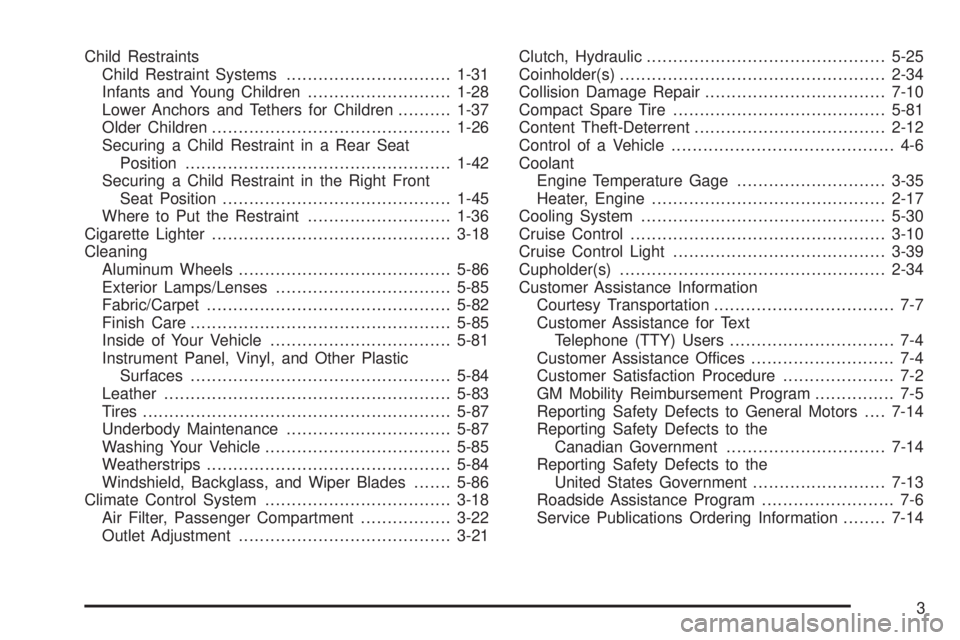
Child Restraints
Child Restraint Systems...............................1-31
Infants and Young Children...........................1-28
Lower Anchors and Tethers for Children..........1-37
Older Children.............................................1-26
Securing a Child Restraint in a Rear Seat
Position..................................................1-42
Securing a Child Restraint in the Right Front
Seat Position...........................................1-45
Where to Put the Restraint...........................1-36
Cigarette Lighter.............................................3-18
Cleaning
Aluminum Wheels........................................5-86
Exterior Lamps/Lenses.................................5-85
Fabric/Carpet..............................................5-82
Finish Care.................................................5-85
Inside of Your Vehicle..................................5-81
Instrument Panel, Vinyl, and Other Plastic
Surfaces.................................................5-84
Leather......................................................5-83
Tires..........................................................5-87
Underbody Maintenance...............................5-87
Washing Your Vehicle...................................5-85
Weatherstrips..............................................5-84
Windshield, Backglass, and Wiper Blades.......5-86
Climate Control System...................................3-18
Air Filter, Passenger Compartment.................3-22
Outlet Adjustment........................................3-21Clutch, Hydraulic.............................................5-25
Coinholder(s)..................................................2-34
Collision Damage Repair..................................7-10
Compact Spare Tire........................................5-81
Content Theft-Deterrent....................................2-12
Control of a Vehicle.......................................... 4-6
Coolant
Engine Temperature Gage............................3-35
Heater, Engine............................................2-17
Cooling System..............................................5-30
Cruise Control................................................3-10
Cruise Control Light........................................3-39
Cupholder(s)..................................................2-34
Customer Assistance Information
Courtesy Transportation.................................. 7-7
Customer Assistance for Text
Telephone (TTY) Users............................... 7-4
Customer Assistance Offices........................... 7-4
Customer Satisfaction Procedure..................... 7-2
GM Mobility Reimbursement Program............... 7-5
Reporting Safety Defects to General Motors....7-14
Reporting Safety Defects to the
Canadian Government..............................7-14
Reporting Safety Defects to the
United States Government.........................7-13
Roadside Assistance Program......................... 7-6
Service Publications Ordering Information........7-14
3