2006 PONTIAC G6 light
[x] Cancel search: lightPage 119 of 416

2. Press and hold the on/off button until a zone
number appears on the display.
3. Once the zone number appears on the display,
press the on/off button quickly until you reach
the correct zone number. If C appears in the
compass window, the compass may need
calibration. See “Compass Calibration” listed
previously.
Automatic Dimming Rearview Mirror
with Compass
Your vehicle may have an automatic dimming rearview
mirror with a compass. This feature enables the
mirror to sense nighttime glare from vehicle headlamps
from behind and automatically dim to reduce the
glare to a safe level.
The automatic dimming feature turns on each time the
vehicle is started. Press the OFF button once and
the green indicator light located to the left of the button
will go out indicating the feature is off. To turn the
feature back on, press and release the AUTO button
and the green indicator light will come on.
Compass Operation
Press the on/off button once to turn the compass on
or off.
When the ignition and the compass feature are on,
the compass will show two character boxes for a
few seconds. After a few seconds, the mirror will display
the current compass direction.
2-41
Page 131 of 416
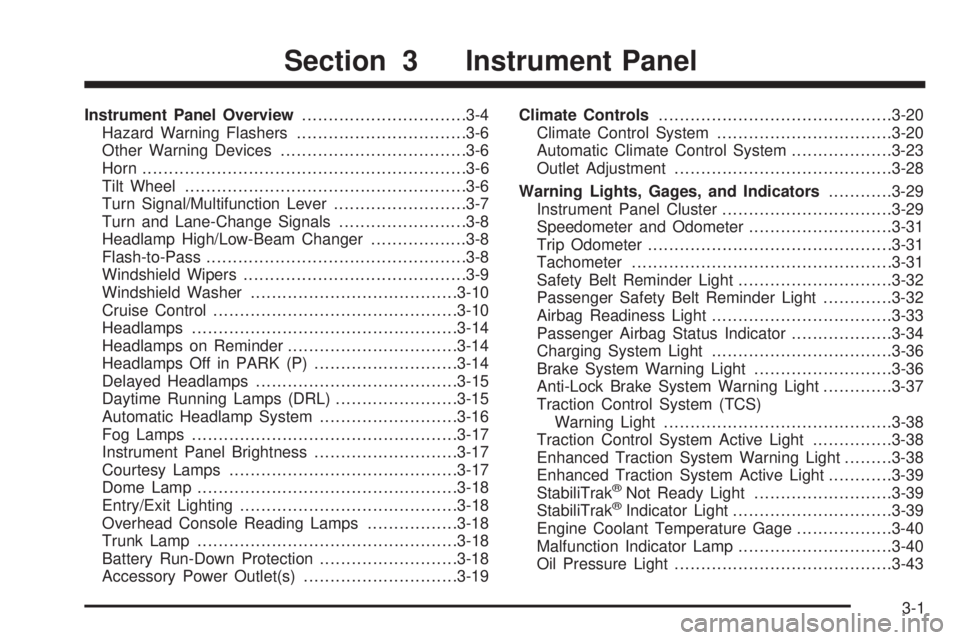
Instrument Panel Overview...............................3-4
Hazard Warning Flashers................................3-6
Other Warning Devices...................................3-6
Horn.............................................................3-6
Tilt Wheel.....................................................3-6
Turn Signal/Multifunction Lever.........................3-7
Turn and Lane-Change Signals........................3-8
Headlamp High/Low-Beam Changer..................3-8
Flash-to-Pass.................................................3-8
Windshield Wipers..........................................3-9
Windshield Washer.......................................3-10
Cruise Control..............................................3-10
Headlamps..................................................3-14
Headlamps on Reminder................................3-14
Headlamps Off in PARK (P)...........................3-14
Delayed Headlamps......................................3-15
Daytime Running Lamps (DRL).......................3-15
Automatic Headlamp System..........................3-16
Fog Lamps..................................................3-17
Instrument Panel Brightness...........................3-17
Courtesy Lamps...........................................3-17
Dome Lamp.................................................3-18
Entry/Exit Lighting.........................................3-18
Overhead Console Reading Lamps.................3-18
Trunk Lamp.................................................3-18
Battery Run-Down Protection..........................3-18
Accessory Power Outlet(s).............................3-19Climate Controls............................................3-20
Climate Control System.................................3-20
Automatic Climate Control System...................3-23
Outlet Adjustment.........................................3-28
Warning Lights, Gages, and Indicators............3-29
Instrument Panel Cluster................................3-29
Speedometer and Odometer...........................3-31
Trip Odometer..............................................3-31
Tachometer.................................................3-31
Safety Belt Reminder Light.............................3-32
Passenger Safety Belt Reminder Light.............3-32
Airbag Readiness Light..................................3-33
Passenger Airbag Status Indicator...................3-34
Charging System Light..................................3-36
Brake System Warning Light..........................3-36
Anti-Lock Brake System Warning Light.............3-37
Traction Control System (TCS)
Warning Light...........................................3-38
Traction Control System Active Light...............3-38
Enhanced Traction System Warning Light.........3-38
Enhanced Traction System Active Light............3-39
StabiliTrak
®Not Ready Light..........................3-39
StabiliTrak®Indicator Light..............................3-39
Engine Coolant Temperature Gage..................3-40
Malfunction Indicator Lamp.............................3-40
Oil Pressure Light.........................................3-43
Section 3 Instrument Panel
3-1
Page 132 of 416

Security Light...............................................3-44
Cruise Control Light......................................3-44
Highbeam On Light.......................................3-44
Service Vehicle Soon Light............................3-44
Fuel Gage...................................................3-45
Low Fuel Warning Light.................................3-45
Driver Information Center (DIC).......................3-45
DIC Operation and Displays...........................3-46
DIC Warnings and Messages.........................3-48
DIC Vehicle Personalization............................3-52
Audio System(s).............................................3-54
Setting the Time for Radios without
Radio Data Systems (RDS)........................3-55
Setting the Time for Radios with
Radio Data Systems (RDS)........................3-55Radio with CD (Base Level)...........................3-56
Radio with CD (Up Level)..............................3-61
Radio with Six-Disc CD.................................3-71
Theft-Deterrent Feature..................................3-86
Audio Steering Wheel Controls
(Three Spoke)...........................................3-86
Audio Steering Wheel Controls
(Four Spoke)............................................3-87
Radio Reception...........................................3-87
Care of Your CDs and DVDs.........................3-88
Care of the CD and DVD Player.....................3-88
Fixed Mast Antenna
(Retractable Hardtop).................................3-88
Backglass Antenna.......................................3-89
XM™ Satellite Radio Antenna System.............3-89
Section 3 Instrument Panel
3-2
Page 137 of 416

The lever that allows you to tilt and telescope the
steering wheel is located on the left side of the
steering column.
To tilt and telescope the wheel, pull down the lever.
Then move the wheel to a comfortable position, pull up
the lever to lock the wheel in place. The wheel can
be adjusted up and down as well as forward and
backward.Turn Signal/Multifunction Lever
The lever on the left side of the steering column
includes the following:
GTurn and Lane-Change Signals. SeeTurn and
Lane-Change Signals on page 3-8.
3Headlamp High/Low-Beam Changer. See
Headlamp High/Low-Beam Changer on page 3-8.
Flash-to-Pass. SeeFlash-to-Pass on page 3-8.
2Exterior Light Control. SeeHeadlamps
on page 3-14.
3-7
Page 138 of 416

Turn and Lane-Change Signals
The turn signal has two upward (for right) and
two downward (for left) positions. These positions
allow you to signal a turn or a lane change.
To signal a turn, move the lever all the way up or down.
When the turn is nished, the lever will return
automatically.
An arrow on the instrument
panel cluster will ash in
the direction of the
turn or lane change.
To signal a lane change, just raise or lower the lever
until the arrow starts to ash. Hold it there until you
complete your lane change. The lever will return by itself
when you release it.
As you signal a turn or a lane change, if the arrows
ash rapidly, a signal bulb may be burned out and other
drivers won’t see your turn signal.
If a bulb is burned out, replace it to help avoid an
accident. If the arrows don’t go on at all when you signal
a turn, check for burned-out bulbs and then check the
fuse. SeeFuses on page 5-97.
Headlamp High/Low-Beam Changer
To change the headlamps from low beam to high
beam, push the turn signal/multifunction lever away
from you.
When the high beams are
on, a light on the
instrument panel cluster
also will be on if the
ignition is in ON.
To change the headlamps from high beam to low beam,
pull the turn signal lever toward you.
Flash-to-Pass
This feature lets you use your high-beam headlamps to
signal a driver in front of you that you want to pass.
To use it, pull the turn signal/multifunction lever toward
you until the high-beam headlamps come on, then
release the lever to turn them off.
3-8
Page 142 of 416

To set a speed do the following:
1. Press the on/off symbol to turn cruise control on.
The indicator light on the button will come on.
2. Get to the speed you want.
3. Press the SET−symbol and release it. The cruise
symbol will display in the instrument panel cluster
to show the system is engaged.
4. Take your foot off the accelerator pedal.
When the brakes are applied, the cruise control
shuts off.
If the vehicle is in cruise control and the Traction
Control System (TCS) or Enhanced Traction
System (ETS) begins to limit wheel spin, the cruise
control will automatically disengage. SeeTraction
Control System (TCS) on page 4-9andEnhanced
Traction System (ETS) on page 4-11. When road
conditions allow, the cruise control can be used again.Resuming a Set Speed
Suppose you set your cruise control at a desired speed
and then you apply the brakes. This, of course,
disengages the cruise control. The cruise symbol in the
instrument panel cluster will also go out indicating
cruise is no longer engaged. To return to your previously
set speed, you do not need to go through the set
process again. Once at a speed of about 25 mph
(40 km/h) or more, you can press the RES+ symbol
briey.
This will take you back up to your previously chosen
speed and stay there.
Increasing Speed While Using Cruise
Control
There are two ways to go to a higher speed.
If the cruise control system is already engaged,
press the RES+ symbol. Hold it there until you
get up to the speed you want, and then release
the button.
To increase your speed in very small amounts,
press the RES+ symbol briey and then release
it. Each time you do this, your vehicle will go about
1 mph (1.6 km/h) faster.
3-12
Page 143 of 416

Reducing Speed While Using Cruise
Control
If the cruise control system is already engaged,
Push and hold the SET−symbol until you reach the
lower speed you want, then release it.
To slow down in very small amounts, push the
SET−symbol briey. Each time you do this, you will
go about 1 mph (1.6 km/h) slower.
Passing Another Vehicle While Using
Cruise Control
Use the accelerator pedal to increase your speed.
When you take your foot off the pedal, your vehicle will
slow down to the cruise control speed you set earlier.
Using Cruise Control on Hills
How well your cruise control will work on hills depends
upon your speed, load, and the steepness of the
hills. When going up steep hills, you may have to step
on the accelerator pedal to maintain your vehicle’s
speed. When going downhill, you may have to brake or
shift to a lower gear to keep your vehicle’s speed
down. Of course, applying the brakes ends cruise
control. Many drivers nd this to be too much trouble
and do not use cruise control on steep hills.
Ending Cruise Control
There are four ways to disengage the cruise control:
Step lightly on the brake pedal; when cruise control
disengages, the cruise symbol in the instrument
panel cluster will go out.
Press the on/off button, this will turn off the cruise
control system.
Press the cancel button (3–spoke wheel only).
When cruise control disengages, the cruise symbol
in the instrument panel cluster will go out.
Step on the clutch pedal; when the cruise control
disengages, the cruise symbol in the instrument
panel cluster will go out.
Erasing Speed Memory
When you turn off the cruise control or the ignition, your
cruise control set speed memory is erased.
3-13
Page 144 of 416

Headlamps
The lever on the left side of the steering column
operates the exterior lamps.
The exterior lamp switch has the following four positions:
2(Headlamps):This position turns on the
headlamps, parking lamps, and taillamps.
;(Parking Lamps):This position turns on the
parking lamps and taillamps only.
AUTO (Automatic Headlamp System):This position
automatically turns on the Daytime Running Lamps
during daytime, and the headlamps, parking lamps, and
taillamps at night.
P(Off/On):This position is the momentary Off/On
switch for the Automatic Headlamp System. In Canada,
this only works when a vehicle with an automatic
transaxle is in PARK (P).
When operating in AUTO, a momentary turn of the
switch to off/on will turn off the Automatic Headlamp
System. Rotating the switch to off/on again will turn the
Automatic Headlamp System back on. The Automatic
Headlamp System is always turned on at the beginning
of an ignition cycle.
Headlamps on Reminder
If you open the driver’s door and turn off the
ignition while leaving the lamps on, you will hear a
warning chime.
Headlamps Off in PARK (P)
This feature works for vehicles with an automatic
transaxle when the ignition is on and it is dark outside.
To turn the headlamps off when it is dark outside
but keep other exterior lights on, turn the exterior lamp
control to the parking lamp position. In this position,
the parking lamps, sidemarker lamps, taillamps, license
plate lamps and instrument panel lights will be on,
but the headlamps will be off.
To turn on the headlamps along with the other lamps
when it is dark outside, turn the exterior lamp control to
the AUTO or headlamp position.
3-14