�2
TIN (Tire Identification Number) for a
new tire (example: DOT XX XX XXX
XXXX)
1. DOT: Abbreviation for the “Depart-
ment Of Transportation”. The
symbol can be placed above,
below or to the left or right of the
Tire Identification Number.
2. Two-digit code: Manufacturer’s identi-
fication mark
3. Two-digit code: Tire size4. Three-digit code: Tire type code (Op-
tional)
5. Three-digit code: Date of Manufacture
6. Four numbers represent the week and
year the tire was built. For example, the
numbers 3103 means the 31st week
of 2003. If these numbers are missing,
then look on the other sidewall of the
tire.
�3
Tire ply composition and material
The number of layers or plies of
rubber-coated fabric in the tire. Tire
manufacturers also must indicate the
materials in the tire, which include
steel, nylon, polyester, and others.
�4
Maximum permissible inflation pres-
sure
This number is the greatest amount
of air pressure that should be put in
the tire. Do not exceed the maximum
permissible inflation pressure.
�5
Maximum load rating
This number indicates the maximumload in kilograms and pounds that
can be carried by the tire. When
replacing the tires on the vehicle,
always use a tire that has the same
load rating as the factory installed
tire.
�6
Term of “tubeless” or “tube type”
Indicates whether the tire requires an
inner tube (“tube type”) or not
(“tubeless”).
�7
The word “radial”
The word “radial” is shown if the tire
has radial structure.
�8
Manufacturer or brand name
Manufacturer or brand name is
shown.
Other tire-related terminology:
In addition to the many terms that are
defined throughout this section, Intended
Outboard Sidewall is (1) the sidewall that
contains a whitewall, bears white letter-
ing or bears manufacturer, brand and/or
model name molding that is higher or
deeper than the same molding on the
SDI1607
EXAMPLE
8-38
Maintenance and do-it-yourself
�
06.4.14/T30-J/V5.0
�
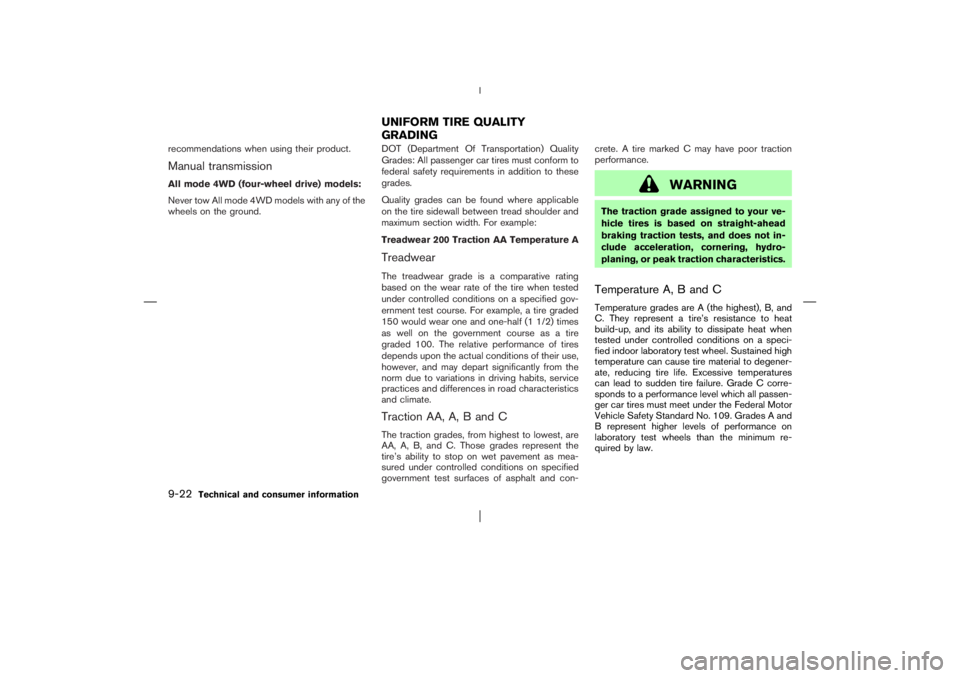
recommendations when using their product.Manual transmissionAll mode 4WD (four-wheel drive) models:
Never tow All mode 4WD models with any of the
wheels on the ground.DOT (Department Of Transportation) Quality
Grades: All passenger car tires must conform to
federal safety requirements in addition to these
grades.
Quality grades can be found where applicable
on the tire sidewall between tread shoulder and
maximum section width. For example:
Treadwear 200 Traction AA Temperature A
TreadwearThe treadwear grade is a comparative rating
based on the wear rate of the tire when tested
under controlled conditions on a specified gov-
ernment test course. For example, a tire graded
150 would wear one and one-half (1 1/2) times
as well on the government course as a tire
graded 100. The relative performance of tires
depends upon the actual conditions of their use,
however, and may depart significantly from the
norm due to variations in driving habits, service
practices and differences in road characteristics
and climate.Traction AA, A, B and CThe traction grades, from highest to lowest, are
AA, A, B, and C. Those grades represent the
tire’s ability to stop on wet pavement as mea-
sured under controlled conditions on specified
government test surfaces of asphalt and con-crete. A tire marked C may have poor traction
performance.
WARNING
The traction grade assigned to your ve-
hicle tires is based on straight-ahead
braking traction tests, and does not in-
clude acceleration, cornering, hydro-
planing, or peak traction characteristics.Temperature A, B and CTemperature grades are A (the highest), B, and
C. They represent a tire’s resistance to heat
build-up, and its ability to dissipate heat when
tested under controlled conditions on a speci-
fied indoor laboratory test wheel. Sustained high
temperature can cause tire material to degener-
ate, reducing tire life. Excessive temperatures
can lead to sudden tire failure. Grade C corre-
sponds to a performance level which all passen-
ger car tires must meet under the Federal Motor
Vehicle Safety Standard No. 109. Grades A and
B represent higher levels of performance on
laboratory test wheels than the minimum re-
quired by law.
UNIFORM TIRE QUALITY
GRADING
9-22
Technical and consumer information
�
06.4.14/T30-J/V5.0
�