Page 59 of 360

2. Position the booster seat on the seat. Only
place it in a front facing direction. Always
follow the booster seat manufacturer’s in-
structions.
3. The booster seat should be positioned on
the vehicle seat so that it is stable. If neces-
sary, adjust or remove the head restraint to
obtain the correct booster seat fit. See
“Head restraint adjustment” earlier in this
section. If the head restraint is removed,
store it in a secure place. Be sure to install
the head restraint when the booster seat is
removed. If the seating position does not
have an adjustable head restraint and it is
interfering with the proper booster seat fit,
try another seating position or a different
booster seat.
4. Position the lap portion of the seat belt low
and snug on the child’s hips. Be sure to
follow the booster seat manufacturer’s in-
structions for adjusting the belt routing.
5. Pull the shoulder belt portion of the seat belt
toward the retractor to take up extra slack.
Be sure the shoulder belt is positioned
across the top, middle portion of the child’s
shoulder. Be sure to follow the booster seat
manufacturer’s instructions for adjusting the
belt routing.6. Follow the warnings, cautions and instruc-
tions for properly fastening a seat belt
shown in the “Three-point seat belt with
retractor” earlier in this section.
7. When the ignition is turned to the ON posi-
tion, the passenger air bag status light may
or may not be illuminated, depending on the
size of the child and the type of booster seat
being used. See “NISSAN advanced air bag
system” later in this section.PRECAUTIONS ON
SUPPLEMENTAL RESTRAINT
SYSTEM
This Supplemental Restraint System (SRS) sec-
tion contains important information concerning
the driver and passenger supplemental front air
bags (NISSAN Advanced Air Bag System) ,
supplemental side air bags, curtain side-impact
and rollover air bags and pre-tensioner seat belts.
Supplemental front impact air bag system:
The NISSAN advanced air bag system can help
cushion the impact force to the head and chest of
the driver and right front, passenger in certain
frontal collisions.
Supplemental side-impact air bag system
(if so equipped):This system can help cushion
the impact force to the chest area of the driver
and right front, passenger in certain side impact
collisions. The supplemental side air bag is de-
signed to inflate on the side where the vehicle is
impacted.
Supplemental curtain side-impact and roll-
over air bag system (if so equipped):This
system can help cushion the impact force to the
head of occupants in front and rear outboard
seating positions in certain side impact or rollover
collisions. In a side impact, the curtain air bags
are designed to inflate on the side where the
SUPPLEMENTAL RESTRAINT
SYSTEM
Safety—Seats, seat belts and supplemental restraint system1-43
ZREVIEW COPYÐ2006 Titan(tzw)
Owners ManualÐUSA_English(nna)
06/15/05Ðdebbie
X
Page 60 of 360
vehicle is impacted. In a rollover both curtain air
bags are designed to inflate and remain inflated
for a short time.
These supplemental restraint systems are de-
signed tosupplementthe crash protection pro-
vided by the seat belts and arenot a substitute
for them. Seat belts should always be correctly
worn and the occupant seated a suitable dis-
tance away from the steering wheel, instrument
panel and door finishers. See “Seat belts” earlier
in this section for instructions and precautions on
seat belt usage.
The supplemental air bags operate only
when the ignition switch is in the ON or
START position.
After turning the ignition key to the ON
position, the supplemental air bag warning
light illuminates. The supplemental air bag
warning light will turn off after about 7
seconds if the system is operational.
WARNING
cThe supplemental front air bags ordi-
narily will not inflate in the event of a
side impact, rear impact, rollover, or
lower severity frontal collision. Also,
the right front passenger air bag will not
inflate if the passenger air bag status
light is lit or if the passenger’s seat is
unoccupied. See “Front passenger air
bag and status light” later in this sec-
tion. Always wear your seat belts to
help reduce the risk or severity of injury
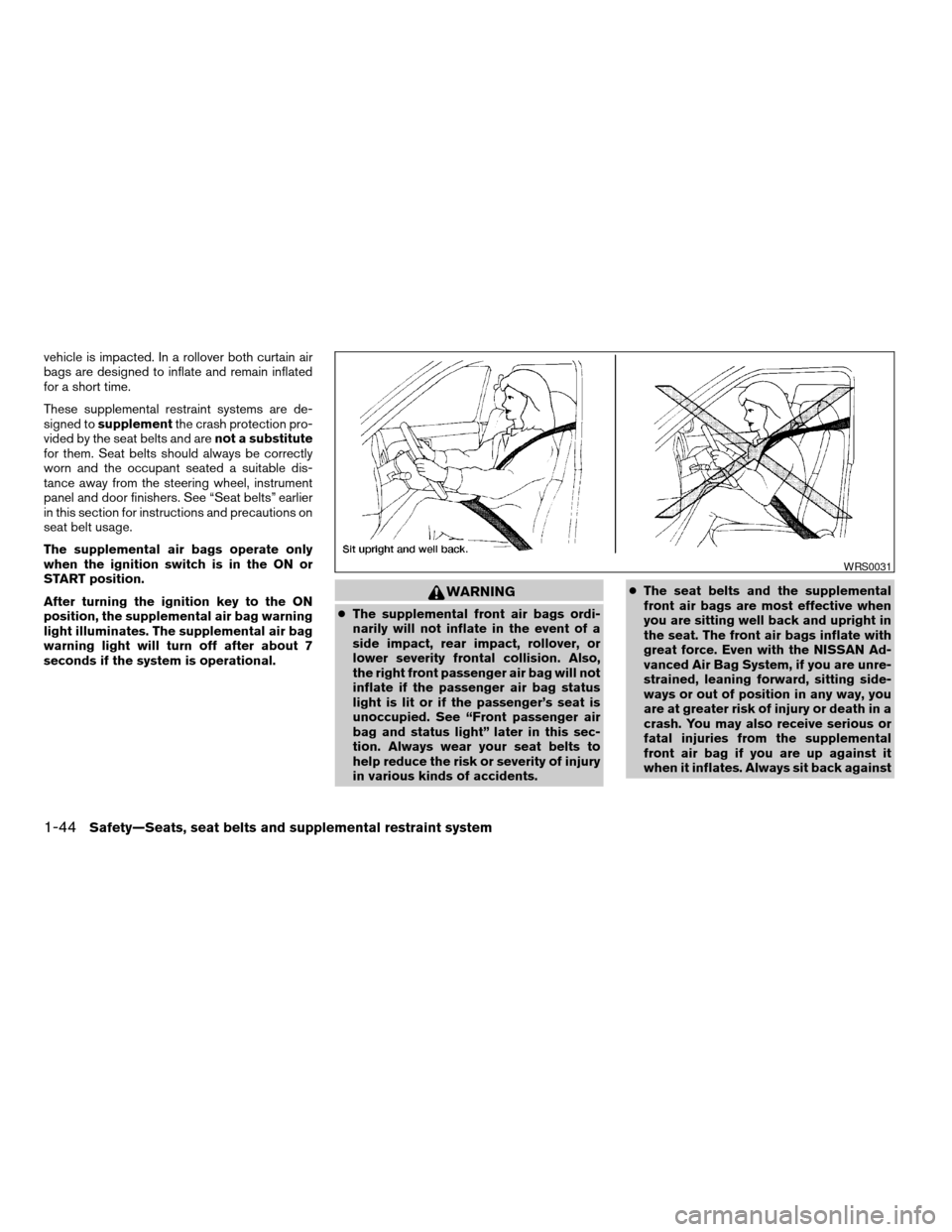
in various kinds of accidents.cThe seat belts and the supplemental
front air bags are most effective when
you are sitting well back and upright in
the seat. The front air bags inflate with
great force. Even with the NISSAN Ad-
vanced Air Bag System, if you are unre-
strained, leaning forward, sitting side-
ways or out of position in any way, you
are at greater risk of injury or death in a
crash. You may also receive serious or
fatal injuries from the supplemental
front air bag if you are up against it
when it inflates. Always sit back against
WRS0031
1-44Safety—Seats, seat belts and supplemental restraint system
ZREVIEW COPYÐ2006 Titan(tzw)
Owners ManualÐUSA_English(nna)
06/15/05Ðdebbie
X
Page 61 of 360
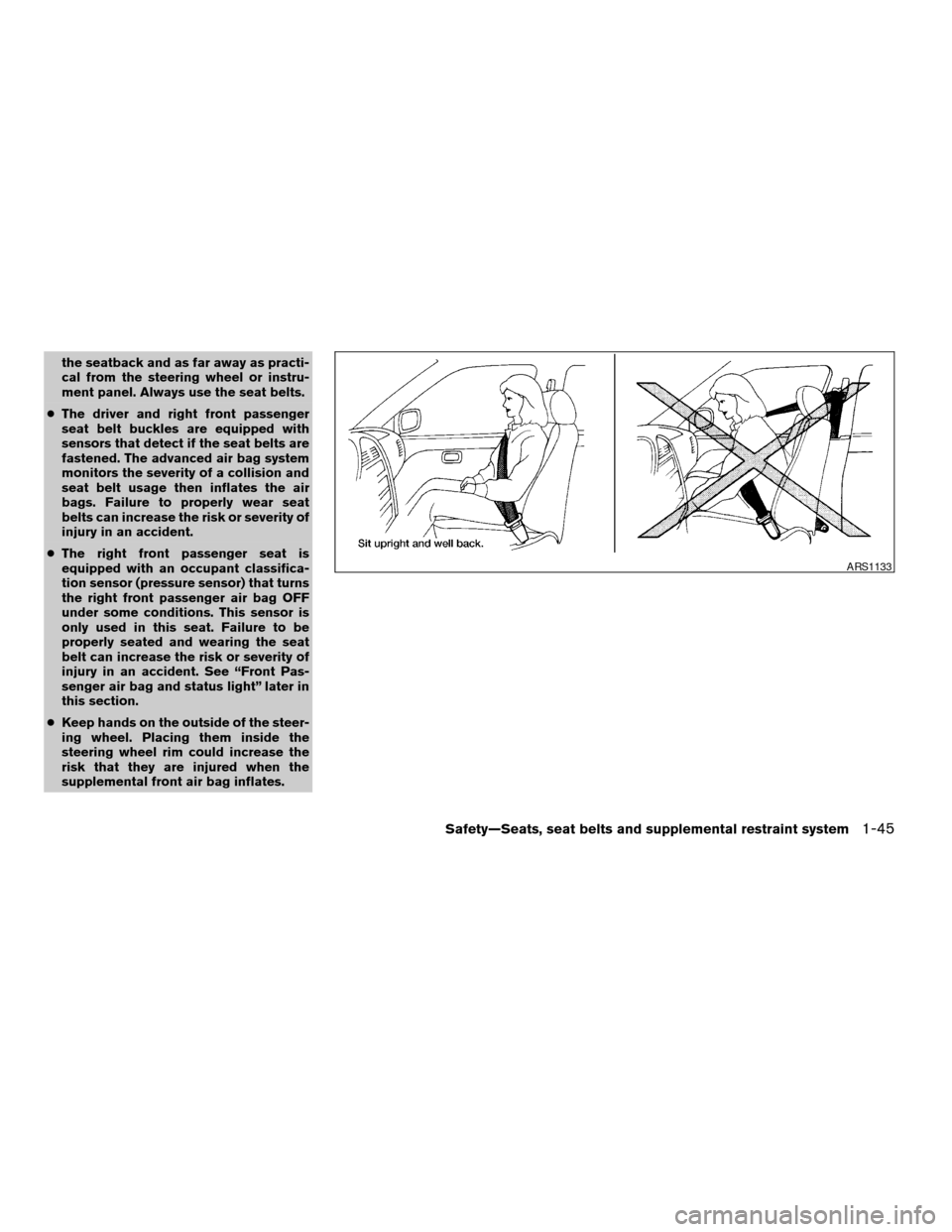
the seatback and as far away as practi-
cal from the steering wheel or instru-
ment panel. Always use the seat belts.
cThe driver and right front passenger
seat belt buckles are equipped with
sensors that detect if the seat belts are
fastened. The advanced air bag system
monitors the severity of a collision and
seat belt usage then inflates the air
bags. Failure to properly wear seat
belts can increase the risk or severity of
injury in an accident.
cThe right front passenger seat is
equipped with an occupant classifica-
tion sensor (pressure sensor) that turns
the right front passenger air bag OFF
under some conditions. This sensor is
only used in this seat. Failure to be
properly seated and wearing the seat
belt can increase the risk or severity of
injury in an accident. See “Front Pas-
senger air bag and status light” later in
this section.
cKeep hands on the outside of the steer-
ing wheel. Placing them inside the
steering wheel rim could increase the
risk that they are injured when the
supplemental front air bag inflates.
ARS1133
Safety—Seats, seat belts and supplemental restraint system1-45
ZREVIEW COPYÐ2006 Titan(tzw)
Owners ManualÐUSA_English(nna)
06/15/05Ðdebbie
X
Page 62 of 360
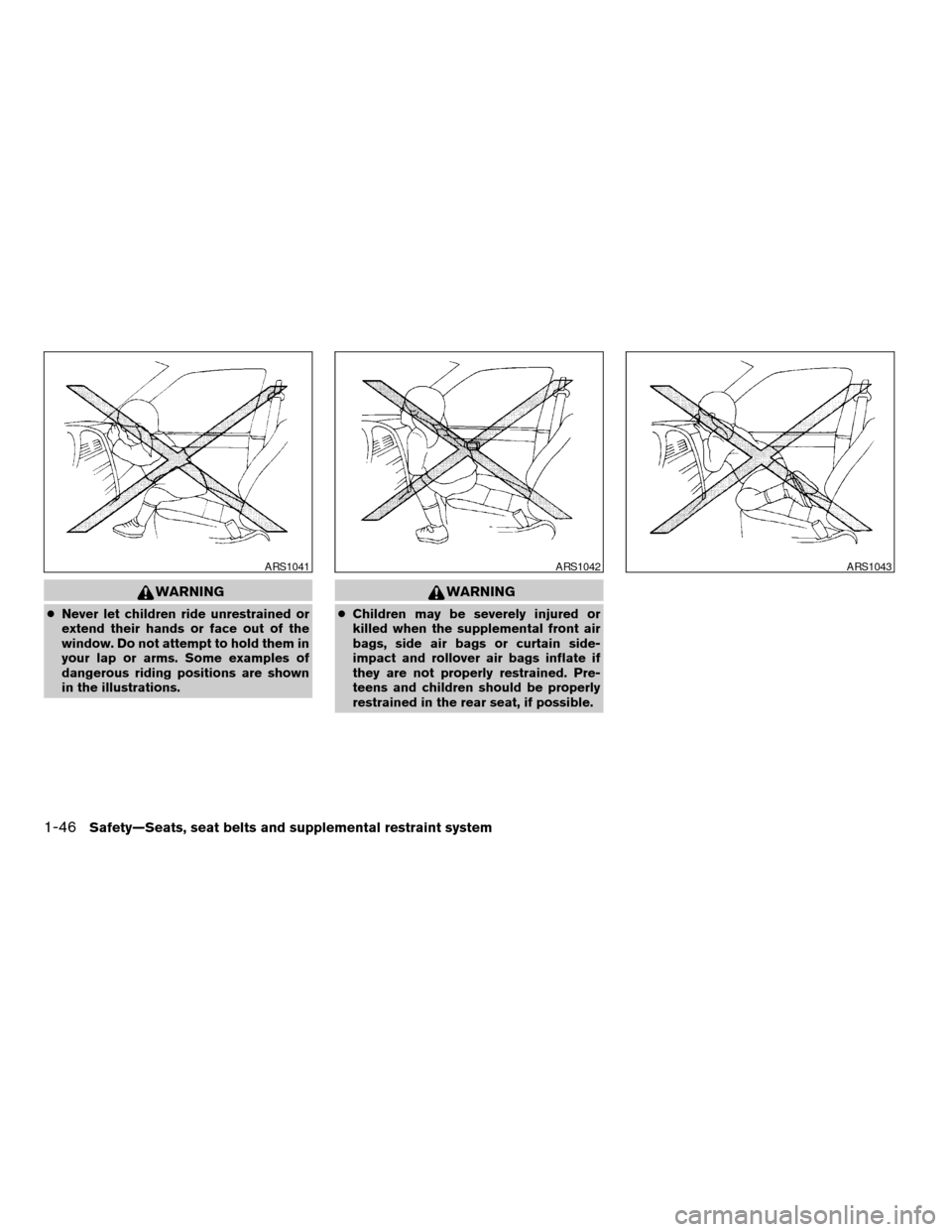
WARNING
cNever let children ride unrestrained or
extend their hands or face out of the
window. Do not attempt to hold them in
your lap or arms. Some examples of
dangerous riding positions are shown
in the illustrations.
WARNING
cChildren may be severely injured or
killed when the supplemental front air
bags, side air bags or curtain side-
impact and rollover air bags inflate if
they are not properly restrained. Pre-
teens and children should be properly
restrained in the rear seat, if possible.
ARS1041ARS1042ARS1043
1-46Safety—Seats, seat belts and supplemental restraint system
ZREVIEW COPYÐ2006 Titan(tzw)
Owners ManualÐUSA_English(nna)
06/15/05Ðdebbie
X
Page 63 of 360
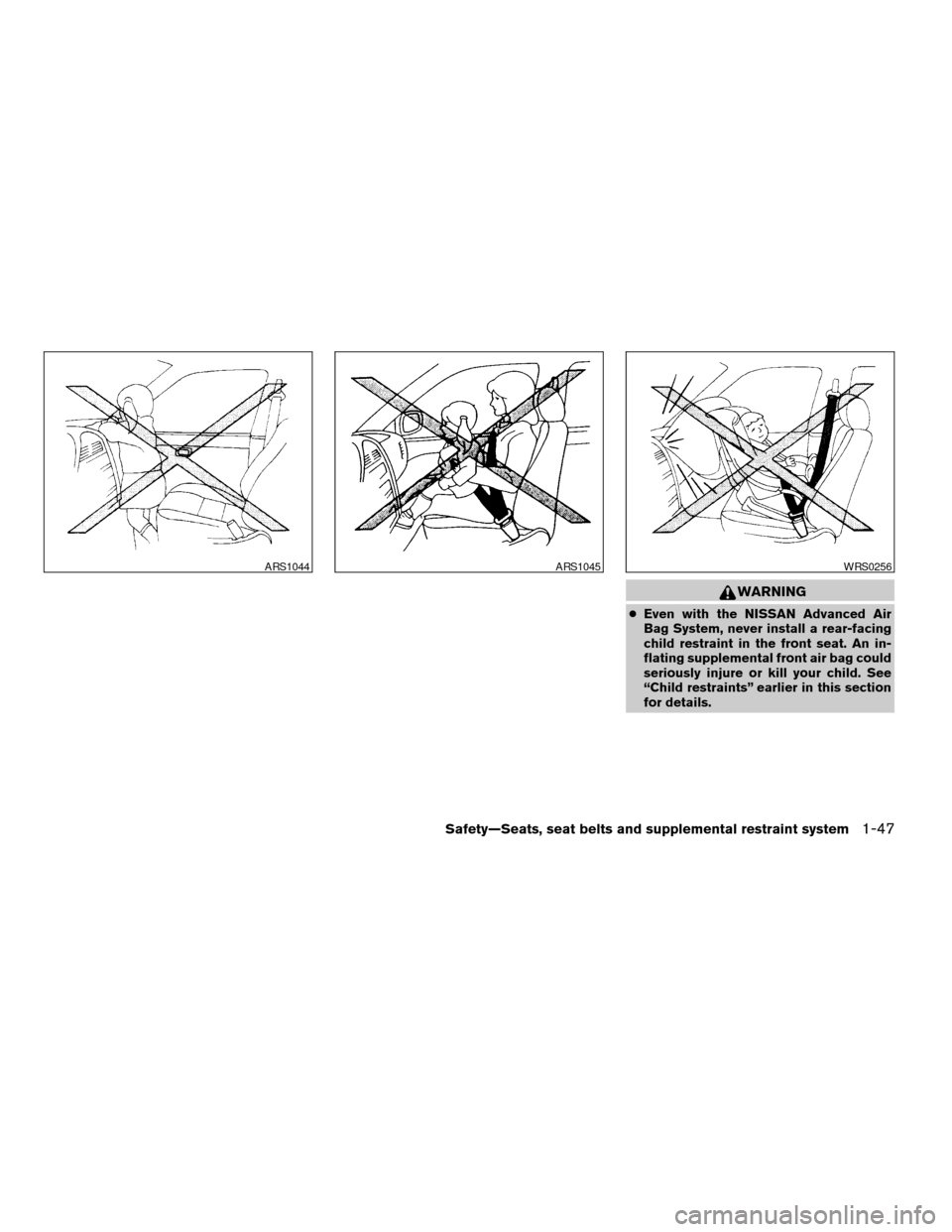
WARNING
cEven with the NISSAN Advanced Air
Bag System, never install a rear-facing
child restraint in the front seat. An in-
flating supplemental front air bag could
seriously injure or kill your child. See
“Child restraints” earlier in this section
for details.
ARS1044ARS1045WRS0256
Safety—Seats, seat belts and supplemental restraint system1-47
ZREVIEW COPYÐ2006 Titan(tzw)
Owners ManualÐUSA_English(nna)
06/15/05Ðdebbie
X
Page 64 of 360
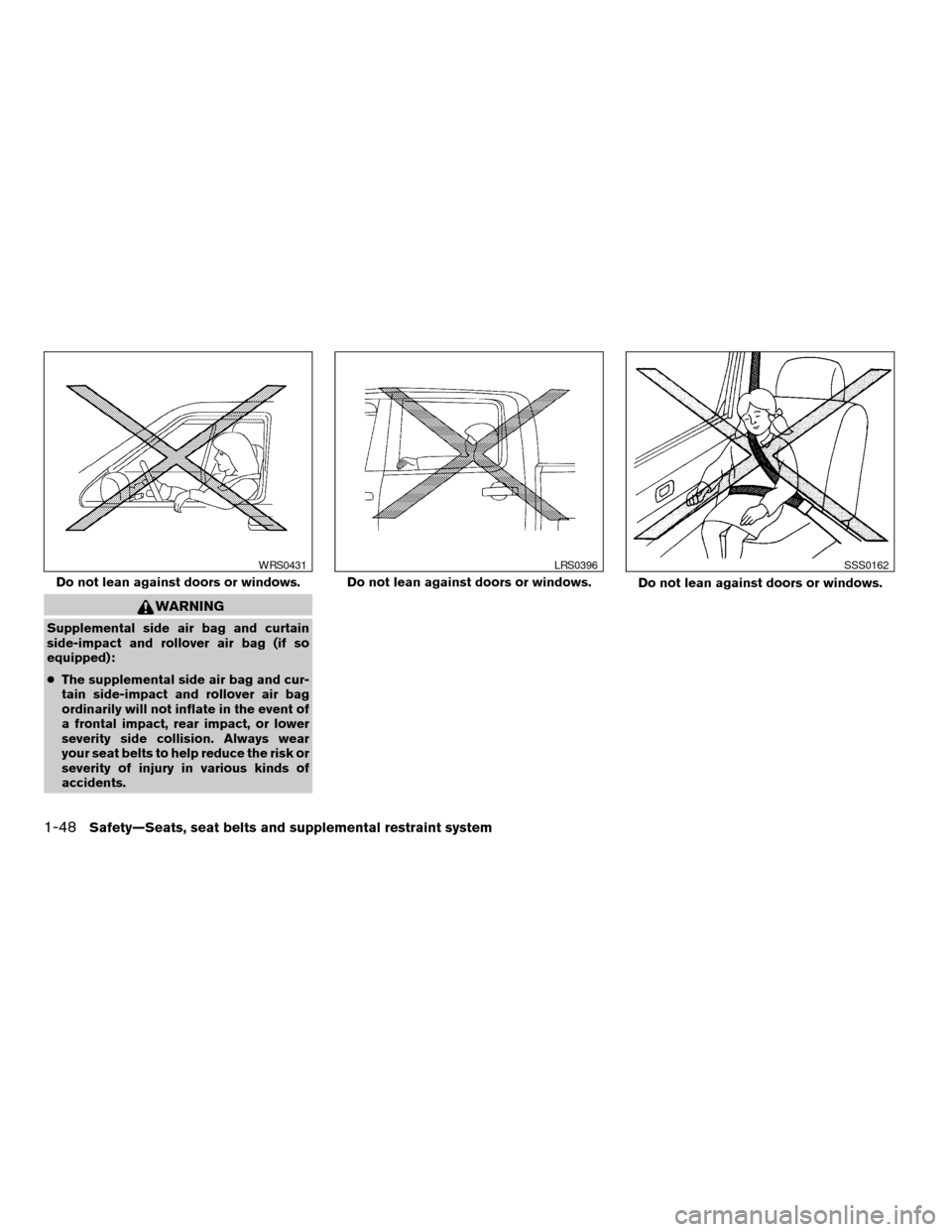
WARNING
Supplemental side air bag and curtain
side-impact and rollover air bag (if so
equipped):
cThe supplemental side air bag and cur-
tain side-impact and rollover air bag
ordinarily will not inflate in the event of
a frontal impact, rear impact, or lower
severity side collision. Always wear
your seat belts to help reduce the risk or
severity of injury in various kinds of
accidents.
Do not lean against doors or windows.
WRS0431
Do not lean against doors or windows.
LRS0396
Do not lean against doors or windows.
SSS0162
1-48Safety—Seats, seat belts and supplemental restraint system
ZREVIEW COPYÐ2006 Titan(tzw)
Owners ManualÐUSA_English(nna)
06/15/05Ðdebbie
X
Page 65 of 360
WARNING
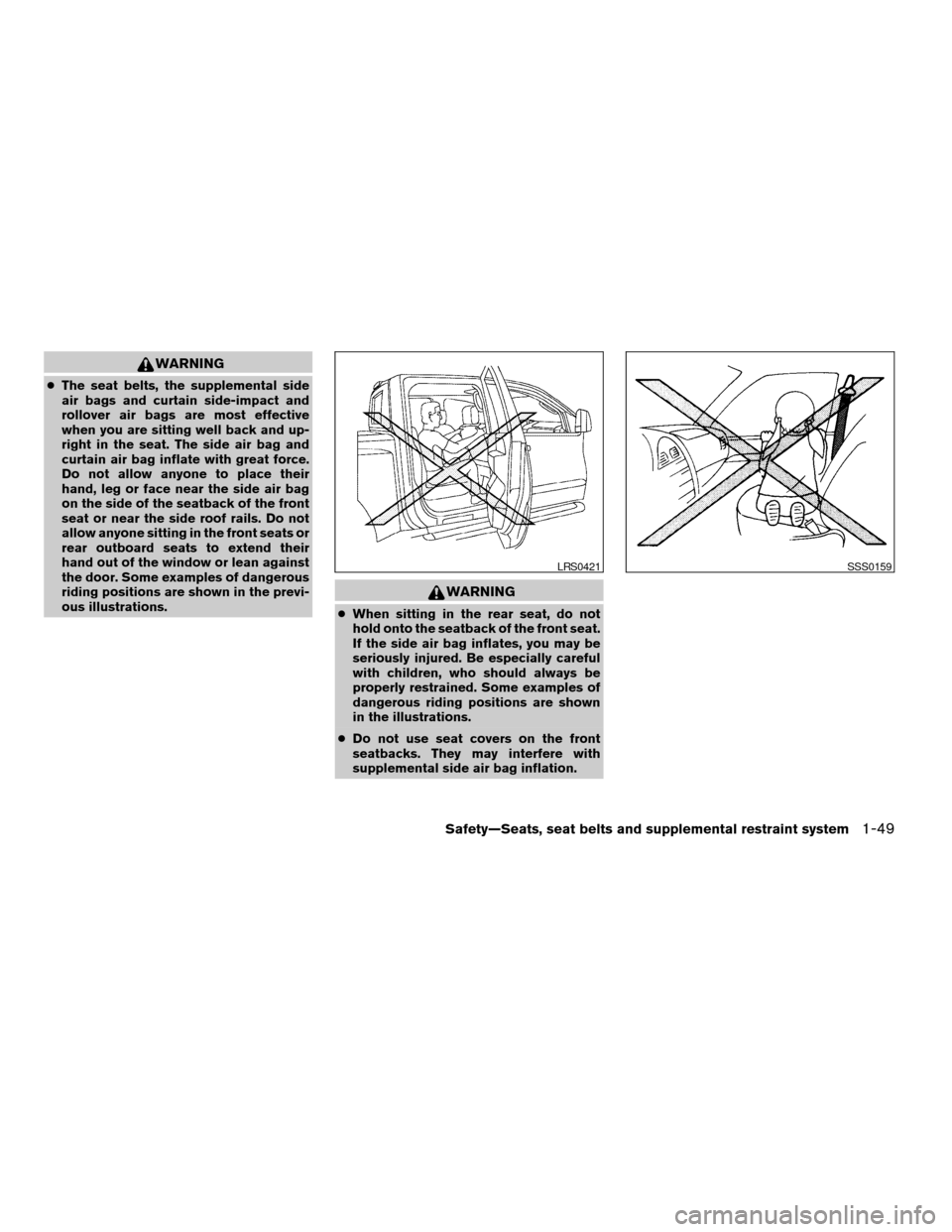
cThe seat belts, the supplemental side
air bags and curtain side-impact and
rollover air bags are most effective
when you are sitting well back and up-
right in the seat. The side air bag and
curtain air bag inflate with great force.
Do not allow anyone to place their
hand, leg or face near the side air bag
on the side of the seatback of the front
seat or near the side roof rails. Do not
allow anyone sitting in the front seats or
rear outboard seats to extend their
hand out of the window or lean against
the door. Some examples of dangerous
riding positions are shown in the previ-
ous illustrations.
WARNING
cWhen sitting in the rear seat, do not
hold onto the seatback of the front seat.
If the side air bag inflates, you may be
seriously injured. Be especially careful
with children, who should always be
properly restrained. Some examples of
dangerous riding positions are shown
in the illustrations.
cDo not use seat covers on the front
seatbacks. They may interfere with
supplemental side air bag inflation.
LRS0421SSS0159
Safety—Seats, seat belts and supplemental restraint system1-49
ZREVIEW COPYÐ2006 Titan(tzw)
Owners ManualÐUSA_English(nna)
06/15/05Ðdebbie
X
Page 66 of 360
1. SRS curtain side-impact and rollover air
bag modules (if so equipped)
2. SRS curtain side-impact and rollover air
bag (if so equipped)
3. Diagnosis sensor unit
4. Supplemental front air bag modules
5. Crash zone sensor
6. Occupant classification system control
unit
7. Occupant classification sensor
(pressure sensor)
8. Seat belt buckle switches
9. Pre-tensioner retractor
10. Satellite sensors
11. Supplemental side air bag modules
(if so equipped)
NISSAN Advanced Air Bag System
(front seats)
This vehicle is equipped with the NISSAN ad-
vanced air bag system for the driver and right
front passenger seats. This system is designed to
meet certification requirements under U.S. regu-
lations. It is also permitted in Canada.However,
all of the information, cautions and warn-
ings in this manual still apply and must be
followed.
WRS0405
1-50Safety—Seats, seat belts and supplemental restraint system
ZREVIEW COPYÐ2006 Titan(tzw)
Owners ManualÐUSA_English(nna)
06/15/05Ðdebbie
X