2006 NISSAN SENTRA automatic transmission
[x] Cancel search: automatic transmissionPage 184 of 256
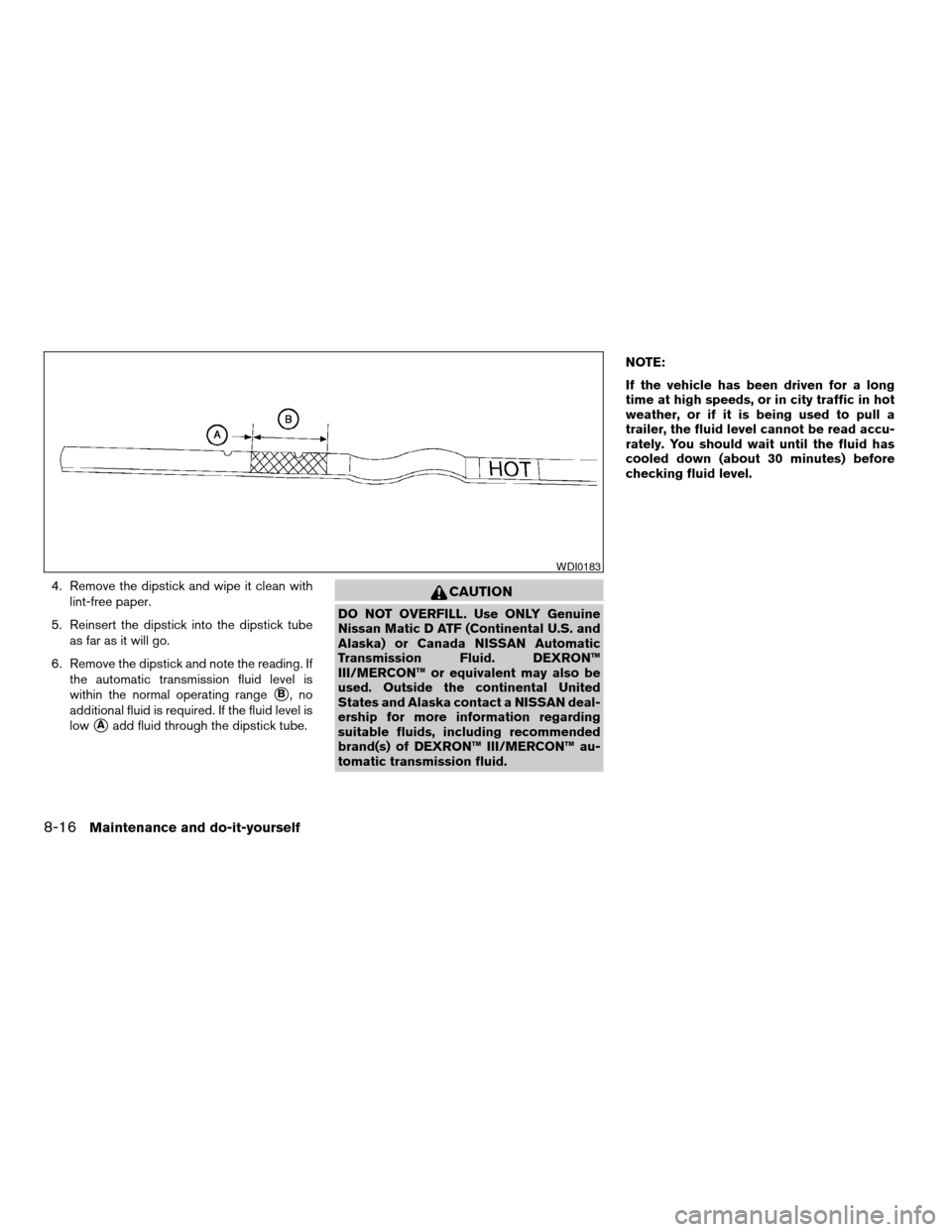
4. Remove the dipstick and wipe it clean with
lint-free paper.
5. Reinsert the dipstick into the dipstick tube
as far as it will go.
6. Remove the dipstick and note the reading. If
the automatic transmission fluid level is
within the normal operating range
sB,no
additional fluid is required. If the fluid level is
low
sAadd fluid through the dipstick tube.
CAUTION
DO NOT OVERFILL. Use ONLY Genuine
Nissan Matic D ATF (Continental U.S. and
Alaska) or Canada NISSAN Automatic
Transmission Fluid. DEXRON™
III/MERCON™ or equivalent may also be
used. Outside the continental United
States and Alaska contact a NISSAN deal-
ership for more information regarding
suitable fluids, including recommended
brand(s) of DEXRON™ III/MERCON™ au-
tomatic transmission fluid.NOTE:
If the vehicle has been driven for a long
time at high speeds, or in city traffic in hot
weather, or if it is being used to pull a
trailer, the fluid level cannot be read accu-
rately. You should wait until the fluid has
cooled down (about 30 minutes) before
checking fluid level.
WDI0183
8-16Maintenance and do-it-yourself
ZREVIEW COPYÐ2006 Sentra(b15)
Owners ManualÐUSA_English(nna)
09/01/05Ðdebbie
X
Page 195 of 256

If you wax the surface of the hood, be careful not
to let wax get into the washer nozzle
s1. This may
cause clogging or improper windshield washer
operation. If wax gets into the nozzle, remove it
with a needle or small pin
s2.
CHECKING PARKING BRAKE
From the released position, pull the parking brake
lever up slowly and firmly. If the number of clicks is
out of the range listed, see a NISSAN dealer.
c6 - 7 clicks under pulling force of 44 lb (196
N) .
CHECKING BRAKE PEDAL
With the engine running, check the distanceA
between the upper surface of the pedal and the
metal floor. If it is out of the range shown, see a
NISSAN dealer.
Distance A: under depressing force of 110
lb (490 N)
Automatic
TransmissionManual
Transmission
3 1/2 in (90 mm) or more
WDI0424
WDI0196WDI0197
PARKING BRAKE AND BRAKE PEDAL
Maintenance and do-it-yourself8-27
ZREVIEW COPYÐ2006 Sentra(b15)
Owners ManualÐUSA_English(nna)
09/01/05Ðdebbie
X
Page 218 of 256
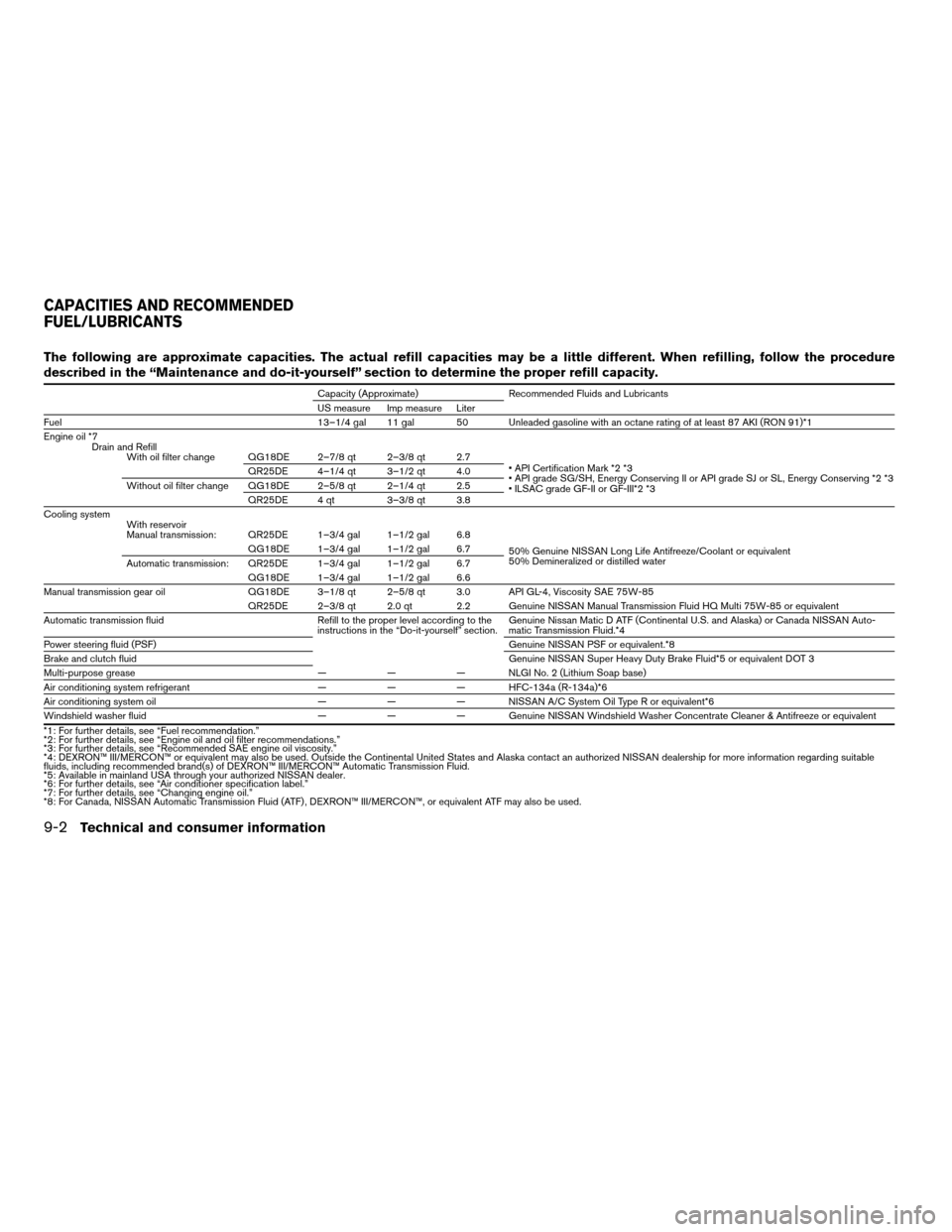
The following are approximate capacities. The actual refill capacities may be a little different. When refilling, follow the procedure
described in the “Maintenance and do-it-yourself” section to determine the proper refill capacity.
Capacity (Approximate) Recommended Fluids and Lubricants
US measure Imp measure Liter
Fuel 13–1/4 gal 11 gal 50 Unleaded gasoline with an octane rating of at least 87 AKI (RON 91)*1
Engine oil *7
Drain and Refill
With oil filter change QG18DE 2–7/8 qt 2–3/8 qt 2.7
• API Certification Mark *2 *3
• API grade SG/SH, Energy Conserving II or API grade SJ or SL, Energy Conserving *2 *3
• ILSAC grade GF-II or GF-III*2 *3 QR25DE 4–1/4 qt 3–1/2 qt 4.0
Without oil filter change QG18DE 2–5/8 qt 2–1/4 qt 2.5
QR25DE 4 qt 3–3/8 qt 3.8
Cooling system
With reservoir
Manual transmission: QR25DE 1–3/4 gal 1–1/2 gal 6.8
50% Genuine NISSAN Long Life Antifreeze/Coolant or equivalent
50% Demineralized or distilled water QG18DE 1–3/4 gal 1–1/2 gal 6.7
Automatic transmission: QR25DE 1–3/4 gal 1–1/2 gal 6.7
QG18DE 1–3/4 gal 1–1/2 gal 6.6
Manual transmission gear oil QG18DE 3–1/8 qt 2–5/8 qt 3.0 API GL-4, Viscosity SAE 75W-85
QR25DE 2–3/8 qt 2.0 qt 2.2 Genuine NISSAN Manual Transmission Fluid HQ Multi 75W-85 or equivalent
Automatic transmission fluid Refill to the proper level according to the
instructions in the “Do-it-yourself” section.Genuine Nissan Matic D ATF (Continental U.S. and Alaska) or Canada NISSAN Auto-
matic Transmission Fluid.*4
Power steering fluid (PSF)Genuine NISSAN PSF or equivalent.*8
Brake and clutch fluidGenuine NISSAN Super Heavy Duty Brake Fluid*5 or equivalent DOT 3
Multi-purpose grease — — — NLGI No. 2 (Lithium Soap base)
Air conditioning system refrigerant — — — HFC-134a (R-134a)*6
Air conditioning system oil — — — NISSAN A/C System Oil Type R or equivalent*6
Windshield washer fluid — — — Genuine NISSAN Windshield Washer Concentrate Cleaner & Antifreeze or equivalent
*1: For further details, see “Fuel recommendation.”
*2: For further details, see “Engine oil and oil filter recommendations.”
*3: For further details, see “Recommended SAE engine oil viscosity.”
*4: DEXRON™ III/MERCON™ or equivalent may also be used. Outside the Continental United States and Alaska contact an authorized NISSAN dealership formore information regarding suitable
fluids, including recommended brand(s) of DEXRON™ III/MERCON™ Automatic Transmission Fluid.
*5: Available in mainland USA through your authorized NISSAN dealer.
*6: For further details, see “Air conditioner specification label.”
*7: For further details, see “Changing engine oil.”
*8: For Canada, NISSAN Automatic Transmission Fluid (ATF) , DEXRON™ III/MERCON™, or equivalent ATF may also be used.
CAPACITIES AND RECOMMENDED
FUEL/LUBRICANTS
9-2Technical and consumer information
ZREVIEW COPYÐ2006 Sentra(b15)
Owners ManualÐUSA_English(nna)
09/01/05Ðdebbie
X
Page 235 of 256
WARNING
Never connect a trailer brake system di-
rectly to the vehicle brake system.
Pre-towing tips
cBe certain your vehicle maintains a level
position when a loaded and/or unloaded
trailer is hitched. Do not drive the vehicle if it
has an abnormal nose-up or nose-down
condition; check for improper tongue load,
overload, worn suspension or other possible
causes of either condition.
cAlways secure items in the trailer to prevent
load shift while driving.
cLoad the trailer so approximately 60% of the
trailer load is in the front half and 40% is in
the back half.
cCheck your hitch, trailer tire pressure, ve-
hicle tire pressure, trailer light operation, and
trailer wheel lug nuts every time you attach a
trailer to the vehicle.
cBe certain your rearview mirrors conform to
all federal, state or local regulations. If not,
install any mirrors required for towing before
driving the vehicle.
Trailer towing tips
In order to gain skill and an understanding of the
vehicle’s behavior, you should practice turning,
stopping and backing up in an area which is free
from traffic. Steering stability and braking perfor-
mance will be somewhat different than under
normal driving conditions.
cAlways secure items in the trailer to prevent
load shift while driving.
cAvoid abrupt starts, acceleration or stops.
cAvoid sharp turns or lane changes.
cAlways drive your vehicle at a moderate
speed. Some states or provinces have spe-
cific speed limits for vehicles that are towing
trailers. Obey the local speed limits.
cWhen backing up, hold the bottom of the
steering wheel with one hand. Move your
hand in the direction in which you want the
trailer to go. Make small corrections and
back up slowly. If possible, have someone
guide you when you are backing up.
cAlways block the wheels on both vehicle and
trailer when parking. Parking on a slope is
not recommended; however, if you must do
so, and if your vehicle is equipped with an
automatic transmission, first block the
wheels and apply the parking brake, andthen move the transmission shift selector
lever into the P (Park) position. If you move
the shift selector lever to the P (Park) posi-
tion before blocking the wheels and applying
the parking brake, transmission damage
could occur.
cWhen going down a hill, shift into a lower
gear and use the engine braking effect.
When going up a long grade, downshift the
transmission to a lower gear and reduce
speed to reduce chances of engine over-
loading and/or overheating.
cIf the engine coolant rises to an extremely
high temperature when the air conditioner
system is on, turn off the air conditioner.
Coolant heat can be additionally vented by
opening the windows, switching the fan
control to high and setting the temperature
control to the HOT position.
cTrailer towing requires more fuel than normal
circumstances.
cAvoid towing a trailer for your vehicle’s first
500 miles (805 km) .
cFor the first 500 miles that you do tow, do
not drive over 50 MPH (80 km/h) .
Technical and consumer information9-19
ZREVIEW COPYÐ2006 Sentra(b15)
Owners ManualÐUSA_English(nna)
09/01/05Ðdebbie
X
Page 236 of 256
cHave your vehicle serviced more often than
at intervals specified in the recommended
Maintenance Schedule in the “NISSAN Ser-
vice and Maintenance Guide”.
cWhen making a turn, your trailer wheels will
be closer to the inside of the turn than your
vehicle wheels. To compensate for this,
make a larger than normal turning radius
during the turn.
cCrosswinds and rough roads will adversely
affect vehicle/trailer handling, possibly caus-
ing vehicle sway. When being passed by
larger vehicles, be prepared for possible
changes in crosswinds that could affect ve-
hicle handling. If swaying does occur, firmly
grip the steering wheel, steer straight ahead,
and immediately (but gradually) reduce ve-
hicle speed. This combination will help sta-
bilize the vehicle. Never increase speed.
cBe careful when passing other vehicles.
Passing while towing a trailer requires con-
siderably more distance than normal pass-
ing. Remember, the length of the trailer must
also pass the other vehicle before you can
safely change lanes.
cTo maintain engine braking efficiency and
electrical charging performance, do not use
5th gear (manual transmission) or overdrive
(automatic transmission) .cAvoid holding the brake pedal down too long
or too frequently. This could cause the
brakes to overheat, resulting in reduced
braking efficiency.
cIncrease your following distance to allow for
greater stopping distances while towing a
trailer. Anticipate stops and brake gradually.
cDo not use cruise control while towing a
trailer.
cCheck your hitch, trailer wiring harness con-
nections, and trailer wheel lug nuts after 50
miles (80 km) of travel and at every break.
cWhen stopped in traffic for long periods of
time in hot weather, put the vehicle in the P
(Park) position.
When towing a trailer, transmission
oil/fluid should be changed more fre-
quently. For additional information, see the
“Maintenance and do-it-yourself” section
earlier in this manual.
FLAT TOWING
Towing your vehicle with all four wheels on the
ground is sometimes called flat towing. This
method is sometimes used when towing a vehicle
behind a recreational vehicle, such as a motor
home.
CAUTION
cFailure to follow these guidelines can
result in severe transmission damage.
cWhenever flat towing your vehicle, al-
ways tow forward, never backward.
cDO NOT tow any automatic transmis-
sion vehicle with all four wheels on the
ground (flat towing) . Doing so WILL
DAMAGE internal transmission parts
due to lack of transmission lubrication.
cFor emergency towing procedures refer
to “Towing recommended by NISSAN”
in the “In case of emergency” section of
this manual.
Automatic Transmission
To tow a vehicle equipped with an automatic
transmission, an appropriate vehicle dollyMUST
be placed under the towed vehicle’s drive
wheels.Alwaysfollow the dolly manufacturer’s
recommendations when using their product.
Manual Transmission
cAlways tow with the manual transmission in
Neutral.
9-20Technical and consumer information
ZREVIEW COPYÐ2006 Sentra(b15)
Owners ManualÐUSA_English(nna)
09/01/05Ðdebbie
X
Page 243 of 256

10 Index
A
Air bag (See supplemental restraint
system).....................1-31
Air bag warning light...........1-42, 2-11
Air cleaner housing filter............8-23
Air conditioner
Air conditioner operation...........4-5
Air conditioner service............4-9
Air conditioner specification label.....9-11
Air conditioner system refrigerant and oil
recommendations..............9-6
Heater and air conditioner controls.....4-2
Servicing air conditioner...........4-9
Air flow charts..................4-6
Alarm system (See vehicle security system) .2-13
Anchor point locations.............1-23
Antenna.....................4-20
Anti-lock brake system (ABS).........5-18
Anti-lock brake warning light..........2-9
Audible reminders................2-12
Audio system..................4-10
Compact Disc (CD) changer.......4-18
Compact disc (CD) player.........4-16
FM-AM radio with compact disc (CD)
player....................4-13
Radio....................4-10
Automatic
Automatic power window switch.....2-27
Automatic transmission fluid (ATF). . . .8-14
Driving with automatic transmission.....5-7Transmission selector lever lock
release....................5-10
B
Battery......................8-19
Charge warning light............2-10
Before starting the engine............5-6
Belts (See drive belts).............8-21
Booster seats..................1-27
Brake
Anti-lock brake system (ABS).......5-18
Brake booster................8-28
Brake fluid..................8-17
Brake light (See stop light).........8-35
Brake pedal.................8-27
Brake system................5-18
Brake warning light..............2-9
Brake wear indicators........2-12, 8-28
Parking brake check............8-27
Parking brake operation..........5-13
Self-adjusting brakes............8-28
Break-in schedule................5-15
Brightness control
Instrument panel..............2-19
Bulb check/instrument panel..........2-9
Bulb replacement................8-35C
Capacities and recommended
fuel/lubricants...................9-2
Car phone or CB radio.............4-20
Cargo (See vehicle loading information) . . .9-12
CD care and cleaning.............4-19
CD changer (See audio system)........4-18
CD player (See audio system).........4-16
Child restraint with top tether strap......1-23
Child restraints........1-8, 1-9, 1-14, 1-22
Precautions on child restraints . . .1-14, 1-27
Top tether strap anchor point locations . .1-23
Child safety rear door lock............3-5
Chimes, audible reminders...........2-12
Cleaning exterior and interior..........7-2
Clock......................4-14
Clutch
Clutch fluid.................8-18
C.M.V.S.S. certification label..........9-10
Coin box.....................2-24
Cold weather driving..............5-20
Compact disc (CD) player...........4-16
Console box...................2-24
Controls
Heater and air conditioner controls.....4-2
Coolant
Capacities and recommended
fuel/lubricants.................9-2
Changing engine coolant..........8-9
Checking engine coolant level........8-8
ZREVIEW COPYÐ2006 Sentra(b15)
Owners ManualÐUSA_English(nna)
09/01/05Ðdebbie
X
Page 244 of 256

Engine coolant temperature gauge.....2-7
Corrosion protection...............7-5
Cruise control..................5-14
Cup holders...................2-23
D
Daytime running light system
(Canada only)..................2-19
Defogger switch
Rear window defogger switch.......2-17
Dimmer switch for instrument panel......2-19
Door locks....................3-3
Door open warning light............2-10
Drive belts....................8-21
Driving
Cold weather driving............5-20
Driving with automatic transmission.....5-7
Driving with manual transmission.....5-11
Precautions when starting and driving . . .5-2
E
Economy - fuel.................5-16
Emission control information label.......9-11
Emission control system warranty.......9-22
Engine
Before starting the engine..........5-6
Capacities and recommended
fuel/lubricants.................9-2
Changing engine coolant..........8-9
Changing engine oil............8-12
Changing engine oil filter..........8-13
Checking engine coolant level........8-8Checking engine oil level..........8-11
Engine compartment check locations. . . .8-8
Engine coolant temperature gauge.....2-7
Engine cooling system............8-8
Engine oil..................8-11
Engine oil and oil filter recommendation . .9-5
Engine oil pressure warning light.....2-10
Engine oil viscosity..............9-5
Engine serial number............9-10
Starting the engine..............5-6
Event data recorders..............9-24
Exhaust gas (Carbon monoxide)........5-2
F
Flashers
(See hazard warning flasher switch)......2-20
Flat tire......................6-2
Floor mat positioning aid.............7-5
Fluid
Automatic transmission fluid (ATF). . . .8-14
Brake fluid..................8-17
Capacities and recommended
fuel/lubricants.................9-2
Clutch fluid.................8-18
Engine coolant................8-8
Engine oil..................8-11
Power steering fluid.............8-17
Window washer fluid............8-18
F.M.V.S.S. certification label..........9-10
Fog light switch.................2-20
Folding rear seat.................1-4
Front seats....................1-2Fuel
Capacities and recommended
fuel/lubricants.................9-2
Fuel economy................5-16
Fuel gauge..................2-8
Fuel octane rating..............9-4
Fuel recommendation............9-3
Fuel-filler door and cap...........3-12
Fuel-filler door lock opener lever......3-12
Fuses......................8-29
Fusible links...................8-29
G
Gascap.....................3-12
Gauge
Engine coolant temperature gauge.....2-7
Fuel gauge..................2-8
Odometer...................2-5
Speedometer.................2-4
Tachometer..................2-6
Trip computer.................2-5
Trip odometer.................2-5
General maintenance..............8-2
Glove box....................2-24
H
Hazard warning flasher switch.........2-20
Head restraints..................1-5
Headlight aiming adjustment..........8-34
Headlight and turn signal switch........2-18
Headlight control switch............2-18
Headlights....................8-33
10-2
ZREVIEW COPYÐ2006 Sentra(b15)
Owners ManualÐUSA_English(nna)
09/01/05Ðdebbie
X
Page 246 of 256

N
NISSAN vehicle immobilizer
system................2-15, 3-2, 5-5
O
Octane rating (See fuel octane rating).....9-4
Odometer.....................2-5
Oil
Capacities and recommended
fuel/lubricants.................9-2
Changing engine oil............8-12
Changing engine oil filter..........8-13
Checking engine oil level..........8-11
Engine oil..................8-11
Engine oil and oil filter recommendation . .9-5
Engine oil viscosity..............9-5
Outside mirrors.................3-14
Overdrive switch................5-10
Overheat
If your vehicle overheats..........6-10
Owner’s manual order form..........9-24
Owner’s manual/service manual order
information....................9-24
P
Parking
Parking brake check............8-27
Parking brake operation..........5-13
Parking/parking on hills...........5-17Power
Power door locks...............3-4
Power outlet.................2-21
Power rear windows............2-27
Power steering fluid.............8-17
Power steering system...........5-18
Power windows...............2-25
Rear power windows............2-27
Precautions
Maintenance precautions..........8-5
Precautions on child restraints . . .1-14, 1-27
Precautions on seat belt usage.......1-6
Precautions on supplemental restraint
system....................1-31
Precautions when starting and driving . . .5-2
Push starting...................6-9
R
Radio
Car phone or CB radio...........4-20
Compact Disc (CD) changer.......4-18
FM-AM radio with compact disc (CD)
player....................4-13
Readiness for inspection maintenance (I/M)
test........................9-23
Rear power windows..............2-27
Rear seat.....................1-4
Rear window defogger switch.........2-17
Recorders
Event data..................9-24
Refrigerant recommendation..........9-6
Registering your vehicle in another country. . .9-9
Remote keyless entry system..........3-5
Reporting safety defects (US only)......9-22S
Safety
Child safety rear door lock..........3-5
Child seat belts...........1-14, 1-27
Reporting safety defects (US only). . . .9-22
Seat adjustment
Front manual seat adjustment........1-2
Seat belt
Child safety..................1-8
Infants and small children..........1-9
Injured Person................1-10
Larger children................1-9
Precautions on seat belt usage.......1-6
Pregnant women..............1-10
Seat belt extenders.............1-13
Seat belt maintenance...........1-13
Seat belts...................1-6
Shoulder belt height adjustment......1-13
Three-point type with retractor.......1-10
Seat belt warning light.............2-11
Seats
Adjustment..................1-2
Front seats..................1-2
Manual front seat adjustment........1-2
Rear seat...................1-4
Security system (NISSAN vehicle immobilizer
system) , engine start.........2-15, 3-2, 5-5
Self-adjusting brakes..............8-28
Service manual order form...........9-24
Servicing air conditioner.............4-9
Shift lock release................5-10
Shifting
Automatic transmission...........5-8
Manual transmission............5-11
10-4
ZREVIEW COPYÐ2006 Sentra(b15)
Owners ManualÐUSA_English(nna)
09/01/05Ðdebbie
X