Page 260 of 312
Replacement procedures
All other lights are either type A, B, C or D. When
replacing a bulb, first remove the lens, lamp
and/or cover.
Indicates bulb removal
Indicates bulb installationUse a cloth
s1to protect the housing. Use a cloths1to protect the housing.
WDI0263Front personal/map lights – Type A
LDI0338
Front personal/map lights – Type B
LDI0339
8-30Maintenance and do-it-yourself
ZREVIEW COPYÐ2006 Maxima(max)
Owners ManualÐUSA_English(nna)
06/23/05Ðtbrooks
X
Page 261 of 312
Use a cloths1to protect the housing.
Use a cloths1to protect the housing.
Use a cloth
s1to protect the housing.
Vanity mirror light
WDI0340
Step light
LDI0341
Rear personal lightWDI0342
Maintenance and do-it-yourself8-31
ZREVIEW COPYÐ2006 Maxima(max)
Owners ManualÐUSA_English(nna)
06/23/05Ðtbrooks
X
Page 262 of 312
Squeeze the tabs on the connector. Pull out the
bulb.
Rear console box light
LDI0397
High-mounted stop light
WDI0344
Trunk light
WDI0343
8-32Maintenance and do-it-yourself
ZREVIEW COPYÐ2006 Maxima(max)
Owners ManualÐUSA_English(nna)
06/23/05Ðtbrooks
X
Page 263 of 312
If you have a flat tire, see the “In case of
emergency” section of this manual.
TIRE PRESSURE
Tire inflation pressure
Check the tire pressures (including the
spare) often and always prior to long dis-
tance trips. The recommended tire pres-
sure specifications are shown on the Tire
and Loading Information label under the
9Recommended Cold Tire Inflation Pres-
sure9heading. The Tire and Loading Infor-
mation label is affixed to the driver side
center pillar. Tire pressures should be
checked regularly because:
cMost tires naturally lose air over time.
cTires can lose air suddenly when
driven over potholes or other objects
or if the vehicle strikes a curb while
parking.The tire pressures should be checked
when the tires are cold. The tires are
considered COLD after the vehicle has
been parked for 3 or more hours, or driven
less than 1 mile (1.6 km) at moderate
speeds.
If the tires are used at speeds above 100
mph (162 km/h) where it is legal to do so
(on a race track for example) , the cold tire
inflation pressure must be increased. Re-
fer to9Checking tire pressure9later in this
section.
Set the tire pressure to the normal cold
tire inflation pressure when the vehicle
speed or load is reduced.
Incorrect tire pressure, including un-
der inflation, may adversely affect
tire life and vehicle handling.
WARNING
cImproperly inflated tires can fail
suddenly and cause an accident.
cThe Gross Maximum Weight rat-
ing is located on the FMVSS la-
bel. The vehicle weight capacity
is indicated on the Tire and Load-
ing Information label (if so
equipped) . Do not load your ve-
hicle beyond this capacity. Over-
loading your vehicle may result in
reduced tire life, unsafe operat-
ing conditions due to premature
tire failure, or unfavorable han-
dling characteristics and could
also lead to a serious accident.
Loading beyond the specified ca-
pacity may also result in failure of
other vehicle components.
cBefore taking a long trip, or
whenever you heavily load your
vehicle, use a tire pressure gauge
to ensure that the tire pressures
are at the specified level.
WHEELS AND TIRES
Maintenance and do-it-yourself8-33
ZREVIEW COPYÐ2006 Maxima(max)
Owners ManualÐUSA_English(nna)
06/23/05Ðtbrooks
X
Page 264 of 312
cIncrease the cold tire inflation
pressure as indicated in(Check-
ing tire pressure(later in this sec-
tion when using the tires speci-
fied by NISSAN above 100 MPH
(162 km/h) where it is legal to do
so (on a race track for example) .
Failure to increase the cold tire
inflation pressure may result in
tire failure, loss of control and
possible injury. After such use,
readjust tire pressure.
cDo not drive your vehicle over 85
MPH (137 km/h) unless it is
equipped with high speed rated
tires. Driving faster than 85 MPH
(137 km/h) may result in tire fail-
ure, loss of control and possible
injury.
cFor additional information re-
garding tires, refer to “Important
Tire Safety Information” (US) or
“Tire Safety Information”
(Canada) in the Warranty Infor-
mation Booklet.
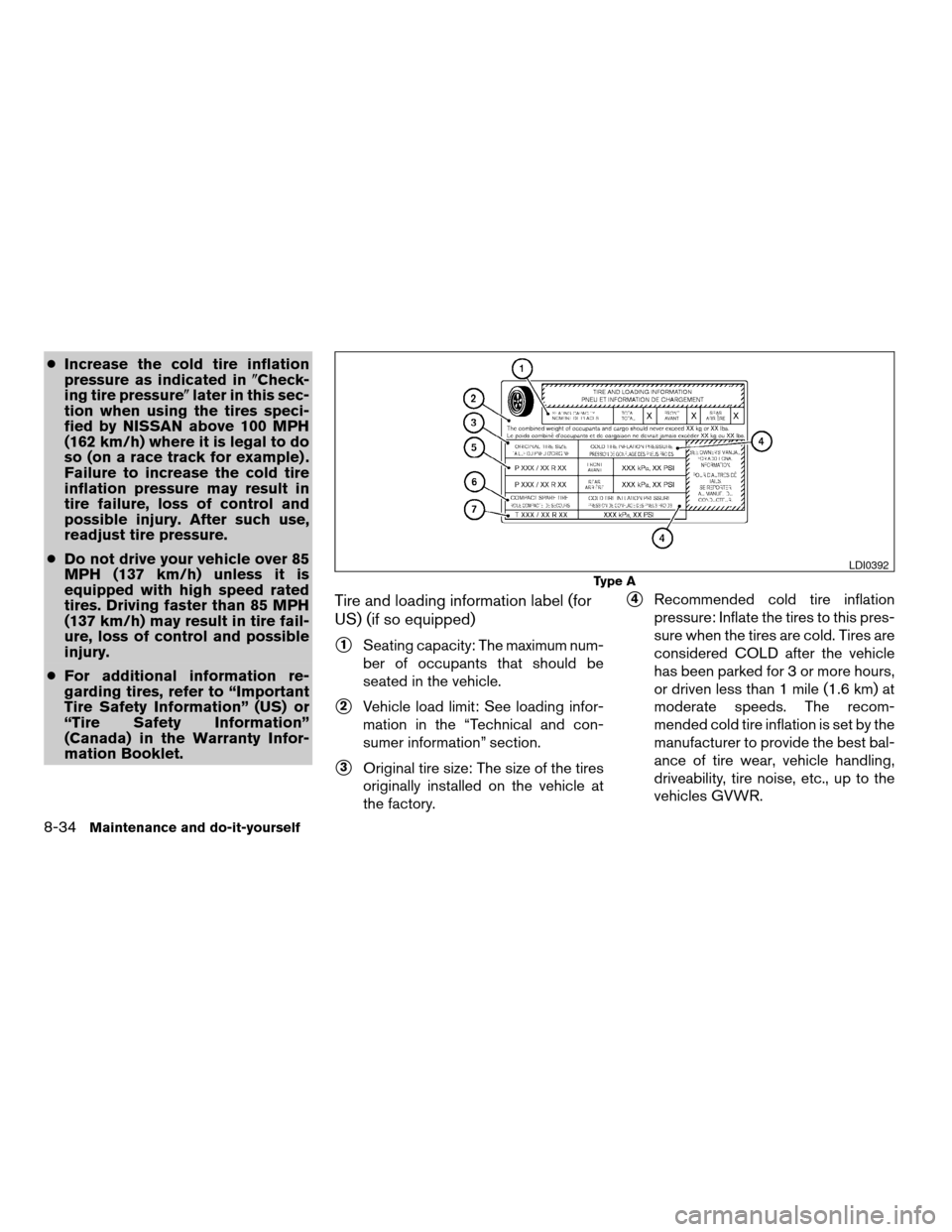
Tire and loading information label (for
US) (if so equipped)
s1Seating capacity: The maximum num-
ber of occupants that should be
seated in the vehicle.
s2Vehicle load limit: See loading infor-
mation in the “Technical and con-
sumer information” section.
s3Original tire size: The size of the tires
originally installed on the vehicle at
the factory.
s4Recommended cold tire inflation
pressure: Inflate the tires to this pres-
sure when the tires are cold. Tires are
considered COLD after the vehicle
has been parked for 3 or more hours,
or driven less than 1 mile (1.6 km) at
moderate speeds. The recom-
mended cold tire inflation is set by the
manufacturer to provide the best bal-
ance of tire wear, vehicle handling,
driveability, tire noise, etc., up to the
vehicles GVWR.
Type A
LDI0392
8-34Maintenance and do-it-yourself
ZREVIEW COPYÐ2006 Maxima(max)
Owners ManualÐUSA_English(nna)
06/23/05Ðtbrooks
X
Page 265 of 312
s5Tire size – refer to “Tire labeling” later
in this section.
s6ands7Spare tire size or compact
spare tire size (if so equipped) .
Tire and loading information label (for
US)
s1Seating capacity: The maximum num-
ber of occupants that should be
seated in the vehicle.
s2Vehicle load limit: See loading infor-
mation in the “Technical and con-
sumer information” section.
s3Recommended cold tire inflation
pressure: Inflate the tires to this pres-
sure when the tires are cold. Tires are
considered COLD after the vehicle
has been parked for 3 or more hours,
or driven less than 1 mile (1.6 km) at
moderate speeds. The recom-
mended cold tire inflation is set by the
manufacturer to provide the best bal-
ance of tire wear, vehicle handling,
driveability, tire noise, etc., up to the
vehicles GVWR.
Type B
LDI0434
Maintenance and do-it-yourself8-35
ZREVIEW COPYÐ2006 Maxima(max)
Owners ManualÐUSA_English(nna)
06/23/05Ðtbrooks
X
Page 266 of 312

s4Original tire size: The size of the tires
originally installed on the vehicle at
the factory.
s5Spare tire size or compact spare tire
size (if so equipped) .
Checking tire pressure
1. Remove the valve stem cap from the
tire.
2. Press the pressure gauge squarely
onto the valve stem. Do not press too
hard or force the valve stem side-
ways, or air will escape. If the hissing
of air escaping from the tire is heard
while checking the pressure, reposi-
tion the gauge to eliminate this leak-
age.3. Remove the gauge.
4. Read the tire pressure on the gauge
stem and compare to the specifica-
tion shown on the Tire and Loading
Information label.
5. Add air to the tire as needed. If too
much air is added, press the core of
the valve stem briefly with the tip of
the gauge stem to release pressure.
Recheck the pressure and add or
release air as needed.
6. Install the valve stem cap.
7. Check the pressure of all other tires,
including the spare.
LDI0393
8-36Maintenance and do-it-yourself
ZREVIEW COPYÐ2006 Maxima(max)
Owners ManualÐUSA_English(nna)
06/23/05Ðtbrooks
X
Page 267 of 312
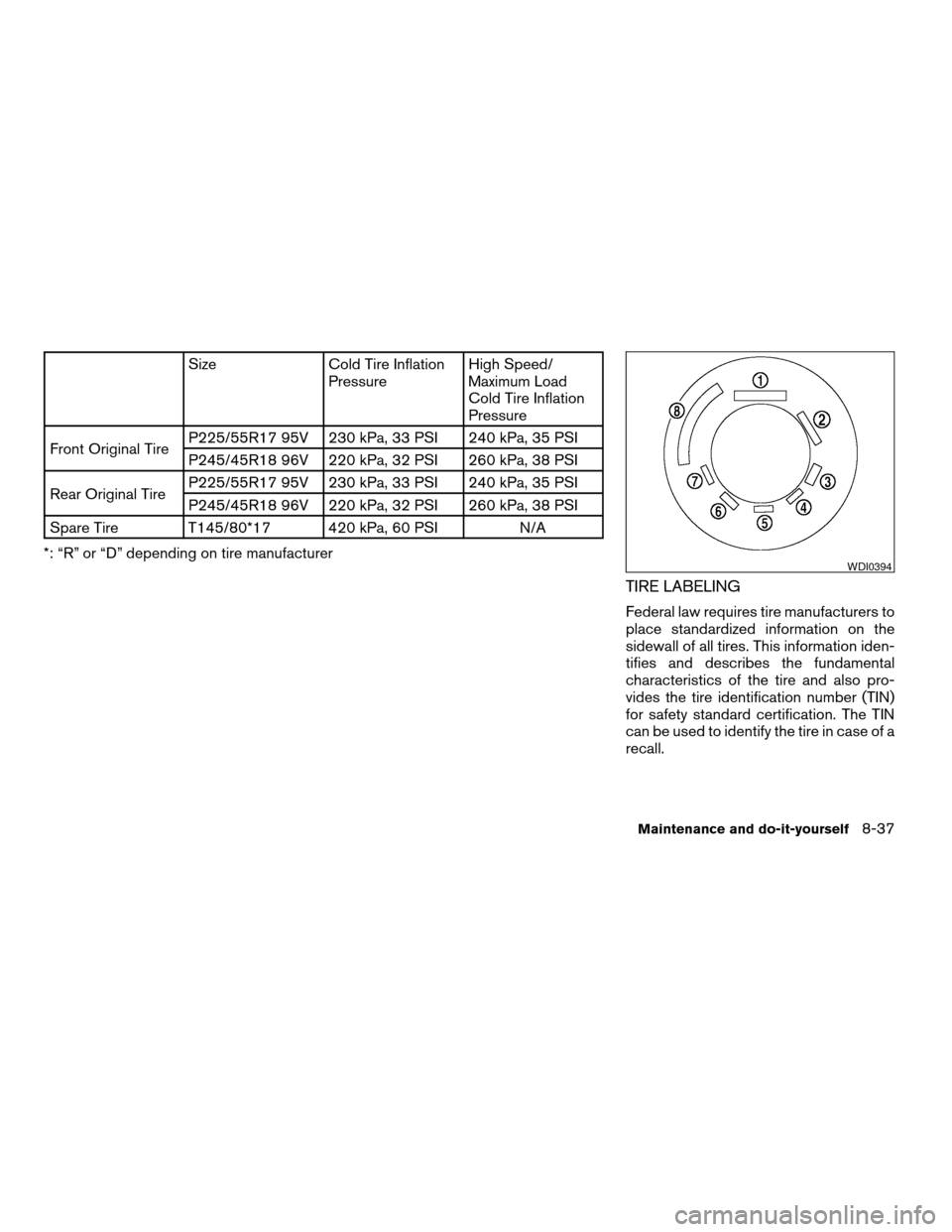
Size Cold Tire Inflation
PressureHigh Speed/
Maximum Load
Cold Tire Inflation
Pressure
Front Original TireP225/55R17 95V 230 kPa, 33 PSI 240 kPa, 35 PSI
P245/45R18 96V 220 kPa, 32 PSI 260 kPa, 38 PSI
Rear Original TireP225/55R17 95V 230 kPa, 33 PSI 240 kPa, 35 PSI
P245/45R18 96V 220 kPa, 32 PSI 260 kPa, 38 PSI
Spare Tire T145/80*17 420 kPa, 60 PSI N/A
*: “R” or “D” depending on tire manufacturer
TIRE LABELING
Federal law requires tire manufacturers to
place standardized information on the
sidewall of all tires. This information iden-
tifies and describes the fundamental
characteristics of the tire and also pro-
vides the tire identification number (TIN)
for safety standard certification. The TIN
can be used to identify the tire in case of a
recall.
WDI0394
Maintenance and do-it-yourself8-37
ZREVIEW COPYÐ2006 Maxima(max)
Owners ManualÐUSA_English(nna)
06/23/05Ðtbrooks
X