2006 MITSUBISHI COLT ESP
[x] Cancel search: ESPPage 113 of 364

DIAGNOSIS SYSTEM
MULTIPOINT FUEL INJECTION (MPI) <4A9>13A-19
Engine-ECU
•Items useful for grasping the engine control con-
dition by the engine-ECU
engine-CVT-ECU
monitor item section.
•Values of these monitor items vary greatly
depending on marginal difference of measure
-
ment conditions, difference of the environment,
aged deterioration of vehicles and so on, and it is
difficult to show the precise specification values.
Therefore, check conditi ons, display range and
movement of values are described.
Item No.Inspection itemDisplay range, numerical value
5AAir-fuel ratio learning value of B zone (Low
speed load)−25 to 25%
5BIdle speed control position learned value−128 to 127STEP
5CIdle speed control position learned value (A/C
load)−128 to 127STEP
6AKnock retardRetards in response to accelerator opening
6BLearned knock retard0 − 100%
6CTarget idle speedChanges in response to engine coolant
temperature
9BAir-fuel ratio learning value of A zone (Low
load)−25 to 25%
9DAir-fuel ratio feedback integration−25 to 25%
B2Alternator G terminal dutyIncreases
B3Purge control solenoid valve duty0 − 100%
81*Long-term fuel compensation−25 to 25%
82*Short-term fuel compensation−25 to 25%
87*Calculation load value0 − 100%
88*Fuel control conditionChanges depending on driving condition
NOTE: *: This item is not displayed when the data list in check mode is selected.
Page 116 of 364

GENERAL INFORMATION
MULTIPOINT FUEL INJECTION (MPI) <4G1>13B-2
GENERAL INFORMATION
M2132000101001
Although the control systems are basically the same
as those of the 4G1-Non-Turbo engine used in the
COLT, the following improvements have been added.
ImprovementRemark
A heat-sensing type air flow sensor
is used.•Changed to the intake air flow me asurement system by the air flow
sensor.
•The sensor is basically the same as that of the 4G69-MPI engine
used in the GRANDIS.
Supercharging pressure control
system is used.Controls the boost pressure that affects the waste gate actuator in
response to the signals from the engine-ECU.
Fuel pressure control solenoid valve
is used.Idling stability immediately afte r restarting the engine at high
temperature is maintained.
Dual oxygen sensor is used.Higher reliability of air-fuel ratio control.
Clutch switch is used.The information about whether the clutch pedal is depressed or not is
input into the engine-ECU.
Page 125 of 364

WASTE GATE CONTROL
MULTIPOINT FUEL INJECTION (MPI) <4G1>13B-11
WASTE GATE CONTROL
M2132013000078
Turbo pressure used in the waste gate actuator is
controlled by duty control of the waste gate solenoid
valve. As a result, turbo pressure corresponding to
driving conditions can be obtained.
AK402657
Waste gate
solenoid valveWaste gate
actuator
Battery Engine-ECU Crank angle sensor
Engine
control relay
Air flow sensor
Air by-pass valve
Air
inlet Intercooler
Turbocharger
AB
AK305437
Solenoid
On SolenoidSpring set pressure
Set pressure Actual turbo
pressure (kPa)
Turbo pressure acting on waste
gate actuator (kPa)
OFFAB
The eng
ine-ECU turns the power tran sistor ON and,
whe
n normal curren t (duty 100% ) flows in th e waste
gate solen
o id valve coil, the waste gat e solenoid valve do es n o t ope n if tu rbo pre ssu re does not rise
above the set pre s sure of th e waste gate actua t or
spring since some of the turb o pressure used in th e
wa ste g a te actuato r leaks o u t.
On the ot
her hand, when current do es not flow in the
wa
ste g a te soleno id valve co il (d uty 0 % ), the wa ste
gate valve ope
ns if turbo pressure rise to the set
pressure o
f the waste gat e act uator sprin g since no
pressure leaks out
.
Conseq uently , by u s in g duty co ntrol for the waste
g
a te solen o id valve, turbo pressu re can b e con t ro lled
in a range
f r om 0% to 1 00% duty . Th is du ty co ntrol is
performed in cycles of
approximately 60ms.
Page 133 of 364

DIAGNOSIS SYSTEM
MULTIPOINT FUEL INJECTION (MPI) <4G1>13B-19
Engine-ECU Monitor Item
•Items useful for grasping the engine control condition by the engine-ECU are provided in this monitor item
section.
•Values of these monitor items vary greatly depending on marginal difference of measurement conditions,
difference of the environment, aged deterioration of vehicl es and so on, and it is difficult to show the pre
-
cise specification values. Therefore, check conditions, display range and movement of values are
described.
Item No.Inspection itemDisplay range, numerical value
5AAir-fuel ratio learning value of B zone (Low
speed load)−25 to 25%
5BIdle speed control position learned value−128 to 127STEP
5CIdle speed control position learned value (A/C
load)−128 to 127STEP
6AKnock retardRetards in response to accelerator opening
6BLearned knock retard0 − 100%
6CTarget Idle speedChanges in response to engine coolant
temperature
9BAir-fuel ratio learning value of A zone (Low
speed load)−25 to 25%
9DAir-fuel ratio feedback integration−25 to 25%
B1Waste gate solenoid valve duty0 − 100%
B2Alternator G terminal dutyIncreases
B3Purge control solenoid valve duty0 − 100%
81*Long-term fuel compensation−25 to 25%
82*Short-term fuel compensation−25 to 25%
87*Calculation load value0 − 100%
88*Fuel control conditionChanges depending on driving condition
NOTE: *: This item is not displayed when the data list in check mode is selected.
Page 140 of 364
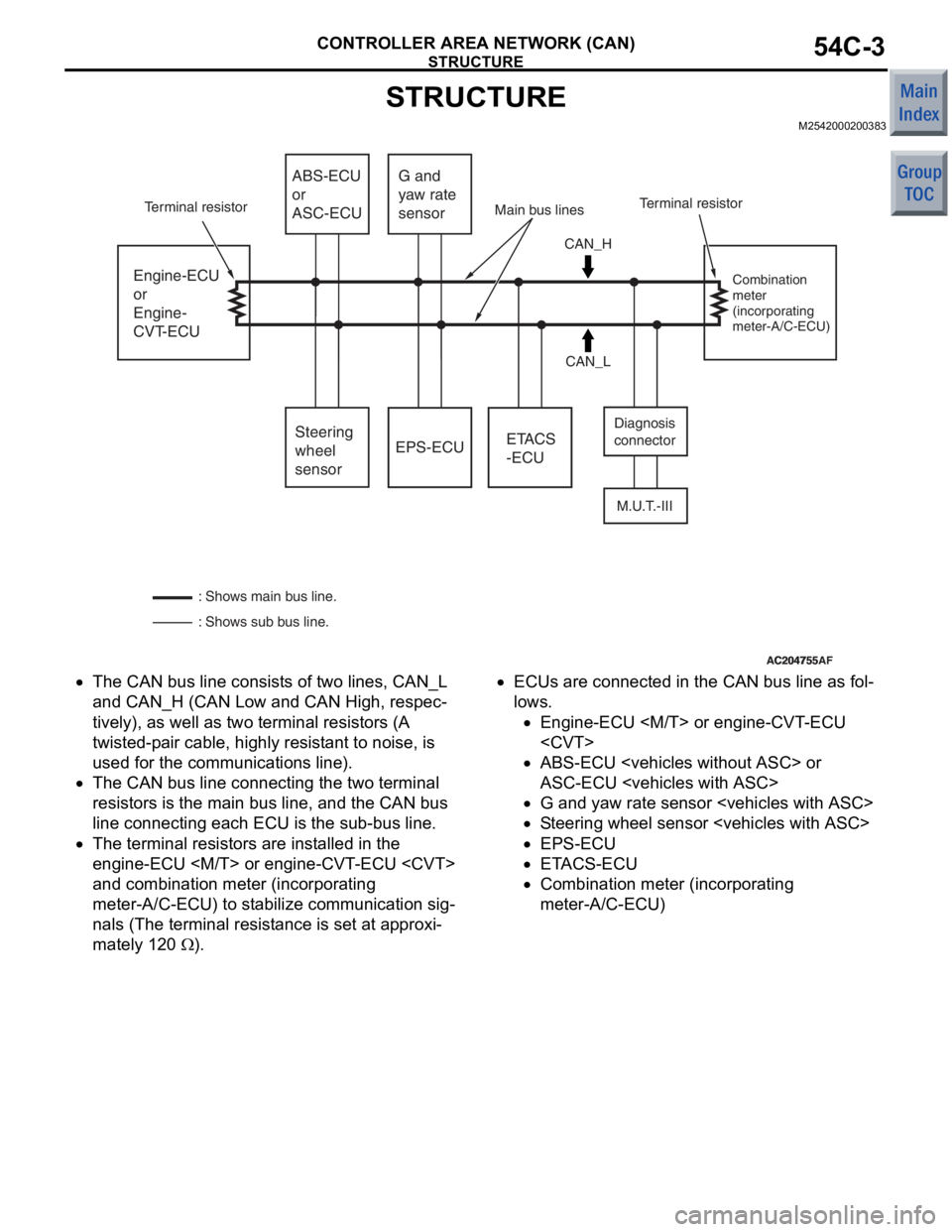
STRUCTURE
CONTROLLER AREA NETWORK (CAN)54C-3
STRUCTURE
M2542000200383
AC204755AC204755AF
Engine-ECU
or
Engine-
CVT-ECUEPS-ECU
M.U.T.-III
ETACS
-ECU
ABS-ECU
or
ASC-ECU
Steering
wheel
sensor G and
yaw rate
sensor
CAN_H
CAN_L Diagnosis
connector
Combination
meter
(incorporating
meter-A/C-ECU)
: Shows sub bus line. : Shows main bus line. Terminal resistor
Terminal resistor Main bus lines
•The CAN bu s line consist s of two lines, CAN_L
and
CAN_H (CAN Low and CAN Hig h , respec
-
tively), as well as two terminal re sistors (A
twisted-p
a ir cable, highly resist ant to noise, is
used for
the communicatio n s line) .
•The CAN bu s line connectin g the two terminal
resist
ors is th e main bus line, an d the CAN bus
line connecting
each ECU is th e su b-bus lin e.
•The terminal resistors are inst alled in the
eng
ine-ECU
and
combin ation mete r (incorpora t ing
meter-A/C-ECU) to st
abi lize co mmunicatio n sig
-
nals (The terminal resist ance is se t at ap proxi-
mately 120 Ω).
•ECUs are conn ected in th e CAN bus line as fo l-
lows.
•En gine -ECU
•ABS-ECU
A
S C-ECU
•G and ya w ra te se nsor
•St e e ring wh eel sensor
•EPS-ECU
•E T ACS-ECU
•Co mbinatio n me ter (in c orpo rating
meter-A/C-ECU)
Page 141 of 364
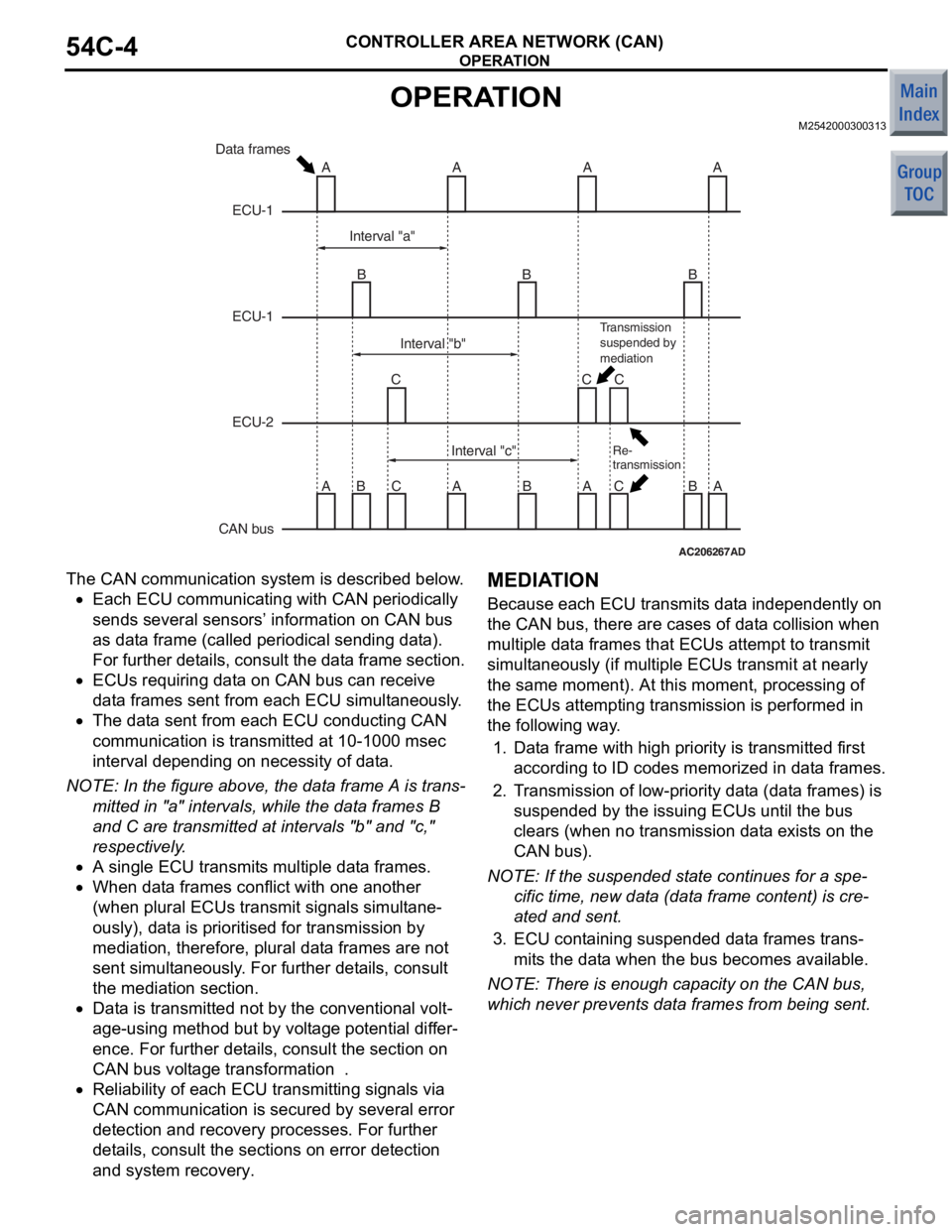
OPERATION
CONTROLLER AREA NETWORK (CAN)54C-4
OPERATION
M2542000300313
AC206267
ECU-1A
AAA
BBB CCA
B
Interval "a"
Interval "b" Interval "c"
CCC BB
AAA
ECU-1
ECU-2
CAN bus
Data frames
AC206267
AD
Transmission
suspended by
mediation
Re-
transmission
The CAN commun ica t ion system is describe d below .
•Each ECU communicating with CAN pe riodically
se
nds several sensors’ inf o rmation on CAN bu s
as dat
a frame (calle d periodical send ing d a t a ).
For furt
her det ails, co nsult the dat a frame sectio n
.
•ECUs requirin g dat a on CAN bu s can receive
dat
a fra m es sen t from each ECU simult aneo usly .
•The dat a se nt from each ECU condu cting CAN
co
mmunicatio n is transmitted at 10-100 0 msec
in
terva l dep endin g on n e cessity of dat a.
NOTE: In the f i gure ab ove, th e dat a frame A is trans-
mitted in "a" intervals, while the d a t a frames B
and
C are tran smitted at int e rvals "b" and "c,"
respective
ly .
•A single ECU tra n smit s multiple dat a frames.
•When dat a frames conf lict with o ne ano ther
(when
plural ECUs tr ansmit signals simu lt ane
-
ously), data is prioriti sed for transmission b y
mediat
ion, t herefore , plu r al da t a frames are not
se
nt simult aneously . F o r furthe r det ails, consult
the
mediatio n se ctio n
.
•Data is transmitted no t by the conve n tion al volt-
age-using method b u t by volt a ge pot entia l dif f er-
ence. For further det ails, consu l t the section on
CAN
bus volt ag e transformation
.
•Reliability of each ECU transmitting sig nals via
CAN
commun ica t ion is secu red by several error
det
ection and reco very processes. For furth e r
det
ails, consult the sections on error detection
and
sy stem rec o very
.
MEDIA T I O N
Because ea ch ECU transmit s dat a indepe ndently o n
the CAN bus,
there a r e ca ses of da t a collision whe n
multiple dat
a frames that ECUs at temp t to tran smit
simult
ane ously (if mu ltiple ECUs tran smit at n early
the same
moment). At th is moment, p r ocessing of
the ECUs atte
mpting tra n smission is performed in
the followin
g way .
1.Dat a frame with high priority is tra n smitted first
accord ing to ID cod e s memo rize d in dat a frames.
2.T r ansmission of lo w-p r iori ty dat a (dat a frames) is
suspe nded b y the issuin g ECUs until the bus
clears (when no transmission da t a exist s on the
CAN bus).
NO TE: If th e su spen ded st a t e co ntinu e s fo r a sp e-
cific time, new d a t a (dat a frame content ) is cre-
ated and sent.
3.ECU cont aining suspende d dat a fra m es trans-
mits the dat a when t he bus become s available .
NOTE: The re is enou gh ca p a city on t he CAN bus,
wh
ich
neve r prevent s da t a f r ames from being se nt.
Page 181 of 364

COMBINATION METER
CHASSIS ELECTRICAL54A-10
COMBINATION METER
M2540005000894
The combination meter features large, clearly visible
analogue indicators. The meter has the speedometer
in the middle, the coolant temperature gauge at
upper right, the fuel gauge at lower right, and the
tachometer at left so that drivers can easily distin
-
guish the information from the meters. The combina-
tion meter offers the following advantages.
•The combination meter is used for air conditioner
and meter drive control to integrate ECU.
•CAN communication is used for more reliable
transmission of all gauge data and indicator lamp
input signals, such as vehicle speed, engine
RPM, and coolant temperature. For further
details on CAN, refer to GROUP 54C, CAN
P.54C-2. The signals that the combination meter
uses are described in the CAN communications
input signals table
.
•Several diagnosis functions such as the diagno-
sis code memory and actuator tests are prepared
in order to improve serviceability.
•For a brighter display at night and for a longer
useful life, all indicator lamps, warning lamps, and
illumination bulbs use LEDs.
•The indicators for the speedometer, fuel gauge,
and other gauges are driven by a stepping motor.
For further details, consult the stepping motor
section
.
•The electronic speedometer operates by receiv-
ing vehicle speed signals sent by the
engine-ECU
via the CAN.
•A large and clear LCD type odo-tripmeter is pro-
vided. The odometer continuously displays val-
ues while the tripmeter adopts a twin-trip (trip A,
trip B) function which is switched by a reset but
-
ton. In addition, clock function is incorporated.
•A fog lamp indicator lamp is provided to let the
driver know that the fog lamp is on.
•A seat belt warning lamp is installed to encourage
the driver to fasten the seat belt.
•The high-contrast meter is adopted. When the
ignition is turned ON, such as the needles and
face display are illuminated with fade-in lighting
by the LED light source.
•To further accentuate the high-contrast lighting,
the light of the high-contrast meter fades in and
fades out when the light is turned on and off
respectively.
•With the auto illumination function incorporated in
the high-contrast meter, a two-stage switching of
daytime (non-dimming) and nighttime (dimming)
is achieved. Also, the brightness can be adjusted
using the illumination control knob.
•A tail lamp indicator lamp is installed which
informs the lighting status of the tail lamps to the
driver.
Page 183 of 364

COMBINATION METER
CHASSIS ELECTRICAL54A-12
STEPPING MOTOR
AC208264
When the battery line is connected or
a voltage drops from cranking or the like.
AD
AC107161
Deviation of
needleNo deviation of
needle
15˚
AE
Ignition switch at ON or LOCK (OFF) position
These
gauge s use a stepp ing motor a s the drive
mechanism for
the indica tor s (calle d the "move
-
ment"). Compared with conventional movement s, the
torque f
o r driving the indicators is much gre a ter for
supe
rior indicator a ccu racy and more st able respo n se. The indicator po sit i on d i sp layed is dete r
-
min
ed a s t he microcon troller circuit in the gauge co n-
trols the stepping moto r . In conve n tion al gaug es, the
indicato
r revo lves 360
° in response to 3 6 0° driving
contro
ls.
Ho
we
ver
,
a ste
pping
mot
o
r is designed so
that the
ind
i
cat
o
r revolves on
ly
15
°, even in
respo
n
se
to a drive contro
l of 3
6
0
°. The 15 ° drive
c
ont
ro
l m
u
st
be
rep
eat
ed
t
o
ma
ke
th
e
ind
i
cat
o r rot a t e
36
0
°. Th us , at a po sit i o n 15 ° a w a y fr om th e in dicat o r
display positio
n, there
will be an iden tica l control. As
a resu
lt, in the
case of a
great imp a ct such as from
an accide
nt wh
en the indicator becomes misalign ed,
if the
ignition
is
switched o
n
to st art driving while t he
indicato
r is
misaligned,
the indicator will fu nction
wh
ile
misaligned.
Thus, to retu rn the indicator to the
norma
l position in
case this ha ppens, when the ig ni
-
tion is switched on , the indicator p o sitions are re set
to their respective
position s af ter th e batte ry line is
conn
ected af ter it is cut. Af ter th e batte ry line is cut
and reconne
cted , the indicators simply retu rn to th e
zero
positio n. Th e same ope ration is pe rforme d af ter
volt
ag e is resto r ed if gauge functions are lost
beca
u se o f a volt age d r op from cra n king or t he like.
Furthermore, t
he in dicator only re turns 15
° after the
ignition
is switched on
or the
lock is turne
d
of f. The
indicato
r is
not moved
if it is not misa
lig
ned.
CAN COMMUNICA TION INPUT SIGNALS T ABLE
SignalTransmitter ECU
Engine speed signalEngine-ECU
engine-CVT-ECU
Vehicle speed signal
Engine malfunction indicator lamp request signal
Engine coolant temperature signal
Shift lever indicator signal
ABS warning lamp request signalABS-ECU or ASC-ECU
EBD (brake) malfunction indicator lamp request signal
ASC indicator lamp request signal
EPS malfunction indicator lamp request signalEPS-ECU