Page 1 of 481
Sommer\ Corporate\ Media AG
Bild in der Größe
215x70 mm einfügen
Operator’s Manual
S-Class
Order No. 6515 2190 13 Part No. 220 584 27 97 USA Edition B 2006
Ê6%t;ÂWË2205842797
Operator’s Manual S-Class
Page 18 of 481
17 Introduction
Problems with your vehicle
�Problems with your vehicle
If you should experience a problem with your vehicle, particularly one that you believe may affect its safe operation, we urge you to
immediately contact an authorized Mercedes-Benz Center to have the problem diagnosed and corrected if required. If the matter is
not handled to your satisfaction, please discuss the problem with the Mercedes-Benz Center management, or if necessary contact us
at one of the following addresses:
In the USA:
Customer Assistance Center
Mercedes-Benz USA, LLC
One Mercedes Drive
Montvale, NJ 07645-0350
In Canada:
Customer Relations Department
Mercedes-Benz Canada, Inc.
98 Vanderhoof Avenue
Toronto, Ontario, M4G 4C9
Page 19 of 481

18 IntroductionReporting safety defectsFor the USA only:
The following text is published as required of manufacturers under Title 49, Code of U.S. Federal Regulations, Part 575 pursuant to the
“National Traffic and Motor Vehicle Safety Act of 1966.”Reporting safety defects
If you believe that your vehicle has a defect which could cause a crash or could cause injury or death, you should immediately inform
the National Highway Traffic Safety Administration (NHTSA) in addition to notifying Mercedes-Benz USA, LLC.
If NHTSA receives similar complaints, it may open an investigation, and if it finds that a safety defect exists in a group of vehicles, it
may order a recall and remedy campaign. However, NHTSA cannot become involved in individual problems between you, your dealer,
or Mercedes-Benz USA, LLC.
To contact NHTSA, you may either call the Auto Safety Hotline toll-free at 1-888-327-4236 (or 366-0123 in Washington, D.C. area) or
write to: NHTSA, U.S. Department of Transportation, Washington, D.C. 20590. You can also obtain other information about motor ve-
hicle safety from the Hotline.
Page 42 of 481

41 Getting started
Adjusting
Mirrors
Adjust the interior and exterior rear view
mirrors before driving so that you have a
good view of the road and traffic condi-
tions.Interior rear view mirror
�
Manually adjust the interior rear view
mirror.
For more information, see “Rear view mir-
rors” (
�page 186).Exterior rear view mirrors
Warning!
G
In case of an accident, liquid electrolyte may
escape the mirror housing if the mirror glass
breaks.
Electrolyte has an irritating effect. Do not al-
low the liquid to come into contact with
eyes, skin, clothing, or respiratory system.
In case it does, immediately flush affected
area with water, and seek medical help if
necessary.!Electrolyte drops coming into contact
with the vehicle paint finish can only be
completely removed while in their liq-
uid state and by applying plenty of wa-
ter.
Warning!
G
Exercise care when using the passenger
side exterior rear view mirror. The mirror
surface is convex (outwardly curved surface
for a wider field of view). Objects in mirror
are closer than they appear. Check your in-
terior rear view mirror or glance over your
shoulder before changing lanes.
Page 47 of 481
46 Getting startedDrivingStarting the engine Automatic transmission
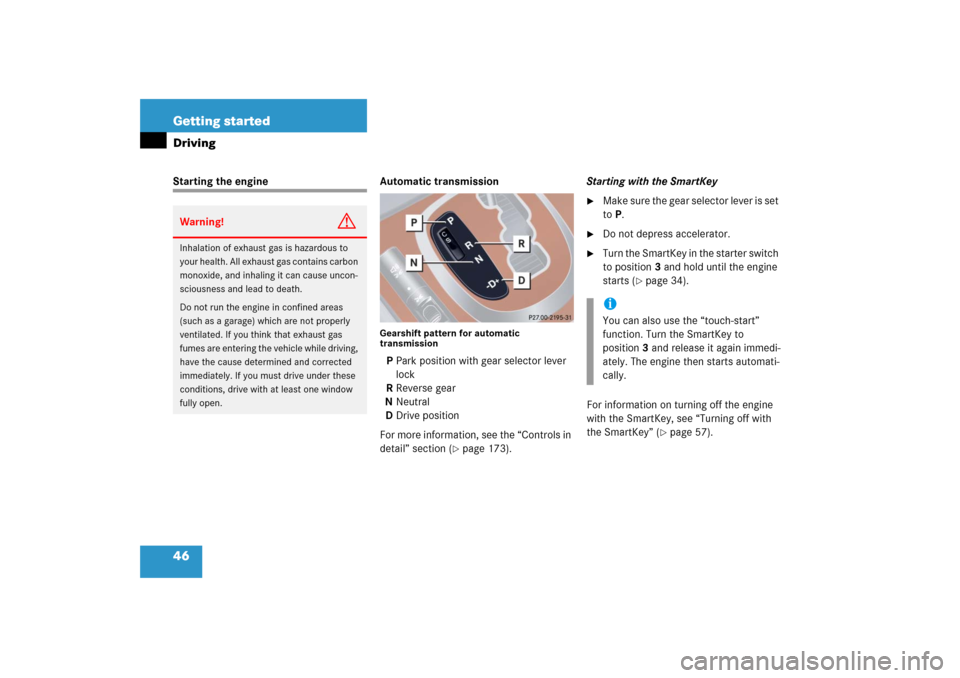
Gearshift pattern for automatic
transmissionPPark position with gear selector lever
lock
RReverse gear
NNeutral
DDrive position
For more information, see the “Controls in
detail” section (
�page 173).Starting with the SmartKey
�
Make sure the gear selector lever is set
toP.
�
Do not depress accelerator.
�
Turn the SmartKey in the starter switch
to position3 and hold until the engine
starts (
�page 34).
For information on turning off the engine
with the SmartKey, see “Turning off with
the SmartKey” (
�page 57).
Warning!
G
Inhalation of exhaust gas is hazardous to
your health. All exhaust gas contains carbon
monoxide, and inhaling it can cause uncon-
sciousness and lead to death.
Do not run the engine in confined areas
(such as a garage) which are not properly
ventilated. If you think that exhaust gas
fumes are entering the vehicle while driving,
have the cause determined and corrected
immediately. If you must drive under these
conditions, drive with at least one window
fully open.
iYou can also use the “touch-start”
function. Turn the SmartKey to
position3 and release it again immedi-
ately. The engine then starts automati-
cally.
Page 54 of 481

53 Getting started
Driving
Intermittent wiping�
Set the wiper switch to position I.
Single wipe
�
Press the combination switch briefly in
the direction of arrow1.
The windshield wipers wipe one time
without washer fluid.
Wiping with windshield washer fluid
�
Press switch in the direction of
arrow1 past the resistance point.
The windshield wiper operates with
washer fluid.
For information on filling up the washer
reservoir, see “Windshield washer system
and headlamp cleaning system*”
(
�page 296).iIntermittent wiping is interrupted when
the vehicle is at a standstill and a front
door is opened.
!If anything blocks the windshield wip-
ers (leaves, snow, etc.), switch them off
immediately.�
For safety reasons, stop the vehicle
in a safe location, �
turn off the engine by turning
the SmartKey to position0 and
withdraw SmartKey from starter
switch
or
�
turn off the engine by pressing
the KEYLESS-GO* start/stop
button (
�page 35) and open
the driver’s door (with the driv-
er’s door open, starter switch is
in position0, same as with
SmartKey removed from starter
switch)
before attempting to remove any
blockage.�
Remove blockage.
�
Turn the windshield wipers on
again.
If windshield wipers fail to function at
all in switch positionI,
�
set the combination switch to the
next highest wiper speed
�
have the windshield wipers
checked at the nearest authorized
Mercedes-Benz Center
Page 61 of 481

60 Safety and SecurityOccupant safetyIn this section you will learn the most im-
portant facts about the restraint systems
of the vehicle.
The restraint systems are:�
Seat belts
�
Emergency tensioning device
�
Air bags
�
Child seats
�
Child seat recognition
�
Lower anchors and tethers for children
(LATCH)
�
Preventive occupant safety
(PRE-SAFE
®)
As independent systems, their protective
effects work in conjunction with each oth-
er.The 1 indicator lamp in the instrument
cluster comes on
�
for about four seconds when you turn
the SmartKey in the starter switch to
position1 or press the KEYLESS-GO*
start/stop button (
�page 35) once. It
then goes out briefly, comes on again
and remains lit until you start the en-
gine.
�
for about four seconds when you start
the engine by turning the SmartKey or
pressing the KEYLESS-GO* start/stop
button.The restraint systems are fully operational
if the 1 indicator lamp is not lit when
the engine is running.
A malfunction in the system has been de-
tected if the1 indicator lamp:
�
fails to extinguish after approximately
four seconds
�
does not come on at all
�
comes on after the engine was started
or while driving
For safety reasons, we strongly recom-
mend that you visit an authorized
Mercedes-Benz Center immediately to
have the system checked.
iFor information on infants and children
traveling with you in the vehicle and re-
straint systems for infants and chil-
dren, see “Children in the vehicle”
(�page 71).
iThe 1 indicator lamp remains lit if
the SmartKey is turned to position 2
and left there or the KEYLESS-GO*
start/stop button is pressed twice. The
indicator lamp will go out when you
start the engine.
Page 62 of 481
61 Safety and Security
Occupant safety
For more information, see “Practical hints”
(�page 347).
Air bags
Warning!
G
In the event that the 1 indicator lamp
comes on during driving or does not come
on at all, the SRS self-check has detected a
malfunction. For your safety, we strongly
recommend that you visit an authorized
Mercedes-Benz Center immediately to have
the system checked; otherwise the SRS may
not be activated when needed in an acci-
dent, which could result in serious or fatal
injury, or it might deploy unexpectedly and
unnecessarily which could also result in
injury.
In addition, improper repair work on the SRS
creates a risk of rendering the SRS inopera-
tive or causing unintended air bag deploy-
ment. Work on the SRS must therefore only
be performed by qualified technicians. Con-
tact an authorized Mercedes-Benz Center.
Warning!
G
Air bags are designed to reduce the poten-
tial of injury and fatality in certain frontal im-
pacts (front air bags), side impacts (side
impact air bags and head protection window
curtain air bags) or rollovers (head protec-
tion window curtain air bags). However, no
system available today can totally eliminate
injuries and fatalities.
The activation of the air bags temporarily re-
leases a small amount of dust from the
air bags. This dust, however, is neither inju-
rious to your health, nor does it indicate a
fire in the vehicle. The dust might cause
some temporary breathing difficulty for peo-
ple with asthma or other breathing trouble.
To avoid this, you may wish to get out of the
vehicle as soon as it is safe to do so. If you
have any breathing difficulty but cannot get
out of the vehicle after the air bag inflates,
then get fresh air by opening a window or
door.
Warning!
G
To reduce the risk of injury when the front
air bags inflate, it is very important for the
driver and passenger front to always be in a
properly seated position and to wear your
seat belts.
For maximum protection in the event of a
collision always be in normal seated position
with your back against the seat backrest.
Fasten your seat belt and make sure it is
properly positioned on your body.
Since the air bag inflates with considerable
speed and force, a proper seating and hands
on steering wheel position will help to keep
you at a safe distance from the air bag. Oc-
cupants who are unbelted, out of position or
too close to the air bag can be seriously in-
jured or killed by an air bag as it inflates with
great force in the blink of an eye:�
Sit properly belted in a nearly upright
position with your back against the seat
backrest.
��