Page 48 of 561
47 Getting started
Adjusting
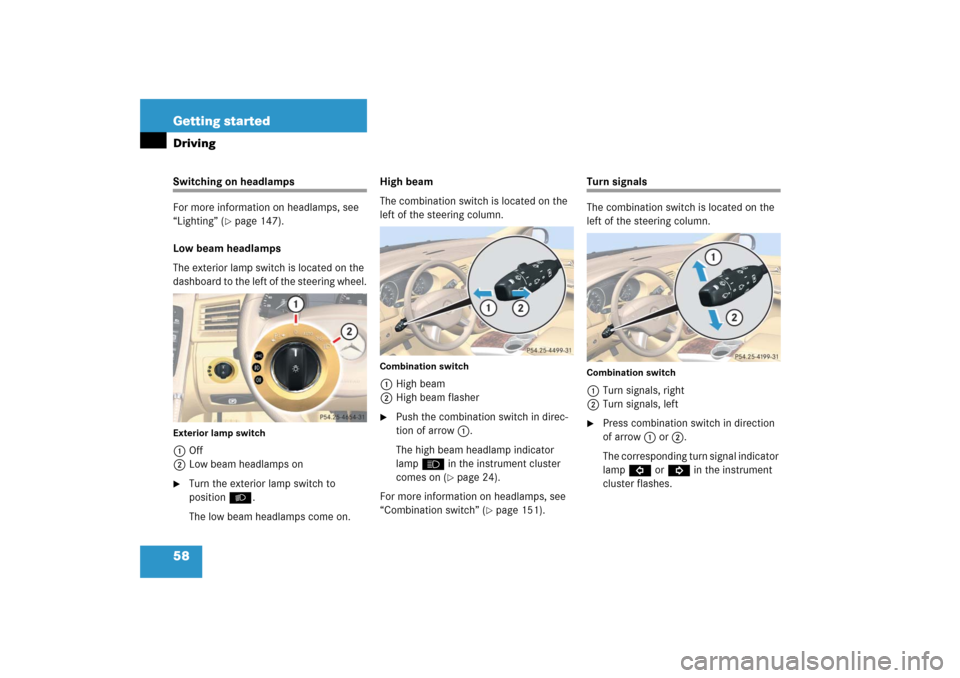
The stalk for steering wheel adjustment is
located on the lower left of the steering
column.
1Adjusting steering column, in or out
2Adjusting steering column, up or down�
Switch on the ignition (
�page 38).
or
�
Open the driver’s door.Adjusting steering column in or out
�
Move stalk forward or back in direction
of arrow1 until a comfortable steer-
ing wheel position is reached with your
arms slightly bent at the elbow.
Adjusting steering column up or down
�
Move stalk up or down in direction of
arrow2.
Make sure your legs can move freely
and that all displays (including malfunc-
tion and indicator lamps) on the instru-
ment cluster are clearly visible.
Mirrors
Adjust the interior and exterior rear view
mirrors before driving so that you have a
good view of the road and traffic condi-
tions.
iThe memory function (
�page 144) lets
you store the settings for the steering
wheel column together with the set-
tings for seat positions and the exterior
rear view mirrors.
Warning!
G
In case of an accident, liquid electrolyte may
escape the mirror housing if the mirror glass
breaks.
Electrolyte has an irritating effect. Do not al-
low the liquid to come into contact with
eyes, skin, clothing, or respiratory system.
In case it does, immediately flush affected
area with water, and seek medical help if
necessary.!Electrolyte drops coming into contact
with the vehicle paint finish can only be
completely removed while in their
liquid state and by applying plenty of
water.
Page 50 of 561
49 Getting started
Adjusting
For more information, see “Rear view mir-
rors” (
�page 208) and “Storing exterior
rear view mirror parking position”
(
�page 146).
!If an exterior rear view mirror was forc-
ibly pushed forward (hit from the rear)
or forcibly pushed rearward (hit from
the front), reposition it by applying firm
pressure until it snaps into place. The
mirror housing is then properly posi-
tioned and you can adjust the mirror in
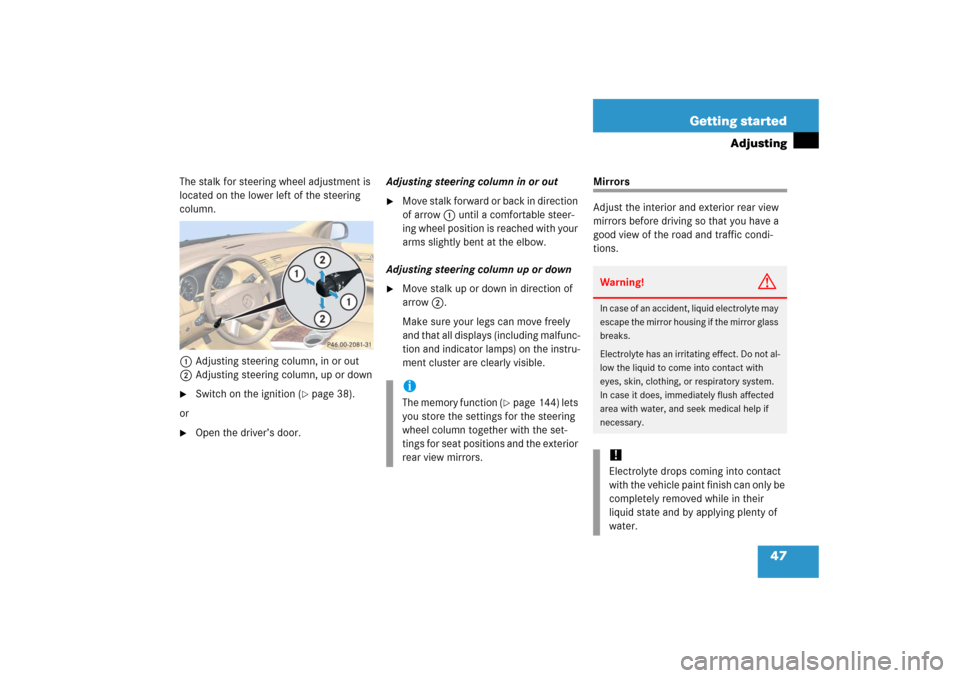
the usual manner.!Vehicles with power folding exterior
rear view mirrors*:
If an exterior rear view mirror housing
is forcibly pushed forward (hit from the
rear) or forcibly pushed rearward (hit
from the front) press button1 to fold
mirrors in, then press button1 again
to fold mirrors out. Do not force mirrors
by hand as this may damage the adjust-
ment mechanism.
The mirror housing is then properly po-
sitioned and you can adjust the mirror
in the usual manner.
iThe memory function* (
�page 144)
lets you store the settings for the exte-
rior rear view mirrors together with the
setting for the steering wheel column
and the seat positions.
At low ambient temperatures, the
exterior rear view mirrors will be heat-
ed automatically.
Page 58 of 561

57 Getting started
Driving
�
Carefully depress the accelerator
pedal.
Once the vehicle is in motion, the auto-
matic central locking system engages
and the locking knobs drop down.After a cold start, the automatic transmis-
sion shifts at a higher engine revolution.
This allows the catalytic converter to reach
its operating temperature earlier.
For more information, see “Driving instruc-
tions” (
�page 331).
iThe automatic door lock feature can be
deactivated (
�page 188).
iYou can open a locked door from the
inside. Open door only when conditions
are safe to do so.!If you hear a warning signal and the
message
Release parking brake
appears in the multifunction display
when driving off, you have forgotten to
release the parking brake.
Release the parking brake.
Warning!
G
On slippery road surfaces, never downshift
in order to obtain braking action. This could
result in drive wheel slip and reduced vehi-
cle control. Your vehicle’s ABS will not pre-
vent this type of loss of control.Warning!
G
It is dangerous to shift the gear selector
lever out ofP orN if the engine speed is
higher than idle speed. If your foot is not
firmly on the brake pedal, the vehicle could
accelerate quickly forward or in reverse. You
could lose control of the vehicle and hit
someone or something. Only shift into gear
when the engine is idling normally and when
your right foot is firmly on the brake pedal.
!Shift the automatic transmission to
positionP orR only when the vehicle is
stopped in order to avoid damaging the
transmission.!Do not run cold engine at high engine
speeds. Running a cold engine at high
engine speeds may shorten the service
life of the engine.!Simultaneously depressing the acceler-
ator pedal and applying the brake re-
duces engine performance and causes
premature brake and drivetrain wear.
Page 59 of 561
58 Getting startedDrivingSwitching on headlamps
For more information on headlamps, see
“Lighting” (
�page 147).
Low beam headlamps
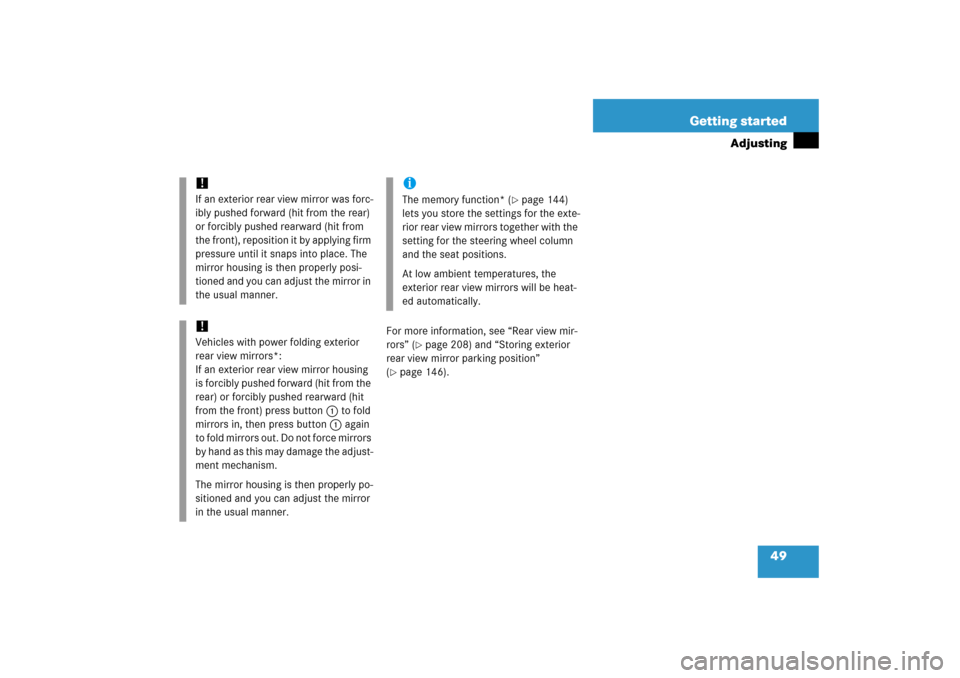
The exterior lamp switch is located on the
dashboard to the left of the steering wheel.
Exterior lamp switch1 Off
2Low beam headlamps on�
Turn the exterior lamp switch to
positionB.
The low beam headlamps come on.High beam
The combination switch is located on the
left of the steering column.
Combination switch1High beam
2High beam flasher�
Push the combination switch in direc-
tion of arrow1.
The high beam headlamp indicator
lampA in the instrument cluster
comes on (
�page 24).
For more information on headlamps, see
“Combination switch” (
�page 151).
Turn signals
The combination switch is located on the
left of the steering column.Combination switch1Turn signals, right
2Turn signals, left�
Press combination switch in direction
of arrow1 or2.
The corresponding turn signal indicator
lampLorK in the instrument
cluster flashes.
Page 60 of 561
59 Getting started
Driving
The combination switch resets automati-
cally after major steering wheel move-
ment.
Windshield wipers
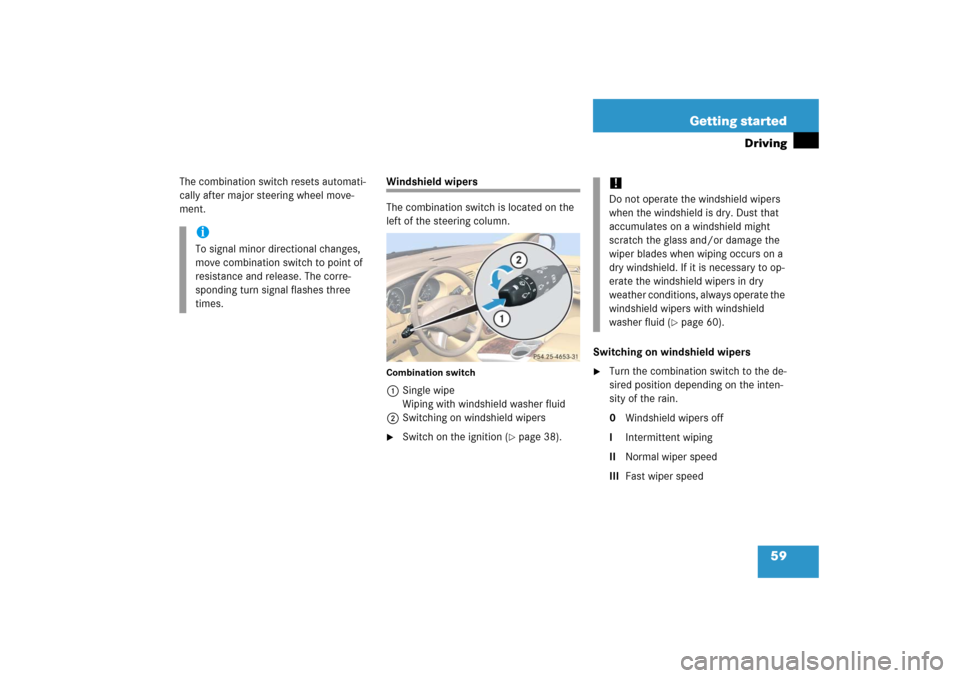
The combination switch is located on the
left of the steering column.Combination switch1Single wipe
Wiping with windshield washer fluid
2Switching on windshield wipers�
Switch on the ignition (
�page 38).Switching on windshield wipers
�
Turn the combination switch to the de-
sired position depending on the inten-
sity of the rain.
0Windshield wipers off
IIntermittent wiping
IINormal wiper speed
IIIFast wiper speed
iTo signal minor directional changes,
move combination switch to point of
resistance and release. The corre-
sponding turn signal flashes three
times.
!Do not operate the windshield wipers
when the windshield is dry. Dust that
accumulates on a windshield might
scratch the glass and/or damage the
wiper blades when wiping occurs on a
dry windshield. If it is necessary to op-
erate the windshield wipers in dry
weather conditions, always operate the
windshield wipers with windshield
washer fluid (
�page 60).
Page 65 of 561

64 Getting startedParking and lockingYou have now completed your first drive.
You have properly stopped and parked
your vehicle. End your drive as follows.Warning!
G
With the engine not running, there is no
power assistance for the brake and the
steering system. In this case, it is important
to keep in mind that a considerably higher
degree of effort is necessary to brake and
steer the vehicle.
Warning!
G
Do not park this vehicle in areas where com-
bustible materials such as grass, hay or
leaves can come into contact with the hot
exhaust system, as these materials could be
ignited and cause a vehicle fire.
To reduce the risk of personal injury as a re-
sult of vehicle movement, before turning off
the engine and leaving the vehicle always:�
Keep right foot on brake pedal.
�
Firmly depress parking brake pedal.
�
Shift the automatic transmission to
positionP.
�
Slowly release brake pedal.
�
When parked on an incline, turn front
wheel towards the road curb.
�
Turn the SmartKey in the starter switch
to position0 and remove the SmartKey
from the starter switch, or press the
start / stop button (vehicles with
KEYLESS-GO*).
�
Take the SmartKey or the SmartKey with
KEYLESS-GO* and lock vehicle when
leaving.
Page 66 of 561
65 Getting started
Parking and locking
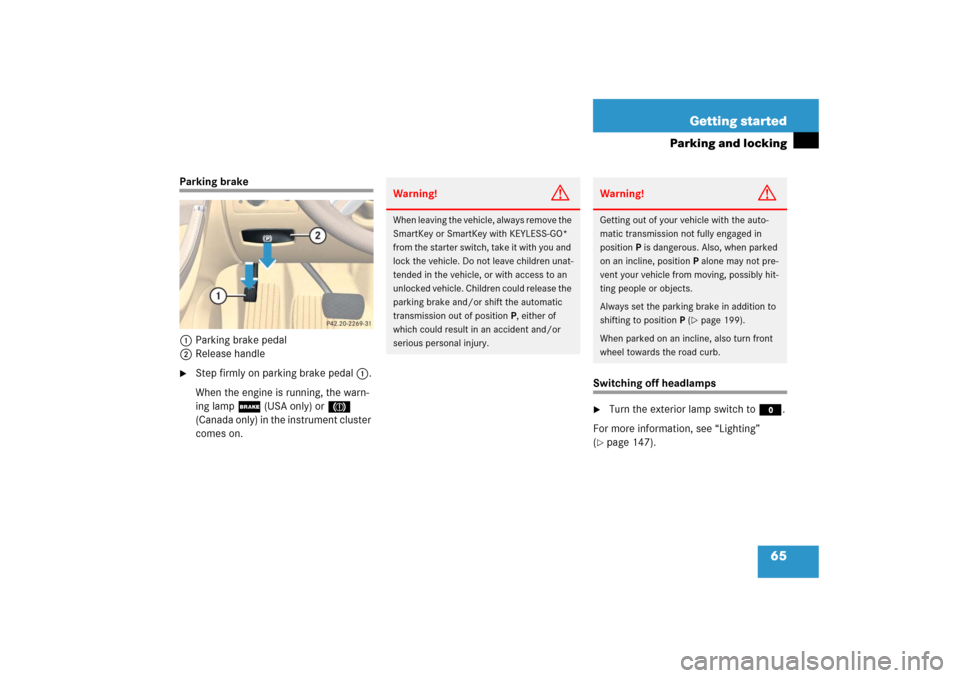
Parking brake
1Parking brake pedal
2Release handle�
Step firmly on parking brake pedal1.
When the engine is running, the warn-
ing lamp; (USA only) or3
(Canada only) in the instrument cluster
comes on.
Switching off headlamps�
Turn the exterior lamp switch toM.
For more information, see “Lighting”
(
�page 147).
Warning!
G
When leaving the vehicle, always remove the
SmartKey or SmartKey with KEYLESS-GO*
from the starter switch, take it with you and
lock the vehicle. Do not leave children unat-
tended in the vehicle, or with access to an
unlocked vehicle. Children could release the
parking brake and/or shift the automatic
transmission out of positionP, either of
which could result in an accident and/or
serious personal injury.
Warning!
G
Getting out of your vehicle with the auto-
matic transmission not fully engaged in
positionP is dangerous. Also, when parked
on an incline, positionP alone may not pre-
vent your vehicle from moving, possibly hit-
ting people or objects.
Always set the parking brake in addition to
shifting to positionP (
�page 199).
When parked on an incline, also turn front
wheel towards the road curb.
Page 67 of 561
66 Getting startedParking and lockingTurning off the engine�
Shift the automatic transmission to
positionP (
�page 199).
�
Apply the parking brake (
�page 65).Turning off with the SmartKey
�
Turn the SmartKey in the starter switch
to position0 (
�page 38).
�
Remove the SmartKey from the starter
switch.
The immobilizer is activated.Turning off with KEYLESS-GO*
�
Press the KEYLESS-GO start / stop
button (
�page 40) to turn off the
engine.
With the driver's door closed, the start-
er switch is now in position1. With the
driver’s door opened, the starter switch
is set to position0, same as SmartKey
removed from starter switch
(
�page 38).
iAlways set the parking brake in addi-
tion to shifting to position
P
(
�page 199).
When parked on an incline, also turn
front wheel towards the road curb.
iIf you turn off the engine using the
SmartKey and remove the SmartKey
from the starter switch with the trans-
mission in a position other than P, the
transmission will automatically shift
toP.
Keep in mind that turning off the engine
with the SmartKey alone will not auto-
matically shift the transmission to P.
Only when the SmartKey is removed
from the starter switch will the trans-
mission automatically shift to P.
iIf you turn off the engine using the
KEYLESS-GO start/stop button and
open the driver’s door with the trans-
mission in a position other than P, the
transmission will automatically shift
toP.
Keep in mind that turning off the engine
with the KEYLESS-GO start/stop
button alone will not automatically shift
the transmission to P. Only when the
driver’s door is opened will the trans-
mission automatically shift to P.