486 Technical dataEngineModel
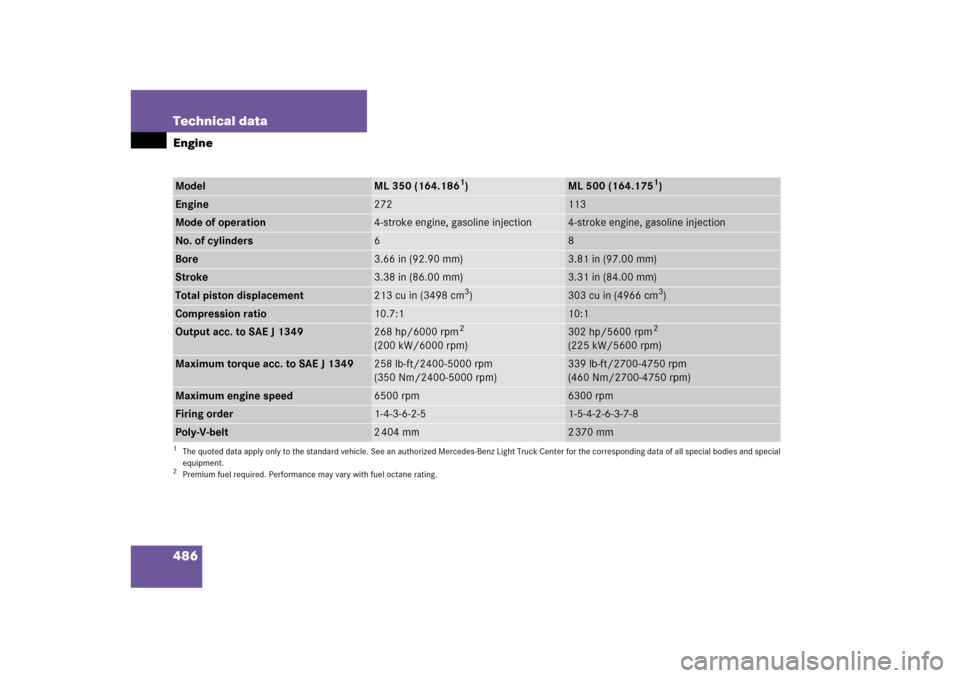
ML 350 (164.186
1)
1The quoted data apply only to the standard vehicle. See an authorized Mercedes-Benz Light Truck Center for the corresponding data of all special bodies and special
equipment.
ML 500 (164.175
1)
Engine
272
113
Mode of operation
4-stroke engine, gasoline injection
4-stroke engine, gasoline injection
No. of cylinders
6
8
Bore
3.66 in (92.90 mm)
3.81 in (97.00 mm)
Stroke
3.38 in (86.00 mm)
3.31 in (84.00 mm)
Total piston displacement
213 cu in (3498 cm
3)
303 cu in (4966 cm
3)
Compression ratio
10.7:1
10:1
Output acc. to SAE J 1349
268 hp/6000 rpm
2
(200 kW/6000 rpm)
2Premium fuel required. Performance may vary with fuel octane rating.
302 hp/5600 rpm
2
(225 kW/5600 rpm)
Maximum torque acc. to SAE J 1349
258 lb-ft/2400-5000 rpm
(350 Nm/2400-5000 rpm)
339 lb-ft/2700-4750 rpm
(460 Nm/2700-4750 rpm)
Maximum engine speed
6500 rpm
6300 rpm
Firing order
1-4-3-6-2-5
1-5-4-2-6-3-7-8
Poly-V-belt
2 404 mm
2370 mm
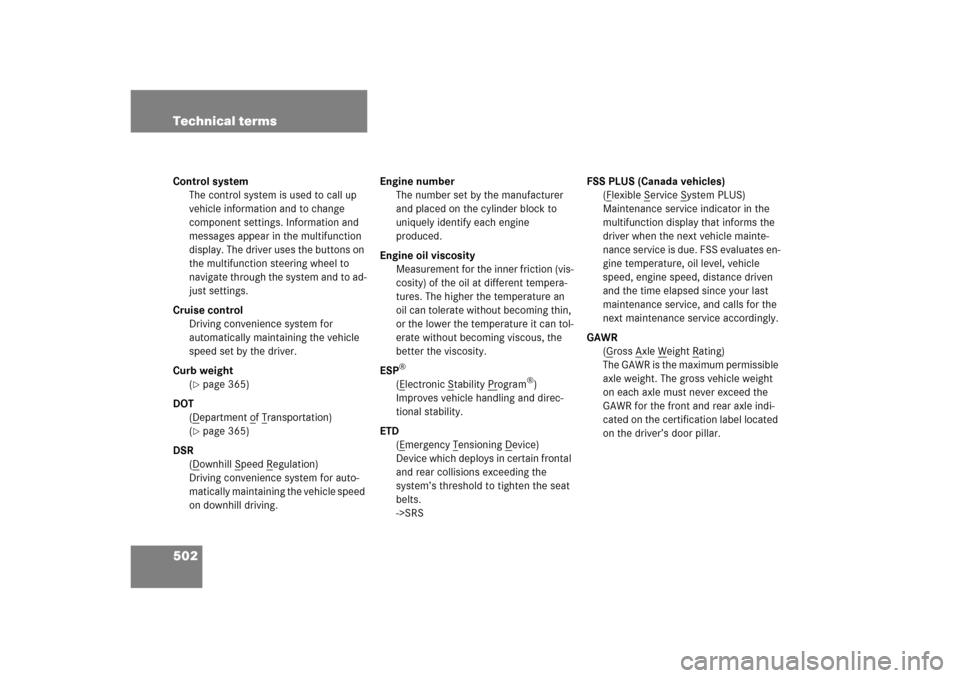
502 Technical termsControl system
The control system is used to call up
vehicle information and to change
component settings. Information and
messages appear in the multifunction
display. The driver uses the buttons on
the multifunction steering wheel to
navigate through the system and to ad-
just settings.
Cruise control
Driving convenience system for
automatically maintaining the vehicle
speed set by the driver.
Curb weight
(
�page 365)
DOT
(Department o
f Transportation)
(
�page 365)
DSR
(Downhill S
peed R
egulation)
Driving convenience system for auto-
matically maintaining the vehicle speed
on downhill driving.Engine number
The number set by the manufacturer
and placed on the cylinder block to
uniquely identify each engine
produced.
Engine oil viscosity
Measurement for the inner friction (vis-
cosity) of the oil at different tempera-
tures. The higher the temperature an
oil can tolerate without becoming thin,
or the lower the temperature it can tol-
erate without becoming viscous, the
better the viscosity.
ESP
®(Electronic S
tability Pr
ogram
®)
Improves vehicle handling and direc-
tional stability.
ETD
(E
mergency T
ensioning D
evice)
Device which deploys in certain frontal
and rear collisions exceeding the
system’s threshold to tighten the seat
belts.
->SRSFSS PLUS (Canada vehicles)
(F
lexible S
ervice S
ystem PLUS)
Maintenance service indicator in the
multifunction display that informs the
driver when the next vehicle mainte-
nance service is due. FSS evaluates en-
gine temperature, oil level, vehicle
speed, engine speed, distance driven
and the time elapsed since your last
maintenance service, and calls for the
next maintenance service accordingly.
GAWR
(G
ross A
xle W
eight R
ating)
The GAWR is the maximum permissible
axle weight. The gross vehicle weight
on each axle must never exceed the
GAWR for the front and rear axle indi-
cated on the certification label located
on the driver’s door pillar.