Page 46 of 521

45 Getting started
Adjusting
Mirrors
Adjust the interior and exterior rear view
mirrors before driving so that you have a
good view of the road and traffic condi-
tions.Interior rear view mirror
�
Manually adjust the interior rear view
mirror.
For more information, see “Rear view mir-
rors” (
�page 197).
Exterior rear view mirrorsThe buttons are located on the driver’s
door.
1Passenger-side exterior rear view mir-
ror button
2Adjustment button
3Driver’s side exterior rear view mirror
button
Warning!
G
In case of an accident, liquid electrolyte may
escape the mirror housing if the mirror glass
breaks.
Electrolyte has an irritating effect. Do not al-
low the liquid to come into contact with
eyes, skin, clothing, or respiratory system.
In case it does, immediately flush affected
area with water, and seek medical help if
necessary.!Electrolyte drops coming into contact
with the vehicle paint finish can only be
completely removed while in their liq-
uid state and by applying plenty of wa-
ter.
Warning!
G
Exercise care when using the
passenger-side exterior rear view mirror.
The mirror surface is convex (outwardly
curved surface for a wider field of view). Ob-
jects in mirror are closer than they appear.
Check your interior rear view mirror or
glance over your shoulder before changing
lanes.
Page 199 of 521

198 Controls in detailGood visibility
Activating exterior rear view mirror
parking position
Follow these steps to activate the mirror
parking position so that the passen-
ger-side exterior rear view mirror will be
turned downward to the stored position.
The buttons are located on the driver’s
door.
1Driver’s side exterior rear view mirror
button
2Passenger-side exterior rear view
mirror button�
Make sure you have stored a parking
position for the passenger-side exterior
rear view mirror (
�page 140).
Warning!
G
The auto-dimming function does not react if
incoming light is not aimed directly at sen-
sors in the interior rear view mirror.
The interior rear view mirror and the exterior
rear view mirror on the driver’s side do not
react, for example, if the rear window sun-
shade* is in raised position.
Glare can endanger you and others.Warning!
G
In case of an accident, liquid electrolyte may
escape from the mirror housing if the mirror
glass breaks.
Electrolyte has an irritating effect. Do not al-
low the liquid to come into contact with
eyes, skin, clothing, or respiratory system.
In case it does, immediately flush affected
area with water, and seek medical help if
necessary.
!Electrolyte drops coming into contact
with the vehicle paint finish can be
completely removed only while in the
liquid state by applying plenty of water.Warning!
G
Exercise care when using the
passenger-side exterior rear view mirror.
The mirror surface is convex (outwardly
curved surface for a wider field of view). Ob-
jects in mirror are closer than they appear.
Check your interior rear view mirror or
glance over your shoulder before changing
lanes.
Page 201 of 521
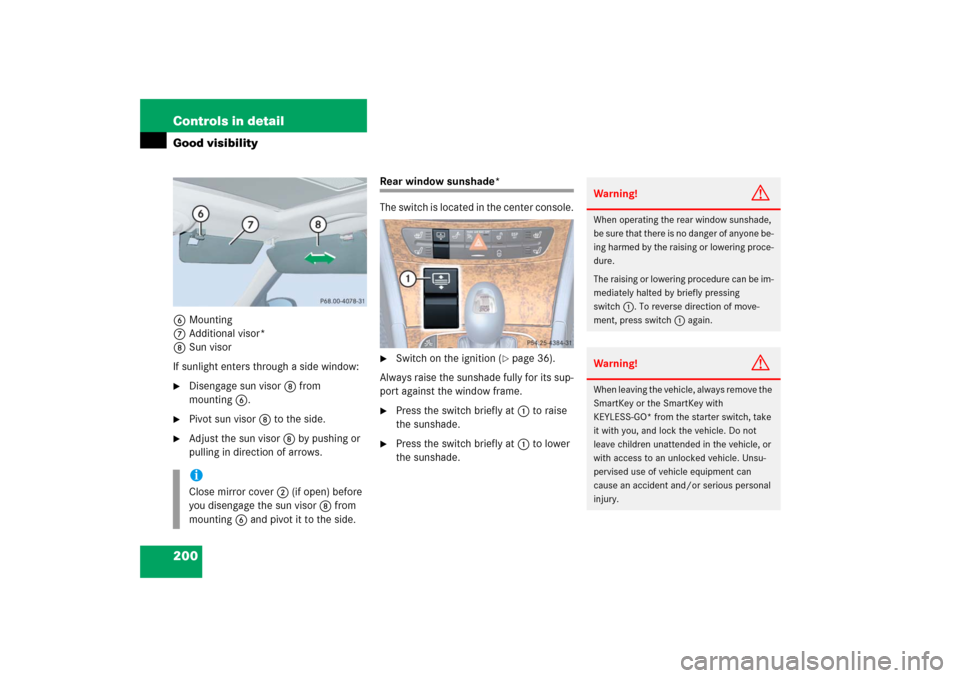
200 Controls in detailGood visibility6Mounting
7Additional visor*
8Sun visor
If sunlight enters through a side window:�
Disengage sun visor 8 from
mounting6.
�
Pivot sun visor 8 to the side.
�
Adjust the sun visor 8 by pushing or
pulling in direction of arrows.
Rear window sunshade*
The switch is located in the center console.�
Switch on the ignition (
�page 36).
Always raise the sunshade fully for its sup-
port against the window frame.
�
Press the switch briefly at 1 to raise
the sunshade.
�
Press the switch briefly at 1 to lower
the sunshade.
iClose mirror cover2 (if open) before
you disengage the sun visor 8 from
mounting 6 and pivot it to the side.
Warning!
G
When operating the rear window sunshade,
be sure that there is no danger of anyone be-
ing harmed by the raising or lowering proce-
dure.
The raising or lowering procedure can be im-
mediately halted by briefly pressing
switch1. To reverse direction of move-
ment, press switch1 again.Warning!
G
When leaving the vehicle, always remove the
SmartKey or the SmartKey with
KEYLESS-GO* from the starter switch, take
it with you, and lock the vehicle. Do not
leave children unattended in the vehicle, or
with access to an unlocked vehicle. Unsu-
pervised use of vehicle equipment can
cause an accident and/or serious personal
injury.
Page 438 of 521

437 Practical hints
Replacing bulbs
High beam bulb/high beam flasher
bulb (halogen headlamps)/high beam
flasher bulb (Bi-Xenon* headlamps)�
Turn bulb socket2 with the bulb
counterclockwise and remove it.
�
Pull the bulb out of bulb socket2.
�
Press the new bulb gently into bulb
socket2.
�
Place bulb socket2 back into the
lamp and turn it clockwise until it en-
gages.Front turn signal lamp bulb
�
Turn bulb socket5 with the bulb
counterclockwise and remove it.
�
Press gently onto the bulb and turn
counterclockwise out of bulb
socket5.
�
Press the new bulb gently into bulb
socket5 and turn clockwise until it
engages.
�
Place bulb socket5 back into the
lamp and turn it clockwise until it en-
gages.
Parking and standing lamp bulb
�
Turn bulb socket3 with the bulb
counterclockwise and remove it.
�
Pull the bulb out of bulb socket3.
�
Press the new bulb gently into bulb
socket3.
�
Place bulb socket3 back into the
lamp and turn clockwise until it engag-
es.Additional turn signal lamp bulbs
The additional turn signal lamps in the
exterior rear view mirrors have LEDs.
If a malfunction occurs or LEDs fail to func-
tion, the entire turn signal unit must be re-
placed. Have the turn signal unit replaced
by an authorized Mercedes-Benz Center.
Front side marker lamp bulbs
Since replacing the side marker lamp bulbs
is a technically highly demanding process,
we recommend you have the side marker
lamp bulbs replaced by an authorized
Mercedes-Benz Center.