Page 377 of 521
376 Practical hintsWhat to do if …Problem
Possible cause/conse-
quence
Suggested solution
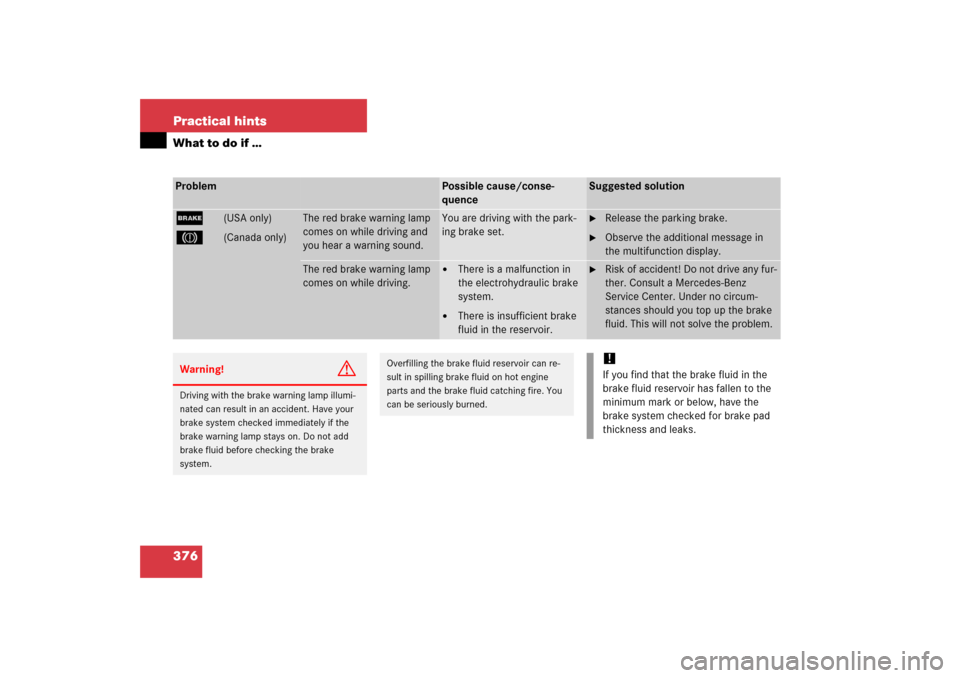
;
(USA only)
3
(Canada only)
The red brake warning lamp
comes on while driving and
you hear a warning sound.
You are driving with the park-
ing brake set.
�
Release the parking brake.
�
Observe the additional message in
the multifunction display.
The red brake warning lamp
comes on while driving.
�
There is a malfunction in
the electrohydraulic brake
system.
�
There is insufficient brake
fluid in the reservoir.
�
Risk of accident! Do not drive any fur-
ther. Consult a Mercedes-Benz
Service Center. Under no circum-
stances should you top up the brake
fluid. This will not solve the problem.
Warning!
G
Driving with the brake warning lamp illumi-
nated can result in an accident. Have your
brake system checked immediately if the
brake warning lamp stays on. Do not add
brake fluid before checking the brake
system.
Overfilling the brake fluid reservoir can re-
sult in spilling brake fluid on hot engine
parts and the brake fluid catching fire. You
can be seriously burned.
!If you find that the brake fluid in the
brake fluid reservoir has fallen to the
minimum mark or below, have the
brake system checked for brake pad
thickness and leaks.
Page 380 of 521

379 Practical hints
What to do if …
Problem
Possible cause/consequence
Suggested solution
D
The red coolant warning lamp
comes on when the engine is
running.
There is insufficient coolant in the reservoir.
If this warning lamp comes on frequently,
there is a leak in the cooling system.
If the coolant level is correct, the electric ra-
diator fan may be broken.
�
Immediately add coolant to prevent
engine from overheating
(�page 325).
�
Have the cooling system checked.
�
If the coolant temperature is below
257°F (125°C), you can continue
driving to the nearest authorized
Mercedes-Benz Center.
�
Avoid high engine loads (e.g. driving
uphill) and stop-and-go driving.
The red coolant warning lamp
comes on while driving and you
hear a warning sound.
The coolant temperature has exceeded
257°F (125°C).
�
Stop as soon as possible in a safe lo-
cation and allow the engine and cool-
ant to cool down.
Warning!
G
Driving when your engine is badly overheat-
ed can cause some fluids which may have
leaked into the engine compartment to
catch fire. You could be seriously burned.
Steam from an overheated engine can cause
serious burns and can occur just by opening
the engine hood. Stay away from the engine
if you see or hear steam coming from it.
Turn off the engine, get out of the vehicle
and do not stand near the vehicle until the
engine has cooled down.
Page 403 of 521

402 Practical hintsWhat to do if …Display symbol
Display messages
Possible cause/consequence
Possible solution
(USA only);(Canada only)3
Brake fluid
Visit workshop
There is insufficient brake fluid in the
reservoir.
�
Risk of accident! Stop the vehicle in a
safe location as soon as it is safe to do
so and notify an authorized
Mercedes-Benz Center. Do not add
brake fluid! This will not solve the
problem.
Warning!
G
Driving with the message
Brake fluid
Visit workshop
displayed can result in an
accident. Have your brake system checked
immediately.
If there is a malfunction in the electrohy-
draulic brake system, we recommend that
the vehicle be transported with all wheels
off the ground using flatbed or appropriate
wheel lift/dolly equipment.
A tow bar must be used if circumstances do
not permit the use of the recommended
towing methods and the vehicle requires
towing with all four wheels on the ground.
Towing the vehicle with all four wheels on
the ground is only permissible for distances
u p t o 3 0 m i l e s ( 5 0 k m ) a n d a t a s p e e d n o t t o
exceed 30 mph (50 km / h). For more infor-
mation, refer to “Towing the vehicle”
(�page 457).
If the electrohydraulic brake system enters
its emergency operation mode, the driver
must apply significantly greater brake pedal
pressure and depress the pedal much fur-
ther than normal to obtain braking effect. If
necessary, apply full pressure to the brake
pedal. Brakes may only be applied to the
front wheels. Stopping distance is in-
creased!
Do not add brake fluid before checking the
brake system. Overfilling the brake fluid res-
ervoir can result in spilling brake fluid on hot
engine parts and the brake fluid catching
fire. You can be seriously burned.!If you find that the brake fluid in the
brake fluid reservoir has fallen to the
minimum mark or below, have the
brake system checked for brake pad
thickness and leaks.
Page 420 of 521
419 Practical hints
What to do if …
Display symbol
Display messages
Possible cause/consequence
Possible solution
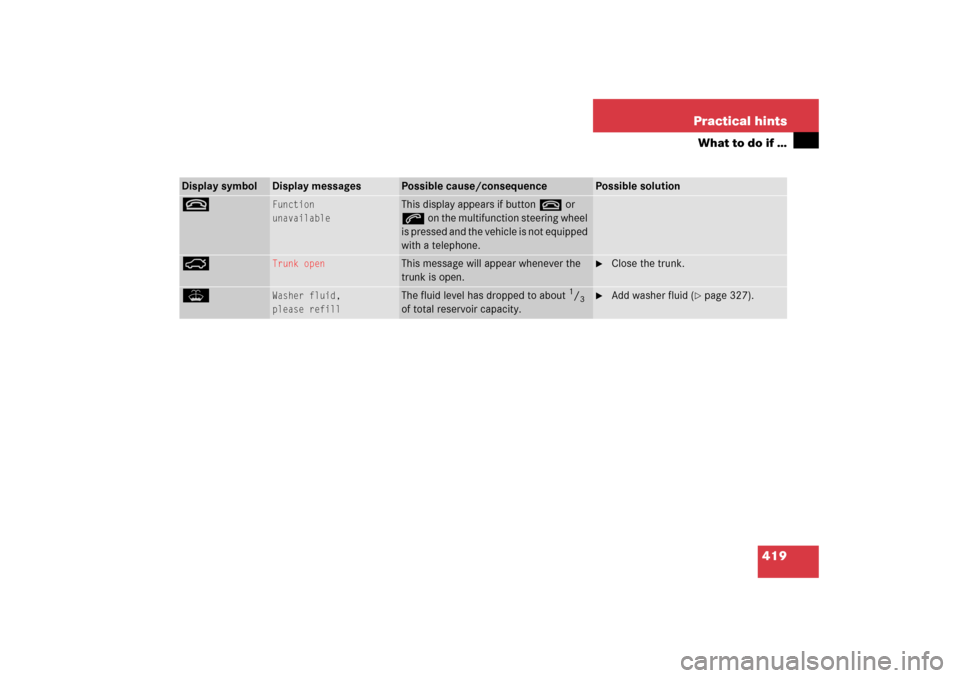
t
Function
unavailable
This display appears if button t or
s on the multifunction steering wheel
is pressed and the vehicle is not equipped
with a telephone.
Ê
Trunk open
This message will appear whenever the
trunk is open.
�
Close the trunk.
W
Washer fluid,
please refill
The fluid level has dropped to about
1/3
of total reservoir capacity.�
Add washer fluid (
�page 327).
Page 493 of 521
492 Technical dataFuels, coolants, lubricants etc.Windshield and headlamp washer system
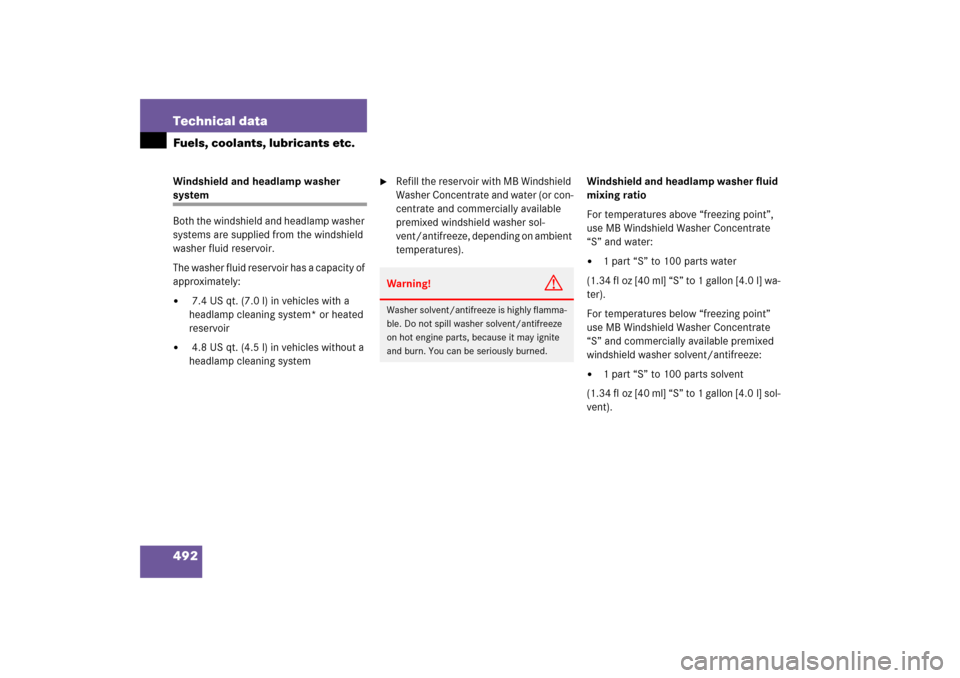
Both the windshield and headlamp washer
systems are supplied from the windshield
washer fluid reservoir.
The washer fluid reservoir has a capacity of
approximately:�
7.4 US qt. (7.0 l) in vehicles with a
headlamp cleaning system* or heated
reservoir
�
4.8 US qt. (4.5 l) in vehicles without a
headlamp cleaning system
�
Refill the reservoir with MB Windshield
Washer Concentrate and water (or con-
centrate and commercially available
premixed windshield washer sol-
vent/antifreeze, depending on ambient
temperatures).Windshield and headlamp washer fluid
mixing ratio
For temperatures above “freezing point”,
use MB Windshield Washer Concentrate
“S” and water:
�
1 part “S” to 100 parts water
(1.34 fl oz [40 ml] “S” to 1 gallon [4.0 l] wa-
ter).
For temperatures below “freezing point”
use MB Windshield Washer Concentrate
“S” and commercially available premixed
windshield washer solvent/antifreeze:
�
1 part “S” to 100 parts solvent
(1.34 fl oz [40 ml] “S” to 1 gallon [4.0 l] sol-
vent).
Warning!
G
Washer solvent/antifreeze is highly flamma-
ble. Do not spill washer solvent/antifreeze
on hot engine parts, because it may ignite
and burn. You can be seriously burned.
Page 519 of 521
518 IndexVoice control system* 499
W
Warning lamps see Lamps, Indicator and
warning
Warning sounds
Distance warning function* 256
Distronic* 250
Parking brake 54
Parktronic system* 267
Seat belt telltale 73
Warranty coverage 467
Washer fluid see Windshield washer fluid
Washer reservoir level 492
Washing the vehicle 364
Wear pattern, Tires 357
Weights, Vehicle 483
Wheel
Change 441
Removing 444
Spare 444
Tightening torque 447
Wheels, Sizes 475
Wheels, Tires and 328
Window curtain air bags 72
Windows see Power windows 231
Windows, cleaning 369Windshield
Cleaning 57
Cleaning wiper blades 369
Defogging 209, 224
Windshield washer fluid 492
Message in display 419
Mixing ratio
Refilling 327
Wiping 57
Windshield washer system 492
Windshield wipers 56
Replacing wiper blade 440
Winter driving
Block heater* (Canada only) 359
Snow chains 359
Tires 358
Winter driving instructions 309
Winter tires 358
Wood trims, cleaning 372
X
Xenon headlamps* see Headlamps