Page 405 of 521
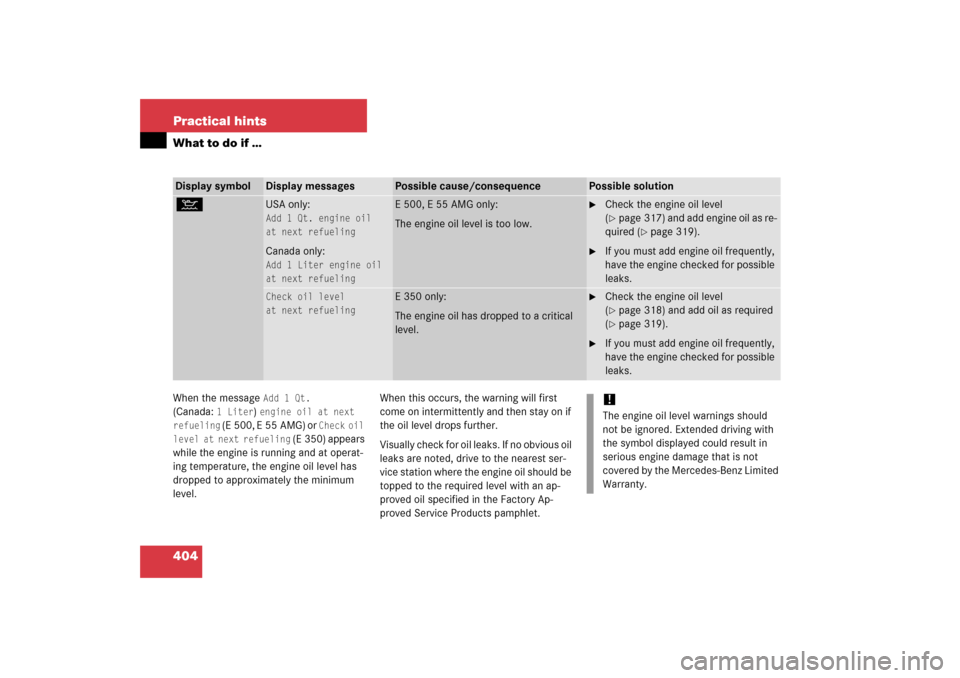
404 Practical hintsWhat to do if …When the message
Add 1 Qt.
(Canada:
1 Liter
) engine oil at next
refueling
(E 500, E 55 AMG) or
Check oil
level at next refueling
(E 350) appears
while the engine is running and at operat-
ing temperature, the engine oil level has
dropped to approximately the minimum
level.When this occurs, the warning will first
come on intermittently and then stay on if
the oil level drops further.
Visually check for oil leaks. If no obvious oil
leaks are noted, drive to the nearest ser-
vice station where the engine oil should be
topped to the required level with an ap-
proved oil specified in the Factory Ap-
proved Service Products pamphlet.
Display symbol
Display messages
Possible cause/consequence
Possible solution
:
USA only:Add 1 Qt. engine oil
at next refuelingCanada only:Add 1 Liter engine oil
at next refueling
E 500, E 55 AMG only:
The engine oil level is too low.
�
Check the engine oil level
(�page 317) and add engine oil as re-
quired (
�page 319).
�
If you must add engine oil frequently,
have the engine checked for possible
leaks.
Check oil level
at next refueling
E 350 only:
The engine oil has dropped to a critical
level.
�
Check the engine oil level
(�page 318) and add oil as required
(�page 319).
�
If you must add engine oil frequently,
have the engine checked for possible
leaks.!The engine oil level warnings should
not be ignored. Extended driving with
the symbol displayed could result in
serious engine damage that is not
covered by the Mercedes-Benz Limited
Warranty.
Page 414 of 521
413 Practical hints
What to do if …
Display symbol
Display messages
Possible cause/consequence
Possible solution
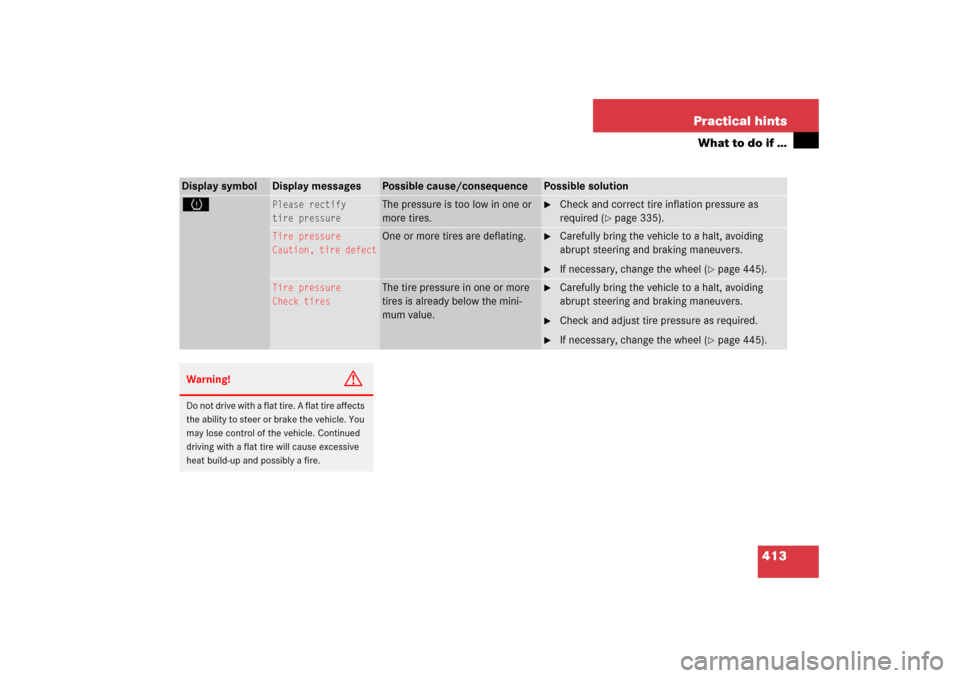
H
Please rectify
tire pressure
The pressure is too low in one or
more tires.
�
Check and correct tire inflation pressure as
required (
�page 335).
Tire pressure
Caution, tire defect
One or more tires are deflating.
�
Carefully bring the vehicle to a halt, avoiding
abrupt steering and braking maneuvers.
�
If necessary, change the wheel (
�page 445).
Tire pressure
Check tires
The tire pressure in one or more
tires is already below the mini-
mum value.
�
Carefully bring the vehicle to a halt, avoiding
abrupt steering and braking maneuvers.
�
Check and adjust tire pressure as required.
�
If necessary, change the wheel (
�page 445).
Warning!
G
Do not drive with a flat tire. A flat tire affects
the ability to steer or brake the vehicle. You
may lose control of the vehicle. Continued
driving with a flat tire will cause excessive
heat build-up and possibly a fire.
Page 416 of 521
415 Practical hints
What to do if …
Display symbol
Display messages
Possible cause/consequence
Possible solution
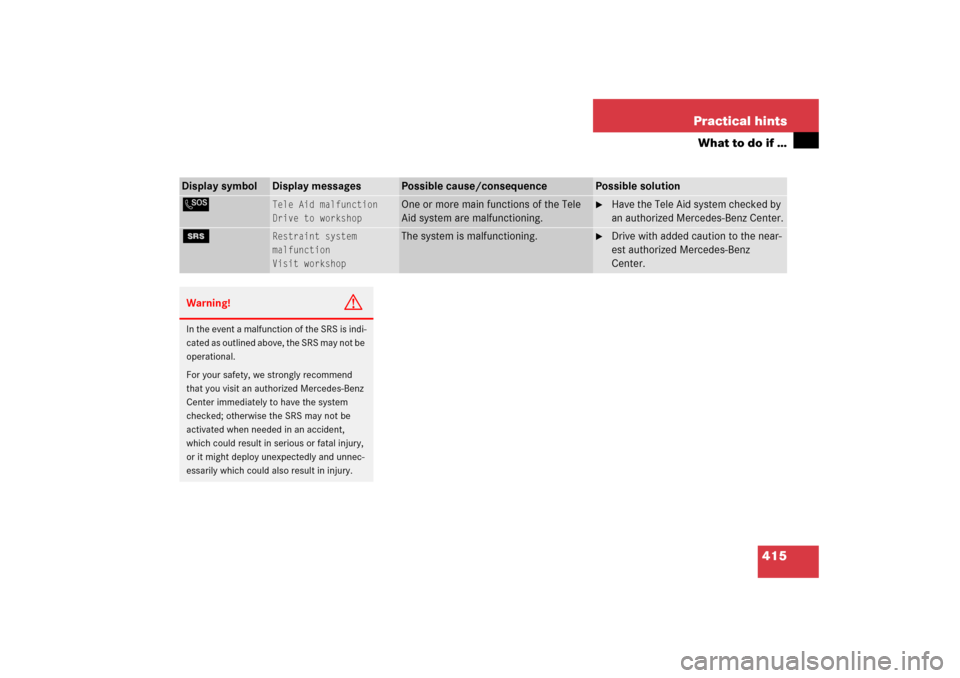
L
Tele Aid malfunction
Drive to workshop
One or more main functions of the Tele
Aid system are malfunctioning.
�
Have the Tele Aid system checked by
an authorized Mercedes-Benz Center.
1
Restraint system
malfunction
Visit workshop
The system is malfunctioning.
�
Drive with added caution to the near-
est authorized Mercedes-Benz
Center.
Warning!
G
In the event a malfunction of the SRS is indi-
cated as outlined above, the SRS may not be
operational.
For your safety, we strongly recommend
that you visit an authorized Mercedes-Benz
Center immediately to have the system
checked; otherwise the SRS may not be
activated when needed in an accident,
which could result in serious or fatal injury,
or it might deploy unexpectedly and unnec-
essarily which could also result in injury.
Page 422 of 521

421 Practical hints
Where will I find ...?
Vehicle tool kit (vehicles with TIREFIT)
1Vehicle tool kit and jack
2Electric air pump
3TIREFIT kitVehicle jackThe vehicle jack is located in the cargo
compartment underneath the third row
seat cushions and footwell (
�page 420) or
underneath the cargo compartment floor
(
�page 419).
Storage position�
Remove vehicle jack from its
compartment.
�
Turn crank handle in direction of arrow
as far as it will go.
Warning!
G
The jack is designed exclusively for jacking
up the vehicle at the jack take-up brackets
built into both sides of the vehicle. To help
avoid personal injury, use the jack only to lift
the vehicle during a wheel change. Never
get beneath the vehicle while it is supported
by the jack. Keep hands and feet away from
the area under the lifted vehicle. Always
firmly set parking brake and block wheels
before raising vehicle with jack.
Do not disengage parking brake while the
vehicle is raised. Be certain that the jack is
always vertical (plumb line) when in use,
especially on hills. Always try to use the jack
on level surface. Make sure the jack arm is
fully seated in the jack take-up bracket.
Always lower the vehicle onto sufficient
capacity jackstands before working under
the vehicle.
Page 423 of 521

422 Practical hintsWhere will I find ...?Operational position�
Turn crank handle clockwise.
Before storing the vehicle jack in its
compartment:
�
It should be fully collapsed.
�
The handle must be folded in (storage
position).Spare wheel
If your vehicle is equipped with a spare
wheel (Minispare or collapsible tire), it is
located in the cargo compartment under-
neath the third row seat cushions and foot-
well (
�page 420) or underneath the cargo
compartment floor (
�page 419). To ac-
cess the spare wheel, fold seat cushions
and footwell up (
�page 420).
1Vehicle tool kit
Wheel bolt wrench and Jack
2Spare wheel
3Luggage bowlRemoving the spare wheel
�
Turn luggage bowl3 counterclock-
wise.
�
Remove spare wheel2.
Storing the spare wheel
�
Place spare wheel2 in wheel well.
�
Turn luggage bowl3 clockwise to its
stop to secure the spare wheel.Warning!
G
The dimensions of the spare wheel
(Minispare or collapsible tire) are different
from those of the road wheels. As a result,
the vehicle handling characteristics change
when driving with a spare wheel mounted.
The Minispare wheel and collapsible tire
should only be used temporarily, and re-
placed with a regular road wheel as quickly
as possible.
Page 429 of 521
428 Practical hintsResetting activated head restraintsIf the active head restraints have been trig-
gered in an accident, the active head re-
straints must be reset. Otherwise, the
active head restraints cannot offer any ad-
ditional protection in the event of another
rear-end collision.
�
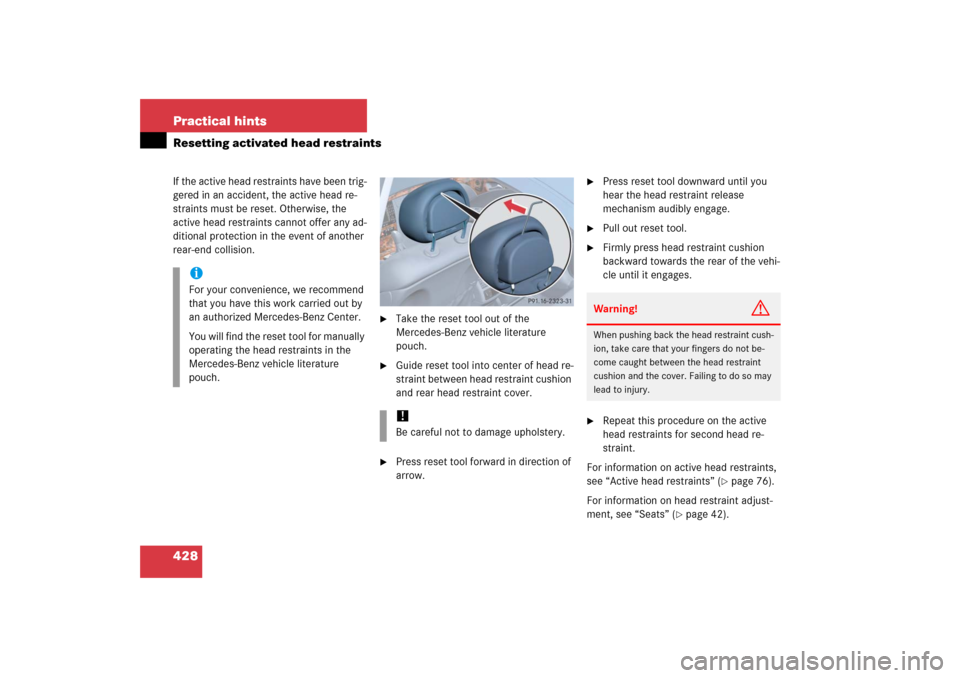
Take the reset tool out of the
Mercedes-Benz vehicle literature
pouch.
�
Guide reset tool into center of head re-
straint between head restraint cushion
and rear head restraint cover.
�
Press reset tool forward in direction of
arrow.
�
Press reset tool downward until you
hear the head restraint release
mechanism audibly engage.
�
Pull out reset tool.
�
Firmly press head restraint cushion
backward towards the rear of the vehi-
cle until it engages.
�
Repeat this procedure on the active
head restraints for second head re-
straint.
For information on active head restraints,
see “Active head restraints” (
�page 76).
For information on head restraint adjust-
ment, see “Seats” (
�page 42).
iFor your convenience, we recommend
that you have this work carried out by
an authorized Mercedes-Benz Center.
You will find the reset tool for manually
operating the head restraints in the
Mercedes-Benz vehicle literature
pouch.
!Be careful not to damage upholstery.
Warning!
G
When pushing back the head restraint cush-
ion, take care that your fingers do not be-
come caught between the head restraint
cushion and the cover. Failing to do so may
lead to injury.
Page 430 of 521

429 Practical hints
Replacing SmartKey batteries
�Replacing SmartKey batteries
If the batteries in the SmartKey are dis-
charged, the vehicle can no longer be
locked or unlocked. It is recommended to
have the batteries replaced at an
authorized Mercedes-Benz Center.
Batteries contain materials that can harm
the environment if disposed of improperly.
Recycling of batteries is the preferred
method of disposal. Many states require
sellers of batteries to accept old batteries
for recycling.
SmartKey
Replacement batteries: Lithium, type
CR 2025 or equivalent.�
Remove the mechanical key1
(�page 424).
1Mechanical key
2Slide
3Battery compartment
�
Insert the mechanical key1 in direc-
tion of arrow in side opening.
�
Using mechanical key1, push gray
slide 2 to unlatch battery compart-
ment 3.
Warning!
G
Keep the batteries out of reach of children.
If a battery is swallowed, seek medical help
immediately.
iWhen inserting the batteries, make
sure they are clean and free of lint.iWhen replacing batteries, always re-
place both batteries.
The required replacement batteries are
available at any Mercedes-Benz Cen-
ter.
��
Page 434 of 521
433 Practical hints
Replacing bulbs
Notes on bulb replacement�
Only use 12-volt bulbs of the same type
and with the specified watt rating.
�
Switch lights off before changing a bulb
to prevent short circuits.
�
Always use a clean lint-free cloth when
handling bulbs.
�
Your hands should be dry and free of oil
and grease.
�
If the newly installed bulb does not light
up, visit an authorized Mercedes-Benz
Center.
�
Have the LEDs and bulbs for the follow-
ing lamps replaced by an authorized
Mercedes-Benz Center:�
Additional turn signals in the exteri-
or rear view mirrors
�
High mounted brake lamp
�
Bi-Xenon* lamps
�
Front fog lamps
�
Rear lamps (except license plate
lamps)
�
Front side marker lamps
Warning!
G
Bulbs and bulb sockets can be very hot. Al-
low the lamp to cool down before changing
a bulb.
Keep bulbs out of reach of children.
Halogen lamps contain pressurized gas. A
bulb can explode if you:�
touch or move it when hot
�
drop the bulb
�
scratch the bulb
Wear eye and hand protection.
Because of high voltage in Bi-Xenon* lamps,
it is dangerous to replace the bulb or repair
the lamp and its components. We recom-
mend that you have such work done by a
qualified technician.
iHave the headlamp adjustment
checked regularly.