2006 MAZDA MODEL MPV seating
[x] Cancel search: seatingPage 55 of 364

Black plate (55,1)
WARNING
Seating Children in a Child-Restraint System on the Front Passenger Seat:
If your vehicle is equipped with front passenger seat weight sensors, the vehicle is also
equipped with an air bag deactivation indicator light (page 2-51). Even with the front
passenger seat weight sensors, if you must use the front passenger seat for children,
seating a child in a child-restraint system on the front passenger seat under the
following conditions increases the danger of the front passenger air bag deploying
and could result in serious injury or death to the child.
lThe total seated weight of the child with the child-restraint system on the front
passenger seat is approximately 30 kg (66 lb) or more with a child in the child-
restraint system.
lLuggage or other items are placed on the seat with the child in the child-restraint
system.
lA rear passenger or luggage push or pull down on the front passenger seatback.lA rear passenger puts their feet on the front seat rails.lLuggage or other items are placed on the seatback or hung on the assist grip, head
restraint or armrest.
lThe seat is washed.lLiquids are spilled on the seat.lThe front passenger seat is moved backward, pushing into luggage or other items
placed behind it.
lThe front passenger seatback contacts the second-row seat.lLuggage or other items are placed between the front passenger seat and driver seat.lAny accessories which might increase the total seated weight on the front passenger
seat are attached to the front passenger seat.
The designated positions with seat belts on the rear seats are the safest places for
children. Always use seat belts and child restraints.
Children and Seating Position with Side Air Bag:
Allowing anyone to lean over or against the front door is dangerous. If the vehicle is
equipped with side air bags, the impact of an inflating side air bag could cause serious
injury or death to the person. Children are more likely to sleep in the vehicle; when
they do, they are more at risk in the front passenger's seat that has a side air bag
because they may slump over into the path of the seatback-mounted air bag.
Furthermore, leaning over or against the doors could block the side air bag and
eliminate the advantages of supplemental protection. With the front air bag and the
additional side air bag that deploys from outboard shoulder of the front passenger
seat, the rear seat is always a better location for children who are prone to sleeping. If
a child can't be seated in the rear, do not allow the child to lean over or against the
side window, even if the child is seated in a child-restraint system.
Essential Safety Equipment
Child Restraint
2-43
Mazda MPV_8U61-EA-05G_Edition1 Page55
Tuesday, June 21 2005 9:32 AM
Form No.8U61-EA-05G
Page 57 of 364

Black plate (57,1)
Installing Child-Restraint
Systems
Accident statistics reveal that a child is
safer in the rear seats (both second-row
seats and third-row center seat). The front
passenger's seat is clearly the worst choice
for any child under 12, and with rear-
facing child-restraint systems it is clearly
unsafe due to air bags.
Some child-restraint systems now come
with tethers and therefore must be
installed on the seats that take tethers to
be effective. In your Mazda, tethered
child-restraint systems can only be
accommodated in the three specific
seating positions on the rear seats (both
second-row seats and third-row center
seat).
Some child-restraint systems also employ
specially designed LATCH attachments;
refer to“LATCH Child-Restraint
Systems”(page 2-53).
WARNING
Tethered Child-Restraint Systems
Work Only on Tether-Equipped Rear
Seats:
Installation of a tether equipped child-
restraint system in the front
passenger's seat or the third-row
outboard seats defeats the safety
design of the system and will result in
an increased chance of serious injury
if the child-restraint system goes
forward without benefit of being
tethered.
Place tether equipped child-restraint
systems where there are tether
anchors.
qSecond-Row Seats Child-
Restraint System Installationí
Follow these instructions when using a
child-restraint system, unless you are
attaching a LATCH-equipped child-
restraint system to the rear LATCH lower
anchors. Refer to“LATCH Child-
Restraint Systems”(page 2-53).
NOTE
Follow the child-restraint system
manufacturer's instructions carefully. If
you are not sure whether you have a
LATCH system or tether, check in the
child-restraint system manufacturer's
instructions and follow them
accordingly. Depending on the type of
child-restraint system, it may not
employ seat belts which are in
automatic locking mode.
Essential Safety Equipment
Child Restraint
2-45íSome models. Mazda MPV_8U61-EA-05G_Edition1 Page57
Tuesday, June 21 2005 9:32 AM
Form No.8U61-EA-05G
Page 62 of 364

Black plate (62,1)
NOTE
To check if your front seats have side
air bags:
Every Mazda side air bag will have a
“SRS AIRBAG”tag on the outboard
shoulder of the front seats.
WARNING
Front Passenger's Seat Position:
As your vehicle has front air bags and
doubly so if your vehicle has side air
bags, a front-facing child-restraint
system should be put on the front seat
only when it is unavoidable.
Even if the front passenger air bag
deactivation indicator light
illuminates, always move the seat as
far back as possible, because the force
of a deploying air bag could cause
serious injury or death to the child.
Rear-Facing Child-Restraint System:
Rear-facing child-restraint systems on
the front seat are particularly
dangerous.
The child-restraint system can be hit
by a deploying air bag and moved
violently backward resulting in serious
injury or death to the child. Even
though you may feel assured that the
front passenger air bag will not deploy
based on the fact that the front
passenger air bag deactivation
indicator light illuminates, NEVER
use a rear-facing child-restraint
system in the front seat with an air bag
that could deploy even in a moderate
collision.
WARNING
Children and Seating Position with
Side Air Bag:
Allowing anyone to lean over or
against the front door is dangerous. If
the vehicle is equipped with side air
bags, the impact of an inflating side
air bag could cause serious injury or
death to the person. Children are more
likely to sleep in the vehicle; when they
do, they are more at risk in the front
passenger's seat that has a side air bag
because they may slump over into the
path of the seatback-mounted air bag.
Furthermore, leaning over or against
the doors could block the side air bag
and eliminate the advantages of
supplemental protection. With the
front air bag and the additional side
air bag that deploys from outboard
shoulder of the front passenger seat,
the rear seat is always a better location
for children who are prone to
sleeping. If a child can't be seated in
the rear, do not allow the child to lean
over or against the side window, even
if the child is seated in a child-
restraint system.
2-50
Essential Safety Equipment
Child Restraint
Mazda MPV_8U61-EA-05G_Edition1 Page62
Tuesday, June 21 2005 9:32 AM
Form No.8U61-EA-05G
Page 64 of 364

Black plate (64,1)
WARNING
Seating a Child in a Child-Restraint
System on the Front Passenger Seat
With the Front Passenger Air Bag
Deactivation Indicator Light Not
Illuminated:
Seating a child in a child-restraint
system installed on the front passenger
seat with the front passenger air bag
deactivation indicator light not
illuminated is dangerous. If this
indicator light does not illuminate
even when the total seated weight is
less than approximately 30 kg (66 lb),
this means that the front passenger
front and side air bags, and seat belt
pretensioner are ready for deployment.
If an accident were to deploy an air
bag, a child sitting in the front
passenger seat could be seriously
injured or killed. If the indicator light
does not illuminate after installing a
child-restraint system on the front
passenger seat, install the child-
restraint system on the rear seat and
consult an Authorized Mazda Dealer
as soon as possible. While it is always
better to install any child-restraint
system on the rear seat, it is essential
to do so if the front passenger air bag
deactivation indicator light does not
illuminate (page 2-63).
2-52
Essential Safety Equipment
Child Restraint
Mazda MPV_8U61-EA-05G_Edition1 Page64
Tuesday, June 21 2005 9:32 AM
Form No.8U61-EA-05G
Page 69 of 364
Black plate (69,1)
WARNING
Air Bags without Seat Belts:
Depending only on the air bags for protection during an accident is dangerous. Alone,
air bags may not prevent serious injuries. The appropriate air bags can be expected to
inflate only in the first collision with frontal, near frontal or side forces that are at
least moderate. Vehicle occupants should always wear seat belts.
Child in the Front Seat:
Placing a child, 12 years or under, in the front seat is dangerous. The child could be
hit by a deploying air bag and be seriously injured or even killed. Even if the front
passenger air bag deactivation indicator light illuminates, always move the front
passenger seat as far back as possible. A sleeping child is more likely to lean against
the door and be hit by the side air bag in a moderate, right-side collision. Whenever
possible, always secure a child 12 years and under on the rear seats with an
appropriate child-restraint system for the child's age and size.
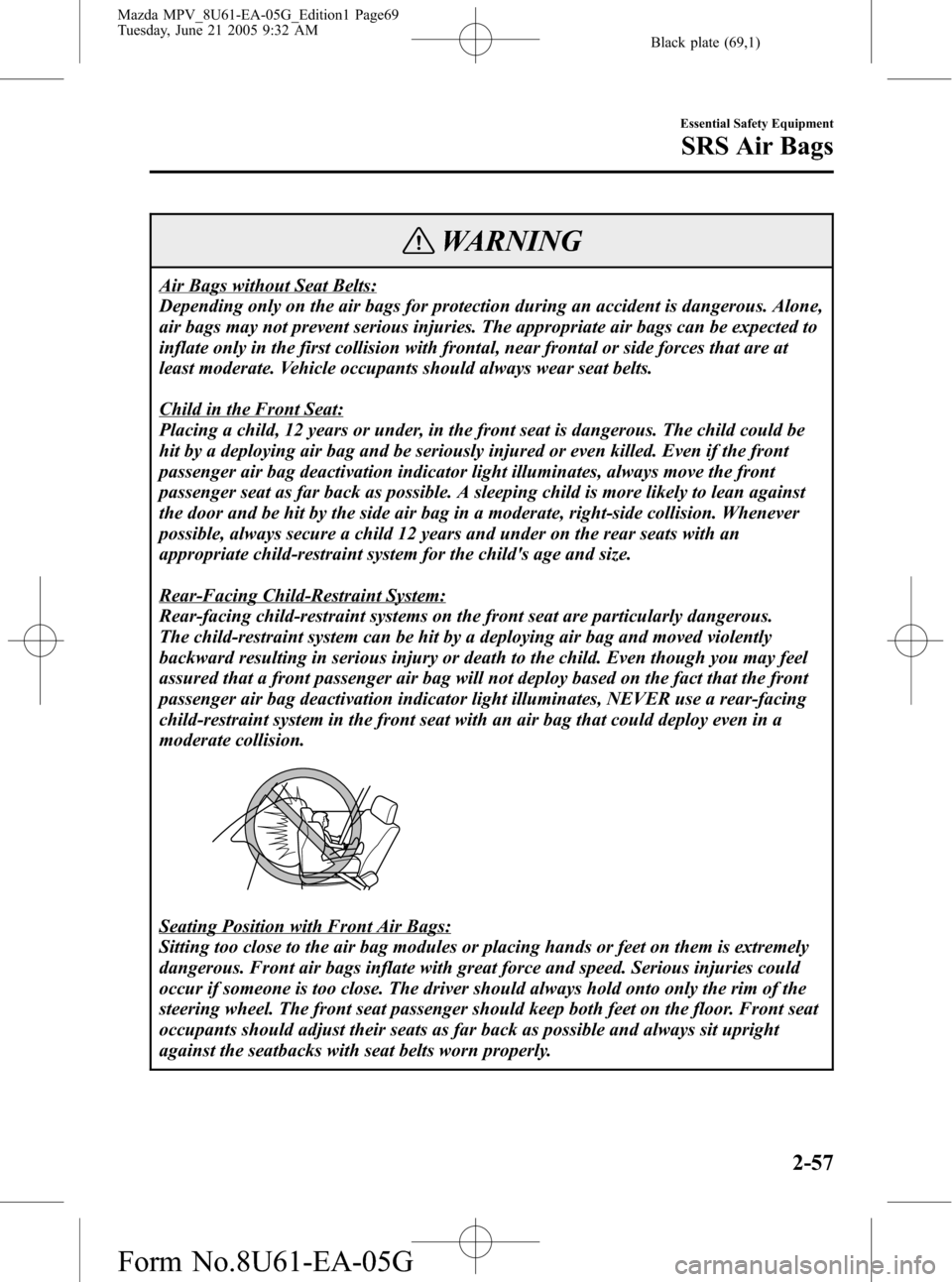
Rear-Facing Child-Restraint System:
Rear-facing child-restraint systems on the front seat are particularly dangerous.
The child-restraint system can be hit by a deploying air bag and moved violently
backward resulting in serious injury or death to the child. Even though you may feel
assured that a front passenger air bag will not deploy based on the fact that the front
passenger air bag deactivation indicator light illuminates, NEVER use a rear-facing
child-restraint system in the front seat with an air bag that could deploy even in a
moderate collision.
Seating Position with Front Air Bags:
Sitting too close to the air bag modules or placing hands or feet on them is extremely
dangerous. Front air bags inflate with great force and speed. Serious injuries could
occur if someone is too close. The driver should always hold onto only the rim of the
steering wheel. The front seat passenger should keep both feet on the floor. Front seat
occupants should adjust their seats as far back as possible and always sit upright
against the seatbacks with seat belts worn properly.
Essential Safety Equipment
SRS Air Bags
2-57
Mazda MPV_8U61-EA-05G_Edition1 Page69
Tuesday, June 21 2005 9:32 AM
Form No.8U61-EA-05G
Page 70 of 364

Black plate (70,1)
WARNING
Seating Position with Side Air Bags:
Sitting too close to the side air bag modules or placing hands on them is extremely
dangerous. A side air bag inflates with great force and speed directly out of the
outboard shoulder of the front seat and expands along the front door on the side the
car is hit.
Serious injury could occur if someone is sitting too close to the door or leaning
against a window in the front seats or if rear seat occupants grab the sides of the front
seatbacks. Furthermore, sleeping up against the door or hanging out the driver's-side
window while driving could block the side air bag and eliminate the advantages of
supplemental protection. Give the side air bags room to work by sitting in the center of
the seat while the vehicle is moving with seat belts worn properly.
Front Air Bag Modules Located in the Steering Wheel Hub and the Dashboard:
Attaching an object to the front air bag modules or placing something in front of them
is dangerous. In an accident, the object could interfere with front air bag inflation and
injure the occupants.
Always keep the front air bag modules free of objects.
Side Air Bag Modules:
Attaching things to the front seat in such a way as to cover the outboard side of the
seat in any way is dangerous. In an accident the object could interfere with the side air
bag, which inflates from the outboard side of the front seats, impeding the added
protection of the side air bag system or redirecting the air bag in a way that is
dangerous. Furthermore, the bag could be cut open spewing exhaust.
Do not hang net bags, map pouches or backpacks with side straps on the front seats.
Never use seat covers on the front seats. Always keep the side air bag modules in your
front seats free to deploy in the event of a side collision.
Hot Air Bag Inflators:
Hot air bag inflators are dangerous. Immediately after inflation, the inflators in the
steering wheel, dashboard or the seatbacks are very hot. You could get burned. Don't
touch the internal components of the air bag modules after the bags have inflated.
Installation of Front-End Equipment:
Installation of front-end equipment, such as frontal protection bar (kangaroo bar, bull
bar, push bar, etc.), snowplow, or winches, is dangerous. The air bag crash sensor
system could be affected. This could cause air bags to inflate unexpectedly, or it could
prevent the air bags from inflating during an accident. Front occupants could be
seriously injured. Never install any front-end equipment to your vehicle.
2-58
Essential Safety Equipment
SRS Air Bags
Mazda MPV_8U61-EA-05G_Edition1 Page70
Tuesday, June 21 2005 9:32 AM
Form No.8U61-EA-05G
Page 335 of 364

Black plate (335,1)
NOTE
Warm tires normally exceed recommended pressures. Don't release air from warm tires
to adjust the pressure.
Under-inflation can cause serious failures and accidents.
Over-inflation can produce a harsh ride and the greater possibility of damage from road
hazards.
qGlossary of Terms
Tire Placard:A label indicating the OE tire sizes, recommended inflation pressure, and
the maximum weight the vehicle can carry.
Tire Identification Number (TIN):A number on the sidewall of each tire providing
information about the tire brand and manufacturing plant, tire size, and date of
manufacture.
Inflation Pressure:A measure of the amount of air in a tire.
kPa:Kilopascal, the metric unit for air pressure.
psi:Pounds per square inch, the English unit for air pressure.
B-pillar:The structural member at the side of the vehicle behind the front door.
Original Equipment (OE):Describes components originally equipped on the vehicle.
Vehicle Load Limit:The maximum value of the combined weight of occupants and cargo.
Bead Area of the Tire:Area of the tire next to the rim.
Sidewall Area of the Tire:Area between the bead area and the tread.
Tread Area of the Tire:Area on the perimeter of the tire that contacts the road when it's
mounted on the vehicle.
Seating capacitymeans the total allowable number of vehicle occupants. Seating capacity
is described on the tire label.
Production options weightis the combined weight of installed regular production options
weighing over 2.3 kilograms in excess of the standard items which they replace, and not
previously considered in the curb weight or accessory weight, including heavy duty brakes,
ride levelers, roof rack, heavy duty battery, and special trim.
Rimis the metal support (wheel) for a tire or a tire and tube assembly upon which the tire
beads are seated.
Customer Information and Reporting Safety Defects
Tire Information (U.S.A.)
9-25
Mazda MPV_8U61-EA-05G_Edition1 Page335
Tuesday, June 21 2005 9:38 AM
Form No.8U61-EA-05G