Page 216 of 256

Used engine coolant should be disposed of in an appropriate
manner. Follow your community’s regulations and standards for recycling
and disposing of automotive fluids.
Coolant refill capacity
To find out how much fluid your vehicle’s cooling system can hold, refer
toRefill capacitiesin this section.
Fill your engine coolant reservoir as outlined inAdding engine coolant
in this section.
Severe climates
If you drive in extremely cold climates (less than –34° F [–36° C ]):
•It may be necessary to increase the coolant concentration
above 50%.
•NEVER increase the coolant concentration above 60%.
•Increased engine coolant concentrations above 60% will
decrease the overheat protection characteristics of the engine
coolant and may cause engine damage.
•Refer to the chart on the coolant container to ensure the
coolant concentration in your vehicle will provide adequate
freeze protection at the temperatures in which you drive in the
winter months.
If you drive in extremely hot climates:
•It is still necessary to maintain the coolant concentration
above 40%.
•NEVER decrease the coolant concentration below 40%.
•Decreased engine coolant concentrations below 40% will
decrease the corrosion protection characteristics of the engine
coolant and may cause engine damage.
•Decreased engine coolant concentrations below 40% will
decrease the freeze protection characteristics of the engine
coolant and may cause engine damage.
•Refer to the chart on the coolant container to ensure the
coolant concentration in your vehicle will provide adequate
protection at the temperatures in which you drive.
Vehicles driven year-round in non-extreme climates should use a 50/50
mixture of engine coolant and distilled water for optimum cooling system
and engine protection.
2006 Mark LT(mlt)
Owners Guide (post-2002-fmt)
USA(fus)
Maintenance and Specifications
216
Page 217 of 256

What you should know about fail-safe cooling (if equipped)
If the engine coolant supply is depleted, this feature allows the vehicle to
be driven temporarily before incremental component damage is incurred.
The “fail-safe” distance depends on ambient temperatures, vehicle load
and terrain.
How fail-safe cooling works
If the engine begins to overheat:
•The engine coolant temperature gauge will move to the red (hot)
area.
•The message center will indicate a system warning, refer toMessage
Centerin theDriver Controlschapter.
•TheService engine soonindicator light will illuminate.
If the engine reaches a preset over-temperature condition, the engine
will automatically switch to alternating cylinder operation. Each disabled
cylinder acts as an air pump and cools the engine.
When this occurs the vehicle will still operate. However:
•The engine power will be limited.
•The air conditioning system will be disabled.
Continued operation will increase the engine temperature:
•The engine will completely shut down.
•Steering and braking effort will increase.
Once the engine temperature cools, the engine can be re-started. Take
your vehicle to a service facility as soon as possible to minimize engine
damage.
When fail-safe mode is activated
You have limited engine power when in the fail-safe mode, so drive the
vehicle with caution. The vehicle will not be able to maintain high speed
operation and the engine will run rough. Remember that the engine is
capable of completely shutting down automatically to prevent engine
damage, therefore:
1. Pull off the road as soon as safely possible and turn off the engine.
2. Arrange for the vehicle to be taken to a service facility.
3. If this is not possible, wait a short period for the engine to cool.
4. Check the coolant level and replenish if low.
2006 Mark LT(mlt)
Owners Guide (post-2002-fmt)
USA(fus)
Maintenance and Specifications
217
Page 236 of 256
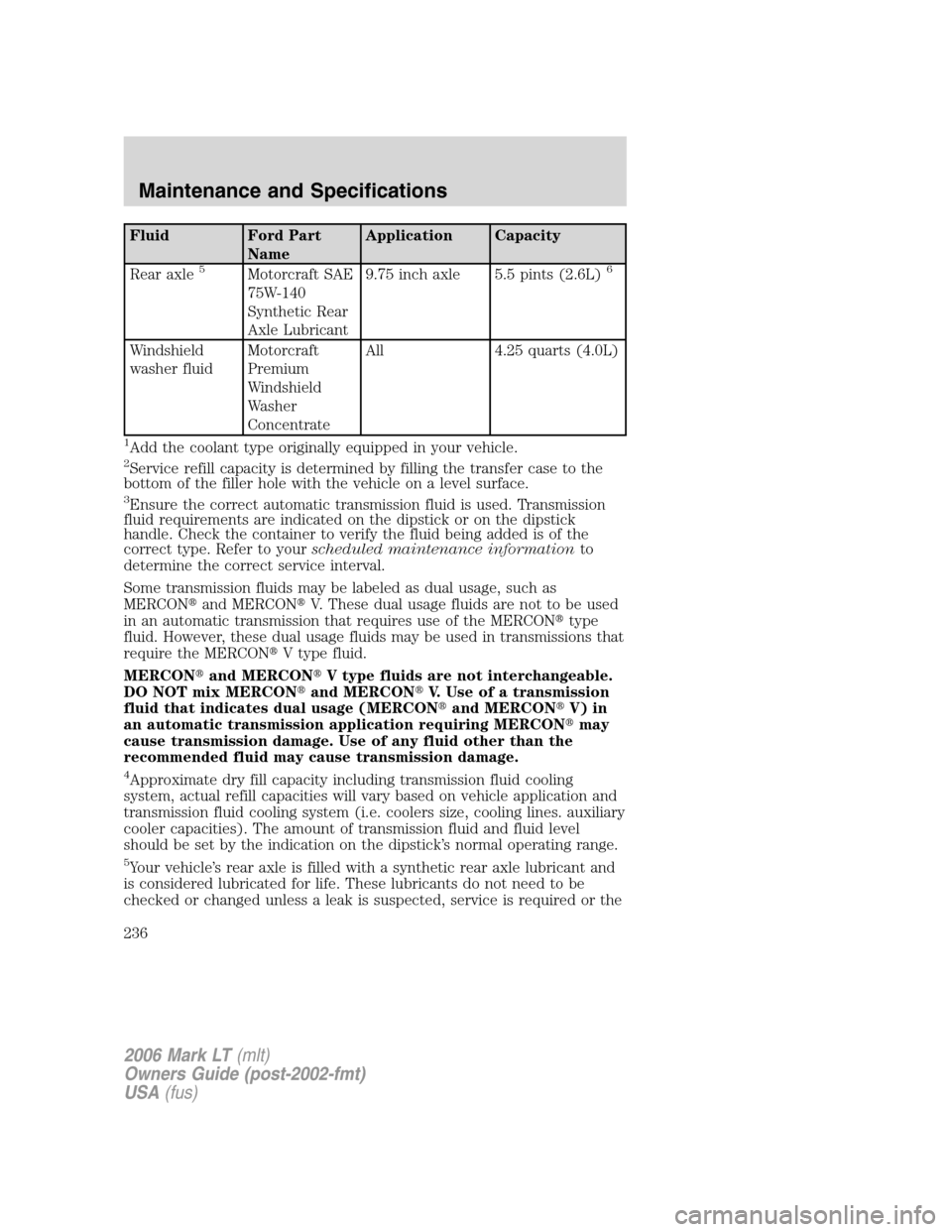
Fluid Ford Part
NameApplication Capacity
Rear axle
5Motorcraft SAE
75W-140
Synthetic Rear
Axle Lubricant9.75 inch axle 5.5 pints (2.6L)6
Windshield
washer fluidMotorcraft
Premium
Windshield
Washer
ConcentrateAll 4.25 quarts (4.0L)
1Add the coolant type originally equipped in your vehicle.2Service refill capacity is determined by filling the transfer case to the
bottom of the filler hole with the vehicle on a level surface.
3Ensure the correct automatic transmission fluid is used. Transmission
fluid requirements are indicated on the dipstick or on the dipstick
handle. Check the container to verify the fluid being added is of the
correct type. Refer to yourscheduled maintenance informationto
determine the correct service interval.
Some transmission fluids may be labeled as dual usage, such as
MERCON�and MERCON�V. These dual usage fluids are not to be used
in an automatic transmission that requires use of the MERCON�type
fluid. However, these dual usage fluids may be used in transmissions that
require the MERCON�V type fluid.
MERCON�and MERCON�V type fluids are not interchangeable.
DO NOT mix MERCON�and MERCON�V. Use of a transmission
fluid that indicates dual usage (MERCON�and MERCON�V) in
an automatic transmission application requiring MERCON�may
cause transmission damage. Use of any fluid other than the
recommended fluid may cause transmission damage.
4Approximate dry fill capacity including transmission fluid cooling
system, actual refill capacities will vary based on vehicle application and
transmission fluid cooling system (i.e. coolers size, cooling lines. auxiliary
cooler capacities). The amount of transmission fluid and fluid level
should be set by the indication on the dipstick’s normal operating range.
5Your vehicle’s rear axle is filled with a synthetic rear axle lubricant and
is considered lubricated for life. These lubricants do not need to be
checked or changed unless a leak is suspected, service is required or the
2006 Mark LT(mlt)
Owners Guide (post-2002-fmt)
USA(fus)
Maintenance and Specifications
236