2006 LINCOLN LS air condition
[x] Cancel search: air conditionPage 293 of 320

If you must replace the fuel filler cap, replace it with a fuel filler
cap that is designed for your vehicle. The customer warranty may
be void for any damage to the fuel tank or fuel system if the
correct genuine Ford or Motorcraft fuel filler cap is not used.
The fuel system may be under pressure. Remove fuel filler cap
slowly. Otherwise, fuel may spray out and injure you or others.
If you do not use the proper fuel filler cap, excessive vacuum in
the fuel tank may damage the fuel system or cause the fuel cap
to disengage in a collision, which may result in possible personal injury.
Choosing the right fuel
Use only UNLEADED FUEL. The use of leaded fuel is prohibited by law
and could damage your vehicle.
Your vehicle was not designed to use fuel or fuel additives with metallic
compounds, including manganese-based additives. Studies indicate that
these additives can cause your vehicle’s emission control system to
deteriorate more rapidly. In Canada, many fuels contain metallic
additives, but fuels free of such additives may be available; check with
your local fuel dealer.
Do not use fuel containing methanol. It can damage critical fuel system
components.
Repairs to correct the effects of using a fuel for which your vehicle was
not designed may not be covered by your warranty.
Octane recommendations
Your vehicle is designed to use
“Premium” unleaded gasoline with
an (R+M)/2 octane rating of 91 or
higher for optimum performance.
The use of gasolines with lower
octane ratings may degrade performance. We do not recommend the use
of gasolines labeled as “Premium” in high altitude areas that are sold
with octane ratings of less than 91.
Do not be concerned if your engine sometimes knocks lightly. However, if
it knocks heavily under most driving conditions while you are using fuel
with the recommended octane rating, see your authorized dealer to
prevent any engine damage.
91(R+M)/2 METHOD
2006 Lincoln LS(dew)
Owners Guide (post-2002-fmt)
USA(fus)
Maintenance and Specifications
293
Page 296 of 320

Calculation 1:Divide total miles traveled by total gallons used.
Calculation 2:Multiply liters used by 100, then divide by total
kilometers traveled.
Keep a record for at least one month and record the type of driving (city
or highway). This will provide an accurate estimate of the vehicle’s fuel
economy under current driving conditions. Additionally, keeping records
during summer and winter will show how temperature impacts fuel
economy. In general, lower temperatures give lower fuel economy.
Driving style — good driving and fuel economy habits
Give consideration to the lists that follow and you may be able to change
a number of variables and improve your fuel economy.
Habits
•Smooth, moderate operation can yield up to 10% savings in fuel.
•Steady speeds without stopping will usually give the best fuel
economy.
•Idling for long periods of time (greater than one minute) may waste
fuel.
•Anticipate stopping; slowing down may eliminate the need to stop.
•Sudden or hard accelerations may reduce fuel economy.
•Slow down gradually.
•Driving at reasonable speeds (traveling at 55 mph [88 km/h] uses 15%
less fuel than traveling at 65 mph [105 km/h]).
•Revving the engine before turning it off may reduce fuel economy.
•Using the air conditioner or defroster may reduce fuel economy.
•You may want to turn off the speed control in hilly terrain if
unnecessary shifting between third and fourth gear occurs.
Unnecessary shifting of this type could result in reduced fuel
economy.
•Warming up a vehicle on cold mornings is not required and may
reduce fuel economy.
•Resting your foot on the brake pedal while driving may reduce fuel
economy.
•Combine errands and minimize stop-and-go driving.
Maintenance
•Keep tires properly inflated and use only recommended size.
2006 Lincoln LS(dew)
Owners Guide (post-2002-fmt)
USA(fus)
Maintenance and Specifications
296
Page 314 of 320

A
Accessory delay ........................109
AdvanceTrac ..............................225
Air cleaner filter ...............301–303
Air conditioning ....................88, 90
Airbag supplemental restraint
system ........................175, 179, 182
and child safety seats ............177
description ..............175, 179, 182
disposal ....................................185
driver airbag ............177, 180, 183
indicator light .........179, 181, 185
operation .................177, 180, 183
passenger airbag .....177, 180, 183
side airbag .......................179, 182
Antifreeze
(see Engine coolant) ................284
Anti-lock brake system
(see Brakes) ......................222–223
Anti-theft system ......................153
arming the system ..................153
disarming a triggered
system .....................................154
Audio system (see Radio) ...16, 20
Automatic transmission
driving an automatic
overdrive .................................230
fluid, adding ............................301
fluid, checking ........................301
fluid, refill capacities ..............304
fluid, specification ..................307
Axle
lubricant
specifications ..................306–307
refill capacities ........................304
B
Battery .......................................282acid, treating emergencies .....282
jumping a disabled battery ....255
maintenance-free ....................282
replacement, specifications ...303
servicing ..................................282
BeltMinder .................................171
Brakes ........................................222
anti-lock ...........................222–223
anti-lock brake system (ABS)
warning light ...........................223
fluid, checking and adding ....300
fluid, refill capacities ..............304
fluid, specifications .........306–307
lubricant specifications ..306–307
parking ....................................223
shift interlock ..........................228
Bulbs ..........................................100
C
Calculating load ........................217
Capacities for refilling fluids ....304
Cargo net ...................................138
Cell phone use ..............................7
Changing a tire .........................249
Child safety restraints ..............186
child safety belts ....................186
Child safety seats ......................190
attaching with tether
straps .......................................194
in front seat ............................191
in rear seat ..............................191
Cleaning your vehicle
engine compartment ..............270
instrument panel ....................272
interior .....................................272
interior trim ............................272
plastic parts ............................271
washing ....................................269
2006 Lincoln LS(dew)
Owners Guide (post-2002-fmt)
USA(fus)
Index
314
Page 315 of 320
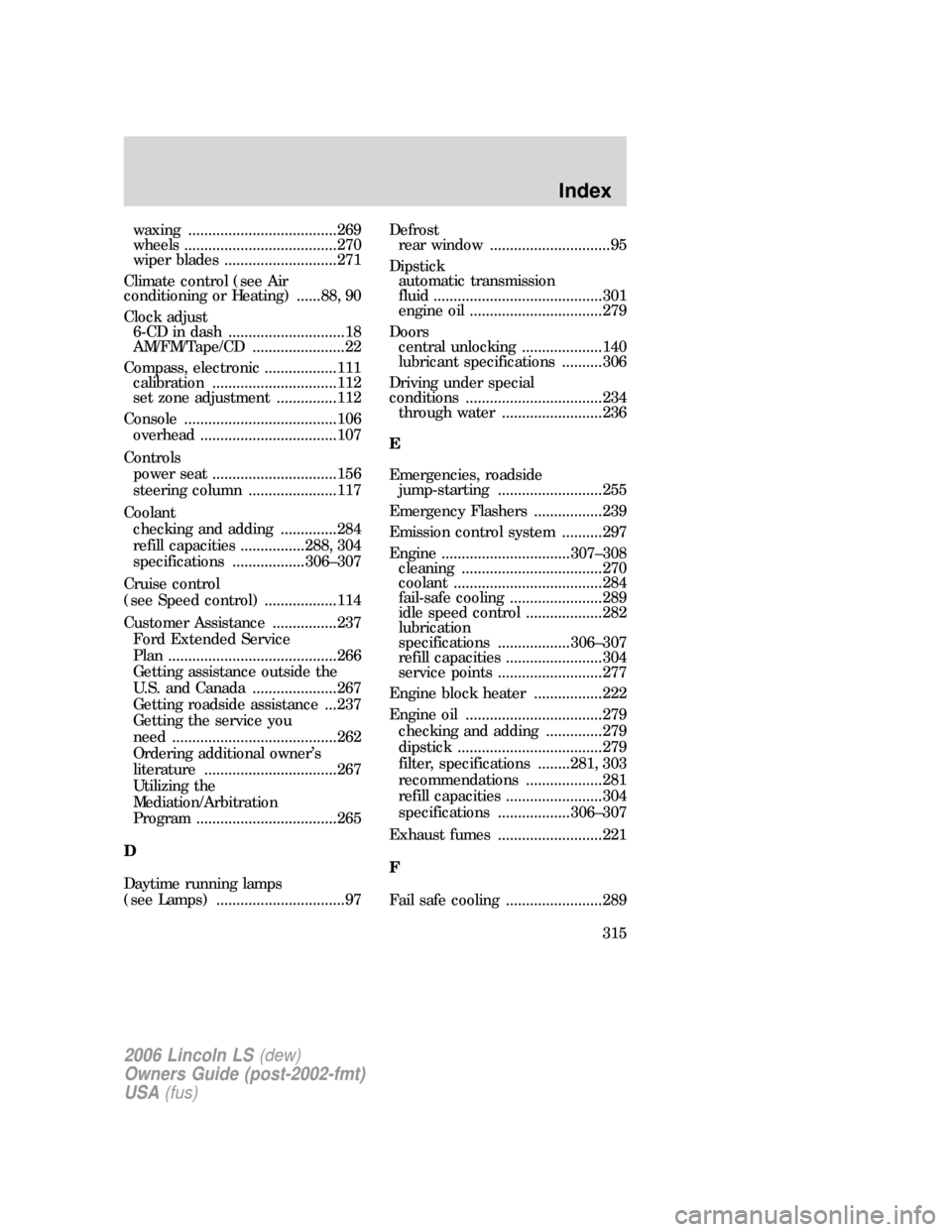
waxing .....................................269
wheels ......................................270
wiper blades ............................271
Climate control (see Air
conditioning or Heating) ......88, 90
Clock adjust
6-CD in dash .............................18
AM/FM/Tape/CD .......................22
Compass, electronic ..................111
calibration ...............................112
set zone adjustment ...............112
Console ......................................106
overhead ..................................107
Controls
power seat ...............................156
steering column ......................117
Coolant
checking and adding ..............284
refill capacities ................288, 304
specifications ..................306–307
Cruise control
(see Speed control) ..................114
Customer Assistance ................237
Ford Extended Service
Plan ..........................................266
Getting assistance outside the
U.S. and Canada .....................267
Getting roadside assistance ...237
Getting the service you
need .........................................262
Ordering additional owner’s
literature .................................267
Utilizing the
Mediation/Arbitration
Program ...................................265
D
Daytime running lamps
(see Lamps) ................................97Defrost
rear window ..............................95
Dipstick
automatic transmission
fluid ..........................................301
engine oil .................................279
Doors
central unlocking ....................140
lubricant specifications ..........306
Driving under special
conditions ..................................234
through water .........................236
E
Emergencies, roadside
jump-starting ..........................255
Emergency Flashers .................239
Emission control system ..........297
Engine ................................307–308
cleaning ...................................270
coolant .....................................284
fail-safe cooling .......................289
idle speed control ...................282
lubrication
specifications ..................306–307
refill capacities ........................304
service points ..........................277
Engine block heater .................222
Engine oil ..................................279
checking and adding ..............279
dipstick ....................................279
filter, specifications ........281, 303
recommendations ...................281
refill capacities ........................304
specifications ..................306–307
Exhaust fumes ..........................221
F
Fail safe cooling ........................289
2006 Lincoln LS(dew)
Owners Guide (post-2002-fmt)
USA(fus)
Index
315
Page 316 of 320

Floor mats .................................138
Fluid capacities .........................304
Foglamps .....................................98
Fuel ............................................290
calculating fuel
economy ..........................128, 294
cap ...........................................292
capacity ...................................304
choosing the right fuel ...........293
comparisons with EPA fuel
economy estimates .................297
detergent in fuel .....................294
filling your vehicle with
fuel ...........................290, 292, 295
filter, specifications ........290, 303
fuel pump shut-off switch .....239
improving fuel economy ........294
octane rating ...........293, 307–308
quality ......................................294
running out of fuel .................294
safety information relating to
automotive fuels .....................290
Fuel pump shut-off switch .......239
Fuses ..................................240–241
G
Garage Door Opener
(see Homelink wireless control
system) ......................................121
Gas cap (see Fuel cap) ............292
Gas mileage
(see Fuel economy) .................294
Gauges .........................................14
GAWR
(Gross Axle Weight Rating)
calculating ...............................217GVWR
(Gross Vehicle Weight Rating)
calculating ...............................217
H
Hazard flashers .........................239
Head restraints .................155, 160
Headlamps ...................................96
aiming ........................................98
autolamp system .......................96
bulb specifications ..................101
daytime running lights .............97
flash to pass ..............................97
replacing bulbs .......................102
turning on and off ....................96
Heating
heating and air conditioning
system .................................88, 90
Homelink wireless control
system ........................................121
Hood ..........................................276
I
Ignition .......................219, 307–308
Infant seats
(see Safety seats) .....................190
Inspection/maintenance (I/M)
testing ........................................299
Instrument panel
cleaning ...................................272
cluster ........................................10
lighting up panel and
interior .......................................98
J
Jack ............................................249
positioning ...............................249
2006 Lincoln LS(dew)
Owners Guide (post-2002-fmt)
USA(fus)
Index
316